Bottom-up: scaling, sampling and lessons learned David M. - - PowerPoint PPT Presentation

bottom up
SMART_READER_LITE
LIVE PREVIEW

Bottom-up: scaling, sampling and lessons learned David M. - - PowerPoint PPT Presentation

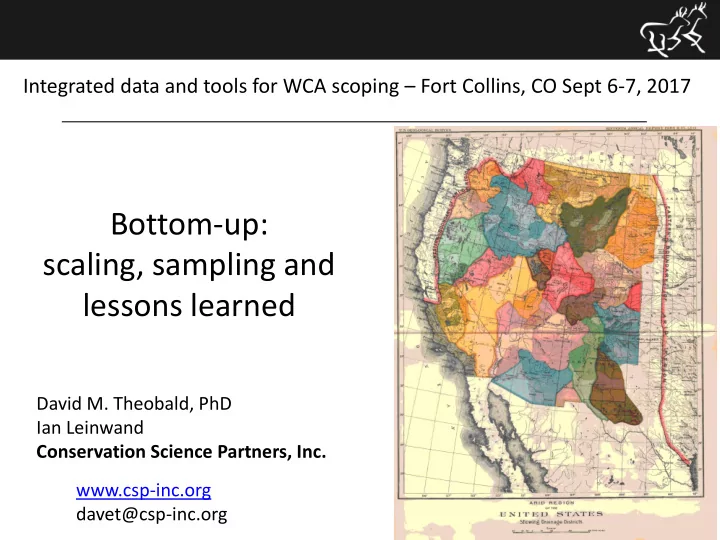
Integrated data and tools for WCA scoping Fort Collins, CO Sept 6-7, 2017 Bottom-up: scaling, sampling and lessons learned David M. Theobald, PhD Ian Leinwand Conservation Science Partners, Inc. www.csp-inc.org davet@csp-inc.org Place


slide-1
SLIDE 1

Bottom-up: scaling, sampling and lessons learned

Integrated data and tools for WCA scoping – Fort Collins, CO Sept 6-7, 2017

David M. Theobald, PhD Ian Leinwand Conservation Science Partners, Inc. www.csp-inc.org davet@csp-inc.org

slide-2
SLIDE 2

Place assessment on foundation of ecological processes

Process  mechanism  measurement

Hydrological process Mechanism

  • f

ecological influence (Allan 2004) Variable

Upland Sedimentation due to human modification Slope-weighted human modification

  • Nutrient

enrichment Nitrogen and phosphorus

  • Contaminant

Pollution Biological impairment

  • Oil

& gas exposure Vulnerability to potential breaches by wells and holding ponds Lateral Riparian clearing/canopy

  • pening

Human modification Longitudinal Hydrologic alteration Flow Modification Index

  • Accumulated

road-stream crossings density

  • Timing
  • f

snowmelt discharge*

  • Thermal

alteration Stream temperature warming*

slide-3
SLIDE 3

Organize by space-time framework

Spatial extent vs. grain (resolution) Temporal duration vs. frequency

slide-4
SLIDE 4

Organize by space-time framework

Spatial extent vs. grain (resolution) Temporal duration vs. frequency

slide-5
SLIDE 5

Scale up using hierarchical analytical units

slide-6
SLIDE 6

Recognize abiotic context

a b c d e f g h

Ecologically-relevant Geophysical (ERGo) Landforms

slide-7
SLIDE 7

Test and validate using rigorous sample design

slide-8
SLIDE 8

All lands

slide-9
SLIDE 9

Analytical framework to engage partners

Analytical framework to identify Conservation Opportunity Areas

Resources Focal sites Actions Vulnerable areas Collaboration Actionable Change agents Resilient areas