Boris Klemz, Martin N ollenburg, Roman Prutkin 1) Freie Universit - - PowerPoint PPT Presentation

boris klemz martin n ollenburg roman prutkin
SMART_READER_LITE
LIVE PREVIEW

Boris Klemz, Martin N ollenburg, Roman Prutkin 1) Freie Universit - - PowerPoint PPT Presentation

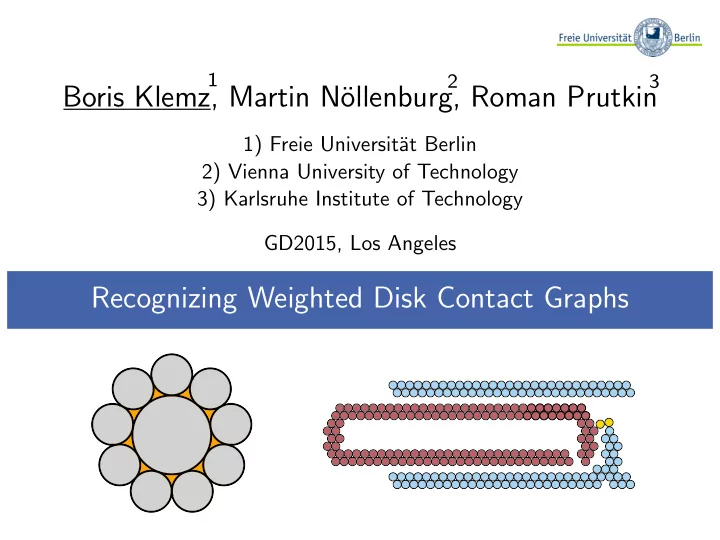
1 2 3 Boris Klemz, Martin N ollenburg, Roman Prutkin 1) Freie Universit at Berlin 2) Vienna University of Technology 3) Karlsruhe Institute of Technology GD2015, Los Angeles Recognizing Weighted Disk Contact Graphs Boris Klemz, Martin


slide-1
SLIDE 1

Boris Klemz, Martin N¨

  • llenburg, Roman Prutkin

Recognizing Weighted Disk Contact Graphs

Recognizing Weighted Disk Contact Graphs

3) Karlsruhe Institute of Technology 2) Vienna University of Technology 1) Freie Universit¨ at Berlin

Boris Klemz, Martin N¨

  • llenburg, Roman Prutkin

1 2 3

GD2015, Los Angeles

slide-2
SLIDE 2

Boris Klemz, Martin N¨

  • llenburg, Roman Prutkin

Recognizing Weighted Disk Contact Graphs

Disk Contact Representations

disk contact graph G disk contact representation of G A disk contact representation (DCR) of a graph G = (V, E) consists

  • f a set D of interior-disjoint disks and a bijection D : V → D such

that disks D(u), D(v) touch ⇔ (u, v) ∈ E. A disk contact graph (DCG) is a graph that can be represented with a DCR.

slide-3
SLIDE 3

Boris Klemz, Martin N¨

  • llenburg, Roman Prutkin

Recognizing Weighted Disk Contact Graphs

Application Areas

[Inoue, 2011]

visualizing statistical data population growth rate, population size, spread of diseases, etc. modeling physical problems e.g., broadcast range of transmitter/ receiver stations covering problems e.g., facility location DCGs related to Disk Intersection Graphs

slide-4
SLIDE 4

Boris Klemz, Martin N¨

  • llenburg, Roman Prutkin

Recognizing Weighted Disk Contact Graphs

Problem Variations, Results, Related Work

All planar graphs are Disk Contact Graphs [Koebe, 1936] We want to have control over disk sizes and the embedding. Weighted DCG Recognition Problem: Does vertex-weighted graph G have a DCR in which the disks’ radii correspond to their weights? Embedded DCG Recognition Problem: Does plane graph G have a DCR with an according rotation system?

1 2 3 a c b v v a b c

slide-5
SLIDE 5

Boris Klemz, Martin N¨

  • llenburg, Roman Prutkin

Recognizing Weighted Disk Contact Graphs

Problem Variations, Results, Related Work

All planar graphs are Disk Contact Graphs [Koebe, 1936] We want to have control over disk sizes and the embedding. Weighted DCG Recognition Problem: Does vertex-weighted graph G have a DCR in which the disks’ radii correspond to their weights? Embedded DCG Recognition Problem: Does plane graph G have a DCR with an according rotation system?

1 2 3 Breu, Kirkpatrick 98

Our results: NP-hardness statements and construction algorithms. Unit-Weighted Unit-Weighted, Embedded Weighted Weighted, Embedded star tree

  • uterplanar

planar caterpillar

Breu, Kirkpatrick 98

Related work: NP-hardness statements and construction algorithms.

a c b v v a b c

slide-6
SLIDE 6

Boris Klemz, Martin N¨

  • llenburg, Roman Prutkin

Recognizing Weighted Disk Contact Graphs

Problem Variations, Results, Related Work

All planar graphs are Disk Contact Graphs [Koebe, 1936] We want to have control over disk sizes and the embedding. Weighted DCG Recognition Problem: Does vertex-weighted graph G have a DCR in which the disks’ radii correspond to their weights? Embedded DCG Recognition Problem: Does plane graph G have a DCR with an according rotation system?

1 2 3 Breu, Kirkpatrick 98

Our results: NP-hardness statements and construction algorithms. Unit-Weighted Unit-Weighted, Embedded Weighted Weighted, Embedded star tree

  • uterplanar

planar caterpillar

Breu, Kirkpatrick 98

Related work: NP-hardness statements and construction algorithms.

a c b v v a b c

1.

slide-7
SLIDE 7

Boris Klemz, Martin N¨

  • llenburg, Roman Prutkin

Recognizing Weighted Disk Contact Graphs

Problem Variations, Results, Related Work

All planar graphs are Disk Contact Graphs [Koebe, 1936] We want to have control over disk sizes and the embedding. Weighted DCG Recognition Problem: Does vertex-weighted graph G have a DCR in which the disks’ radii correspond to their weights? Embedded DCG Recognition Problem: Does plane graph G have a DCR with an according rotation system?

1 2 3 Breu, Kirkpatrick 98

Our results: NP-hardness statements and construction algorithms. Unit-Weighted Unit-Weighted, Embedded Weighted Weighted, Embedded star tree

  • uterplanar

planar caterpillar

Breu, Kirkpatrick 98

Related work: NP-hardness statements and construction algorithms.

a c b v v a b c

1.

slide-8
SLIDE 8

Boris Klemz, Martin N¨

  • llenburg, Roman Prutkin

Recognizing Weighted Disk Contact Graphs

Problem Variations, Results, Related Work

All planar graphs are Disk Contact Graphs [Koebe, 1936] We want to have control over disk sizes and the embedding. Weighted DCG Recognition Problem: Does vertex-weighted graph G have a DCR in which the disks’ radii correspond to their weights? Embedded DCG Recognition Problem: Does plane graph G have a DCR with an according rotation system?

1 2 3 Bowen et al. Breu, Kirkpatrick 98

Our results: NP-hardness statements and construction algorithms. Unit-Weighted Unit-Weighted, Embedded Weighted Weighted, Embedded star tree

  • uterplanar

planar caterpillar

Breu, Kirkpatrick 98 Bowen et al. GD 2015 GD 2015

Related work: NP-hardness statements and construction algorithms.

a c b v v a b c

1.

slide-9
SLIDE 9

Boris Klemz, Martin N¨

  • llenburg, Roman Prutkin

Recognizing Weighted Disk Contact Graphs

Problem Variations, Results, Related Work

All planar graphs are Disk Contact Graphs [Koebe, 1936] We want to have control over disk sizes and the embedding. Weighted DCG Recognition Problem: Does vertex-weighted graph G have a DCR in which the disks’ radii correspond to their weights? Embedded DCG Recognition Problem: Does plane graph G have a DCR with an according rotation system?

1 2 3 Bowen et al. Breu, Kirkpatrick 98

Our results: NP-hardness statements and construction algorithms. Unit-Weighted Unit-Weighted, Embedded Weighted Weighted, Embedded star tree

  • uterplanar

planar caterpillar

Breu, Kirkpatrick 98 Bowen et al. GD 2015

?

GD 2015

Related work: NP-hardness statements and construction algorithms.

a c b v v a b c

1.

slide-10
SLIDE 10

Boris Klemz, Martin N¨

  • llenburg, Roman Prutkin

Recognizing Weighted Disk Contact Graphs

Problem Variations, Results, Related Work

All planar graphs are Disk Contact Graphs [Koebe, 1936] We want to have control over disk sizes and the embedding. Weighted DCG Recognition Problem: Does vertex-weighted graph G have a DCR in which the disks’ radii correspond to their weights? Embedded DCG Recognition Problem: Does plane graph G have a DCR with an according rotation system?

1 2 3 Bowen et al. Breu, Kirkpatrick 98

Our results: NP-hardness statements and construction algorithms. Unit-Weighted Unit-Weighted, Embedded Weighted Weighted, Embedded star tree

  • uterplanar

planar caterpillar

Breu, Kirkpatrick 98 Bowen et al. GD 2015

?

GD 2015

Related work: NP-hardness statements and construction algorithms.

a c b v v a b c

1. 2.

slide-11
SLIDE 11

Boris Klemz, Martin N¨

  • llenburg, Roman Prutkin

Recognizing Weighted Disk Contact Graphs

Problem Variations, Results, Related Work

All planar graphs are Disk Contact Graphs [Koebe, 1936] We want to have control over disk sizes and the embedding. Weighted DCG Recognition Problem: Does vertex-weighted graph G have a DCR in which the disks’ radii correspond to their weights? Embedded DCG Recognition Problem: Does plane graph G have a DCR with an according rotation system?

1 2 3 Bowen et al. Breu, Kirkpatrick 98

Our results: NP-hardness statements and construction algorithms. Unit-Weighted Unit-Weighted, Embedded Weighted Weighted, Embedded star tree

  • uterplanar

planar caterpillar

Breu, Kirkpatrick 98 Bowen et al. GD 2015

?

GD 2015

Related work: NP-hardness statements and construction algorithms.

a c b v v a b c

1. 2. 3.

slide-12
SLIDE 12

Boris Klemz, Martin N¨

  • llenburg, Roman Prutkin

Recognizing Weighted Disk Contact Graphs

Problem Variations, Results, Related Work

All planar graphs are Disk Contact Graphs [Koebe, 1936] We want to have control over disk sizes and the embedding. Weighted DCG Recognition Problem: Does vertex-weighted graph G have a DCR in which the disks’ radii correspond to their weights? Embedded DCG Recognition Problem: Does plane graph G have a DCR with an according rotation system?

1 2 3 Bowen et al. Breu, Kirkpatrick 98

Our results: NP-hardness statements and construction algorithms. Unit-Weighted Unit-Weighted, Embedded Weighted Weighted, Embedded star tree

  • uterplanar

planar caterpillar

Breu, Kirkpatrick 98 Bowen et al. GD 2015

?

GD 2015

Related work: NP-hardness statements and construction algorithms.

a c b v v a b c

1. 2. 3. 4.

slide-13
SLIDE 13

Boris Klemz, Martin N¨

  • llenburg, Roman Prutkin

Recognizing Weighted Disk Contact Graphs

Problem Variations, Results, Related Work

All planar graphs are Disk Contact Graphs [Koebe, 1936] We want to have control over disk sizes and the embedding. Weighted DCG Recognition Problem: Does vertex-weighted graph G have a DCR in which the disks’ radii correspond to their weights? Embedded DCG Recognition Problem: Does plane graph G have a DCR with an according rotation system?

1 2 3 Bowen et al. Breu, Kirkpatrick 98

Our results: NP-hardness statements and construction algorithms. Unit-Weighted Unit-Weighted, Embedded Weighted Weighted, Embedded star tree

  • uterplanar

planar caterpillar

Breu, Kirkpatrick 98 Bowen et al. GD 2015

?

GD 2015

Related work: NP-hardness statements and construction algorithms.

a c b v v a b c

1. 2. 3. 4.

slide-14
SLIDE 14

Boris Klemz, Martin N¨

  • llenburg, Roman Prutkin

Recognizing Weighted Disk Contact Graphs

Unit-Weighted DCG Recognition

Theorem: Deciding whether a graph G has a unit disk contact representation is NP-hard even if G is outerplanar.

slide-15
SLIDE 15

Boris Klemz, Martin N¨

  • llenburg, Roman Prutkin

Recognizing Weighted Disk Contact Graphs

Unit-Weighted DCG Recognition

Theorem: Deciding whether a graph G has a unit disk contact representation is NP-hard even if G is outerplanar. Proof: Reduction from ...

v1 v2 v3 ¯ v1 ∨ ¯ v2 ∨ ¯ v3 v1 ∨ v2 ∨ v3 v1 ∨ v2

[Lichtenstein 82, Knuth & Raghunathan 92, de Berg & Khosravi 10]

positive variables clauses negative clauses Planar Monotone 3SAT there is a planar graph G with a vertex for each clause and variable and edges connect clauses and their variables NP-hard special case of 3SAT clauses contain either only positive or negative literals G can be embedded on a rectangular grid of polynomial size s.t. variables are located on a line l and all positive / negative clauses on one side of l

slide-16
SLIDE 16

Boris Klemz, Martin N¨

  • llenburg, Roman Prutkin

Recognizing Weighted Disk Contact Graphs

Rigid Subgraphs

A graph is rigid if it has a unique unit disk contact representation (up to rotation, translation and mirroring). Lemma: Let G be a biconnected graph with a UDC representation that induces an internally triangulated outerplane embedding of G. G is rigid. Sufficient condition for rigidity: a rigid graph and its unit-DCR

slide-17
SLIDE 17

Boris Klemz, Martin N¨

  • llenburg, Roman Prutkin

Recognizing Weighted Disk Contact Graphs

Rigid Subgraphs

A graph is rigid if it has a unique unit disk contact representation (up to rotation, translation and mirroring). Lemma: Let G be a biconnected graph with a UDC representation that induces an internally triangulated outerplane embedding of G. G is rigid. Sufficient condition for rigidity: a rigid graph and its unit-DCR

slide-18
SLIDE 18

Boris Klemz, Martin N¨

  • llenburg, Roman Prutkin

Recognizing Weighted Disk Contact Graphs

Wire Gadgets

Reduction idea: Combine rigid subgraphs to enable information transfer. rigid bar

slide-19
SLIDE 19

Boris Klemz, Martin N¨

  • llenburg, Roman Prutkin

Recognizing Weighted Disk Contact Graphs

Wire Gadgets

Reduction idea: Combine rigid subgraphs to enable information transfer. rigid bar rigid tunnel

slide-20
SLIDE 20

Boris Klemz, Martin N¨

  • llenburg, Roman Prutkin

Recognizing Weighted Disk Contact Graphs

Wire Gadgets

Reduction idea: Combine rigid subgraphs to enable information transfer. rigid bar rigid tunnel non-rigid connection

slide-21
SLIDE 21

Boris Klemz, Martin N¨

  • llenburg, Roman Prutkin

Recognizing Weighted Disk Contact Graphs

Wire Gadgets

Reduction idea: Combine rigid subgraphs to enable information transfer. the bar can be rotated / flipped to either side

slide-22
SLIDE 22

Boris Klemz, Martin N¨

  • llenburg, Roman Prutkin

Recognizing Weighted Disk Contact Graphs

Wire Gadgets

Reduction idea: Combine rigid subgraphs to enable information transfer. Wire gadgets use this mechanic and occupy square tiles on a unit disk

  • grid. They can be flexibly combined in a grid-like fashion.

horizontal wire gadget

slide-23
SLIDE 23

Boris Klemz, Martin N¨

  • llenburg, Roman Prutkin

Recognizing Weighted Disk Contact Graphs

Wire Gadgets

Reduction idea: Combine rigid subgraphs to enable information transfer. Wire gadgets use this mechanic and occupy square tiles on a unit disk

  • grid. They can be flexibly combined in a grid-like fashion.

horizontal wire gadget

slide-24
SLIDE 24

Boris Klemz, Martin N¨

  • llenburg, Roman Prutkin

Recognizing Weighted Disk Contact Graphs

Wire Gadgets

Reduction idea: Combine rigid subgraphs to enable information transfer. Wire gadgets use this mechanic and occupy square tiles on a unit disk

  • grid. They can be flexibly combined in a grid-like fashion.

horizontal wire gadget schematic representation Create different gadgets for other directions ... vertical wire gaget corner wire gadgets ...

slide-25
SLIDE 25

Boris Klemz, Martin N¨

  • llenburg, Roman Prutkin

Recognizing Weighted Disk Contact Graphs

The T-shaped Wire Gadget

A three-way gadget. The bar has to be flipped into one of its three tunnels. schematic representation

slide-26
SLIDE 26

Boris Klemz, Martin N¨

  • llenburg, Roman Prutkin

Recognizing Weighted Disk Contact Graphs

The T-shaped Wire Gadget

A three-way gadget. The bar has to be flipped into one of its three tunnels. schematic representation

slide-27
SLIDE 27

Boris Klemz, Martin N¨

  • llenburg, Roman Prutkin

Recognizing Weighted Disk Contact Graphs

The T-shaped Wire Gadget

A three-way gadget. The bar has to be flipped into one of its three tunnels. schematic representation

slide-28
SLIDE 28

Boris Klemz, Martin N¨

  • llenburg, Roman Prutkin

Recognizing Weighted Disk Contact Graphs

Aligning the Tiles

v1 v2 v3 ¯ v1 ∨ ¯ v2 ∨ ¯ v3 v1 ∨ v2 ∨ v3 v1 ∨ v2

positive clauses negative clauses variables

slide-29
SLIDE 29

Boris Klemz, Martin N¨

  • llenburg, Roman Prutkin

Recognizing Weighted Disk Contact Graphs

Aligning the Tiles

v1 v2 v3 ¯ v1 ∨ ¯ v2 ∨ ¯ v3 v1 ∨ v2 ∨ v3 v1 ∨ v2

positive clauses negative clauses variables

The bar of the T-shaped gadget in each (3 Literal-) clause has to be flipped into one of its tunnels. ⇒ One of the adjacent chains of wire gadgets has to be flipped towards a variable. This corresponds to at least one literal being true.

slide-30
SLIDE 30

Boris Klemz, Martin N¨

  • llenburg, Roman Prutkin

Recognizing Weighted Disk Contact Graphs

Aligning the Tiles

v1 v2 v3 ¯ v1 ∨ ¯ v2 ∨ ¯ v3 v1 ∨ v2 ∨ v3 v1 ∨ v2

positive clauses negative clauses variables

The bar of the T-shaped gadget in each (3 Literal-) clause has to be flipped into one of its tunnels. ⇒ One of the adjacent chains of wire gadgets has to be flipped towards a variable. This corresponds to at least one literal being true. The variables allow either only positive or negative chains flipped towards them ⇒ Realizable if and only if satisfiable.

slide-31
SLIDE 31

Boris Klemz, Martin N¨

  • llenburg, Roman Prutkin

Recognizing Weighted Disk Contact Graphs

So far, so good ...

... but how does our graph look like? For each face of the original layout we created a face bounded by a rigid double layer of vertices: graph induced by the tunnel disks

slide-32
SLIDE 32

Boris Klemz, Martin N¨

  • llenburg, Roman Prutkin

Recognizing Weighted Disk Contact Graphs

So far, so good ...

... but how does our graph look like? For each face of the original layout we created a face bounded by a rigid double layer of vertices: graph induced by the tunnel disks Problem: This graph is ... ... not outerplanar! → Introduce a little gap to each face boundary. ... not connected! We need to connect all the tunnel structures to ensure that they are placed as intended without impeding the information flow.

slide-33
SLIDE 33

Boris Klemz, Martin N¨

  • llenburg, Roman Prutkin

Recognizing Weighted Disk Contact Graphs

So far, so good ...

... but how does our graph look like? For each face of the original layout we created a face bounded by a rigid double layer of vertices: graph induced by the tunnel disks Problem: This graph is ... ... not outerplanar! → Introduce a little gap to each face boundary. ... not connected! We need to connect all the tunnel structures to ensure that they are placed as intended without impeding the information flow.

slide-34
SLIDE 34

Boris Klemz, Martin N¨

  • llenburg, Roman Prutkin

Recognizing Weighted Disk Contact Graphs

So far, so good ...

... but how does our graph look like? For each face of the original layout we created a face bounded by a rigid double layer of vertices: graph induced by the tunnel disks Problem: This graph is ... ... not outerplanar! → Introduce a little gap to each face boundary. ... not connected! We need to connect all the tunnel structures to ensure that they are placed as intended without impeding the information flow.

slide-35
SLIDE 35

Boris Klemz, Martin N¨

  • llenburg, Roman Prutkin

Recognizing Weighted Disk Contact Graphs

So far, so good ...

... but how does our graph look like? For each face of the original layout we created a face bounded by a rigid double layer of vertices: graph induced by the tunnel disks Problem: This graph is ... ... not outerplanar! → Introduce a little gap to each face boundary. ... not connected! We need to connect all the tunnel structures to ensure that they are placed as intended without impeding the information flow.

slide-36
SLIDE 36

Boris Klemz, Martin N¨

  • llenburg, Roman Prutkin

Recognizing Weighted Disk Contact Graphs

The Merging Wire Gadget

We need a gadget that ... propagates information like a normal wire. connects its two tunnel structures. horizontal wire gadget Merging wire gadget

slide-37
SLIDE 37

Boris Klemz, Martin N¨

  • llenburg, Roman Prutkin

Recognizing Weighted Disk Contact Graphs

The Merging Wire Gadget

We need a gadget that ... propagates information like a normal wire. connects its two tunnel structures. horizontal wire gadget Merging wire gadget

slide-38
SLIDE 38

Boris Klemz, Martin N¨

  • llenburg, Roman Prutkin

Recognizing Weighted Disk Contact Graphs

The Merging Wire Gadget

We need a gadget that ... propagates information like a normal wire. connects its two tunnel structures. horizontal wire gadget Merging wire gadget

slide-39
SLIDE 39

Boris Klemz, Martin N¨

  • llenburg, Roman Prutkin

Recognizing Weighted Disk Contact Graphs

The Merging Wire Gadget

We need a gadget that ... propagates information like a normal wire. connects its two tunnel structures. horizontal wire gadget Merging wire gadget

! !

slide-40
SLIDE 40

Boris Klemz, Martin N¨

  • llenburg, Roman Prutkin

Recognizing Weighted Disk Contact Graphs

The Merging Wire Gadget

We need a gadget that ... propagates information like a normal wire. connects its two tunnel structures. horizontal wire gadget Merging wire gadget

slide-41
SLIDE 41

Boris Klemz, Martin N¨

  • llenburg, Roman Prutkin

Recognizing Weighted Disk Contact Graphs

The Merging Wire Gadget

We need a gadget that ... propagates information like a normal wire. connects its two tunnel structures. horizontal wire gadget Merging wire gadget

slide-42
SLIDE 42

Boris Klemz, Martin N¨

  • llenburg, Roman Prutkin

Recognizing Weighted Disk Contact Graphs

The Merging Wire Gadget

We need a gadget that ... propagates information like a normal wire. connects its two tunnel structures. horizontal wire gadget Merging wire gadget

slide-43
SLIDE 43

Boris Klemz, Martin N¨

  • llenburg, Roman Prutkin

Recognizing Weighted Disk Contact Graphs

The Merging Wire Gadget

We need a gadget that ... propagates information like a normal wire. connects its two tunnel structures. horizontal wire gadget Merging wire gadget

slide-44
SLIDE 44

Boris Klemz, Martin N¨

  • llenburg, Roman Prutkin

Recognizing Weighted Disk Contact Graphs

The Merging Wire Gadget

We need a gadget that ... propagates information like a normal wire. connects its two tunnel structures. horizontal wire gadget Merging wire gadget

slide-45
SLIDE 45

Boris Klemz, Martin N¨

  • llenburg, Roman Prutkin

Recognizing Weighted Disk Contact Graphs

The Merging Wire Gadget

We need a gadget that ... propagates information like a normal wire. connects its two tunnel structures. horizontal wire gadget Merging wire gadget

slide-46
SLIDE 46

Boris Klemz, Martin N¨

  • llenburg, Roman Prutkin

Recognizing Weighted Disk Contact Graphs

The Merging Wire Gadget

We need a gadget that ... propagates information like a normal wire. connects its two tunnel structures. horizontal wire gadget Merging wire gadget In each face boundary we replace one horizontal wire with a merging wire. → the graph is now connected and

  • uterplanar!
slide-47
SLIDE 47

Boris Klemz, Martin N¨

  • llenburg, Roman Prutkin

Recognizing Weighted Disk Contact Graphs

The Merging Wire Gadget

We need a gadget that ... propagates information like a normal wire. connects its two tunnel structures. horizontal wire gadget Merging wire gadget In each face boundary we replace one horizontal wire with a merging wire. → the graph is now connected and

  • uterplanar!

Remaining step: This connection is not rigid → wiggle room. We need to argue that the construction can be made tight enough. Can be done.

slide-48
SLIDE 48

Boris Klemz, Martin N¨

  • llenburg, Roman Prutkin

Recognizing Weighted Disk Contact Graphs

Unit-DCRs for Caterpillars

Bowen et al. Breu, Kirkpatrick 98

Our results: NP-hardness statements and construction algorithms. Unit-Weighted Unit-Weighted, Embedded Weighted Weighted, Embedded star tree

  • uterplanar

planar caterpillar

Breu, Kirkpatrick 98 Bowen et al. GD 2015

?

GD 2015

Related work: NP-hardness statements and construction algorithms.

2. 3. 4.

Characterization: A caterpillar has a unit-DCR if and only if ... no vertex has degree > 5 between any two degree-5 vertices on the spine there exists a vertex with degree ≤ 3 5 4 3 5 Corollary: Decidable in linear time!

slide-49
SLIDE 49

Boris Klemz, Martin N¨

  • llenburg, Roman Prutkin

Recognizing Weighted Disk Contact Graphs

Unit-DCRs for Caterpillars

Bowen et al. Breu, Kirkpatrick 98

Our results: NP-hardness statements and construction algorithms. Unit-Weighted Unit-Weighted, Embedded Weighted Weighted, Embedded star tree

  • uterplanar

planar caterpillar

Breu, Kirkpatrick 98 Bowen et al. GD 2015

?

GD 2015

Related work: NP-hardness statements and construction algorithms.

3. 4.

Characterization: A caterpillar has a unit-DCR if and only if ... no vertex has degree > 5 between any two degree-5 vertices on the spine there exists a vertex with degree ≤ 3 5 4 3 5 Corollary: Decidable in linear time!

slide-50
SLIDE 50

Boris Klemz, Martin N¨

  • llenburg, Roman Prutkin

Recognizing Weighted Disk Contact Graphs

Weighted DCG Recognition for Stars

Theorem: Deciding whether a vertex-weighted graph G has a DCR where radii coincide with weights is NP-hard even if G is a star.

slide-51
SLIDE 51

Boris Klemz, Martin N¨

  • llenburg, Roman Prutkin

Recognizing Weighted Disk Contact Graphs

Weighted DCG Recognition for Stars

Theorem: Deciding whether a vertex-weighted graph G has a DCR where radii coincide with weights is NP-hard even if G is a star. 3-Partition (strongly NP-complete [Garey & Johnson, 1979]) Given: Bound B ∈ N, multiset of integers A = {a1, . . . , a3n} s.t. B

4 < ai < B 2 for all i = 1, . . . , 3n.

Can A be partitioned into n triples of sum B each?

slide-52
SLIDE 52

Boris Klemz, Martin N¨

  • llenburg, Roman Prutkin

Recognizing Weighted Disk Contact Graphs

Weighted DCG Recognition for Stars

Theorem: Deciding whether a vertex-weighted graph G has a DCR where radii coincide with weights is NP-hard even if G is a star. Reduction: Create central disk Dc and n outer disks → n gaps

Dc

3-Partition (strongly NP-complete [Garey & Johnson, 1979]) Given: Bound B ∈ N, multiset of integers A = {a1, . . . , a3n} s.t. B

4 < ai < B 2 for all i = 1, . . . , 3n.

Can A be partitioned into n triples of sum B each?

slide-53
SLIDE 53

Boris Klemz, Martin N¨

  • llenburg, Roman Prutkin

Recognizing Weighted Disk Contact Graphs

Weighted DCG Recognition for Stars

Theorem: Deciding whether a vertex-weighted graph G has a DCR where radii coincide with weights is NP-hard even if G is a star. Reduction: Create central disk Dc and n outer disks → n gaps Create a small input disk for each integer a ∈ A. These have to be distributed among the gaps!

ro Dc Dc

3-Partition (strongly NP-complete [Garey & Johnson, 1979]) Given: Bound B ∈ N, multiset of integers A = {a1, . . . , a3n} s.t. B

4 < ai < B 2 for all i = 1, . . . , 3n.

Can A be partitioned into n triples of sum B each?

slide-54
SLIDE 54

Boris Klemz, Martin N¨

  • llenburg, Roman Prutkin

Recognizing Weighted Disk Contact Graphs

Weighted DCG Recognition for Stars

Theorem: Deciding whether a vertex-weighted graph G has a DCR where radii coincide with weights is NP-hard even if G is a star. Reduction: Create central disk Dc and n outer disks → n gaps Create a small input disk for each integer a ∈ A. These have to be distributed among the gaps!

ro Dc

should fit inside a gap, infeasible triples (sum > B) should not. Idea: Input disks of feasible triples (sum ≤ B)

Dc

3-Partition (strongly NP-complete [Garey & Johnson, 1979]) Given: Bound B ∈ N, multiset of integers A = {a1, . . . , a3n} s.t. B

4 < ai < B 2 for all i = 1, . . . , 3n.

Can A be partitioned into n triples of sum B each?

slide-55
SLIDE 55

Boris Klemz, Martin N¨

  • llenburg, Roman Prutkin

Recognizing Weighted Disk Contact Graphs

Assigning Radii to Input Integers

r : {B/4 + 1, . . . , B/2 − 1} → R+ r(x) = 2 − 4/B + 12x/B2 We use the following linear and increasing radius assignment: Assume w.l.o.g. B > 12.

slide-56
SLIDE 56

Boris Klemz, Martin N¨

  • llenburg, Roman Prutkin

Recognizing Weighted Disk Contact Graphs

Assigning Radii to Input Integers

r : {B/4 + 1, . . . , B/2 − 1} → R+ r(x) = 2 − 4/B + 12x/B2 Idea: Place an input disk triple on a horizontal line and decide feasibility based upon horizontal space consumption. Feasible triples take up at most 12 units of space. Infeasible triples consume at least 12 + ε units for a fixed ε ∈ Ω(1/B2).

12 12 + ε

We use the following linear and increasing radius assignment: Assume w.l.o.g. B > 12.

slide-57
SLIDE 57

Boris Klemz, Martin N¨

  • llenburg, Roman Prutkin

Recognizing Weighted Disk Contact Graphs

Assigning Radii to Input Integers

r : {B/4 + 1, . . . , B/2 − 1} → R+ r(x) = 2 − 4/B + 12x/B2 rmin = r(B/4 + 1) = 2 −1/B + 12/B2 rmax = r(B/2 − 1) = 2 +2/B − 12/B2 ≈ 2 Idea: Place an input disk triple on a horizontal line and decide feasibility based upon horizontal space consumption. Feasible triples take up at most 12 units of space. Infeasible triples consume at least 12 + ε units for a fixed ε ∈ Ω(1/B2).

12 12 + ε

We use the following linear and increasing radius assignment: All assigned radii are very similiar (for large B): Assume w.l.o.g. B > 12.

slide-58
SLIDE 58

Boris Klemz, Martin N¨

  • llenburg, Roman Prutkin

Recognizing Weighted Disk Contact Graphs

Simplifying the Gaps

For a central disk with infinite radius, a gap’s base is a horizontal line! Dc

  • uter disk

ro ro ro ro We can decide feasibility by placing disks on a horizontal line ...

slide-59
SLIDE 59

Boris Klemz, Martin N¨

  • llenburg, Roman Prutkin

Recognizing Weighted Disk Contact Graphs

Simplifying the Gaps

For a central disk with infinite radius, a gap’s base is a horizontal line! Dc

  • uter disk

ro ro ro ro Problem: Left and right gap boundaries interfere, have “complex” shape. We can decide feasibility by placing disks on a horizontal line ...

slide-60
SLIDE 60

Boris Klemz, Martin N¨

  • llenburg, Roman Prutkin

Recognizing Weighted Disk Contact Graphs

Simplifying the Gaps

For a central disk with infinite radius, a gap’s base is a horizontal line! Dc

  • uter disk

ro ro ro ro Problem: Left and right gap boundaries interfere, have “complex” shape. 12 Solution: Place separator disks in the gap’s corners with radius rmin and distance 12. We can decide feasibility by placing disks on a horizontal line ...

slide-61
SLIDE 61

Boris Klemz, Martin N¨

  • llenburg, Roman Prutkin

Recognizing Weighted Disk Contact Graphs

Simplifying the Gaps

For a central disk with infinite radius, a gap’s base is a horizontal line! Dc

  • uter disk

ro ro ro ro Problem: Left and right gap boundaries interfere, have “complex” shape. 12 Solution: Place separator disks in the gap’s corners with radius rmin and distance 12. → A feasible triple + 2 separators fits. We can decide feasibility by placing disks on a horizontal line ...

slide-62
SLIDE 62

Boris Klemz, Martin N¨

  • llenburg, Roman Prutkin

Recognizing Weighted Disk Contact Graphs

Simplifying the Gaps

For a central disk with infinite radius, a gap’s base is a horizontal line! Dc

  • uter disk

ro ro ro ro Problem: Left and right gap boundaries interfere, have “complex” shape. 12 Solution: Place separator disks in the gap’s corners with radius rmin and distance 12. An infeasible triple consumes ≥ 12 + ε space with ε ∈ Ω(1/B2).

! !

≥ ε/2

→ A feasible triple + 2 separators fits. We can decide feasibility by placing disks on a horizontal line ... ⇒ One of its disks has horizontal overlap ≥ ε/2 with a separator. The radii of the disks are very similar (both in 2 ± Θ(1/B)). ⇒ No infeasible triple fits together with 2 separators.

slide-63
SLIDE 63

Boris Klemz, Martin N¨

  • llenburg, Roman Prutkin

Recognizing Weighted Disk Contact Graphs

Re-Complicating the Gaps

In reality, the radius rc of Dc is not infinite → Lower boundary is an arc Dc 12 ro ro ro If this arc is sufficiently flat ↔ rc is sufficiently large, then our properties still hold true.

slide-64
SLIDE 64

Boris Klemz, Martin N¨

  • llenburg, Roman Prutkin

Recognizing Weighted Disk Contact Graphs

Re-Complicating the Gaps

In reality, the radius rc of Dc is not infinite → Lower boundary is an arc Dc 12 ro ro ro If this arc is sufficiently flat ↔ rc is sufficiently large, then our properties still hold true. Problem: Radius rc can not be chosen. The number of outer disks/gaps uniquely determines ro and rc. Dc Dc

slide-65
SLIDE 65

Boris Klemz, Martin N¨

  • llenburg, Roman Prutkin

Recognizing Weighted Disk Contact Graphs

Re-Complicating the Gaps

In reality, the radius rc of Dc is not infinite → Lower boundary is an arc Dc 12 ro ro ro If this arc is sufficiently flat ↔ rc is sufficiently large, then our properties still hold true. Problem: Radius rc can not be chosen. The number of outer disks/gaps uniquely determines ro and rc. Dc Dc Any polynomial number m of additional outer disks can be added by adding m dummy triples to A.

slide-66
SLIDE 66

Boris Klemz, Martin N¨

  • llenburg, Roman Prutkin

Recognizing Weighted Disk Contact Graphs

Re-Complicating the Gaps

In reality, the radius rc of Dc is not infinite → Lower boundary is an arc Dc 12 ro ro ro If this arc is sufficiently flat ↔ rc is sufficiently large, then our properties still hold true. Problem: Radius rc can not be chosen. The number of outer disks/gaps uniquely determines ro and rc. Dc Dc Any polynomial number m of additional outer disks can be added by adding m dummy triples to A. Multiply all integers in A and bound B with 180. Then

60 · B − 5 60 · B − 5 60 · B + 10

is a feasible dummy triple whose integers can not be combined with integers from the original input.

, , ( )

slide-67
SLIDE 67

Boris Klemz, Martin N¨

  • llenburg, Roman Prutkin

Recognizing Weighted Disk Contact Graphs

Concluding the Proof

Remaining steps: Specify ”sufficiently flat” Separators have to be distributed as intended (2 per gap) Outer disks are not allowed to touch → wiggle room Computing exact values for ro and rc can take superpolynomial time → poly-time approximations Dc

12 + ε

ro ro ro ro ro rc Requires some work, but can be done.

slide-68
SLIDE 68

Boris Klemz, Martin N¨

  • llenburg, Roman Prutkin

Recognizing Weighted Disk Contact Graphs

Weighted DCRs for Embedded Stars

Bowen et al. Breu, Kirkpatrick 98

Our results: NP-hardness statements and construction algorithms. Unit-Weighted Unit-Weighted, Embedded Weighted Weighted, Embedded star tree

  • uterplanar

planar caterpillar

Breu, Kirkpatrick 98 Bowen et al. GD 2015

?

GD 2015

Related work: NP-hardness statements and construction algorithms.

4.

Greedy iterative construction! naive → O(n2) can be improved to O(n) (on a Real-RAM)

Dc !

slide-69
SLIDE 69

Boris Klemz, Martin N¨

  • llenburg, Roman Prutkin

Recognizing Weighted Disk Contact Graphs

Weighted DCRs for Embedded Stars

Bowen et al. Breu, Kirkpatrick 98

Our results: NP-hardness statements and construction algorithms. Unit-Weighted Unit-Weighted, Embedded Weighted Weighted, Embedded star tree

  • uterplanar

planar caterpillar

Breu, Kirkpatrick 98 Bowen et al. GD 2015

?

GD 2015

Related work: NP-hardness statements and construction algorithms.

Greedy iterative construction! naive → O(n2) can be improved to O(n) (on a Real-RAM)

Dc !

slide-70
SLIDE 70

Boris Klemz, Martin N¨

  • llenburg, Roman Prutkin

Recognizing Weighted Disk Contact Graphs

Weighted DCRs for Embedded Stars

Bowen et al. Breu, Kirkpatrick 98

Our results: NP-hardness statements and construction algorithms. Unit-Weighted Unit-Weighted, Embedded Weighted Weighted, Embedded star tree

  • uterplanar

planar caterpillar

Breu, Kirkpatrick 98 Bowen et al. GD 2015

?

GD 2015

Related work: NP-hardness statements and construction algorithms.

Greedy iterative construction! naive → O(n2) can be improved to O(n) (on a Real-RAM)

Dc !

Thank you!