Bootstrap method and its application to the hypothesis testing in - - PowerPoint PPT Presentation

bootstrap method and its application to the hypothesis
SMART_READER_LITE
LIVE PREVIEW

Bootstrap method and its application to the hypothesis testing in - - PowerPoint PPT Presentation

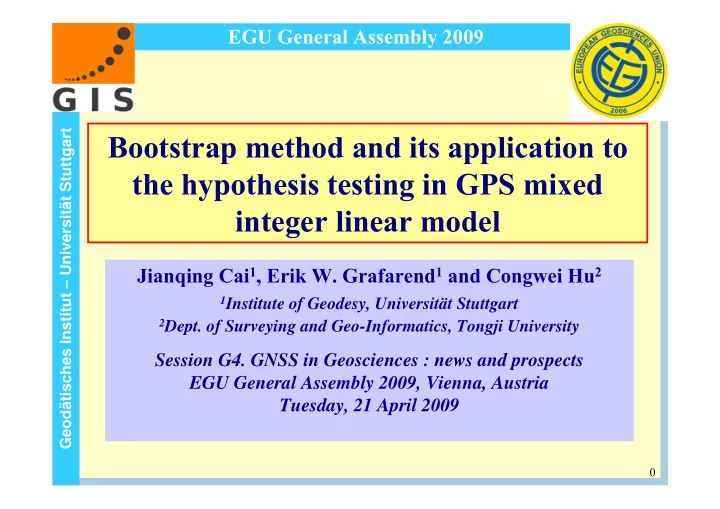
EGU General Assembly 2009 Geodtisches Institut Universitt Stuttgart Bootstrap method and its application to the hypothesis testing in GPS mixed integer linear model Jianqing Cai 1 , Erik W. Grafarend 1 and Congwei Hu 2 1 Institute of


slide-1
SLIDE 1

Bootstrap method and its application to the hypothesis testing in GPS mixed integer linear model

Jianqing Cai1, Erik W. Grafarend1 and Congwei Hu2

1Institute of Geodesy, Universität Stuttgart

  • 2Dept. of Surveying and Geo-Informatics, Tongji University

Session G4. GNSS in Geosciences : news and prospects EGU General Assembly 2009, Vienna, Austria Tuesday, 21 April 2009

Geodätisches Institut – Universität Stuttgart

EGU General Assembly 2009

slide-2
SLIDE 2

1

Main Topics

  • 2. Brief review of statistical property of the GNSS

carrier phase observables

  • 3. Bootstrap methods for the confidence domains/

hypothesis tests

  • 1. Motivation
  • 4. Conclusion and outlook
slide-3
SLIDE 3

2

  • 1. Motivation

The open problem to evaluate the statistical property

  • f GPS carrier phase observables

Ever since von Mises (1918) introduced the von Mises normal distribution on the circle, its importance has not been recognized by the data analysts; In practice, this fact is often ignored, for example, the statistical property of the GPS carrier phase observations are simply regarded as Gauss-Laplace normal

  • distribution. And most of the existed validation and hypothesis tests (e.g. χ2-test,

F-test, t-test, and ratio test etc.) about the float and fixed solution of GPS mixed integer model are performed under this assumption; But according to our new research results (Cai, et al., 2007), the GPS carrier phase observables that are actually measured on the unit circle have been statistically validated to have a von Mises normal distribution; Therefore these validation and hypothesis testing procedures based on the Gauss normal distribution should be improved accordingly; Since the distributions of the statistics commonly used for inference on directional distributions are more complex than those arising in standard normal theory, bootstrap methods are particularly useful in the directional context.

slide-4
SLIDE 4

3

The observation equation of the GNSS carrier phase measurement

( ) ( ) ( ) ( ) [ ( ) ( )] ( ) ( ) ( ) ( ) ( )

p p p k k Frk k k k p p p k k k k k I k k p p p p T k k multik k k k k

t t N t t f f t f dT t dt t d t c c f f d t d t N t e t c c = + − = = + − − + + + − +

ϕ

ϕ ϕ ρ

the carrier phase observation from satellite p and receiver k ; the fractional part of the phase difference (within the range: 0° to 360° as well as 0 to 1 circle); the sum of phase zero passes from start epoch t0 to the time tk (of the receiver observes)

( )

p k k

t ϕ ( )

p Frk k

t ϕ ( )

p k k

N t t −

slide-5
SLIDE 5

4

1 1 1 1 ( ) ( ) ( ) (cycle), or 4 12 6 3

j j Fri k i k k

t t t = − = − = = φ φ φ π ( ) ( ) ( ) 0.5 0.75 0.25 (cycle) Since the fractional part is defined in [0, 1) or [0, 2 ) 3 ( ) 0.25 +1=0.75(cycle), or = 2

j j Fri i i i i j Fri i

t t t t = − = − = − = − φ φ φ π φ π

Representation of the observations of GPS phase measurements

slide-6
SLIDE 6

5

  • 2. Brief review of statistical property of the

GNSS carrier phase observables

The von Mises distribution (1918) has the same important statistical role

  • n the circle as the Gauss normal distribution on the line.

The Fisher distribution (Fisher 1953) is of central important on the sphere for the three dimensional directional data. For the higher dimensional directional data the Langevin distribution is developed.

slide-7
SLIDE 7

6

The density function of the von Mises (k=1.138) and Gauss-Laplace normal distribution (σ=1.189)

The von Mises distribution:

PDF of a circular random variable θ with von Mises distribution:

1

ˆ ( ), ( ( ( A R where A I I κ = κ κ κ

− 1

) = )/ ). And the circualr variance V0 is given by

cos( )

1 ( ; , ) , , 2 ( ) g e I

κ θ µ

θ µ κ θ κ

= − π ≤ ≤ π π I0(κ) - modified Bessel function. the parameter µ0 - mean direction the parameter κ - concentration parameter 1 V R = − . Note the PDF of the Gauss-Laplace normal distribution N (0, σ2) :

2 2

1 2

1 ( ;0, ) 2

x

f x e

− σ

σ = σ π

slide-8
SLIDE 8

7

Test the statistical property of GPS carrier phase

GPS observation set:

Short baselines test data: 2 hour observations with 20 second sampling rate at four baselines (2~3 km) in 2005. Phase baseline lengths were calculated using observations above 10º There are total 7198 L1 double difference phase observables, where these fractional phases are scaled to . [ ] −π, π

slide-9
SLIDE 9

8

Example: L1 double difference phase observables with

σ=0.00973 (cycles) ~ 1.85 mm

(7198 measurements observed on four short baselines in 2005)

slide-10
SLIDE 10

9

Example: Linear histogram of the L1 double difference phase

  • bservables
slide-11
SLIDE 11

10

Example: Rose histogram of the L1 double difference phase observables and the mean value. ( Note the arithmetic mean is +359°.34)

358 .74 µ = +

slide-12
SLIDE 12

11

Example: Linear histogram of the L1 double difference phase

  • bservables and the von Mises distribution and Gauss-Laplace fits
slide-13
SLIDE 13

12

Example: Gauss-Normal and von Mises Q-Q plots for the L1 double difference phase observables

The purpose of the quantile-quantile plot is to determine whether the sample in X is drawn from a specific (i.e., Gaussian or von Mises) distribution, or whether the samples in X and Y come from the same distribution type.

slide-14
SLIDE 14

13

Test for goodness-of-fit:

With calculation of the statistic

2 2 1

( ) ,

m i i i i

f np np

=

− χ = ∑ where f i is the frequencies in interval i and pi is the probability related certain distribution and n is the total sample number. : , against H F F F F = ≠ Since χ2(VM)=59.5 is less than the null hypothesis that the sample is von Mises distributed cannot be rejected.

  • Indeed the close agreement between the observed and expected frequencies suggests

that the von Mises distribution provides a “good fit”.

  • But the hypothesis of Gauss-Laplace normal is rejected since the fit results

χ2(GN)=251.4 is far greater than the critical value of 63.16.

2 0.0001(27)

63.16 χ =

slide-15
SLIDE 15

14

  • 3. Bootstrap methods for the confidence domains/

hypothesis tests

Bootstrap methods:

A data-based simulation method derived from the phase to pull

  • neself up by one’s bootstrap;

In statistics the phase ‘bootstrap method’ refers to a class of computer-intensive (resampling) statistical procedures, which is

  • ne of the modern statistical technique since 1980s;

To be helpful for carrying out a statistical test or for assessing the variability of a point estimate in situations where more usual statistical procedures are not valid and /or not available (e.g. the sampling distribution of a statistic is not known); Yielding more accurate results than Gaussian approximation; One of the principal goal – to produce good confidence intervals automatically; Since the distributions of the statistics commonly used for inference

  • n directional distributions are more complex than those arising in

standard Gauss normal theory, bootstrap methods are particularly useful in the directional context.

slide-16
SLIDE 16

15

Schematic of the bootstrap process for estimating the standard error of a statistic s(x). B bootstrap samples are generated from the original data set. (after Efron and Tibshirani, 1993)

slide-17
SLIDE 17

16

The bootstrap algorithm for estimating the standard error of a statistic ; each bootstrap samples is an independent random sample of size n from . (after Efron and Tibshirani, 1993) ˆ ( ) s θ= x ˆ F

slide-18
SLIDE 18

17

Two distinguished Bootstrap methods:

Parametric bootstrap – a particular mathematical model is available; Nonparametric bootstrap – without such mathematical model.

Two Bootstrap analysis methods for linear model:

Bootstrapping Residuals - Fit the linear model and obtain the n residuals:

∗ =

+ y Gγ e Bootstrapping Pairs - Resampling on the pairs of one observable and cooresponding row of design matrix:

∗∗ ∗∗

= + y G γ e In the linear model context, these bootstrap methods provide inference procedures (e.g. confidence sets) that are more accurate than those produced by the other methods. Just the case for the validation and hypothesis tests of the float and fixed estimates of GPS mixed models in the directional context, with the emphasis on the determination of the confidence intervals of the estimates.

slide-19
SLIDE 19

18

Bootstrap analysis method for linear model:

Bootstrapping Residuals - Fit the linear model and obtain the n residuals Choose a sample of size n from the residuals, generated with the probability 1/n for each residual, and sample with replacement. Attach these sampled values to the n predicted to give a resampled set of y’s. ˆi y Thus if the model is obtained by the LS estimator), the new bootstrapped y-values are where is a resampled set from the vector ˆ ˆ ˆ and ( = + = y Gγ e y Gγ γ ˆ

∗ ∗

= + y Gγ e

e ˆ ˆ. = − e y y LS estimation is now performed on the model to obtain an estimate . As many iterations as desired can be performed, and the usual sample mean and sample standard deviation of those vector estimates can be found, which allows constructing confidence domains of the estimated parameters.

∗ =

+ y Gγ e ˆ∗ γ Normally we can perform the resampling iterations with 1000 times.

slide-20
SLIDE 20

19

GPS DD obs. Eq. Fix the ambiguity with FARA, LLL or LAMBDA method Estimate of the coordinate unknowns Float solution with LS

Bootstrapping confidence intervals for the float solutions

Hypothesis tests

GPS DD obs. Eq. Fix the ambiguity with FARA, LLL or LAMBDA method Estimate of the coordinate unknowns Float solution with LS Confidence Intervals for the float estimates Bootstrapping Residuals

slide-21
SLIDE 21

20

Testing with GPS observation set:

Short baselines test data: about 2 hour observations with 20 second sampling rate at one baselines (~3.6 km); Phase baseline lengths were calculated using observations above 10º; There are total 320 L1 double difference phase observables; For the testing observation period 5~20 epochs there are 11 unknown parameters, including 3 coordinate differences and 8 ambiguities.

slide-22
SLIDE 22

21

The LS float estimates and their confidence intervals

  • f the GPS mixed integer linear model (20 epochs).

The float estimates and their confidence intervals with the bootstrapping residuals methods (20 epochs). The comparison of the float estimates and their confidence intervals with the LS and bootstrapping residuals methods (20 epochs).

slide-23
SLIDE 23

22

The comparison of the float estimates and their confidence intervals with the LS and bootstrapping residuals methods (15 epochs). The comparison of the float estimates and their confidence intervals with the LS and bootstrapping residuals methods (10 epochs). The comparison of the float estimates and their confidence intervals with the LS and bootstrapping residuals methods (5 epochs).

slide-24
SLIDE 24

23

Analysis of the Bootstrapping confidence intervals for the float solutions:

Bootstrapping residuals for linear model provides us an efficient and accurate algorithm to construct the confidence domains of the GPS float solutions; The bootstrapping confidence intervals are consistent with the LS confidence intervals based on the t-test. Both kinds of the confidence intervals all cover the potential correct fixed ambiguity integers, which are important for searching process and fixed solution. But the bootstrapping confidence intervals are derived without any assumption about the probability distribution of the observations. Note: The Bootstrapped confidence sets are slightly varied among the every resampling (simulation) process.

slide-25
SLIDE 25

24

  • 4. Conclusion and outlook

The statistical property of the fractional phase measurements of the GPS double difference carrier phase is validated as von Mises distribution; The classical testing theory (such as, t-test, χ2-test, F-test and the related ratio-test) can not be simply applied to the GPS data analysis since the GPS carrier phase observables are not Gauss normally distributed anymore; We have studied the bootstrap algorithms and successfully applied the efficient bootstrapping residuals method to construct the confidence domains

  • f the GPS float solutions;

This answers the open question mentioned above and provides a complete solution for the estimation and hypothesis tests on the parameters of the GPS mixed integer linear models in the directional context.

slide-26
SLIDE 26

25

Cai J., Grafarend E. und Hu C. (2007): The Statistical Property of the GNSS Carrier Phase Observations and its Effects on the Hypothesis Testing of the Related Estimators, ION GNSS 2007 Meeting Proceedings “ION GNSS 20th International Technical Meeting of the Satellite Division, 25-28, Sep. 2007, Fort Worth, TX, 331-338 Von Mises, R.(1918): Über die „Ganzzahligkeit“ der Atomgewichte und verwandte Fragen, Physikalische Zeitschrift (1918) 7: 490-500 Mardia .K. V. and P.E. Jupp (1999): Directional statistics, J. Wiley, Chichester Efron, B. and R.J. Tibshirani (1993): An Introduction to the Bootstrap, Chapman and Hall, New York (1993) Fisher, N. I. (1993): Statistical analysis of circular data, Cambridge University Press (1993) Efron, B. and R.J. Tibshirani (1993): An Introduction to the Bootstrap, Chapman and Hall, New York (1993)

Some selected References:

slide-27
SLIDE 27

26

Thank you !