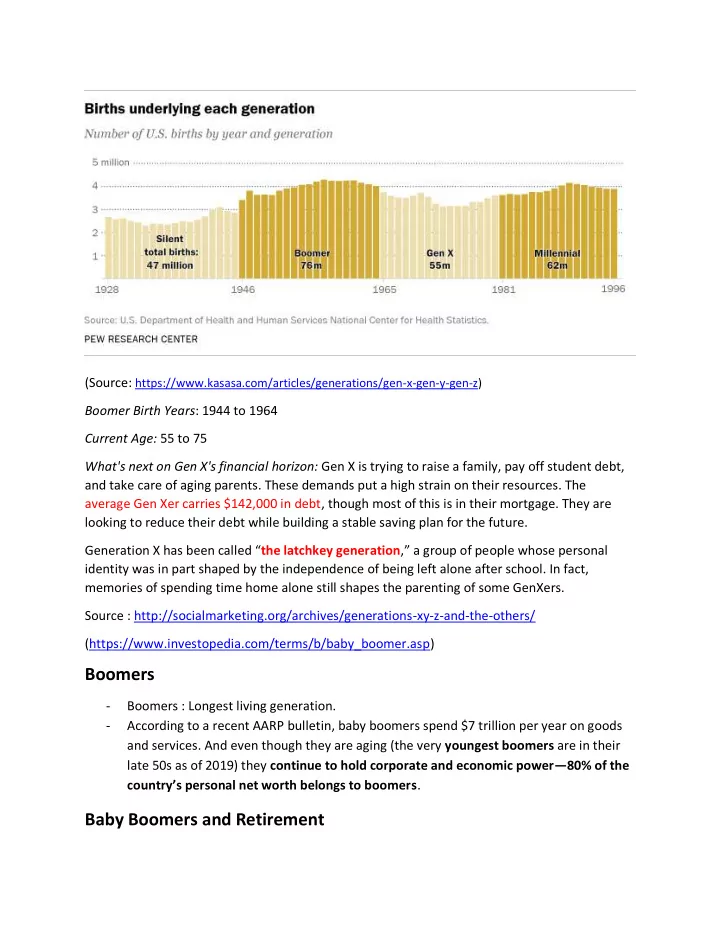
SLIDE 1 (Source: https://www.kasasa.com/articles/generations/gen-x-gen-y-gen-z) Boomer Birth Years: 1944 to 1964 Current Age: 55 to 75 What's next on Gen X's financial horizon: Gen X is trying to raise a family, pay off student debt, and take care of aging parents. These demands put a high strain on their resources. The average Gen Xer carries $142,000 in debt, though most of this is in their mortgage. They are looking to reduce their debt while building a stable saving plan for the future. Generation X has been called “the latchkey generation,” a group of people whose personal identity was in part shaped by the independence of being left alone after school. In fact, memories of spending time home alone still shapes the parenting of some GenXers. Source : http://socialmarketing.org/archives/generations-xy-z-and-the-others/ (https://www.investopedia.com/terms/b/baby_boomer.asp)
Boomers
- Boomers : Longest living generation.
- According to a recent AARP bulletin, baby boomers spend $7 trillion per year on goods
and services. And even though they are aging (the very youngest boomers are in their late 50s as of 2019) they continue to hold corporate and economic power—80% of the country’s personal net worth belongs to boomers.
Baby Boomers and Retirement
SLIDE 2
- Longer Retirement Period: Boomers are expected to live longer than their parents.
- Those retiring in their 60s can expect to live about 25 years more, at least)
Reasons: Better healthcare, no war conditions, better facilities that previous generations, technology revolution and everything getting cheaper
The Biggest Wealth Transfer in History
(Source : https://www.bankrate.com/personal-finance/great-wealth-transfer/) By 2030, it’s estimated that as much as $59 trillion will be passed on from baby boomers, a phenomenon industry experts have coined “The Great Wealth Transfer.” (Source : https://www.cnbc.com/2018/11/20/great-wealth-transfer-is-passing-from-baby- boomers-to-gen-x-millennials.html) The biggest wealth transfer in history is about to happen — and it’s now expected to be more than double what many thought it was. It’s estimated that 45 million U.S. households will transfer $68 trillion in wealth over the next 25 years, according to Asher Cheses, a research analyst and lead author of a new report from financial services research firm Cerulli Associates. Baby boomers, who hold the lion’s share of that amount, are the wealthiest generation in American history — thanks in no small part to a 10-year bull market. (Source: https://www.aarp.org/money/budgeting-saving/info-2018/generational-wealth- transfer.html)
Your Window of opportunity
Gen Xers, who by the end of the 25-year period should replace boomers as the wealthiest generation, according to Asher Cheses, a research analyst in Cerulli’s high-net-worth practice and the report’s lead author. Attitudes towards work a stark finding of our study is the level of dissatisfaction of the Gen X employees. As the mass retirement of Boomers nears, Gen X employees will become even more critical to the success of
- rganizations. Unfortunately, these employees reported the lowest levels of satisfaction and
met expectations, as well as the highest levels of conflict between work and family life.
SLIDE 3
(Book: Generational Career Shifts: How Matures, Boomers, Gen Xers, and Millennials View Work, Page 19, https://books.emeraldinsight.com/resources/pdfs/chapters/9781787544147-TYPE23-
NR2.pdf) WHY this window is open today…
(Source : https://www.americanexpress.com/en-us/business/trends-and- insights/articles/small-business-owner-demographics-are-changing-sba-report-says/) Some of SBA's other findings: Small-business owners are aging. The percentage of business owners age 50 and older rose to almost 51 percent in 2012 from 46 percent in 2007, while the share of business owners ages 35 to 49 fell from 39 percent to 33 percent. This is likely due to the large, aging baby-boomer population, as well as “the unprecedented withdrawal of prime age workers from the labor market,” the report suggests. The portion of business owners under age 35 grew very slightly, from 15.2 percent to 15.9 percent. Veteran business owners are dwindling. The share of veteran business owners fell from 11.9 percent to 9.2 percent between 2007 and 2012, reflecting that the veteran population is predominantly older.
Total Buyers’ Market
Source : https://www.cnbc.com/2015/04/13/ew-small-biz-have-an-exit-plan.html
More Baby Boomers Selling Off Businesses to Fund Retirement
Every month, more than a quarter of a million Americans turn 65. Roughly 17 percent of this contingent has reported they are retired, up from 10 percent in 2010. A Census Bureau report reveals that by 2029, when all baby boomers turn 65 years or older, they will represent 20 percent of the U.S. population.
SLIDE 4 A look at Main Street exemplifies the trend. According to experts, an estimated 10 million small-business owners plan to sell or close their businesses over the next 10 years as a means to fund retirement in their golden years. Already we see the groundswell. Last year, data released by Pepperdine University found that 65 percent of the businesses sold during the first quarter were by baby boomers. This wealth transfer is expected to slowly transform the economic landscape. Entrepreneurs who have spent a lifetime building a business in hopes of funding retirement, however, may need a reality check. According to the FPA/CNBC Business Owner Succession Planning Survey released today, 78 percent of small-business-owner clients plan to sell their businesses to fund their retirement. The proceeds are needed to fund 60 percent to 100 percent of their retirement needs. Yet, less than 30 percent of clients actually have a written succession plan. This comes from a national survey of 182 advisors that specialize in small-business financial planning and are members of the Financial Planning Association. Ron Tamayo, CFP and principal of Moisand Fitzgerald Tamayo in Orlando, Florida, agreed. His advisory manages $380 million in assets for wealthy families and small-business owners with companies that have annual revenues of $100,000 to $10 million. About 70 percent of his firm’s clients are baby boomers. Nearly all of his small-business clients have gotten a wake-up call as they reach retirement and realize they have no succession or exit plan in place in order to cash out for retirement. “For them, this is the biggest anxiety,” he said. “They suddenly realize how hard it is to sell and market a small business if they don’t have a family member or insider willing to take it over.” The FPA/CNBC succession planning survey reported that the only thing harder for small- business owners than emotionally letting go (33 percent) is actually finding a buyer (28 percent). FPA members report that the small-business owners they advise usually stay close to home when it comes to choosing their successors. More than half sell their businesses to employees or family members (23 percent and 31 percent, respectively.) With so many internal sales, it is not surprising that most transactions are financed by installment sales (42 percent) and earn-out arrangements (34 percent). Employee stock
- wnership plans is an option for 14 percent of business owners.
Despite this trend, less than half of small-business owners include their families in the succession planning process, the survey revealed. Yet, there are a host of issues and challenges they face when transferring their legacy to heirs. According to the survey, the biggest is equalizing the business owner’s estate with non- employee children—a problem that 50 percent of respondents cited. Others included distributing executive control among family members and children successors (45 percent),
SLIDE 5 uncertainty about family members and children’s ability to run the business (42 percent), concern about employees’ and customers’ willingness to work with successors (31 percent) and family infighting (31 percent). (Source : https://www.cnbc.com/2014/08/19/small-biz-owners-dont-save-enough-for- retirement-cnbcfpa-poll.html) COULD THIS BE THE GOLDEN ERA TO BUY A SMALL BUSINESS?
100% Buyers’ Market
Source : https://www.genequityco.com/insights/supply-and-demand-what-baby-boomer- business-owners-need-to-realize Fundamentally if there are more sellers than buyers in the market, there is excess supply, and valuations tend to drop and it takes much longer to close transactions (a buyer's market). On the supply side, we have about 60 percent of the 15 million privately held businesses in the U.S. are owned by business owners born before 1964,” says Christopher Nicholas, Shields & Co., at ACG Boston’s DealSource Select. Sixty percent of 15 million is 9 million. Eventually all 9 million businesses will need to transition to new ownership as their baby boomer owners retire and move on. For the sake of our discussion, let’s assume that 50% of these 9 million either close the business, sell to their employees, or pass the company on to their children. That leaves a staggering 4.5 million that will need to transition to new owners via an M&A event over the next 15 years or so. Again, keeping the math easy, that is roughly 300,000 that will need to find buyers per year. The Issue How does that sound to you? Well, the key information you are lacking is the number of businesses sold annually now in the U.S. According to Dealogic, between 2007 and 2016 (ten years’ worth of data), 100,373 M&A deals were announced in the U.S., or about 10K annually. Even if you are bad at math, that means over the next 15 years we will have a staggering increase in the number of baby boomer business owners in market looking for buyers AT THE SAME TIME, far surpassing the number of deals completed right now. What will that do to the law of supply and demand for transactions? Drive down valuations
- verall and significantly increase the time it takes to find a buyer.
“Now, wait,” you say. “Hold on. Lots and lots of transactions occur in the U.S. every year that are never reported or documented.” This is true. It is estimated that at least 50% to 60% of
SLIDE 6
transactions go unreported every year. So even if we factor that into the 100K announced in the last 10 years, it still means that the number of pending baby boomer transactions will swamp the market. What does this mean to you as the owner of a business? Simply this: It is much better to move now and find a buyer than wait. It is estimated that far too many baby boomers will delay action until the latter stages of this 15-year time frame and that is when the real seller’s crunch will occur.
Statistics (Source: https://www.genequityco.com/insights/baby-boomer-business-owners-
the-retirement-conundrum) Simply put, the glut of baby boomer businesses hitting the market will swamp and overwhelm the buying community. A 15x or 11x increase is far too large for the M&A market to handle. And I kept the math simple and linear. In reality, the number per year will most likely increase every year, especially in the latter years of this 15- to 20-year window (which we are living through right now) as age and illness force more and more aging baby boomers to hit the market. Source: https://finance.zacks.com/influences-pricetoearnings-ratio-3474.html
P/E Ratios and List Valuation Models
The price-to-earnings ratio, often called the PE ratio, is the ratio of market price per share to annual earnings per share for a company's stock. It measures the payback period for your investment in years. The PE ratio is not particularly relevant as a standalone number, but it is useful for comparing companies in the same industry, and for determining possible entry and exit points for stocks. Current and expected earnings have the most influence on PE ratios. Source : https://www.mckinsey.com/business-functions/strategy-and-corporate-finance/our- insights/the-right-role-for-multiples-in-valuation
The big multipliers P/E Ratios:
SLIDE 7 EBITDA P/E Less than $150k 1 - 2.5 $150k - $250k 2 – 4 $250k - $500k 3 – 7 $500k - $1M 5 – 10 $1M - $3M 8 – 12 $3M - $10M 10 – 15 $10M - $25M 12 – 20 $25M + 20 – 25 Typical private equity firms: buy for a 12-15x multiple, cluster and sell for 20-25x P/E ratio. Doubling their investments in five years or fewer. YOU CAN’T INVEST IN P/E WITH LESS THAN A FEW $100k TO
- START. This is where Westernston Holdings is headed in the next few years.
For now, though, our window is different. We’re combining our skills and the greatest window of
- pportunity in the history of the world (in the greatest generational transfer of wealth ever) to buy
small businesses that are successful but not scalable, systemize them, cluster them and sell them to either a Private Equity firm for a 10 – 15x P/E ratio, or a strategic buyer that’s larger at a significantly higher P/E like 20 or 25 or even higher. (Examples are coming soon) Why? (Well, for that, stay tuned, because a lot more interesting data and information is headed your way over the next few days. Along with how you can be one of the ONLY investors in the world to be able to leverage this unique, short-time opportunity.)