Bookkeeping HW 1 due last night Grades within 1.5 weeks (hopefully - - PowerPoint PPT Presentation

bookkeeping
SMART_READER_LITE
LIVE PREVIEW

Bookkeeping HW 1 due last night Grades within 1.5 weeks (hopefully - - PowerPoint PPT Presentation

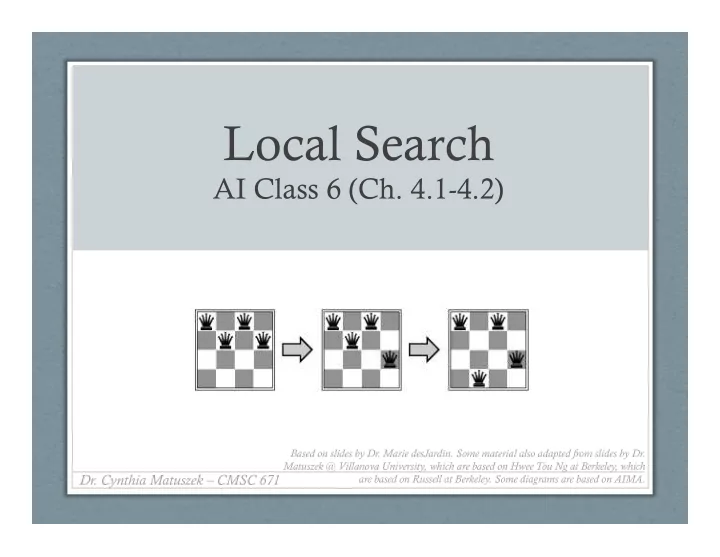
Local Search AI Class 6 (Ch. 4.1-4.2) Based on slides by Dr. Marie desJardin. Some material also adapted from slides by Dr. Matuszek @ Villanova University, which are based on Hwee Tou Ng at Berkeley, which Dr. Cynthia Matuszek CMSC 671 are


slide-1
SLIDE 1

Local Search

AI Class 6 (Ch. 4.1-4.2)

  • Dr. Cynthia Matuszek – CMSC 671

Based on slides by Dr. Marie desJardin. Some material also adapted from slides by Dr. Matuszek @ Villanova University, which are based on Hwee Tou Ng at Berkeley, which are based on Russell at Berkeley. Some diagrams are based on AIMA.

slide-2
SLIDE 2

Bookkeeping

  • HW 1 due last night
  • Grades within 1.5 weeks (hopefully sooner)
  • Discussions after grading
  • HW 2 out tonight 11:59
  • Due 10/3, 11:59pm

2

slide-3
SLIDE 3

Today’s Class

  • Iterative improvement methods
  • Hill climbing
  • Simulated annealing
  • Local beam search
  • Genetic algorithms
  • Online search

3

“If the path to the goal does not matter… [we can use] a single current node and move to neighbors of that node.” – R&N pg. 121

slide-4
SLIDE 4

Admissibility

  • Admissibility is a property of heuristics
  • They are optimistic – think goal is closer than it is
  • (Or, exactly right)
  • Admissible algorithms

can be pretty bad!

  • Is h(n): “1 kilometer” admissible?
  • Using admissible heuristics guarantees that the first

solution found will be optimal, for some algorithms (A*).

4

slide-5
SLIDE 5

Admissibility and Optimality

  • Intuitively:
  • When A* finds a path of length k, it has already tried

every other path which can have length ≤ k

  • Because all frontier nodes have been sorted in ascending
  • rder of f(n)=g(n)+h(n)
  • Does an admissible heuristic guarantee optimality

for greedy search?

  • Reminder: f(n) = h(n), always choose node “nearest” goal
  • No sorting beyond that

5

slide-6
SLIDE 6

E

Local Search Algorithms

6

  • Sometimes the path to the goal is irrelevant
  • Goal state itself is the solution
  • an objective function to evaluate states
  • In such cases, we can use local search algorithms
  • Keep a single “current” state, try to improve it

X

slide-7
SLIDE 7

E

Local Search Algorithms

7

  • Sometimes the path to the goal is irrelevant
  • Goal state itself is the solution
  • an objective function to evaluate states
  • State space = set of “complete” configurations
  • That is, all elements of a solution are present
  • Find configuration satisfying constraints
  • Example?
  • In such cases, we can use local search algorithms
  • Keep a single “current” state, try to improve it

Very efficient! Why?

slide-8
SLIDE 8

What Is This?

8

slide-9
SLIDE 9

Iterative Improvement Search

  • Start with an initial guess
  • Gradually improve it until it is legal or optimal
  • Some examples:
  • Hill climbing
  • Simulated annealing
  • Constraint satisfaction

9

slide-10
SLIDE 10

Hill Climbing on State Surface

  • Concept:

trying to reach the “highest” (most desirable) point (state)

  • “Height”

Defined by Evaluation Function

10

slide-11
SLIDE 11

Hill Climbing Search

  • If there exists a successor s for the current state n such that
  • h(s) < h(n)
  • h(s) ≤ h(t) for all the successors t of n,

then move from n to s. Otherwise, halt at n.

  • Look one step ahead to determine if any successor is “better” than

current state

  • If so, move to the best successor
  • A kind of Greedy search in that it uses h
  • But, does not allow backtracking or jumping to an alternative path
  • Doesn’t “remember” where it has been.
  • Not complete
  • Search will terminate at local minima, plateaux, ridges.

11

slide-12
SLIDE 12

2 8 3 1 6 4 7 5 2 8 3 1 4 7 6 5 2 3 1 8 4 7 6 5 1 3 8 4 7 6 5 2 3 1 8 4 7 6 5 2 1 3 8 4 7 6 5 2 start goal

  • 5

h = -3 h = -3 h = -2 h = -1 h = 0 h = -4

  • 5
  • 4
  • 4
  • 3
  • 2

f(n) = -(number of tiles out of place)

Hill Climbing Example

12

slide-13
SLIDE 13

Image from: http://classes.yale.edu/fractals/CA/GA/Fitness/Fitness.html

local maximum ridge plateau

Exploring the Landscape

  • Local Maxima:
  • Peaks that aren’t the highest

point in the space

  • Plateaus:
  • A broad flat region that gives

the search algorithm no direction (random walk)

  • Ridges:
  • Flat like a plateau, but with

drop-offs to the sides; steps to the North, East, South and West may go down, but a step to the NW may go up.

slide-14
SLIDE 14

Drawbacks of Hill Climbing

  • Problems: local maxima, plateaus, ridges
  • Remedies:
  • Random restart: keep restarting the search from random

locations until a goal is found.

  • Problem reformulation: reformulate the search space to

eliminate these problematic features

  • Some problem spaces are great for hill climbing;
  • thers are terrible

14

slide-15
SLIDE 15

Example of a Local Optimum

1 2 5 8 7 4 6 3 4 1 2 3 8 7 6 5 1 2 5 8 7 4 3 f = -6 f = -7 f = -7 f = 0 start goal 2 5 7 4 8 6 3 1 6

move up move right

f = -(manhattan distance)

15

slide-16
SLIDE 16

Some Extensions of Hill Climbing

  • Simulated Annealing
  • Escape local maxima by allowing some “bad” moves but

gradually decreasing their frequency

  • Local Beam Search
  • Keep track of k states rather than just one
  • At each iteration:
  • All successors of the k states are generated and evaluated
  • Best k are chosen for the next iteration

16

slide-17
SLIDE 17

Some Extensions of Hill Climbing

  • Stochastic Beam Search
  • Chooses semi-randomly from “uphill” possibilities
  • “Steeper” moves have a higher probability of being chosen
  • Random-Restart Climbing
  • Can actually be applied to any form of search
  • Pick random starting points until one leads to a solution
  • Genetic Algorithms
  • Each successor is generated from two predecessor (parent)

states

17

slide-18
SLIDE 18
  • Gradient descent procedure for finding the argx min f(x)
  • choose initial x0 randomly
  • repeat
  • xi+1 ← xi – η f’ (xi)
  • until the sequence x0, x1, …, xi, xi+1 converges
  • Step sizeη(eta) is

small (~0.1–0.05)

  • Good for differentiable, continuous spaces

Gradient Ascent / Descent

Images from http://en.wikipedia.org/wiki/Gradient_descent

18

slide-19
SLIDE 19

Gradient Methods vs. Newton’s Method

  • A reminder of Newton’s

method from Calculus: xi+1 ← xi – η f’ (xi) / f’’ (xi)

  • Newton’s method uses 2nd
  • rder information (the second

derivative, or, curvature) to take a more direct route to the minimum.

  • The second-order information

is more expensive to compute, but converges more quickly.

Contour lines of a function Gradient descent (green) Newton’s method (red)

Images from http://en.wikipedia.org/wiki/Newton's_method_in_optimization

slide-20
SLIDE 20

Simulated Annealing

  • Simulated annealing (SA): analogy between the way

metal cools into a minimum-energy crystalline structure and the search for a minimum generally

  • In very hot metal, molecules can move fairly freely
  • But, they are slightly less likely to move out of a stable structure
  • As you slowly cool the metal, more molecules are “trapped” in

place

  • Conceptually: Escape local maxima by allowing some

“bad” (locally counterproductive) moves but gradually decreasing their frequency

20

slide-21
SLIDE 21

Simulated Annealing (II)

  • Can avoid becoming trapped at local minima.
  • Uses a random local search that:
  • Accepts changes that increase objective function f
  • As well as some that decrease it
  • Uses a control parameter T
  • By analogy with the original application
  • Is known as the system “temperature”
  • T starts out high and gradually decreases toward 0

21

slide-22
SLIDE 22

Simulated Annealing (IIII)

  • f (s) represents the quality of state n (high is good)
  • A “bad” move from A to B is accepted with a probability

P(moveA→B) ≈ e

( f (B) – f (A)) / T

  • (Note that f (B) – f (A) will be negative, so bad moves always have a relatively

probability less than one. Good moves, for which f (B) – f (A) is positive, have a relative probability greater than one.)

  • Temperature
  • The higher the temperature, the more likely it is that a “bad” move

can be made.

  • As T tends to zero, this probability tends to zero, and SA becomes

more like hill climbing

  • If T is lowered slowly enough, SA is complete and admissible.

22

slide-23
SLIDE 23

Visualizing SA Probabilities

p(neg) = 0.1422741 [-1,1] ratio = 49.402449 p(neg) = 0.0202419 [-1,1] ratio = 294267566 p(neg) =

0" 0.5" 1" 1.5" 2" 2.5" (1.5" (1" (0.5" 0" 0.5" 1" 1.5" T=1" 0" 1" 2" 3" 4" 5" 6" 7" 8" (1.5" (1" (0.5" 0" 0.5" 1" 1.5"

T=0.5$

T=0.5" 5000" 10000" 15000"

T=0.1$

T=0.1"

23

slide-24
SLIDE 24

The Simulated Annealing Algorithm

24

slide-25
SLIDE 25

Local Beam Search

  • Begin with k random states
  • k, instead of one, current state(s)
  • Generate all successors of these states
  • Keep the k best states
  • Stochastic beam search
  • Probability of keeping a state is a function of its heuristic

value

  • More likely to keep “better” successors

25

slide-26
SLIDE 26

Genetic Algorithms

  • The Idea:
  • New states are generated by

“mutating” a single state or “reproducing” (somehow combining) two parent states

  • Selected according to their fitness
  • Similar to stochastic beam search
  • Start with k random states (the initial population)
  • Encoding used for the “genome” of an individual strongly affects the

behavior of the search

  • Genetic algorithms / genetic programming are a large and active area
  • f research

26

slide-27
SLIDE 27

Class Exercise: Local Search for N-Queens

Q Q Q Q Q Q (more on constraint satisfaction heuristics next time...)

27

slide-28
SLIDE 28

Tabu Search

  • Problem: Hill climbing can get stuck on local

maxima

  • Solution: Maintain a list of k previously visited

states, and prevent the search from revisiting them

  • Why not always do this?

28

slide-29
SLIDE 29

Online Search

  • Interleave computation and action (search some, act some)
  • Exploration: Can’t infer outcomes of actions; must actually perform them to learn what

will happen

  • Competitive ratio = Path cost found* / Path cost that could be found**

* On average, or in an adversarial scenario (worst case) ** If the agent knew the nature of the space, and could use offline search

  • Relatively easy if actions are reversible
  • LRTA* (Learning Real-Time A*): Update h(s) (in state table) based on

experience

  • More about online search and nondeterministic actions next time…

29

slide-30
SLIDE 30

Summary: Informed Search

  • Best-first search is general search where the minimum-cost nodes are expanded first.
  • Greedy search uses minimal estimated cost h(n) to the goal state as measure
  • Reduces the search time, but is neither complete nor optimal.
  • A* search combines uniform-cost search and greedy search: f (n) = g(n) + h(n). A* handles state

repetitions and h(n) never overestimates.

  • Complete and optimal, but space complexity is high
  • The time complexity depends on the quality of the heuristic function
  • IDA* and SMA* reduce the memory requirements of A*
  • Hill-climbing algorithms keep only a single state in memory, but can get stuck on local optima.
  • Simulated annealing escapes local optima, and is complete and optimal given a “long enough” cooling

schedule.

  • Genetic algorithms can search a large space by modeling biological evolution.
  • Online search algorithms are useful in state spaces with partial/no information.

30