Dynamic Programming II Sequence alignment Shortest paths with - - PowerPoint PPT Presentation

dynamic programming ii
SMART_READER_LITE
LIVE PREVIEW

Dynamic Programming II Sequence alignment Shortest paths with - - PowerPoint PPT Presentation

Dynamic Programming Optimal substructure Last time Weighted interval scheduling Segmented least squares Today Dynamic Programming II Sequence alignment Shortest paths with negative weights Inge Li Grtz KT section 6.6


slide-1
SLIDE 1

Dynamic Programming II

Inge Li Gørtz KT section 6.6 and 6.8

Thank you to Kevin Wayne for inspiration to slides

1

  • Optimal substructure
  • Last time
  • Weighted interval scheduling
  • Segmented least squares
  • Today
  • Sequence alignment
  • Shortest paths with negative weights

Dynamic Programming

2

Sequence Alignment

3

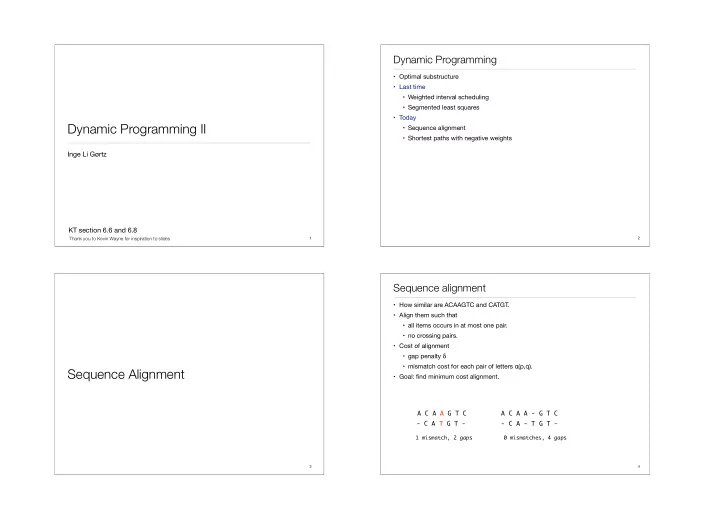
A C A A G T C

  • C A T G T -
  • How similar are ACAAGTC and CATGT.
  • Align them such that
  • all items occurs in at most one pair.
  • no crossing pairs.
  • Cost of alignment
  • gap penalty δ
  • mismatch cost for each pair of letters α(p,q).
  • Goal: find minimum cost alignment.

Sequence alignment

A C A A - G T C

  • C A - T G T -

1 mismatch, 2 gaps 0 mismatches, 4 gaps

A C A A G T C

  • C A T G T -

A C A A G T C

  • C A T G T -

4

slide-2
SLIDE 2
  • Subproblem property.
  • SA(Xi,Yj) = min cost of aligning strings X[1…i] and Y[1…j].
  • Case 1. Align xi and yj.
  • Pay mismatch cost for xi and yj + min cost of aligning Xi-1 and Yj-1.
  • Case 2. Leave xi unaligned.
  • Pay gap cost + min cost of aligning Xi-1 and Yj.
  • Case 3. Leave yj unaligned.
  • Pay gap cost + min cost of aligning Xi and Yj-1.

Sequence Alignment

xi Xi-1 yj Yj-1

5

Sequence alignment

A C A A G T C C A T G T A C G T A 1 2 2 C 1 2 3 G 2 2 1 T 2 3 1 Penalty matrix SA(Xi, Yj) =                jδ if i = 0 iδ if j = 0 min      α(xi, yj) + SA(Xi−1, Yj−1), δ + SA(Xi, Yj−1), δ + SA(Xi−1, Yj)}

  • therwise

δ = 1 SA(X5, Y3)

6

Sequence alignment

A C A A G T C C A T G T A C G T A 1 2 2 C 1 2 3 G 2 2 1 T 2 3 1 Penalty matrix SA(Xi, Yj) =                jδ if i = 0 iδ if j = 0 min      α(xi, yj) + SA(Xi−1, Yj−1), δ + SA(Xi, Yj−1), δ + SA(Xi−1, Yj)}

  • therwise

δ = 1 SA(X5, Y3) Depends on ?

7

Sequence alignment

A C A A G T C C A T G T A C G T A 1 2 2 C 1 2 3 G 2 2 1 T 2 3 1 Penalty matrix SA(Xi, Yj) =                jδ if i = 0 iδ if j = 0 min      α(xi, yj) + SA(Xi−1, Yj−1), δ + SA(Xi, Yj−1), δ + SA(Xi−1, Yj)}

  • therwise

δ = 1 SA(X5, Y3) Depends on ?

8

slide-3
SLIDE 3

Sequence alignment

A C A A G T C 1 2 3 4 5 6 7 C 1 A 2 T 3 G 4 T 5 A C G T A 1 2 2 C 1 2 3 G 2 2 1 T 2 3 1 Penalty matrix SA(Xi, Yj) =                jδ if i = 0 iδ if j = 0 min      α(xi, yj) + SA(Xi−1, Yj−1), δ + SA(Xi, Yj−1), δ + SA(Xi−1, Yj)}

  • therwise

δ = 1

9

Sequence alignment

A C A A G T C 1 2 3 4 5 6 7 C 1 A 2 T 3 G 4 T 5 A C G T A 1 2 2 C 1 2 3 G 2 2 1 T 2 3 1 Penalty matrix SA(Xi, Yj) =                jδ if i = 0 iδ if j = 0 min      α(xi, yj) + SA(Xi−1, Yj−1), δ + SA(Xi, Yj−1), δ + SA(Xi−1, Yj)}

  • therwise

δ = 1 min( ) 1+0, 1+1, 1+1

10

Sequence alignment

A C A A G T C 1 2 3 4 5 6 7 C 1 1 A 2 T 3 G 4 T 5 A C G T A 1 2 2 C 1 2 3 G 2 2 1 T 2 3 1 Penalty matrix SA(Xi, Yj) =                jδ if i = 0 iδ if j = 0 min      α(xi, yj) + SA(Xi−1, Yj−1), δ + SA(Xi, Yj−1), δ + SA(Xi−1, Yj)}

  • therwise

δ = 1 min( ) 1+0, 1+1, 1+1

11

Sequence alignment

A C A A G T C 1 2 3 4 5 6 7 C 1 1 A 2 T 3 G 4 T 5 A C G T A 1 2 2 C 1 2 3 G 2 2 1 T 2 3 1 Penalty matrix SA(Xi, Yj) =                jδ if i = 0 iδ if j = 0 min      α(xi, yj) + SA(Xi−1, Yj−1), δ + SA(Xi, Yj−1), δ + SA(Xi−1, Yj)}

  • therwise

δ = 1 min( ) 0+1, 1+2, 1+1

12

slide-4
SLIDE 4

Sequence alignment

A C A A G T C 1 2 3 4 5 6 7 C 1 1 1 A 2 T 3 G 4 T 5 A C G T A 1 2 2 C 1 2 3 G 2 2 1 T 2 3 1 Penalty matrix SA(Xi, Yj) =                jδ if i = 0 iδ if j = 0 min      α(xi, yj) + SA(Xi−1, Yj−1), δ + SA(Xi, Yj−1), δ + SA(Xi−1, Yj)}

  • therwise

δ = 1 min( ) 0+1, 1+2, 1+1

13

Sequence alignment

A C A A G T C 1 2 3 4 5 6 7 C 1 1 1 A 2 T 3 G 4 T 5 A C G T A 1 2 2 C 1 2 3 G 2 2 1 T 2 3 1 Penalty matrix SA(Xi, Yj) =                jδ if i = 0 iδ if j = 0 min      α(xi, yj) + SA(Xi−1, Yj−1), δ + SA(Xi, Yj−1), δ + SA(Xi−1, Yj)}

  • therwise

δ = 1 min(1+2, 1+3, 1+1)

14

Sequence alignment

A C A A G T C 1 2 3 4 5 6 7 C 1 1 1 2 A 2 T 3 G 4 T 5 A C G T A 1 2 2 C 1 2 3 G 2 2 1 T 2 3 1 Penalty matrix SA(Xi, Yj) =                jδ if i = 0 iδ if j = 0 min      α(xi, yj) + SA(Xi−1, Yj−1), δ + SA(Xi, Yj−1), δ + SA(Xi−1, Yj)}

  • therwise

δ = 1 min(1+2, 1+3, 1+1)

15

Sequence alignment

A C A A G T C 1 2 3 4 5 6 7 C 1 1 1 2 A 2 T 3 G 4 T 5 A C G T A 1 2 2 C 1 2 3 G 2 2 1 T 2 3 1 Penalty matrix SA(Xi, Yj) =                jδ if i = 0 iδ if j = 0 min      α(xi, yj) + SA(Xi−1, Yj−1), δ + SA(Xi, Yj−1), δ + SA(Xi−1, Yj)}

  • therwise

δ = 1 min(1+3, 1+4, 1+2)

16

slide-5
SLIDE 5

Sequence alignment

A C A A G T C 1 2 3 4 5 6 7 C 1 1 1 2 3 A 2 T 3 G 4 T 5 A C G T A 1 2 2 C 1 2 3 G 2 2 1 T 2 3 1 Penalty matrix SA(Xi, Yj) =                jδ if i = 0 iδ if j = 0 min      α(xi, yj) + SA(Xi−1, Yj−1), δ + SA(Xi, Yj−1), δ + SA(Xi−1, Yj)}

  • therwise

δ = 1 min(1+3, 1+4, 1+2)

17

Sequence alignment

A C A A G T C 1 2 3 4 5 6 7 C 1 1 1 2 3 4 A 2 T 3 G 4 T 5 A C G T A 1 2 2 C 1 2 3 G 2 2 1 T 2 3 1 Penalty matrix SA(Xi, Yj) =                jδ if i = 0 iδ if j = 0 min      α(xi, yj) + SA(Xi−1, Yj−1), δ + SA(Xi, Yj−1), δ + SA(Xi−1, Yj)}

  • therwise

δ = 1 min(2+4, 1+5, 1+3)

18

Sequence alignment

A C A A G T C 1 2 3 4 5 6 7 C 1 1 1 2 3 4 5 6 A 2 1 2 1 2 3 4 5 T 3 2 3 2 3 3 3 4 G 4 3 4 3 4 3 4 5 T 5 4 5 4 5 4 3 4 A C G T A 1 2 2 C 1 2 3 G 2 2 1 T 2 3 1 Penalty matrix SA(Xi, Yj) =                jδ if i = 0 iδ if j = 0 min      α(xi, yj) + SA(Xi−1, Yj−1), δ + SA(Xi, Yj−1), δ + SA(Xi−1, Yj)}

  • therwise

δ = 1

19

SA(X[1…m],Y[1…n],δ,A){ for i=0 to m M[i,0] := iδ for j=0 to n M[0,j] := jδ for i=1 to m for j = 1 to n M[i,j] := min{ A[i,j] + M[i-1,j-1], δ + M[i-1,j], δ + M[i,j-1]} Return M[m,n] }

Sequence alignment

20

  • Time: Ɵ(mn)
  • Space: Ɵ(mn)
slide-6
SLIDE 6

Sequence alignment: Finding the solution

A C A A G T C 1 2 3 4 5 6 7 C 1 1 1 2 3 4 5 6 A 2 1 2 1 2 3 4 5 T 3 2 3 2 3 3 3 4 G 4 3 4 3 4 3 4 5 T 5 4 5 4 5 4 3 4 A C G T A 1 2 2 C 1 2 3 G 2 2 1 T 2 3 1 Penalty matrix

SA(Xi, Yj) =                jδ if i = 0 iδ if j = 0 min      α(xi, yj) + SA(Xi−1, Yj−1), δ + SA(Xi, Yj−1), δ + SA(Xi−1, Yj)}

  • therwise

δ = 1 A C A A G T C

← ← ← ← ← ← ←

C ↑

↖ ↖ ← ← ← ← ↖

A

↑ ↖ ↖ ↖ ↖ ← ← ←

T ↑

↑ ↑ ↑ ↖ ↖ ↖ ←

G ↑

↑ ↖ ↑ ↖ ↖ ↖ ↖

T ↑

↑ ↑ ↑ ↖ ↑ ↖ ←

21

  • Use dynamic programming to compute an optimal alignment.
  • Time: Ɵ(mn)
  • Space: Ɵ(mn)
  • Find actual alignment by backtracking (or saving information in another matrix).
  • Linear space?
  • Easy to compute value (save last and current row)
  • How to compute alignment? Hirschberg. (not part of the curriculum).

Sequence alignment

22

Shortest paths

23

  • All-Pairs Shortest Path Problem (APSP)
  • Given directed weighted graph G=(V,E).
  • Weights of edges cij are real numbers (might be negative).
  • Let n = |V| and m= |E|.
  • Weight of a path is the sum of the weights on its edges.
  • Goal: Compute the shortest path for from node s to node t.

Shortest Paths

s t 9 10 6 18 15

  • 8

30 20 44

  • 16

11 6 19 6 16

24

slide-7
SLIDE 7
  • All-Pairs Shortest Path Problem (APSP)
  • Given directed weighted graph G=(V,E).
  • Weights of edges cij are real numbers (might be negative).
  • Let n = |V| and m= |E|.
  • Weight of a path is the sum of the weights on its edges.
  • Goal: Compute the shortest path for from node s to node t.

Shortest Paths

s t 9 10 6 18 15

  • 8

30 20 44

  • 16

11 6 19 6 16

25

  • All-Pairs Shortest Path Problem (APSP)
  • Given directed weighted graph G=(V,E).
  • Weights of edges cij are real numbers (might be negative).
  • Let n = |V| and m= |E|.
  • Weight of a path is the sum of the weights on its edges.
  • Goal: Compute the shortest path for from node s to node t.

Shortest Paths

s t 9 10 6 18 15

  • 8

30 20 44

  • 16

11 6 19 6 16

  • 26
  • Dijkstra
  • Re-weighting

Failed attempts

s t 3 2

  • 3

3 2 5 5 6 6

27

s 2 1

  • 10

2 t 1

  • Negative cycle. If some path from s to t contains a negative cost cycle, then there

does not exist a shortest s-t path. Otherwise, there exists one that is simple.

  • Optimal substructure. Subpaths of shortest paths are shortest paths

Observations

s t

28

slide-8
SLIDE 8
  • OPT(i,v) = length of shortest v-t path P using at most i edges.
  • Case 1: P uses at most i-1 edges.
  • Case 2: P uses exactly i edges.
  • If no negative cycles then OPT(n-1,v) = length of shortest path

Recurrence

t v

w

shortest w ➝ t path using at most i-1 edges cvw v

t

shortest v ➝ t path using at most i-1 edges

OPT(i,v) = OPT(i-1,v) OPT(i,v) = OPT(i-1,w) + cvw

OPT(i, v) = { if i = 0 min{OPT(i − 1,v), min(v,w)∈E{OPT(i − 1,w) + cvw}}

  • therwise

29

Bellman-Ford

OPT(i, v) = { if i = 0 min{OPT(i − 1,v), min(v,w)∈E{OPT(i − 1,w) + cvw}}

  • therwise

Bellmann-Ford(G,s,t) for each node v ∈ V M[0,v] = ∞ M[0,t] = 0. for i=1 to n-1 for each node v ∈ V M[i,v] = M[i-1,v] for each edge (v,w) ∈ E M[i,v] = min(M[i,v], M[i-1,w] + cvw)

30

Example

s t 9 10 6 18 15

  • 8

30 20 44

  • 16

11 6 19 6 16 ∞ ∞ ∞ ∞ ∞ ∞ ∞

Bellmann-Ford(G,s,t) for each node v ∈ V M[0,v] = ∞ M[0,t] = 0. for i=1 to n-1 for each node v ∈ V M[i,v] = M[i-1,v] for each edge (v,w) ∈ E M[i,v] = min(M[i,v], M[i-1,w] + cvw

31

1 2 3 4 5 6 7 s ∞ a ∞ b ∞ c ∞ d ∞ e ∞ f ∞ t

a d b e c f

Example

s t 9 10 6 18 15

  • 8

30 20 44

  • 16

11 6 19 6 16

32

a d b e c f

1 2 3 4 5 6 7 s ∞ a ∞ b ∞ c ∞ d ∞ e ∞ f ∞ t ∞ ∞ ∞ 44 16 6 19

∞ ∞ ∞ ∞ ∞ ∞ ∞ 6 16 44 19

Bellmann-Ford(G,s,t) for each node v ∈ V M[0,v] = ∞ M[0,t] = 0. for i=1 to n-1 for each node v ∈ V M[i,v] = M[i-1,v] for each edge (v,w) ∈ E M[i,v] = min(M[i,v], M[i-1,w] + cvw

slide-9
SLIDE 9

Example

s t 9 10 6 18 15

  • 8

30 20 44

  • 16

11 6 19 6 16 ∞ ∞ ∞ 19 6 44 16 59 29 36

33

a d b e c f

1 2 3 4 5 6 7 s ∞ ∞ a ∞ ∞ b ∞ ∞ c ∞ 44 d ∞ 16 e ∞ 6 f ∞ 19 t 59 29 36 44 16 6 Bellmann-Ford(G,s,t) for each node v ∈ V M[0,v] = ∞ M[0,t] = 0. for i=1 to n-1 for each node v ∈ V M[i,v] = M[i-1,v] for each edge (v,w) ∈ E M[i,v] = min(M[i,v], M[i-1,w] + cvw

Example

s t 9 10 6 18 15

  • 8

30 20 44

  • 16

11 6 19 6 16 36 29 59 6 44 16 38 10 18

34

a d b e c f

1 2 3 4 5 6 7 s ∞ ∞ 59 a ∞ ∞ 29 b ∞ ∞ 36 c ∞ 44 44 d ∞ 16 16 e ∞ 6 6 f ∞ 19 t 38 10 18 44 16 6 Bellmann-Ford(G,s,t) for each node v ∈ V M[0,v] = ∞ M[0,t] = 0. for i=1 to n-1 for each node v ∈ V M[i,v] = M[i-1,v] for each edge (v,w) ∈ E M[i,v] = min(M[i,v], M[i-1,w] + cvw

Example

s t 9 10 6 18 15

  • 8

30 20 44

  • 16

11 6 19 6 16 18 10 38 6 44 16 19

35

a d b e c f

1 2 3 4 5 6 7 s ∞ ∞ 59 38 a ∞ ∞ 29 10 b ∞ ∞ 36 18 c ∞ 44 44 44 d ∞ 16 16 16 e ∞ 6 6 6 f ∞ 19 t 19 10 18 44 16 6 Bellmann-Ford(G,s,t) for each node v ∈ V M[0,v] = ∞ M[0,t] = 0. for i=1 to n-1 for each node v ∈ V M[i,v] = M[i-1,v] for each edge (v,w) ∈ E M[i,v] = min(M[i,v], M[i-1,w] + cvw

Example

s t 9 10 6 18 15

  • 8

30 20 44

  • 16

11 6 19 6 16 18 10 19 6 44 16

36

a d b e c f

1 2 3 4 5 6 7 s ∞ ∞ 59 38 19 a ∞ ∞ 29 10 10 b ∞ ∞ 36 18 18 c ∞ 44 44 44 44 d ∞ 16 16 16 16 e ∞ 6 6 6 6 f ∞ 19 t 19 10 18 44 16 6 Bellmann-Ford(G,s,t) for each node v ∈ V M[0,v] = ∞ M[0,t] = 0. for i=1 to n-1 for each node v ∈ V M[i,v] = M[i-1,v] for each edge (v,w) ∈ E M[i,v] = min(M[i,v], M[i-1,w] + cvw

slide-10
SLIDE 10

Example

s t 9 10 6 18 15

  • 8

30 20 44

  • 16

11 6 19 6 16 18 10 19 6 44 16

37

a d b e c f

1 2 3 4 5 6 7 s ∞ ∞ 59 38 19 19 19 19 a ∞ ∞ 29 10 10 10 10 10 b ∞ ∞ 36 18 18 18 18 18 c ∞ 44 44 44 44 44 44 44 d ∞ 16 16 16 16 16 16 16 e ∞ 6 6 6 6 6 6 6 f ∞ 19 t

can stop when no changes in a round

Bellmann-Ford(G,s,t) for each node v ∈ V M[0,v] = ∞ M[0,t] = 0. for i=1 to n-1 for each node v ∈ V M[i,v] = M[i-1,v] for each edge (v,w) ∈ E M[i,v] = min(M[i,v], M[i-1,w] + cvw

Bellman-Ford

Bellmann-Ford(G,s,t) for each node v ∈ V M[v] = ∞ M[t] = 0. for i=1 to n-1 for each node v ∈ V M[i,v] = M[i-1,v] for each edge (v,w) ∈ E M[i,v] = min(M[i,v], M[i-1,w] + cvw

  • Running time. O(mn)
  • Space. O(n2)

38

  • Improvements to basic implementation
  • Maintain only one array
  • No need to check edges of form (v,w) if M[w] didn’t change in previous iteration.
  • Space: O(m+n)
  • Running time: O(mn) worst case, but substantially faster in practice.

Bellman-Ford

Bellmann-Ford-push-based(G,s,t) for each node v ∈ V M[v] = ∞ succ[v] = nil M[t] = 0. for i=1 to n-1 for each node w ∈ V if M[w] was updated in previous iteration do for each node v such that (v,w) ∈ E if M[v] > M[w] + cvw do

M[v] = M[w] + cvw

succ[v] = w if no M[w] changed in iteration i, stop.

39

  • Lemma. If OPT(n,v) < OPT(n-1,v) for some node, then (any) shortest path from v to t

contains a cycle C with negative cost.

  • Proof. By contradiction.
  • OPT(n,v) < OPT(n-1,v) => P has exactly n edges
  • => P contains a cycle C.
  • Deleting C gives a v-t path with < n edges => C makes v-t path shorter => C has

negative cost.

  • Lemma. If OPT(n,v) = OPT(n-1,v) for all v, then no negative cycles.

Detecting negative cycles

v t C

40

slide-11
SLIDE 11
  • Detect negative cost cycles in O(mn) time.
  • Add new node t and connect all nodes to t with 0-cost edge.
  • Check if OPT(n,v) = OPT(n-1,v) for all nodes v.
  • Yes: No negative cycles.
  • No: Can find negative cycle from shortest path from v to t.

Detecting negative cycles

t 18

  • 8

30 20

  • 16

11 6

  • 41