HELCOM workshop on status of nutrient bookkeeping in the Baltic Sea - - PowerPoint PPT Presentation

helcom workshop on status of nutrient
SMART_READER_LITE
LIVE PREVIEW

HELCOM workshop on status of nutrient bookkeeping in the Baltic Sea - - PowerPoint PPT Presentation

HELCOM workshop on status of nutrient bookkeeping in the Baltic Sea countries 28-29 April, Oldenburg, Germany Introduction HELCOM workshop on status of nutrient bookkeeping in the Baltic Sea countries: Took place on the 28-29 April in


slide-1
SLIDE 1

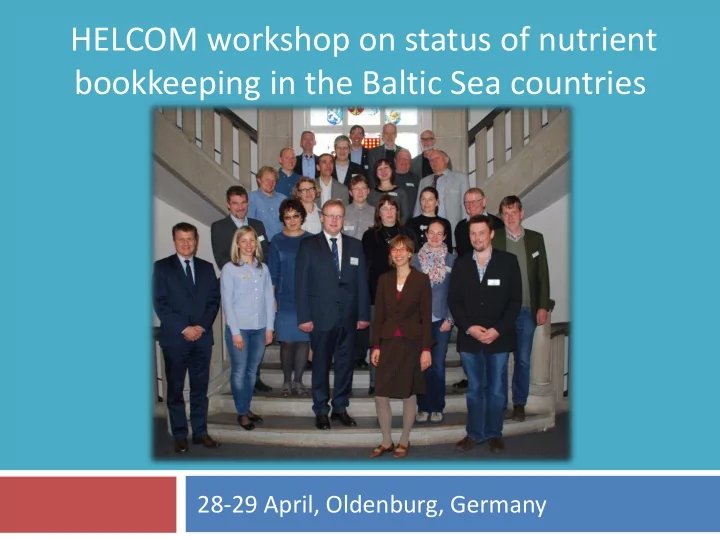
HELCOM workshop on status of nutrient bookkeeping in the Baltic Sea countries

28-29 April, Oldenburg, Germany

slide-2
SLIDE 2

Introduction

HELCOM workshop on status of nutrient bookkeeping in the Baltic Sea countries:

  • Took place on the 28-29 April in Oldenburg
  • Organized by the Chamber of Agriculture Lower Saxony

and the Federal Environmental Agency in Germany

  • Chaired by Mr. Dietrich Schulz and Mrs. Anette Pedersen
  • National experts from Denmark, Estonia, Finland,

Germany, Latvia, Lithuania, Poland, Russia and Sweden presented the status of nutrient bookkeeping in their country (The presentation of Russia was held substituted by Mr. Dimitry Frank-Kamenetsky)

slide-3
SLIDE 3

Aims of the workshop

Sustainable agricultural production is a key to the success of reaching a healthy Baltic Sea. Effective nutrient management can bring opportunities for better addressing nutrient losses to the sea. The Baltic Sea countries agreed at the 2013 HELCOM Ministerial Meeting to promote and advance towards applying by 2018 at the latest annual nutrient accounting at farm level The workshop aimed to identify the status of the nutrient bookkeeping and balance calculations in the Baltic Sea countries (relevant legislation, mandatory or voluntary schemes, reporting systems, responsible authorities etc.)

slide-4
SLIDE 4

Nutrient regulatories in the Baltic Sea countries

slide-5
SLIDE 5

Conclusions (1)

Main obstacles for promotion of nutrient bookkeeping in the Baltic Sea region are:

  • Insufficient or missing data on production and consumption

quantity

  • Uncertainties of standard values (manure excretion, uptake in

crops …)

  • Differences in used methodologies to assess nutrient surplus
  • Lack of awareness among farmers on advantages of nutrient

accounting

  • Low level of cooperation and engagement of involved parties
  • Undeveloped legal framework regulating nutrient management

and control of nutrient flows in agriculture

slide-6
SLIDE 6

The following priorities for implementation in the coming 1-2 years were identified:

  • Stocktaking and harmonization of the standard values

for manure excretion, nutrient contents in manure, crop uptake and others

  • Finding concepts for monitoring farm level bookkeeping

and balances to be used for regional nutrient balances and to identify hot spots

  • Increase of education and awareness (e.g. material for

teachers) at all levels

Conclusions (2)

slide-7
SLIDE 7

Need for regional cooperation in promoting and advancing nutrient bookkeeping in the Baltic Sea countries by:

  • Establishing dialogue between regions with similar environmental and

economic conditions (e.g. concerning intensity and character of agricultural production)

  • Seeking for methods to measure nutrient surplus based on field balances

depending on soil type, which can be recommended for use in the region

  • A list of best regional practices, which could be used as a pick-up list to

promote nutrient bookkeeping

  • Need for unification of to calculate nutrient balances for all countries, but

based on national factual figures

  • Need for common understanding of terminology used (accounting,

bookkeeping, balancing, planning)

Conclusions (3)

slide-8
SLIDE 8

Field balance

(Crop production)

Nitrogen offtake

Cash-crops Fodder

Nutrient Bookkeeping in Germany

Surplus crop production

  • Soil fixation
  • Groundwater
  • Drainage
  • Atmosphere

Standard value Bookkeeping Calculated

INPUT Crop production

Mineral and secondary fertilizer Organic fertilizer (Animal manure) Symbiotic Nitrogen fixation

slide-9
SLIDE 9

Questions and discussion