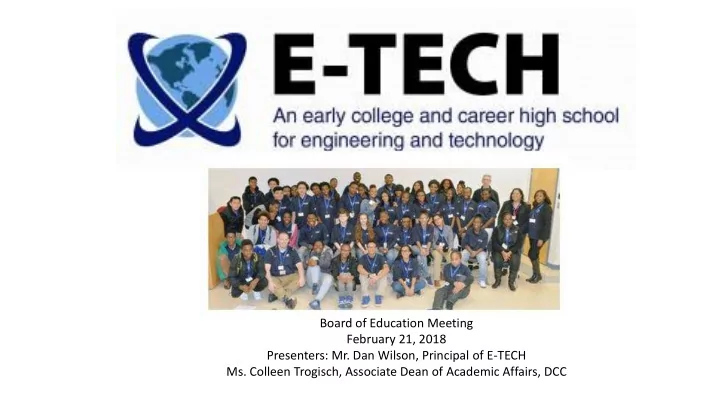
Board of Education Meeting February 21, 2018 Presenters: Mr. Dan - - PowerPoint PPT Presentation

board of education meeting
SMART_READER_LITE
LIVE PREVIEW

Board of Education Meeting February 21, 2018 Presenters: Mr. Dan - - PowerPoint PPT Presentation

Board of Education Meeting February 21, 2018 Presenters: Mr. Dan Wilson, Principal of E-TECH Ms. Colleen Trogisch, Associate Dean of Academic Affairs, DCC Program Overview 6-year integrated high school and college program Scholars

slide-1
SLIDE 1

Board of Education Meeting February 21, 2018 Presenters: Mr. Dan Wilson, Principal of E-TECH

  • Ms. Colleen Trogisch, Associate Dean of Academic Affairs, DCC
slide-2
SLIDE 2

Program Overview

  • 6-year integrated high school and college program
  • Scholars complete high school course work concurrently with college course

work.

  • College degree options (Dutchess Community College)
  • ELT (Electrical Technology)
  • ENR (Engineering Science)
  • School to Work (Central Hudson)
  • Workplace experience to ensure scholars are prepared to excel in an ever

changing workplace.

slide-3
SLIDE 3

E-Tech High School Data

Cohort 1 (44 Scholars)

  • 27 Green
  • 16 Yellow
  • 1 Red

Cohort 3 (42 Scholars)

  • 37 Green
  • 4 Yellow
  • 1 Red

Cohort 2 (43 Scholars)

  • 29 Green
  • 10 Yellow
  • 4 Red
slide-4
SLIDE 4

Adjustments in Program

Year 2 (2016-2017)

  • After School
  • Math and ELA

Year 3 (2017-2018)

  • After School
  • Academic Support for all Subject

Areas

  • Clubs for application of skills
  • Impact
  • 74% of Freshman attending
  • 54% of all E-Tech scholars

attending

slide-5
SLIDE 5

Adjustments in Program

Year 2 (2016-2017)

  • Access to Technology
  • 1 E-Tech Computer Lab

Year 3 (2017-2018)

  • Access to Technology
  • 1 E-Tech Computer Lab
  • Chromebooks in 4 Classrooms
  • Impact
  • Project-Based Learning
  • Increased Feedback Loop
slide-6
SLIDE 6

Adjustments in Program

Year 2 (2016-2017)

  • College Class Model at PHS
  • Pull-out model
  • Data:
  • 71% pass rate (31 Scholars)
  • 2 A’s
  • 2B’s

Year 3 (2017-2018)

  • College Class Model at PHS
  • Integrated Schedule
  • Impact:
  • 82% pass rate (28 Scholars)
  • 11 A’s
  • 7 B’s
slide-7
SLIDE 7

Adjustments in Progress

  • College Readiness Criteria (Spring 2018 for ENR 100)
  • Transitional Classes in ELA and Math (Fall 2018)
  • Collaborative Schedule Planning for College Classes (Fall 2018)
slide-8
SLIDE 8

Work in Progress

  • Communication
  • Growth of the program
  • Adjustments in program
  • Benchmarks
  • Trust in Process
slide-9
SLIDE 9
slide-10
SLIDE 10

What the P-Tech Model Is

  • Integrated six year program, combining high school, college, and career training
  • Requires that the school district, the industry partner and the college collaborate

to develop a “Six Year Integrated Scope and Sequence” of course requirements and work-based learning opportunities leading to completion of both high school and college credits. This Scope and Sequence must be approved by New York State Education Department

  • Targets at-risk students. The program is intended to provide extensive supports to

help students bridge any gaps to college readiness

  • Includes extended day and summer programs to provide additional instructional

time to prepare students for college work

  • Intensive and individual interventions should be provided at high school for all

students starting in first year

  • Only courses required in the college program (major) may be taken for college

credit (college remedial courses are not allowed)

slide-11
SLIDE 11

What the P-Tech Model Is Not

  • It is not an accelerated program.
  • It is not a two plus two or four plus two model. Integration of the

Scope and Sequence specifies that students will not graduate from high school until they complete their associate’s degree.

  • It is not a program targeting only high-performing students.
  • It is not a program for students who are unable to commit to

extended day or extended year in order to prepare for college courses.

slide-12
SLIDE 12

Comparison of HS Readiness for Graduation Data with DCC Readiness for College Data*

Cohort 1 (44 Scholars)

  • 27 Green
  • 16 Yellow
  • 1 Red
  • Cohort 3 (42 Scholars)
  • 37 Green
  • 4 Yellow
  • 1 Red

Cohort 2 (43 Scholars)

  • 29 Green
  • 10 Yellow
  • 4 Red

Coh

  • hort 1

1 (44 (44 Sc Scholars)

  • 7

7 Gr Green

  • 12

12 Yell llow

  • 25

25 Red Coh

  • hort 3

3 (42 (42 Sc Scholars) Fir First year in in program- need more in information Coh

  • hort 2

2 (43 (43 Sc Scholars)

  • 12

12 Gr Green

  • 13

13 Yell llow

  • 15

15 Red

  • Based on DCC evaluation of student academic records received from district and DCC requirements
  • DCC data – Green is college course ready with some support, Yellow is remediation needed in one or more areas, Red is extreme supports and remediation needed
  • Three students transcripts not available for evaluation in Cohort 2
slide-13
SLIDE 13

Poughkeepsie HS Grads Enrolling at DCC Fall 2017

90.5% of PHS graduates who enrolled at DCC in Fall 2017 needed some form of remediation

  • Math
  • 80% needed math remediation
  • English
  • 73.7% needed math remediation
  • Both math and English
  • 63.2% needed math and English Remediation
slide-14
SLIDE 14

DCC Program Data

Cohort 1 Data

Spring 2016/Fall 2016

  • 23 students took ENT 131
  • 21.7% failed or were failing and withdrew

Fall 2016

  • 8 students took CHE 111
  • One student received D

Spring 2017

  • 31 students took ENR 100
  • 51.6 % received D or below
  • 29% failed or withdrew
  • 5 students took MAT 184 @ PHS
  • 80 % received a D, F or W
  • This group was required to spend 2 hours per

week inside the bell and had the opportunity to receive tutoring after school.

  • 5 students took MAT 184 @DCC
  • 100% success rate.
  • These were the top performers in the program.
  • This group was required to spend 3 hours per

week in DCC’s Math tutoring center with a faculty member.

slide-15
SLIDE 15

Cohort One – Aggregate Data

2016 - 2017

  • 23 students successfully completed one college course
  • 8 students successfully completed 3 college courses
  • In all, those students acquired 79 college credits

2017-2018

  • 2 students taking 1 college course outside the bell @ DCC
  • In total, 6 college credits have been completed this year
  • This year’s HS schedules do not permit college courses
  • Example: 5 seats were held in ENR 101 - May through August but scheduling at high school did

not allow for enrollment

slide-16
SLIDE 16

Cohort One – Aggregate Data (continued)

  • 11 students out of 44 have failed at least one course – 25 % unsuccessful
  • 9 students out of 44 have a D in one course - 20.4 % unsuccessful
  • 20 students out of 44 have a D or an F - 45.5% unsuccessful
  • 3 students out of 44 were failing and withdrew from course
  • 1 student has enrolled in 2 courses and failed both courses
  • 24 students out of 44 have a W, D, or a F – 52 % unsuccessful
  • Students need a minimum of a 2.0 GPA to graduate from DCC; a grade of D has a 1.0 Grade Point.
  • If a D is received in a prerequisite course, the student cannot take next course in sequence. ”D” grades do not typically transfer to
  • ther academic institutions. A grade of a D should not be viewed as a success
slide-17
SLIDE 17

WHAT INTERVENTIONS HAVE BEEN TRIED?

  • Fall 2016 - DCC provided Math faculty @ PHS for

math tutoring

  • program failed due to lack of student participation
  • Spring 2017 - Planned English tutoring was based
  • n success of math tutoring program - English

tutoring program never started

slide-18
SLIDE 18

Program Challenges

  • Lack of structured after-school program or summer program to

provide interventions to support student readiness for college courses.

  • Lack of student participation in after-school programs.
  • Lack of clear communication to parents and students that is

consistent and coordinated between high school and college partners.

  • Lack of understanding of the difference between completion of high

school courses and readiness for college courses.

slide-19
SLIDE 19

HOW CAN WE MAKE THIS WORK?

  • REQUIRED, STRUCTURED, TARGETED after school program designed to prepare all students for

academic success

  • REQUIRED, STRUCTURED TARGETED summer program designed to prepare all students for

academic success

  • Interventions beginning in 9th grade so that students can start taking college courses by 10th

grade (as P-tech model indicates)

  • Re-focus away from merely meeting HS requirements for graduation in order to concentrate on

college-readiness

  • Example – 65 on Common Core Algebra I Regents is necessary to meet graduation requirements. However, it is not

sufficient for college readiness to enroll in lowest required Math course in programs

  • Example – students may take English 11 as HS summer course in order to prepare for English 11 Regents and fulfill

HS requirement for graduation. However, it is not sufficient for college readiness as three full years of HS English are required for preparation for College English

  • Develop and offer math and English transitional courses for fall 2018 to students who are not

yet college ready

  • Condensed content of math and English transitional courses offered as intensive modules this

spring to students

  • All stakeholders invited to all student and parent E-Tech college course planning meetings