Board End Measures College Board Monitoring Presentation Board End - - PDF document

board end measures college board monitoring presentation
SMART_READER_LITE
LIVE PREVIEW

Board End Measures College Board Monitoring Presentation Board End - - PDF document

Board End Measures College Board Monitoring Presentation Board End #1: Educational and Career Goal Success All students achieve the learning necessary to be successful in their educational and career goals. Board End #1, Outcome 1


slide-1
SLIDE 1

Board End Measures – College Board Monitoring Presentation

Board End #1: All students achieve the learning necessary to be successful in their educational and career goals. September, 2012 1

Board End #1: Educational and Career Goal Success – All students achieve the learning necessary to be successful in their educational and career goals.

Board End #1, Outcome 1 – Course Success Results

Measure Definition: Percentage of all courses attempted by degree credit students per year receiving a grade

  • f “C” or better. Included in this measure are the following degree types: Occupational Associate, Liberal Arts

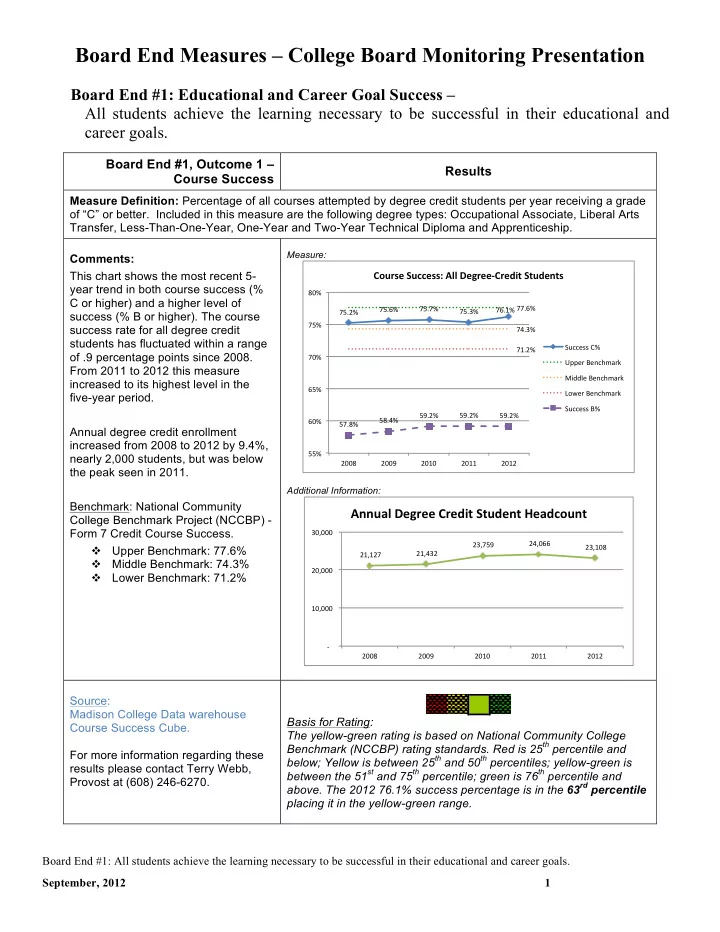
Transfer, Less-Than-One-Year, One-Year and Two-Year Technical Diploma and Apprenticeship. Comments: This chart shows the most recent 5- year trend in both course success (% C or higher) and a higher level of success (% B or higher). The course success rate for all degree credit students has fluctuated within a range

  • f .9 percentage points since 2008.

From 2011 to 2012 this measure increased to its highest level in the five-year period. Annual degree credit enrollment increased from 2008 to 2012 by 9.4%, nearly 2,000 students, but was below the peak seen in 2011. Benchmark: National Community College Benchmark Project (NCCBP) - Form 7 Credit Course Success. v Upper Benchmark: 77.6% v Middle Benchmark: 74.3% v Lower Benchmark: 71.2%

Measure: Additional Information:

Source: Madison College Data warehouse Course Success Cube. For more information regarding these results please contact Terry Webb, Provost at (608) 246-6270. Basis for Rating: The yellow-green rating is based on National Community College Benchmark (NCCBP) rating standards. Red is 25th percentile and below; Yellow is between 25th and 50th percentiles; yellow-green is between the 51st and 75th percentile; green is 76th percentile and

  • above. The 2012 76.1% success percentage is in the 63rd percentile

placing it in the yellow-green range.

!"#$%& !"#'%& !"#!%& !"#(%& !'#)%&!!#'%& !*#(%& !)#$%& "!#+%& "+#*%& ",#$%& ",#$%& ",#$%& ""%& '-%& '"%& !-%& !"%& +-%& $--+& $--,& $-)-& $-))& $-)$&

!"#$%&'(#))&%%*'+,,'-&.$&&/!$&012'(2#0&32%'

./00122&3%& 45516&71809:;6<& =>??@1&71809:;6<& ABC16&71809:;6<& ./00122&7%& !"#$#"%!! !"#$&'"!! !"'$%()!! !"&$*++!! !"'$#*,!! !-!!!! !#*$***!! !"*$***!! !'*$***!! "**,! "**)! "*#*! "*##! "*#"!

!""#$%&'()*((&+*(,-.&/.#,(".&0($,12#".&

slide-2
SLIDE 2

Board End Measures – College Board Monitoring Presentation

Board End #1: All students achieve the learning necessary to be successful in their educational and career goals. September, 2012 2

Board End #1, Outcome 2 – Graduation Results

Measure Definition: 3-Year Graduation Rate – graduation rate of first-time full-time and part-time students entering in the fall semester. Comments: This measure is based on the National Community College Benchmark Project (NCCBP) Form 2 Completion

  • measure. It tracks 3-year graduation

rates for entering full-time, first-time and part-time, first-time student cohorts. In the most recent cohort year, Madison College is slightly below the upper benchmark for full-time students, and substantially above the upper benchmark for part-time students. The number of students in first time full-time and part-time cohorts is shown on the bottom chart. The entering first-time, full-time cohort grew by 19 students (1.3%) while the entering first-time, part-time cohort grew by 60 students (7.1%).

!"#$%& '(#)%& '*#)%& '+#$%& '"#'%& ,!#$%& "%& ,"%& '"%& !"%& ("%& $"%&

  • .//&'""*0"+&
  • .//&'""+0")&
  • .//&'"")0"1&

!"#$%&'%()&"*+","-)%$."/"0'11/2*3)"

2.34567&86//9:9&

  • ;//0<=9>&-4?5@0<=9&

47&-.//& ABB9?&C97DE=.?F& 2433/9&C97DE=.?F& G6H9?&C97DE=.?F& !"#$%& '(#)%& !*#"%& ''#!%& *#)%& +#!%& $%& '$%& !$%& ,$%& +$%& )$%&

  • .//&!$$*0$"&
  • .//&!$$"0$1&
  • .//&!$$10$(&

!"#$%&'%()&"*+","-)%$."/"0%$(/1*2)"

2.34567&86//9:9& ;.<=0>?9@&-4<5=0>?9& 47&-.//& ABB9<&C97DE?.<F& 2433/9&C97DE?.<F& G6H9<&C97DE?.<F& !"#$%"!! !"#&'&!! !"#&&$!! !(")!! !(&'!! !)*'!! !+!!!! !,**!! !"#***!! !"#,**!! !'#***!!

  • .//!'**%+*0!
  • .//!'**0+*(!
  • .//!'**(+*)!

!"#$%&'"()*+,%)#",-*./0/#%*

  • 1234!5167!-5!
  • 1234!5167!85!
slide-3
SLIDE 3

Board End Measures – College Board Monitoring Presentation

Board End #1: All students achieve the learning necessary to be successful in their educational and career goals. September, 2012 3 Sources:

  • 1. IRE custom SAS program running
  • n extracted cohort information.
  • 2. Madison College Data Warehouse

FTE & Enrollment Cube. Benchmark Source:

  • 1. NCCBP: Form 2: 3-year Cohort

Graduation Rate for Entering Full- Time and Part-Time students. For more information regarding these results please contact Terry Webb, Provost at (608) 246-6270. Full-Time: 73rd percentile Part-Time: 94th percentile Basis for Rating: Percentile ranking based on benchmarks as with previous measure.

slide-4
SLIDE 4

Board End Measures – College Board Monitoring Presentation

Board End #1: All students achieve the learning necessary to be successful in their educational and career goals. September, 2012 4

Board End #1, Outcome 3 – Overall Student Success Results

Measure Definitions: § 3-Year Cohort Graduation Rate + Transfer Rate + Retention Rate. Total of the graduation rate, transfer rate and retention rate of first-time students entering in the fall semester, 3 years after first enrollment - excludes students in programs less than 1 year in length and apprenticeships (no benchmarks available); § Cohort 3-year percent of all first-time, full-time students and first-time part-time students; § Two re-enrollment measures of all degree credit students:

  • 1. Fall to Spring Persistence.
  • 2. Fall to Fall Retention.

Comments: Cohort year information on each chart shows the year that students first took a Madison College degree credit class. Students are followed for 3 years and their success in graduation, retention, or transfer is

  • recorded. Combining the results for a student cohort’s

graduation, transfer and retention rates reveals the

  • verall student success of that cohort. 3-Year total

student success decreased from 61.5% to 58.9% in the most recent cohort year.

Benchmark Notes:

  • Useful benchmarks are not available to take into

account all 3 outcomes simultaneously while tracking

  • n an entering cohort basis. Alternative 3-year

graduate, transfer, retention, and persistence measures with associated benchmarks are presented in the following 4 charts. The 2 charts below combine graduation and transfer

  • utcomes for entering degree-seeking, first-time, full-time

and first time, part-time student cohorts. Both full-time and part-time cohorts showed substantial increases in the % Graduated or Transferred measure. Data Notes:

  • The above chart includes students in programs of 1 year or
  • longer. Short-term program enrollees in programs such as

Certified Nursing Assistant and the short-term EMT programs are excluded.

  • Since we are following students for 3 years, the most

recent retention, graduation, and transfer outcome information available is for the 2008-09 cohort.

!"#$%& !'#(%& !)#(%& !$#*%& !$#!%& +,#-%& +,#+%& ++#)%& ++#(%& ++#+%& !)#!%& !)#)%& !$#"%& +*#!%& !)#'%& ")#-%& "-#!%& "$#'%& '!#"%& "-#$%& *%& +*%& ,*%& '*%&

  • *%&

./00&+**,1*"& ./00&+**"1*'& ./00&+**'1*)& ./00&+**)1*-& ./00&+**-1*$&

!"#$""%&$"'()%*)+'",)%*+--"..%/%0% /1"2$%

23456573893& :4/;</=>8& ?4/85@34& !"#$%& '(#)%& !*#+%& !!#'%& '(#,%& '+#'%& +%& *+%& )+%& '+%& !+%& ,+%&

  • .//&)++"0+(&
  • .//&)++(0+1&
  • .//&)++10+$&

!"#$%&'%()&"*$"+$%,-.)$$)&"/,"0"1)%$-"" 2/$-(3+/4)5"2'663+/4)"

2.34567&86//9:9&

  • ;//0<=9>&-4?5@0<=9&

47&-.//& ABB9?&C97DE=.?F& 2433/9&C97DE=.?F& G6H9?&C97DE=.?F& !"#$%& "'#'%& ()#)%& "*#*%& +,#!%& +(#!%&

  • %&

+-%& "-%& (-%& !-%& *-%& ./00&"--)1-'& ./00&"--'1-,& ./00&"--,1-$&

!"#$%&'%()&"*$"+$%,-.)$$)&"/,"0"1)%$-"" 2/$-(3+/4)5"6%$(3+/4)"

2/34567&86009:9& ;/<=1>?9@&.4<5=1>?9& 47&./00& ABB9<&C97DE?/<F& 243309&C97DE?/<F& G6H9<&C97DE?/<F&

slide-5
SLIDE 5

Board End Measures – College Board Monitoring Presentation

Board End #1: All students achieve the learning necessary to be successful in their educational and career goals. September, 2012 5

The charts below track persistence of Fall students to the Spring Term and retention of Fall students to the next Fall. These charts are based on all enrolled degree credit students. Next term persistence increased by 2.1 percentage points while Fall to Fall retention decreased by 5.2 percentage points.

Sources: 1. Enrollment / Graduation: IRE custom SAS program running on extracted cohort information. 2. Transfer: National Student Clearinghouse Benchmark Sources: 1. Graduation and Transfer: NCCBP – Form 2. 2. Persistence: NCCBP – Form 4. For more information regarding these results please contact Keith Cornille, Vice President-Student Development (608) 246-6464.

% Graduated or Transferred in 3 Years - Full Time: 63rd Percentile % Graduated or Transferred in 3 Years - Part Time: 89th Percentile Next-Term Persistence Rate: 72nd Percentile Fall-Fall Retention Rate: 65th Percentile Basis for Rating: Percentile ranking based on benchmarks.

!"#$%& !'#'%& !(#$%& !(#)%& !"#)%& )!#*%& +%& ',%& ,+%& !,%& "++%&

  • .//&'++*0+1&
  • .//&'++10"+&
  • .//&'+"+0""&

!"#$%&"'()*+,--)$.)/0'1234)5"'616$"27")) 8--)/$9:"2$6)

2.34567&86//9:9& ;9<=0=9>?& @9>545=97A9&B.=9& CDD9>&E97AF?.>G& 2433/9&E97AF?.>G& H6I9>&E97AF?.>G& !"#"$% !!#&$% !'#"$% !(#&$% )&#)$% ))#*$% '$% +!$% !'$% *!$% (''$% ,-..%+''&/'0% ,-..%+''0/('% ,-..%+'('/((%

!"##$%&$!"##$'(%()*&)$$ $+##$,%-.()%/$

1-23456%75..898%,-../ ,-..%:8;86<56%:-;8% =>>8?%@86ABC-?D% 1322.8%@86ABC-?D% E5F8?%@86ABC-?D%

slide-6
SLIDE 6

Board End Measures – College Board Monitoring Presentation

Board End #1: All students achieve the learning necessary to be successful in their educational and career goals. September, 2012 6

Board End #1, Outcome 4 – Community College Survey of Student Engagement (CCSSE) Results

Measure Definition: Madison College continues to work on assessing and improving Student Engagement. Student Engagement is defined as the amount of time and energy students invest in meaningful educational practices. The Community College Survey of Student Engagement (or CCSSE, pronounced “SESS-ee”) is a well-respected national survey of 2-year colleges created for this purpose. The survey population includes degree credit students only. CCSSE responses are grouped and summarized into 5 benchmark categories:

  • Active and collaborative Learning
  • Student Effort
  • Academic Challenge
  • Student-Faculty Interaction
  • Support for Learners

Comments:

The CCSSE National Norm is set at 50 for each of the five

  • benchmarks. Colleges are rated in each of these 5

benchmarks against this norm. A description of the benchmark categories is attached. Performance for each benchmark will be tracked over time and addressed by the college. Our plan is to repeat the CCSSE and related quality improvement cycle every 2

  • years. The most recent survey was completed in 2011.

CCSSE is scheduled to be repeated in Spring 2013. Source:

1.

CCSSE student reports.

Full-Time / Part-Time CCSSE Performance Benchmarks:

FT Students: § 4 of 5 benchmarks were above the 50 national norm. § Performance improved significantly in 3 of 5 benchmarks: 1. Active and Collaborative Learning 2. Student-Faculty Interaction 3. Support for Learners § Performance improved slightly in 2 of 5 benchmarks: 1. Student Effort 2. Academic Challenge PT Students: § All 5 benchmarks were below the 50 national norm. § Performance improved slightly in 1 of 5 benchmarks: 1. Active and Collaborative Learning. § Performance decreased significantly in 1 of 5 benchmarks: 1. Student Effort § Performance improved significantly in 3 of 5 benchmarks 1. Academic Challenge 2. Student-Faculty Interaction 3. Support for Learners

!"#$% !"#&% !"#'% !(#!% !"#$% !"#)% !(#(% !(#)% !!#)% !)#)% !!% !(% '*% '&% $**"% $*++%

!"#$%&'()&**+,+())--.(/+'012"34%(5(6**(-78#+'7%(

,-./0%123%456617581./0%90182:2;% <=>302=%?@58=% ,-130A:-%4B16602;0% <=>302=CD1->6=E%F2=081-.52% <>GG58=%H58%9018208I% !!"#$ !%"&$ !'"%$ !#"&$ !!"%$ !("&$ !#"&$ !!"&$ )!"*$ )+"&$ ))$ )%$ !&$ !#$ !($ !+$ '&&+$ '&,,$

!"#$%&'()&**+,+())--.(/+'012"34%(5(67(-89#+'8%(

  • ./01$234$567728692/01$:1293;3<$

=>?413>$@A69>$

  • .241B;.$5C27713<1$

=>?413>DE2.?7>F$G3>192./63$ =?HH69>$I69$:129319J$ !"#$% !&#'% !(#(% !"#'% !"#&% !(#'% !!#(% !&#'% !)#$% !"#'% !)% !"% !(% !$% "*% +''$% +'**%

!"#$%&'()&**+,+())--.(/+'012"34%(567(-89#+'8%(

,-./0%123%456617581./0%90182:2;% <=>302=%?@58=% ,-130A:-%4B16602;0% <=>302=CD1->6=E%F2=081-.52% <>GG58=%H58%9018208I%

slide-7
SLIDE 7

Board End Measures – College Board Monitoring Presentation

Board End #1: All students achieve the learning necessary to be successful in their educational and career goals. September, 2012 7

Benchmark Sources: 1. Graduation and Transfer: NCCBP – Form 5. NCCBP colleges who participate in CCSSE use benchmark information.

For more information regarding these results please contact Dr. Keith Cornille, Vice-President for Student Development at (608) 246-6464. Full-Time: 4th quartile Part-Time: 1st quartile Rationale for Rating: Full-time and part-time students taking CCSSE had quite different results. The best way to describe the

  • verall results is to show the average of 5

benchmarks for each population separately

  • Full-time: Average quartile ranking for Full-time

students is 3.6 on a 4-point scale. Estimated percentile ranking would be 77.5.

  • Part-time: Average quartile ranking for part-time

students is 1 on a 4-poing scale. Estimated percentile ranking would be 12.5.

slide-8
SLIDE 8

Board End Measures – College Board Monitoring Presentation

Board End #1: All students achieve the learning necessary to be successful in their educational and career goals. September, 2012 8 Student Engagement definition: The amount of time and energy that students invest in meaningful educational practices. CCSSE Benchmarks

Active and Collaborative Learning

CCSSE Items

During the current school year, how often have you

  • Asked questions in class or contributed to class discussions
  • Made a class presentation
  • Worked with other students on projects during class
  • Worked with classmates outside of class to prepare class assignments
  • Tutored or taught other students (paid or voluntary)
  • Participated in a community-based project as a part of a regular course
  • Discussed ideas from your readings or classes with others outside of class (students, family members, co-workers, etc.)

Student Effort

CCSSE Items

During the current school year, how often have you

  • Prepared two or more drafts of a paper or assignment before turning it in
  • Worked on a paper or project that required integrating ideas or information from various sources
  • Come to class without completing readings or assignments (reverse coded)
  • Used peer or other tutoring
  • Used skill labs
  • Used a computer lab

During the current school year

  • How many books did you read on your own (not assigned) for personal enjoyment or academic enrichment
  • How many hours did you spend in a typical week preparing for class (studying, reading, writing, rehearsing or other activities

related to your program) Academic Challenge

CCSSE Items

During the current school year, how often have you

  • Worked harder than you thought you could to meet an instructor’s standards or expectations

How much does your coursework at this college emphasize

  • Analyzing the basic elements of an idea, experience, or theory
  • Synthesizing and organizing ideas, information, or experiences in new ways Making judgments about the value or

soundness of information, arguments, or methods

  • Applying theories or concepts to practical problems or in new situations
  • Using information you have read or heard to perform a new skill

During the current school year

  • How many assigned textbooks, manuals, books, or book-length packs of course readings did you read
  • How many papers or reports of any length did you write
  • To what extent have your examinations challenged you to do your best work

How much does this college emphasize

  • Encouraging you to spend significant amounts of time studying

Student-Faculty Interaction

CCSSE Items

During the current school year, how often have you

  • Used email to communicate with an instructor
  • Discussed grades or assignments with an instructor
  • Talked about career plans with an instructor or advisor
  • Discussed ideas from your readings or classes with instructors outside of class
  • Received prompt feedback (written or oral) from instructors on your performance
  • Worked with activities other than coursework

Support for Learners

CCSSE Items

How much does this college emphasize

  • Providing the support you need to help you succeed at this college
  • Encouraging contact among students from different economic, social, and racial or ethnic backgrounds
  • Helping you cope with your non-academic responsibilities (work, family, etc.)
  • Providing the support you need to thrive socially
  • Providing the financial support you need to afford your education

During the current school year, how often have you

  • Used academic advising/planning services
  • Used career counseling services