
SLIDE 1
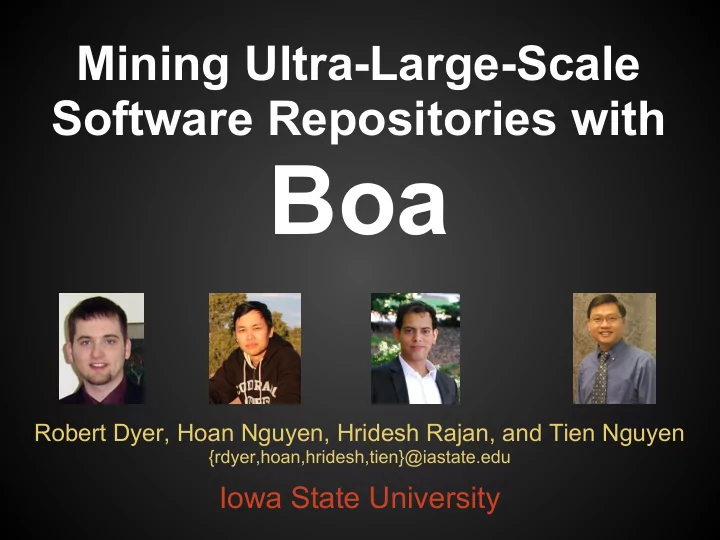
Mining Ultra-Large-Scale Software Repositories with
Boa
Robert Dyer, Hoan Nguyen, Hridesh Rajan, and Tien Nguyen
{rdyer,hoan,hridesh,tien}@iastate.edu
Iowa State University
Boa Robert Dyer, Hoan Nguyen, Hridesh Rajan, and Tien Nguyen - - PowerPoint PPT Presentation
Mining Ultra-Large-Scale Software Repositories with Boa Robert Dyer, Hoan Nguyen, Hridesh Rajan, and Tien Nguyen {rdyer,hoan,hridesh,tien}@iastate.edu Iowa State University Why mine software repositories? Why mine software repositories?
Robert Dyer, Hoan Nguyen, Hridesh Rajan, and Tien Nguyen
{rdyer,hoan,hridesh,tien}@iastate.edu
Iowa State University
Why mine software repositories?
Why mine software repositories?
Learn from the past
Why mine software repositories?
Learn from the past
Spot anti-patterns What is actually practiced
Why mine software repositories?
Learn from the past Inform the future
Why mine software repositories?
Learn from the past
Empirical validation To find better designs
Inform the future
Keep doing what works
Open source repositories
1,000,000+ projects 1,000,000,000+ lines of code 10,000,000+ revisions 3,000,000+ issue reports
Open source repositories
1,000,000+ projects 1,000,000,000+ lines of code 10,000,000+ revisions 3,000,000+ issue reports What is the most used PL? How many methods are named "test"? How many words are in log messages? How many issue reports have duplicates?
Open source repositories
Consider a task that answers
"What is the average churn rate for Java projects on SourceForge?"
Note: churn rate is the average number of files changed per revision
mine project metadata
mine project metadata foreach project
Is Java project? Has repository? Access repository Calculate project's churn rate mine project metadata Yes Yes mine revision data foreach project
Is Java project? Has repository? Access repository Calculate project's churn rate mine project metadata Yes Yes mine revision data foreach project Calculate average churn rate
A solution in Java...
public class GetChurnRates { public static void main(String[] args) { new GetChurnRates().getRates(args[0]); } public void getRates(String cachePath) { for (File file : (File[])FileIO.readObjectFromFile(cachePath)) { String url = getSVNUrl(file); if (url != null && !url.isEmpty()) System.out.println(url + "," + getChurnRateForProject(url)); } } private String getSVNUrl(File file) { String jsonTxt = ""; ... // read the file contents into jsonTxt JSONObject json = null, jsonProj = null; ... // parse the text, get the project data if (!jsonProj.has("programming-languages")) return ""; if (!jsonProj.has("SVNRepository")) return ""; boolean hasJava = false; ... // is the project a Java project? if (!hasJava) return ""; JSONObject svnRep = jsonProj.getJSONObject("SVNRepository"); if (!svnRep.has("location")) return ""; return svnRep.getString("location"); } private double getChurnRateForProject(String url) { double rate = 0; SVNURL svnUrl; ... // connect to SVN and compute churn rate return rate; } }Full program
Uses JSON and SVN libraries Runs sequentially Takes over 24 hrs Takes almost 3 hrs - with data locally cached!
Too much code! Do not read
A better solution...
rates: output mean[string] of int; p: Project = input; when (i: some int; match(`^java$`, lowercase(p.programming_languages[i]))) when (j: each int; p.code_repositories[j].repository_type == RepositoryType.SVN) when (k: each int; def(p.code_repositories[j].revisions[k])) rates[p.id] << len(p.code_repositories[j].revisions[k].files);
Full program 6 lines of code! No external libraries needed! Automatically parallelized! Results in about 1 minute!
http://boa.cs.iastate.edu/
Easy to use Scalable and efficient Reproducible research results
Design goals
Easy to use
○ Software repository mining ○ Data parallelization
Design goals
Scalable and efficient
Design goals
Reproducible research results
Design goals
Robles, MSR'10 Studied 171 papers Only 2 were "replication friendly"
Boa architecture
Boa's Data Infrastructure
Local Cache Replicator Caching Translator SF.net
1 Pike et al, Scientific Prog. Journal, Vol 13, No 4, 2005 2 Anthony Urso, http://github.com/anthonyu/Sizzle Boa architecture
Boa's Data Infrastructure
Local Cache Replicator Caching Translator SF.net
Boa Language
MapReduce1 Domain-specific Types
1 Pike et al, Scientific Prog. Journal, Vol 13, No 4, 2005 2 Anthony Urso, http://github.com/anthonyu/Sizzle Boa architecture
Boa's Data Infrastructure
Local Cache Replicator Caching Translator SF.net
Boa's Compiler
MapReduce2 Domain-specific Types Quantifiers Runtime Cached Data input reader User Functions
Boa Language
MapReduce1 Domain-specific Types
1 Pike et al, Scientific Prog. Journal, Vol 13, No 4, 2005 2 Anthony Urso, http://github.com/anthonyu/Sizzle Boa architecture
Boa's Data Infrastructure
Local Cache Replicator Caching Translator SF.net Compile Execute on Hadoop Cluster Deploy Query Program Query Plan Query Result
Boa's Compiler
MapReduce2 Domain-specific Types Quantifiers Runtime Cached Data input reader User Functions
Boa Language
MapReduce1 Domain-specific Types
1 Pike et al, Scientific Prog. Journal, Vol 13, No 4, 2005 2 Anthony Urso, http://github.com/anthonyu/Sizzle Domain-specific types
http://boa.cs.iastate.edu/docs/dsl-types.php
rates: output mean[string] of int; p: Project = input; when (i: some int; match(`^java$`, lowercase(p.programming_languages[i]))) when (j: each int; p.code_repositories[j].repository_type == RepositoryType.SVN) when (k: each int; def(p.code_repositories[j].revisions[k])) rates[p.id] << len(p.code_repositories[j].revisions[k].files);
Abstracts details of how to mine software repositories
Domain-specific types
http://boa.cs.iastate.edu/docs/dsl-types.php
Project
id : string name : string description : string homepage_url : string programming_languages : array of string licenses : array of string maintainers : array of Person .... code_repositories : array of CodeRepository
Domain-specific types
http://boa.cs.iastate.edu/docs/dsl-types.php
CodeRepository
url : string repository_type : RepositoryType revisions : array of Revision
Revision
id : int author : Person committer : Person commit_date : time log : string files : array of File
File
name : string
Domain-specific functions
http://boa.cs.iastate.edu/docs/dsl-functions.php
Mines a revision to see if it contains any files of the type specified.
hasfiletype := function (rev: Revision, ext: string) : bool {
when (i: some int; matches(format(`\.%s$`, ext), rev.files[i].name)) return true; return false; }
Domain-specific functions
http://boa.cs.iastate.edu/docs/dsl-functions.php
Mines a revision log to see if it fixed a bug.
isfixingrevision := function (log: string) : bool {
if (matches(`\s+fix(es|ing|ed)?\s+`, log)) return true; if (matches(`(bug|issue)(s)?[\s]+(#)?\s*[0-9]+`, log)) return true; if (matches(`(bug|issue)\s+id(s)?\s*=\s*[0-9]+`, log)) return true; return false; }
User-defined functions
http://boa.cs.iastate.edu/docs/user-functions.php id := function (a1: t1, ..., an: tn) [: ret] { ... # body [return ...;] }
Return type is optional
Quantifiers and when statements
http://boa.cs.iastate.edu/docs/quantifiers.php
rates: output mean[string] of int; p: Project = input; when (i: some int; match(`^java$`, lowercase(p.programming_languages[i]))) when (j: each int; p.code_repositories[j].repository_type == RepositoryType.SVN) when (k: each int; def(p.code_repositories[j].revisions[k])) rates[p.id] << len(p.code_repositories[j].revisions[k].files);
Quantifiers and when statements
http://boa.cs.iastate.edu/docs/quantifiers.php
when (i: each int; condition...) body; For each value of i, if condition holds then run body (with i bound to the value)
Quantifiers and when statements
http://boa.cs.iastate.edu/docs/quantifiers.php
when (i: some int; condition...) body; For some value of i, if condition holds then run body once (with i bound to the value)
Quantifiers and when statements
http://boa.cs.iastate.edu/docs/quantifiers.php
when (i: all int; condition...) body; For all values of i, if condition holds then run body once (with i not bound)
Output and aggregation
What is MapReduce?
Output and aggregation
source: https://developers.google.com/appengine/docs/python/dataprocessing/overview
Output and aggregation
http://boa.cs.iastate.edu/docs/aggregators.php
rates: output mean[string] of int; p: Project = input; when (i: some int; match(`^java$`, lowercase(p.programming_languages[i]))) when (j: each int; p.code_repositories[j].repository_type == RepositoryType.SVN) when (k: each int; def(p.code_repositories[j].revisions[k])) rates[p.id] << len(p.code_repositories[j].revisions[k].files);
○
sum, set, mean, maximum, minimum, etc
Let's see it in action!
<<demo>>
Why are we waiting for results?
Program is analyzing... 621,671 projects 370,554 repositories 4,137,763 revisions 39,629,911 files
Let's check the results!
<<demo>>
Efficient execution
Efficient execution
Efficient execution
3 2 1
Efficient execution
Scalability of input size
Scalability of input size
Scalability of input size
Scales to more cores
Reproducing MSR results
Robles, MSR'10 2/154 experimental papers "replication friendly." 48 due to lack of published data
Prior research results are difficult (or impossible) to reproduce.
Let's reproduce some prior results!
<<demo>>
Controlled Experiment
○
Boa source code
○
Dataset used (timestamp of data)
○
Results
Ongoing work
cvs git hg bzr GitHub Google Code Launchpad
Ongoing work
cvs git hg bzr GitHub Google Code Launchpad Other artifacts
Ongoing work
cvs git hg bzr GitHub Google Code Launchpad Other artifacts Language abstractions Infrastructure improvements
Conclusions
for software repository mining
○ Easy to use ○ Efficient and scalable ○ Allows reproducing prior results
For more information...
http://boa.cs.iastate.edu/