
SLIDE 1
What To Do When Your Lake is Affected
Summary of the 2015 Season Paula Stewart and Teresa Clow
Blue-Green Algae
Picture Courtesy of MOECC
Blue-Green Algae What To Do When Your Lake is Affected Summary of - - PowerPoint PPT Presentation
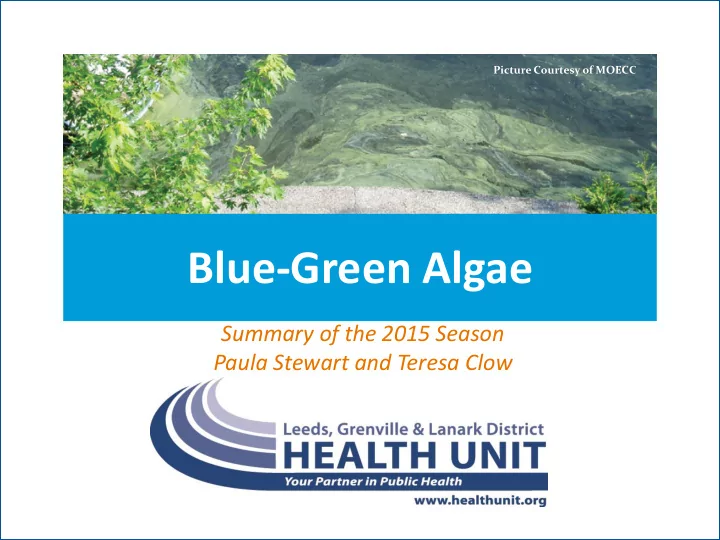
Picture Courtesy of MOECC Blue-Green Algae What To Do When Your Lake is Affected Summary of the 2015 Season Paula Stewart and Teresa Clow Responding to Blue -Green Algae Incidents In 2015 the Health Unit and area Lake Associations launched
What To Do When Your Lake is Affected
Summary of the 2015 Season Paula Stewart and Teresa Clow
Picture Courtesy of MOECC
In 2015 the Health Unit and area Lake Associations
launched a collaborative effort on blue green algae
Information for lakes users on potential health risks by blue-
green algae blooms and how to respond.
Notification of blooms in a timely manner to lake users.
April 2015 presentation to Lake Networking Group by
various agencies involved with blue-green algae
Lake Networking Group compiled an extensive list of Lake
Associations and their contacts and email addresses and provided to it to the health unit.
Resources such as fact sheets and a PowerPoint
presentation were made available to Lake Associations
Resident reports of blue-green algae were directed to Spills
Action Centre (SAC)
SAC notified the Ministry of Environment and Climate
Change (MOECC) area Environmental Officer
Environmental Officer reviewed photos if provided or
and/or conduct site visit to confirm and collect samples
Health Unit notified by MOECC, and where visual
confirmation was made, a notice was sent out to the contacts on the Lake Association list for distribution
Copy of notice was also sent to township, and conservation
authority as an FYI
When sample results were provided to the Health
Unit, another notice was sent to the same groups indicating if toxin was present or not and at what levels
All notices were posted on the Health Unit website
This summer a student distributed this poster to:
To educate visitors to our lakes regarding blue-green algae A table top version of blue-green algae display is available to lake associations upon request
Key Messages Include:
Being able to recognize blue-green algae blooms and
taking a cautionary approach rather than waiting for results of testing
Knowing what precautions need to be taken regarding
drinking water, swimming and recreational activities, and fishing
Assessing conditions in their area of the lake to
determine when they can resume their activities
The health unit responded to 16 reports of blue-green algae Highest number of reports in recent years Earliest report received in June, reports continued into late
September, early Ocober.
Number of Reported Sightings Number Confirmed as BGA Number Confirmed as not BGA Number Containing Toxins 16 7 9 3
The Health Unit would like to express their sincere
thanks to Lake Association partners for all their assistance in getting the message out.
We hope to continue to work together and improve the
system.
We are open to your suggestions, so please feel free to
put forth ideas for our consideration.
Know the Plant Know the sap Know what to do
Found in disturbed areas
Most commonly fund in railway
Ontario – along fence rows,
Can invade agricultural fields
Sap on stem, leaves and flowers
Furocoumarins are absorbed
Sap most potent when plant
Moisture form perspiration
Sunlight (UV radiation)
interacts with furocoumarins under skin
Purplish skin discolouration Red painful rash within one
day
Inflammation and blisters to
skin within 3 days
Risk of long lasting scars,
temporary or permanent blindness
Photo credit: Andrew Link, Winona Daily News, 2013
Control of wild parsnip
Mowing over repeated seasons (May – June) Removal by shovel
Gloves, pants and long sleeve shirt and in evening
Tarping Chemical control
From: Wild Parsnip – Best Management Practices in Ontario (Ontario Invasive Plant Council)
@LGLbeaches – June – Sept @areyousafe