Black Diamond or Black Death: Diverging transition pathways towards a - - PowerPoint PPT Presentation

black diamond or black death diverging transition
SMART_READER_LITE
LIVE PREVIEW

Black Diamond or Black Death: Diverging transition pathways towards a - - PowerPoint PPT Presentation

Black Diamond or Black Death: Diverging transition pathways towards a future without coal consumption in the United Kingdom, Germany and Poland IAEE Vienna Session 6A: Climate VI 06.09.2017 Hanna Brauers and Dr. Pao-Yu Oei Guest Researcher


slide-1
SLIDE 1
  • 0 -

Hanna Brauers DIW Berlin and TU Berlin Black Diamond or Black Death: Diverging coal phase-out strategies 06.09.2017
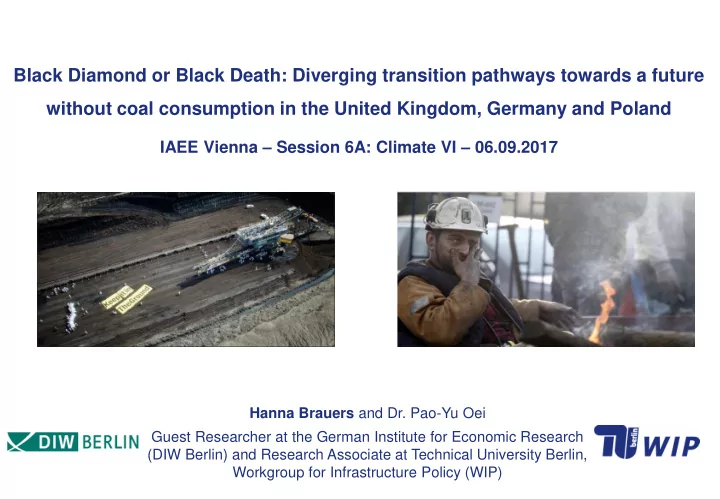
Black Diamond or Black Death: Diverging transition pathways towards a future without coal consumption in the United Kingdom, Germany and Poland

IAEE Vienna – Session 6A: Climate VI – 06.09.2017

Hanna Brauers and Dr. Pao-Yu Oei Guest Researcher at the German Institute for Economic Research (DIW Berlin) and Research Associate at Technical University Berlin, Workgroup for Infrastructure Policy (WIP)

slide-2
SLIDE 2
  • 1 -

Hanna Brauers DIW Berlin and TU Berlin Black Diamond or Black Death: Diverging coal phase-out strategies 06.09.2017

Coal is currently an important factor for global economies but also the single biggest contributor to climate change.

Sources: Le Quéré et al. (2015), WorldCoal (2017), Carbon Brief (2017).

How can a reduction in coal consumption in line with the 2°C target be achieved in the EU? Coal used to generate

41 % of global electricity.

Coal was used in

70 % of global steel production.

Coal was responsible for

39 % of total EU ETS emissions.

Coal (& steel) historically played a crucial part for the EU in terms of its creation, employment, its economy, etc. Paris Agreement entered into force in November 2016

slide-3
SLIDE 3
  • 2 -

Hanna Brauers DIW Berlin and TU Berlin Black Diamond or Black Death: Diverging coal phase-out strategies 06.09.2017

Research outline and methodology

Research Questions Starting point Analysis Approach Results

A coal phase-out is crucial to reach emission reduction targets. It needs to be actively structured to enable a socially acceptable transition, to avoid e.g. capacity or grid constraints and to overcome vested interests.

slide-4
SLIDE 4
  • 3 -

Hanna Brauers DIW Berlin and TU Berlin Black Diamond or Black Death: Diverging coal phase-out strategies 06.09.2017

Why analyse an EU coal phase-out through the UK, Germany & Poland?

Various quantitative analyses (Breevoort et al. 2015; Climate Analytics 2017; Shearer et al. 2017;

Rockström et al. 2017; Oei et al. 2015, etc.) have shown that to comply with the Paris

Agreement, coal consumption will have to end around 2030. But how can a coal phase-out be achieved?

Own depiction based on World Bank (2017) and Agora Energiewende (2016).

The UK, Germany and Poland are the biggest producers, importers and consumers of coal. Different dependencies

  • n hard coal & lignite

production and imports.

slide-5
SLIDE 5
  • 4 -

Hanna Brauers DIW Berlin and TU Berlin Black Diamond or Black Death: Diverging coal phase-out strategies 06.09.2017

Necessity to phase-out coal vs. current status quo.

Germany Poland United Kingdom

  • Installed coal capacity:

15 GW.

  • Import dependence coal:

88%.

  • First country to mainly

use fossil fuels (steam engine 18th century).

  • 52% drop in coal use in

2016 compared to 2015.

  • Coal phase-out: by 2025.

Sources: Amazon (2016); Deutsches Polen-Institut Darmstadt und Forschungsstelle Osteuropa(2016); Politico (2015); RBB 24 (2016).

  • Installed coal capacity:

49 GW.

  • Import dependence coal:

45%.

  • Biggest lignite producer

globally, biggest hard coal importer EU.

  • Coal phase-out plans

currently discussed on political level, no fixed date set.

  • Installed coal capacity:

27 GW.

  • Import dependence coal:
  • 8%.
  • EU’s 1st hard coal & 2nd

largest lignite producer.

  • Bad mining conditions,

domestic coal more expensive that imports.

  • Expansion plans for coal

mines and power plants.

slide-6
SLIDE 6
  • 5 -

Hanna Brauers DIW Berlin and TU Berlin Black Diamond or Black Death: Diverging coal phase-out strategies 06.09.2017

Research outline and methodology

Research Questions Starting point Analysis Approach Results

A coal phase-out is crucial to reach emission reduction targets. It needs to be actively structured to enable a socially acceptable transition, to avoid e.g. capacity or grid constraints and to overcome vested interests. Which factors led to the diverging developments of the coal market in the UK, Germany and Poland? Which factors have enabled coal regime destructions in the past, and which ones have prevented the transition?

slide-7
SLIDE 7
  • 6 -

Hanna Brauers DIW Berlin and TU Berlin Black Diamond or Black Death: Diverging coal phase-out strategies 06.09.2017

Research outline and methodology

Research Questions Starting point Analysis Approach Results

A coal phase-out is crucial to reach emission reduction targets. It needs to be actively structured to enable a socially acceptable transition, to avoid e.g. capacity or grid constraints and to overcome vested interests. Which factors led to the diverging developments of the coal market in the UK, Germany and Poland? Which factors have enabled coal regime destructions in the past, and which ones have prevented the transition? An approach needed that incorporates political, social, economic, environmental and technical factors. Application of a stakeholder analysis combined with the Triple Embeddedness Framework by Geels (2014).

slide-8
SLIDE 8
  • 7 -

Hanna Brauers DIW Berlin and TU Berlin Black Diamond or Black Death: Diverging coal phase-out strategies 06.09.2017

Illustration of Triple Embeddedness Framework (TEF)

UK GER POL

slide-9
SLIDE 9
  • 8 -

Hanna Brauers DIW Berlin and TU Berlin Black Diamond or Black Death: Diverging coal phase-out strategies 06.09.2017

TEF analysis results for Poland as illustration for methodology

slide-10
SLIDE 10
  • 9 -

Hanna Brauers DIW Berlin and TU Berlin Black Diamond or Black Death: Diverging coal phase-out strategies 06.09.2017

Vested interests in Polish coal prevent a transition

Poland Socio- political pressures

  • Strong political power of miners and unions
  • Concerns about import dependence on Russia (gas)
  • Laws restricting wind power expansion
  • Rising opposition mainly due to air-pollution
  • High energy poverty levels create resistance to change

Techno- economic pressures

  • Hard coal mining sector loss making, dependent on state support
  • Open lignite mines expected to be depleted by ~2030
  • Electricity capacity shortage

Firm-level responses

  • State enforced bail-outs of (majority state-owned) coal

corporations

  • Lobby against renewables to avoid more competition and losses
  • Continued production leads to mounting coal stockpiles
slide-11
SLIDE 11
  • 10 -

Hanna Brauers DIW Berlin and TU Berlin Black Diamond or Black Death: Diverging coal phase-out strategies 06.09.2017

Main results of TEF analysis for each case study country

UK: The Carbon Price Floor and Emission Performance Standards were

successful tools to drive coal out of the market. Cautionary tale: mere switch to natural gas needs to be prevented in other countries.

GER: The overall increase of renewable energies is not enough to drive coal out of

the market, due to successful lobbying of major electricity corporations and unions against e.g. the climate levy and for continued (financial) support for coal.

POL: Uneconomic coal is not enough to end its production due to strong relations

between the state and corporations and powerful unions. Dwindling resources and rising resistance against air pollution might accelerate coal’s decline.

slide-12
SLIDE 12
  • 11 -

Hanna Brauers DIW Berlin and TU Berlin Black Diamond or Black Death: Diverging coal phase-out strategies 06.09.2017

Research outline and methodology

Research Questions Starting point Analysis Approach Results

A coal phase-out is crucial to reach emission reduction targets. It needs to be actively structured to enable a socially acceptable transition, to avoid e.g. capacity or grid constraints and to overcome vested interests. Which factors led to the diverging developments of the coal market in the UK, Germany and Poland, and to the East-West divide? Which factors have enabled coal regime destructions in the past, and which ones have prevented the transition? Approach necessary that can incorporate political, social, economic, environmental and technical factors. Application of a stakeholder analysis combined with the Triple Embeddedness Framework by Geels. Which policies could best support a coal phase-out at a domestic and EU-wide level?

slide-13
SLIDE 13
  • 12 -

Hanna Brauers DIW Berlin and TU Berlin Black Diamond or Black Death: Diverging coal phase-out strategies 06.09.2017

Politically feasible measures to foster coal phase-outs

MEASURE POSSIBLE ADVANTAGES POSSIBLE SHORTCOMINGS PROSPECTS OF IMPLEMENTATION CO2 floor price (and ceiling) If implemented EU-wide: no cross-border leakage effects; targets several sectors besides electricity; more planning security Politically feasible prices probably too low incentivise renewable investments on the necessary scale EU-wide: Possibility UK: Implemented Carbon Price Floor GER: Possibility POL: Unlikely Coal phase-out law Increasing investment security and reducing long- term emissions Outcome of auctioning of allowances would be difficult to predict UK: Coal phase-out by 2025 GER: Possibility POL: Unlikely; no political ambition Emissions performance standard (EPS, for new plants and retrofits) Prevention of CO2-intensive investments and future stranded assets (possibly increasing resistance) Minor short-term reduction in emissions UK: EPS introduced in 2013 GER: Likely, but German utilities committed to stop investments in new plants by 2020 POL: Possibility Emissions performance standard (EPS, for existing plants) Preservation of generation capacities; short-term emission reductions Negative impact on economic efficiency of power plants might lead to unintended closures of older blocks Updated BREF standards (adopted by the EU in 2017; not for CO2); distinction for different ages unlikely to be implemented in any of the three countries Ending coal subsidies by 2020 Shut-down of uneconomic coal assets Might cause too rapid shut- downs, causing supply security problems and resistance UK: Unlikely; supply security concerns GER: Questionable POL: Unlikely, supply security & economic concerns

slide-14
SLIDE 14
  • 13 -

Hanna Brauers DIW Berlin and TU Berlin Black Diamond or Black Death: Diverging coal phase-out strategies 06.09.2017

Main results as a basis for further research

Tailored solutions for each country need to be developed to address concerns about rising energy prices, job losses, energy security, etc. Implementation of findings as realistic scenarios in energy models (like e.g. DynELMOD). Hurdles but also opportunities to enable a coal phase-out for each case study country have been identified and (preliminary) policy recommendations were derived. Ending coal consumption is technologically feasible but power, vested interests and social costs need to be taken into account when designing and implementing coal phase-out strategies. Further research: In depth analysis of the impact of politically feasible policies on electricity prices, grid stability, system costs etc.

slide-15
SLIDE 15
  • 14 -

Hanna Brauers DIW Berlin and TU Berlin Black Diamond or Black Death: Diverging coal phase-out strategies 06.09.2017

Thank you for your attention.

Hanna Brauers hbrauers@diw.de German Institute for Economic Research (DIW Berlin) and Research Associate at Technical University Berlin, Workgroup for Infrastructure Policy (WIP)

slide-16
SLIDE 16
  • 15 -

Hanna Brauers DIW Berlin and TU Berlin Black Diamond or Black Death: Diverging coal phase-out strategies 06.09.2017

References

slide-17
SLIDE 17
  • 16 -

Hanna Brauers DIW Berlin and TU Berlin Black Diamond or Black Death: Diverging coal phase-out strategies 06.09.2017

Relevant References (1/2)

Baer, Paul. 2002. ‘Equity, Greenhouse Gas Emissions, and Global Common Resources’. In Climate Change Policy: A Survey, edited by Stephen H Schneider, A. Rosencranz, and J.O. Niles. Washington, DC: Island Press. Breevoort, van, Pieter, Kornelis Blok, Markus Hagemann, Hanna Fekete, Niklas Höhne, Bill Hare, Michiel Schaeffer, Marcia Rocha, and Louise Jeffery. 2015. ‘The Coal Gap: Planned Coal-Fired Power Plants Inconsistent with 2 ̊C and Threaten Achievement of INDCs’. Climate Action Tracker. Caldecott, Ben, and Jeremy McDaniels. 2014. ‘Stranded Generation Assets: Implications for European Capacity Mechanisms, Energy Markets and Climate Policy’. Working Paper. Smith School of Enterprise and the Environment, University of Oxford. Caney, Simon. 2016. ‘Climate Change, Equity, and Stranded Assets’. Oxfam America Research Backgrounder Series. http://www.oxfamamerica.org/explore/research-publications/climate-change-equity-and-stranded-assets. Carbon Tracker, and The Grantham Research Institute, LSE. 2013. ‘Unburnable Carbon 2013: Wasted Capital and Stranded Assets’. Carbon Brief. 2017a. ‘Analysis: Just Four Years Left of the 1.5C Carbon Budget’. https://www.carbonbrief.org/analysis-four-years-left-one-point-five-carbon-budget. Carbon Brief (2017): https://www.carbonbrief.org/analysis-uk-cuts-carbon-record-coal-drop?utm_source=CP+Daily&utm_campaign=efb8275e4e- CPdaily06032017&utm_medium=email&utm_term=0_a9d8834f72-efb8275e4e-110249805 Climate Analytics. 2017. ‘A Stress Test for Coal in Europe under the Paris Agreement. Scientific Goalposts for a Coordinated Phase-Out And Divestment.’ http://climateanalytics.org/files/eu_coal_stress_test_report_2017.pdf. Department for Business, Energy & Industrial Strategy. 2016. ‘UK Energy Statistics: Statistical Press Release - September 2016’. https://www.gov.uk/government/news/uk-energy-statistics-statistical-press-release-september-2016. Deutsches Polen-Institut Darmstadt und Forschungsstelle Osteuropa(2016): Polen-Analysen Nr. 175. 02.02.2016. www.laender- analysen.de/polen/pdf/PolenAnalysen175.pdf. EndCoal (2016): Why coal. http://endcoal.org/about/why-coal/. European Commission. 2015. ‘EU Energy in Figures - Statistical Pocketbook 2015’. Luxembourg Publications Office of the European Union. doi:10.2833/77358. ———. 2016. ‘EU Energy in Figures - Statistical Pocketbook 2016’. Luxembourg Publications Office of the European Union. doi:10.2833/670359. Euracoal (2015): Coal in Europe 2015. euracoal2.org/download/Public-Archive/Library/Charts-Maps/Coal-in-Europe/EURACOAL-Coal-in-Europe-2015-02.pdf. Geels, Frank W. (2014): Reconceptualising the co-evolution of firms-in-industries and their environments: Developing an inter-disciplinary Triple Embeddedness

  • Framework. In; Research Policy 43 (2014), 261 -77.

Greenpeace and CAN Europe (2015): End of an era: Why every European country Needs a coal phase-out plan. http://www.caneurope.org/attachments/article/930/End%20of%20an%20Era%20report%20single%20pages%20final.pdf.

  • IEA. 2015a. ‘CO2 Emissions from Fuel Combustion - Highlights. IEA Statistics.’ OECD/IEA, Paris.

https://www.iea.org/publications/freepublications/publication/CO2EmissionsFromFuelCombustionHighlights2015.pdf.

slide-18
SLIDE 18
  • 17 -

Hanna Brauers DIW Berlin and TU Berlin Black Diamond or Black Death: Diverging coal phase-out strategies 06.09.2017

Relevant References (2/2)

  • IEA. 2015b. ‘World Energy Outlook 2015’. OECD/IEA, Paris.

———. 2016a. ‘Coal Information 2016’. OECD/IEA, Paris. ———. 2016b. ‘Energy and Air Pollution. Special Report World Energy Outlook’. OECD/IEA, Paris, 2016. https://www.iea.org/publications/freepublications/publication/WorldEnergyOutlookSpecialReport2016EnergyandAirPollution.pdf.

  • IMF. 2015. IMF Survey : Counting the Cost of Energy Subsidies. http://www.imf.org/external/pubs/ft/survey/so/2015/new070215a.htm.

International Energy Agency. 2014. ‘World Energy Investment Outlook. Special Report’. OECD/IEA, Paris, 2014.

  • IPCC. 2014. ‘Climate Change 2014 Synthesis Report - Summary for Policymakers’. https://www.ipcc.ch/pdf/assessment-report/ar5/syr/AR5_SYR_FINAL_SPM.pdf.

Kahn, Matthew E. 2015. ‘No More Free Riders? Lessons from the Paris Climate Change Mitigation Treaty’, December. http://greeneconomics.blogspot.co.uk/2015/12/no-more-free-riders-lessons-from-paris.html. Kanitkar, Tejal, T. Jayaraman, Mario D’Souza, and Prabir Purkayastha. 2013. ‘Carbon Budgets for Climate Change Mitigation – a GAMS-Based Emissions Model’. Current Science 104 (9): 1200–1206. Krukowska, Ewa, and Maciej Martewicz. 2016. ‘Poland to Bring Up Coal Mines Survival, Russian Gas With EU’. Bloomberg, January 14. http://www.bloomberg.com/news/articles/2016-01-14/nord-stream-2-coal-on-agenda-as-eu-energy-chief-heads-to-poland. McGlade, Christophe, and Paul Ekins. 2015. ‘The Geographical Distribution of Fossil Fuels Unused When Limiting Global Warming to 2 °C’. Nature 517 (7533): 187–

  • 90. doi:10.1038/nature14016.

Markandya, Anil, Iñaki Arto, Mikel González-Eguino and Maria V. Román (2016): Towards a green energy economy? Tracking the employment effects of low-carbon technologies in the European Union. Oil Change International. 2016. ‘The Sky’s Limit - Why the Paris Climate Goals Require a Managed Decline of Fossil Fuel Production’. Washington. http://priceofoil.org/content/uploads/2016/09/OCI_the_skys_limit_2016_FINAL_2.pdf. Oxford University Environmental Change Institute. 2016. ‘Current Global Warming Index’. Oxford University Environmental Change Institute. Reed et al. (2009): Who’s in and why? A typology of stakeholder analysis methods for natural resource management. In: Journal of Environmental Management 90 , 1933-49. TheNation(2015): ฀ With a 1.5 Degrees Celsius Target, the Climate-Justice Movement Is Poised to Score a Surprise Win. https://www.thenation.com/article/with-1-5- degrees-celsius-target-climate-justice-movement-poised-to-score-surprise-win/. WISE (2015): Whither are you headed, Polish coal? Development prospects of the Polish hard coal mining sector. Warsaw, 2015. World Bank (2014): http://data.worldbank.org/indicator/EG.ELC.RNWX.ZS. World Coal Association (2015): Coal Facts 2015. http://www.worldcoal.org/coal-facts-2015. World Coal Association (2016): BASIC COAL FACTS. http://www.worldcoal.org/file_validate.php?file=WCA_Basic%20Coal%20Facts_0.pdf.

slide-19
SLIDE 19
  • 18 -

Hanna Brauers DIW Berlin and TU Berlin Black Diamond or Black Death: Diverging coal phase-out strategies 06.09.2017

References Pictures Presentation

Amazon (2016): No coal. https://s3.amazonaws.com/s3.credoaction.com/images/campaigns/no_coal_200.gif. Politico (2015): Polish government chokes on coal. http://www.politico.eu/article/poland-duda-szydlo-coal-emissions-pollution-cop21/. RBB 24 (2016): Debatte um Lausitzer Braunkohle. http://www.rbb-online.de/wirtschaft/thema/braunkohle/beitraege/protestaktion-gegen-braunkohle.html.

slide-20
SLIDE 20
  • 19 -

Hanna Brauers DIW Berlin and TU Berlin Black Diamond or Black Death: Diverging coal phase-out strategies 06.09.2017

Backup

slide-21
SLIDE 21
  • 20 -

Hanna Brauers DIW Berlin and TU Berlin Black Diamond or Black Death: Diverging coal phase-out strategies 06.09.2017

Reasons to abandon coal Matching Policies Impediments to abandon coal

Coal regime

  • Core business is coal
  • Electricity corporations not

diversified (enough) Unions

  • Coal jobs will be destroyed

long-term regardlessly: incentives to negotiate Government

  • Long term energy security
  • UK&GER: Emission reduction

commitments

  • POL: Financial burden

subsidies & EU pressure Civil Society

  • Rising electricity prices
  • Regional economic

dependence Unions

  • Job losses
  • Less well-paid jobs

Government

  • Influence unions/ voters/ coal

regime

  • Short-term energy security
  • POL: Financial constraints for

alternative investments Civil Society

  • Health, air quality and climate

change concerns Coal regime

  • Long-term existence
  • POL: Dwindling resources

& uncompetitiveness NGOs

  • External effects
  • Civil society‘s interests

NGOs

  • Potential financial burden on

civil society and job losses

slide-22
SLIDE 22
  • 21 -

Hanna Brauers DIW Berlin and TU Berlin Black Diamond or Black Death: Diverging coal phase-out strategies 06.09.2017

Reasons to abandon coal Matching Policies Impediments to abandon coal

Coal regime

  • Core business is coal
  • Electricity corporations not

diversified (enough) Unions

  • Coal jobs will be destroyed

long-term regardlessly: incentives to negotiate Government

  • Long term energy security
  • UK&GER: Emission reduction

commitments

  • POL: Financial burden

subsidies & EU pressure Civil Society

  • Rising electricity prices
  • Regional economic

dependence Unions

  • Job losses
  • Less well-paid jobs

Government

  • Influence unions/ voters/ coal

regime

  • Short-term energy security
  • POL: Financial constraints for

alternative investments Civil Society

  • Health, air quality and climate

change concerns Coal regime

  • Long-term existence
  • POL: Dwindling resources

& uncompetitiveness NGOs

  • External effects
  • Civil society‘s interests

NGOs

  • Potential financial burden on

civil society and job losses

  • Increased

subsidies for RENs and low-carbon technologies

  • Structural support for regions: creation of new jobs

and retraining programmes

  • Short-term closure of most inefficient and polluting

mines & power plants

  • CO2 floor price
  • End of fossil-fuel subsidies by 2020
  • Redesign of capacity payments
  • Energy price support for poorest households and

crucial industries

  • Financial and capacity building support between EU

states

slide-23
SLIDE 23
  • 22 -

Hanna Brauers DIW Berlin and TU Berlin Black Diamond or Black Death: Diverging coal phase-out strategies 06.09.2017

Electricity Generation United Kingdom 2015

Source: IEA (2016): ‘United Kingdom - Energy System Overview’. https://www.iea.org/media/countries/UnitedKingdom.pdf.

slide-24
SLIDE 24
  • 23 -

Hanna Brauers DIW Berlin and TU Berlin Black Diamond or Black Death: Diverging coal phase-out strategies 06.09.2017

Electricity Generation Germany 2016

Source: AG Energiebilanzen e.V. 2017. ‘Stromerzeugung nach Energieträgern 1990 - 2016’. www.agenergiebilanzen.de/index.php?article_id=29&fileName=20170207_brd_stromerzeugung1990-2016.pdf.

slide-25
SLIDE 25
  • 24 -

Hanna Brauers DIW Berlin and TU Berlin Black Diamond or Black Death: Diverging coal phase-out strategies 06.09.2017

Electricity Generation Poland 2015

Sources: Agora Energiewende. 2016. ‘Renewable Energy Sources Dominate EU Electricity Mix - Agora Energiewende Submits Review of the European Electricity System in 2015’. https://www.agoraenergiewende.de/en/press/press-releases/detail- and IEA. 2016. ‘Poland - Energy System Overview’. https://www.iea.org/media/countries/Poland.pdf.

slide-26
SLIDE 26
  • 25 -

Hanna Brauers DIW Berlin and TU Berlin Black Diamond or Black Death: Diverging coal phase-out strategies 06.09.2017

Why analyse an EU coal phase-out through the UK, Germany & Poland?

The UK, Germany and Poland are the biggest producers, importers and consumers of coal.

Source: Euracoal (2015).

The three countries can be seen as blueprints for

  • ther EU states.

Different dependencies on hard coal & lignite production and imports. Private vs. public ownership.

slide-27
SLIDE 27
  • 26 -

Hanna Brauers DIW Berlin and TU Berlin Black Diamond or Black Death: Diverging coal phase-out strategies 06.09.2017

A glimpse of factors influencing the national coal regimes.

United Kingdom Germany Poland Socio-political pressures

  • Coal phase-out by 2025
  • Low political power of unions
  • Climate Leadership aspirations
  • EPS and other air pollution

regulations

  • Stop of CCTS support
  • Rising electricity prices and fear of

black-out lead to opposition to change

  • Lignite as domestic resource reduces

import dependence and stabilises the electricity grid

  • Nuclear phase-out
  • (Inter-)national climate commitments
  • Strong civil society participation,

climate change concerns

  • Rising electricity prices create
  • pposition to the energiewende
  • Fear of import dependence on Russia

and energy poverty

  • Strong political power of miners and

unions, coal sector major employer

  • Failed attempts of fracking and

nuclear energy, laws restricting renewables expansion

  • Rising opposition due to air-pollution
  • Weak financial state Poland

compared to Western EU Techno-economic pressures

  • CPF made coal uncompetitive
  • Expensive exploration stopped

domestic mining

  • Dash for gas created dominance of

gas

  • Renewables competitor, especially

large scale solutions

  • Old infrastructure
  • Competition renewables strong
  • Low wholesale electricity prices,

comparably high natural gas prices

  • End of hard coal subsidies 2018

(reversing now)

  • Lignite reserve payments
  • Low EU ETS prices (making lignite

competitive)

  • Losses hard coal mining sector since

1990s, not internationally competitive

  • Open coal mines expected to be

depleted by ~2030

  • Low efficiency and high costs mining
  • No existing alternatives in installed

electricity capacities

  • Capacity shortage

Firm-level responses

  • Closure of deep-pit mines
  • Closure of most coal plants
  • Switch to biomass-co-firing and

natural gas

  • Framing: ‘Keep the lights on’ debate,

to create fears of blackouts

  • No investments in CCTS

infrastructure

  • Lobbying against climate levy,

enforcing capacity payments

  • Company splits (RWE, E.ON)
  • Framing of coal as partner of the

renewables, bridge technology

  • Presenting renewables as unfit for

electricity market

  • State enforced bail-outs of coal

corporations

  • Mounting coal stockpiles
  • Lobby against renewables to avoid

more competition and losses

slide-28
SLIDE 28
  • 27 -

Hanna Brauers DIW Berlin and TU Berlin Black Diamond or Black Death: Diverging coal phase-out strategies 06.09.2017

Recent policy developments concerning coal.

Germany Poland United Kingdom

  • Former period of climate

leadership, with carbon floor price.

  • Coal phase-out

announcement.

  • Capacity concerns –

“keep the lights on” discourse.

  • Now slashing of REN

support, CCS funding.

  • Implications of Brexit still

uncertain.

  • Effective support for

REN and phase-out of nuclear power.

  • End of hard coal

subsidies but continued support for lignite.

  • Rejection of commission

with exclusive focus on coal phase-out, climate levy, etc.

  • Elections of PSI won

(also) on coal-promises.

  • Collision course with EU

climate policies, hostile REN policies.

  • Coal mining, electricity

generation and electricity grid mainly state owned.

  • Government enforces

rescue of loss-making coal companies.

Sources:

EU: Main instrument EU-ETS; emission directives & standards; development funds, refusal of 2030 climate and energy target adaptation to Paris Agreement.

slide-29
SLIDE 29
  • 28 -

Hanna Brauers DIW Berlin and TU Berlin Black Diamond or Black Death: Diverging coal phase-out strategies 06.09.2017

Subsidies for Coal in the UK, Germany and Poland

Sources: IMF. 2015. ‘How Large Are Global Energy Subsidies? Country-Level Subsidy Estimates’. International Monetary Fund, Fiscal Affairs Department. www.imf.org/external/np/fad/subsidies/data/codata.xlsx and Overseas Development Institute. 2017. ‘Cutting Europe’s Lifelines to Coal: Tracking Subsidies in 10 Countries - Data’. https://www.odi.org/sites/odi.org.uk/files/resource-documents/11493.xlsx.

Post-tax subsidies for coal in 2015 in US$ billions (nominal) as a percentage of GDP in US$ per capita (nominal) United Kingdom 29 0.95% 440 Germany 41 1.04% 501 Poland 48 8.02% 1,253 Subsidies for coal including externalities in 2015. IMF (2015). Coal subsidies in € million, annual average 2005-2016 United Kingdom 435 Germany 3202 Poland 920 Direct coal subsidies, without externalities annual average 2005-2016. Overseas Development Institute (2017).

slide-30
SLIDE 30
  • 29 -

Hanna Brauers DIW Berlin and TU Berlin Black Diamond or Black Death: Diverging coal phase-out strategies 06.09.2017

TEF Analysis Results Germany

slide-31
SLIDE 31
  • 30 -

Hanna Brauers DIW Berlin and TU Berlin Black Diamond or Black Death: Diverging coal phase-out strategies 06.09.2017

TEF Analysis Results UK

slide-32
SLIDE 32
  • 31 -

Hanna Brauers DIW Berlin and TU Berlin Black Diamond or Black Death: Diverging coal phase-out strategies 06.09.2017

TEF Analysis Results Poland

slide-33
SLIDE 33
  • 32 -

Hanna Brauers DIW Berlin and TU Berlin Black Diamond or Black Death: Diverging coal phase-out strategies 06.09.2017

Coal Phase Out Scenarios.

Sources: Climate Analytics (2017).

Policies aiming to achieve a coal phase-out will have a strong impact on the profitability of thermal power generation and utility business models.

  • Should avoid lock-in effects and additional stranded

assets

  • Should manage the deep systemic transformation with

strong distributional consequences (corporations, local and state governments, workers, civil society and also between countries)

slide-34
SLIDE 34
  • 33 -

Hanna Brauers DIW Berlin and TU Berlin Black Diamond or Black Death: Diverging coal phase-out strategies 06.09.2017

Poland’s coal industry losses

slide-35
SLIDE 35
  • 34 -

Hanna Brauers DIW Berlin and TU Berlin Black Diamond or Black Death: Diverging coal phase-out strategies 06.09.2017

Coal industries contribution to real GDP Growth 2005-2013

Warsaw Institute for Economic Studies (2015): Whither are you headed Polish coal?