Bittorrent Introduction Introduction to BitTorrent Efficiency - - PowerPoint PPT Presentation

bittorrent
SMART_READER_LITE
LIVE PREVIEW

Bittorrent Introduction Introduction to BitTorrent Efficiency - - PowerPoint PPT Presentation

Bittorrent Introduction Introduction to BitTorrent Efficiency & Reliability The incentive mechanism Trackerless with DHT Arvid Norberg arvid@cs.umu.se http://libtorrent.net Distributed systems C, TDBC85, Ume University,


slide-1
SLIDE 1

Introduction to BitTorrent

Arvid Norberg

arvid@cs.umu.se http://libtorrent.net

Distributed systems C, TDBC85, Umeå University, Fall 2006

Bittorrent

Introduction Efficiency & Reliability The incentive mechanism Trackerless with DHT

Introduction

Bittorrent is a system for efficient and

scalable replication of large amounts of static data

– Scalable - the throughput increases with the

number of downloaders

– Efficient - it utilises a large amount of available

network bandwidth

Introduction

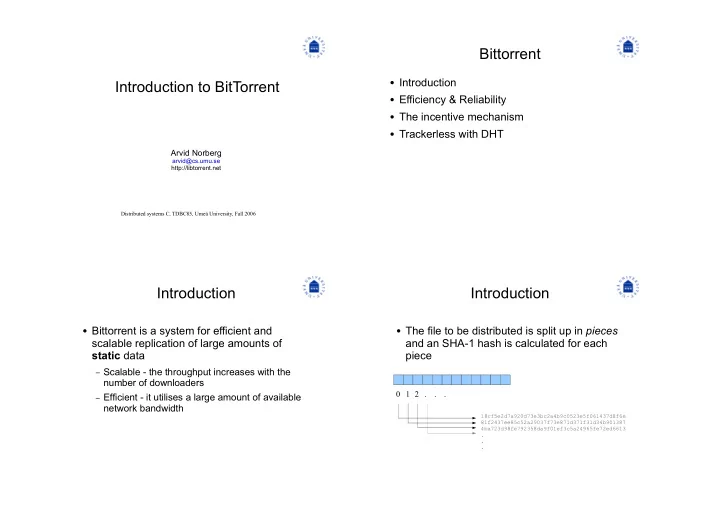
The file to be distributed is split up in pieces

and an SHA-1 hash is calculated for each piece

0 1 2 . . .

18cf5e2d7a920d73e3bc2a4b9c0523e5f061437d8f6e 81f2437ee85c52a29037f73e871d371f31d34b901387 4ba723d98fe792358da9f01ef3c5a24965fe72ed6613 . . .

slide-2
SLIDE 2

Introduction

A metadata file (.torrent) is distributed to all

peers

– Usually via HTTP

The metadata contains:

– The SHA-1 hashes of all pieces – A mapping of the pieces to files – A tracker reference

Introduction

The tracker is a central server keeping a list of

all peers participating in the swarm

A swarm is the set of peers that are

participating in distributing the same files

A peer joins a swarm by asking the tracker for a

peer list and connects to those peers

Introduction

Tracker

Introduction

Tracker

slide-3
SLIDE 3

Goals

Efficiency

– Fast downloads

Reliability

– Tolerant to dropping peers – Ability to verify data integrity (SHA-1 hashes)

Efficiency

Ability to download from many peers yields fast

downloads

Minimise piece overlap among peers to allow

each peer to exchange pieces with as many

  • ther peers as possible

Piece overlap

Peer 1 Peer 2 Peer 3 Peer 4

Small overlap

– Every peer can

exchange pieces with all other peers

– The bandwidth can be

well utilised

Big overlap

– Only a few peers

can exchange pieces

– The bandwidth is

under utilised

Piece overlap

To minimise piece overlap:

– Download random pieces – Prioritise the rarest pieces, aiming towards uniform

piece distribution

slide-4
SLIDE 4

Reliability

Be tolerant against dropping peers

– Each dropped peer means decreased piece

availability

Maximise piece redundancy

– Maximise the number of distributed copies

Distributed copies

The number of distributed copies is the

number of copies of the rarest piece e.g.

Peer 1 Peer 2 Peer 3 Peer 4 Distributed copies = 2 Distributed copies = 1

Distributed copies

To maximise the distributed copies, maximise

the availability of the rarest pieces

To increase the availability of a piece, download

it

To maximise the distributed copies:

– Download the rarest pieces first

Rarest first

The piece picking algorithm used in Bittorrent is

called rarest first

Picks a random piece from the set of rarest

pieces

No peer has global knowledge of piece

availability, it is approximated by the availibility among neighbours

slide-5
SLIDE 5

Rarest first

Pick a random piece from the set of rarest

pieces {2, 3}

Ignore pieces that we already have

Us Peer 1 Peer 2 Peer 3 0 1 2 3 4 5 Piece Availability 1 2 3 4 2 3 1 4 Pieces

The incentive to share

All peer connections are symmetric Both peers have an interest of exchanging data Peers may prefer to upload to peers from whom

they can download

– Leads to slow starts – Fixed in a recent extension

The incentive to share

There is a loose connection between upload

and download speed

Each peer has an incentive to upload

Trackerless torrents

Common problems with trackers

– Single point of failure – Bandwidth bottleneck for publishers

Solutions

– Multiple trackers – UDP trackers – DHT tracker

slide-6
SLIDE 6

DHT distributed hash table

Works as a hash table with sha1-hashes as

keys

The key is the info-hash, the hash of the

  • metadata. It uniquely identifies a torrent

The data is a peer list of the peers in the

swarm

DHT distributed hash table

Each node is assigned an ID

– in the key space (160 bit numbers)

Nodes order themselves in a defined

topography

– Makes it possible to search for Ids by traversing the

node topography

Bittorrent uses kademlia as DHT

Kademlia bootstrap

Each node bootstraps by looking for its own ID

– The search is done recursively until no closer nodes

can be found

– The nodes passed on the way are stored in the

routing table

– The routing table have more room for close nodes

than distant nodes

Kademlia routing table

Each node knows much more about close

nodes than distant nodes

– The key space each bucket represents is growing

with the power of 2 with the distance

– Querying a node for a specific ID will on average

halve the distance to the target ID each step

Node distance Our node-id Node buckets

slide-7
SLIDE 7

Kademlia routing table

The distance metric is defined as XOR

– In practice, the distance is 2 to the power of the

inverse of the size of the common bit prefix

100110110011101010110001 100110110010101110101100 Common prefix = 11 Distance 213

Kademlia routing table

160 bit key space Our node-id Distance (should be 159 levels)

Kademlia search

Each search step increases the common bit

prefix by at least one

– Search complexity: O(log n)

Kademlia distributed tracker

Each peer announces itself with the distributed

tracker

– by looking up the 8 nodes closest to the info-hash

  • f the torrent

– And send an announce message to them – Those 8 nodes will then add the announcing peer to

the peer list stored at that info-hash

slide-8
SLIDE 8

Kademlia distributed tracker

A peer joins a torrent by looking up the peer list

at a specific info-hash

– Like a search but nodes return the peer list if they

have it

Kademlia distributed tracker

8 nodes is considered enough to minimise the

probability that all of them will drop from the network within the announce interval

– Each announce looks up new nodes, in case nodes

have joined the network with Ids closer to the info- hash than a previous node