
SLIDE 1
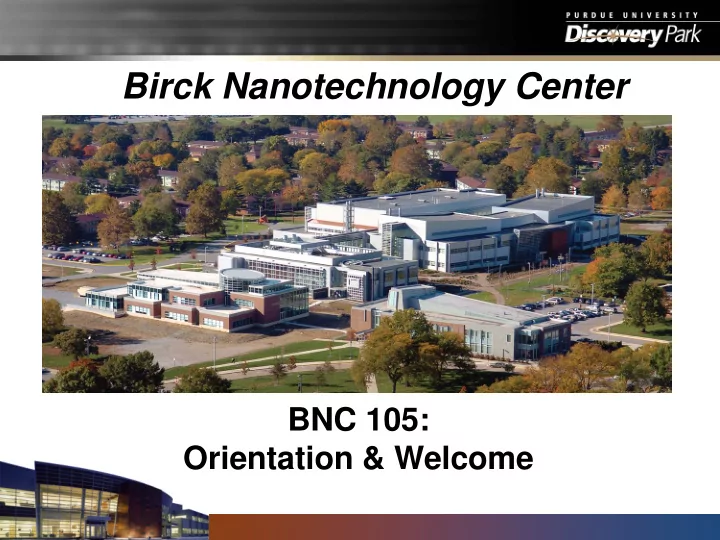
Birck Nanotechnology Center BNC 105: Orientation & Welcome - - PowerPoint PPT Presentation
Birck Nanotechnology Center BNC 105: Orientation & Welcome Course Overview Introductions Facility Overview General Lab Safety BNC Specific policies Right-To-Know (RTK) New User information As a new user, you can
As a new user, you can use this link to find information for Birck.
– Heavy Equipment Labs (MBE, CVD, Optics, High Accuracy) – Light General Labs (Biological, Chemical, Characterization) – 88 laboratory modules
– Semiconductor Fabrication Cleanroom – Pharmaceutical-Grade Cleanroom – ISO Class 3, 4, 5 (Class 1, 10, 100) – Bay-Chase Design
10-2 m 10-3 m 10-4 m 10-5 m 10-6 m 10-7 m 10-8 m 10-9 m 10-10 m 1 cm 1 mm 100 µm 10 µm 1 µm 100 nm 10 nm 1 nm 0.1 nm
Natural World Manmade World
Modified from DOE file http://www.er.doe.gov/bes/scale_of_things.html
microscale nanoscale
I SO 14644-1 Class FED-STD- 209E Class 8 100,000 7 10,000 6 1,000 5 100 4 10 3 1
0.5µm particles per meter cubed 0.5µ particles per foot cubed 3,520,000 100,000 352,000 10,000 35,200 1,000 3,520 100 352 10 35 1
– Emergency response team
Labs on the First Floor
Labs on the Second Floor
1. Complete safety training
2. Email from F.I.C. (Faculty in Charge) of lab to Mary Jo Totten (tottenm@purdue.edu) that you are authorized to enter lab and your card will be activated.
3. Make appointment with Mary Jo to meet in BRK 1220 for ID Card creation
ALL other training sessions are requested by contacting individual staff members.
13
14
https://wiki.itap.purdue.edu/display/BNCWiki/BNCWiki+Home
15
https://purdue.ilabsolutions.com/homepage
16
Our biggest concern is your safety!!! Evacuation Procedures:
proceed to the police station lobby.
Safety and Emergency Response Procedures
– Do not use the elevators – Ask others in your area if they need assistance
– Do NOT exit by the gas rooms
State Street Jischze Drive Birck Nanotechnology Center
Bindley Biosciences Center Burton Morgan Housing parking lot
Purdue Police Station
(use in the event Burton Morgan Is closed – after hours)
1 2
Tornado/Take Cover Alarm
area
require emergency assistance
Safety and Emergency Response Procedures
Laboratory Spills All spills in the laboratory must be reported to a Laboratory Staff member immediately to remediate the spill as quickly as possible. This includes biological materials. Safety and Emergency Response Procedures
Bodily Fluid Spills Do not try to clean this up. Follow the Purdue University Blood-borne Pathogen procedures. Medical Emergency
incident.
Safety and Emergency Response Procedures
– https://www.purdue.edu/discoverypark/birck/operations/safety.php and click on the Building Emergency Plan link under “Helpful Safety Links” at the bottom of the page.
– Training is required for escorted access to the labs. – Visitors are allowed
user.
– Visitors may not handle Hazardous Materials or Equipment
– Personnel entering the Nanofabrication Laboratories must not wear contact lenses.
additional PPE
– Splash proof goggles, face shield, chemical resistant apron and gloves
– There are two types of fume hoods, acid and solvent.
NEVER PUT SOLVENTS DOWN DRAI NS
Ariba
– All chemical orders MUST have an up to date SDS attached to the order for approval by Steve Jurss (BNC Safety Officer) – All orders must be made using the University’s new electronic ordering system
Lab Supplies delivered daily – give at least 24 hours
– Request supplies through Lorraine Fox foxl@purdue.edu – CR stocked in AM, Labs stocked in PM
32
Gas Cylinders
trained staff personnel.
– Contact staff before weekend run to verify gas level.
laboratory
Gloves are for your protection and the protection of the equipment or process
– Open doors – Answer Phones
– The foremost concern is the danger to one’s eyes and exposed skin. The user must be trained and certified on working the laser and wear the appropriate eyewear protection. – Contact REM for laser safety training.
– For biological hazards, special training is necessary. – Contact REM for biological safety training.
– Contact REM for X-ray safety training
members, a staff scientist, a student representative, and the engineering manager. Policy and safety violations are first discussed between the engineering manager and the violator(s), after which the level of discipline is recommended to the committee, who determines the final disposition of the
access to suspension, depending on severity.
for leaving their work areas ready for use by others.
equipment, or leaving an unattended tote not in its proper storage location, they will be subjected to mandatory participation in 4 hours of weekly staff support duties, or a
denied access to the cleanroom for one week.
39
– Provide employees with knowledge to understand the
hazards of the chemicals they work with
– Provide a safer and healthier workplace for all employees – Ensure regulatory compliance with the State and Federal
Right-To-Know Law, 29 CFR 1910.1200
Communication Program (HCP or HazCom)
–
Support Service Employees:
–
Academic Employees:
–
An Employee is
Purdue University
Student
and physical hazards in your work area
techniques and hygiene practices
hazardous situations in your work area without fear of repercussions from your supervisor or the University
– Indiana Department of Labor Indiana
State Government Center South, Indianapolis, Indiana 46204-2287 317.232.2655
and to stay informed about the hazards in your work area
and hygiene practices as a routine part of your daily activities
conducted by your DTI
Employee Rights Employee Responsibilities
– Hazardous Chemicals Used In
This Work Area:
inventory
product or by chemical class
– Chemical classes include but is
not limited to:
» acid » base » solvent
Job Specific Information
–
Solvents
–
Acids, pH < 7
–
Bases, pH > 7
–
Others
– flammable – corrosive – reactive – explosive – cryogens
–
Acetone, Hydrogen, Silane
–
Liquid Nitrogen
–
Nitrogen gas
– Product Name – Health Hazards – Flammability – Hazard Ratings – What to do in an emergency – What is the odor and appearance – Other information appropriate for the
work area
– Exposure control and PERSONAL
PROTECTIVE EQUIPMENT
Safety Data Sheet (SDS)
–
Incoming containers must be labeled by manufacturer or distributor
–
Product name
–
Manufacturer/distributor
–
Address
–
Hazard information –
Labels must be intact and attached to the container
–
Prominently displayed on the container and at least written in English
–
Never remove or deface labels unless container is empty
–
Inspect containers on a regular basis to ensure labels are secure and still legible
packing tape
secondary container label to re-label the container
–
If you transfer a chemical to a new container, it must labeled with:
Required minimum information
–Full Chemical name –Date –Your name
– diamond divided into 4 smaller
diamonds
read the hazard information
–
health
–
fire
–
reactivity
–
special hazard
–
0 = minimal hazard
–
4 = severe hazard
–
refer to pages 41-43 of the written compliance manual for complete definitions
corrosive, acid, base, etc...
0-4 0-4 0-4
Some old familiar labels
Some new classifications, new numbering
MSDSs will be called SDSs Section 2 will provide
▪ Pictograms ▪ Signal word ▪ Precautionary statement ▪ Hazard statements Danger, or Warning, or no word
Teaching and learning the meanings of the
▪ Pictograms ▪ Signal word ▪ Precautionary statement ▪ Hazard statements P210: Keep away from heat/sparks/open flames/hot
H225: Highly flammable liquid and vapor.
– ways to reduce exposure to chemical
products
–
gloves
–
goggles
–
respirators
–
–
local exhaust ventilation
–
remote handling of materials
–
limit work time
–
rotate work groups
–
break areas separate from work areas
–
no smoking, eating, drinking, or applying cosmetics in work area
– Involves one site in the body, usually the
point of contact
– Involves more than one part of the body,
not just the point of contact
– headaches, dizziness, nausea, etc.
Star City 9-1 Window Cleaner
– The written compliance manual, SDSs,
and chemical inventory are located at: Cleanroom entrance, Subfab, each lab galley.
– All containers must be labeled – Secondary labels available from DTI – The DTIs for your work area are: Steve,
Tim, Dave, Ron
– **Ask questions if you’re not sure**
Birck Orientation Training Successfully Completed