BIORENEWABLE POLYMERS AND COMPOSITES WITH SELF-HEALING FUNCTIONALITY - - PDF document

biorenewable polymers and composites with self healing
SMART_READER_LITE
LIVE PREVIEW

BIORENEWABLE POLYMERS AND COMPOSITES WITH SELF-HEALING FUNCTIONALITY - - PDF document

18 TH INTERNATIONAL CONFERENCE ON COMPOSITE MATERIALS BIORENEWABLE POLYMERS AND COMPOSITES WITH SELF-HEALING FUNCTIONALITY M. R. Kessler 1 *, T. C. Mauldin 2, P. R. Hondred 1 , R. Ding 1 1 Department of Materials Science and Engineering, 2


slide-1
SLIDE 1

18TH INTERNATIONAL CONFERENCE ON COMPOSITE MATERIALS

1 Summary This paper outlines resent progress to developing self-healing polymer matrix composites derived from renewable resources. Previous work in the field of self-healing materials is presented, and the potential for applying previously-developed, novel biorenewable polymers and composites into self- healing mechanisms is discussed. 2 Introduction Self-healing polymers are a class of smart materials that mimic the autonomous healing behavior in biological systems by detecting damage and commencing self-repair mechanisms without the need for external damage detection or manual

  • intervention. One of the most successful self-

healing materials developed to date incorporates two particulate fillers—catalyst particles and liquid monomer-filled microcapsules—within a polymer

  • matrix. Upon material failure, cracks propagate

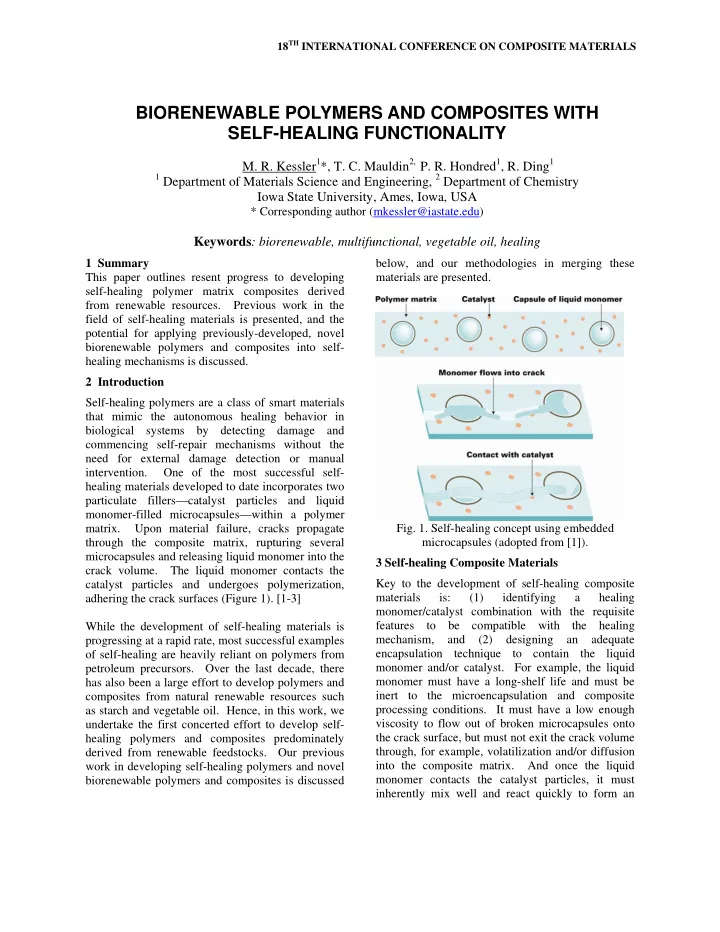
through the composite matrix, rupturing several microcapsules and releasing liquid monomer into the crack volume. The liquid monomer contacts the catalyst particles and undergoes polymerization, adhering the crack surfaces (Figure 1). [1-3] While the development of self-healing materials is progressing at a rapid rate, most successful examples

  • f self-healing are heavily reliant on polymers from

petroleum precursors. Over the last decade, there has also been a large effort to develop polymers and composites from natural renewable resources such as starch and vegetable oil. Hence, in this work, we undertake the first concerted effort to develop self- healing polymers and composites predominately derived from renewable feedstocks. Our previous work in developing self-healing polymers and novel biorenewable polymers and composites is discussed below, and our methodologies in merging these materials are presented.

  • Fig. 1. Self-healing concept using embedded

microcapsules (adopted from [1]). 3 Self-healing Composite Materials Key to the development of self-healing composite materials is: (1) identifying a healing monomer/catalyst combination with the requisite features to be compatible with the healing mechanism, and (2) designing an adequate encapsulation technique to contain the liquid monomer and/or catalyst. For example, the liquid monomer must have a long-shelf life and must be inert to the microencapsulation and composite processing conditions. It must have a low enough viscosity to flow out of broken microcapsules onto the crack surface, but must not exit the crack volume through, for example, volatilization and/or diffusion into the composite matrix. And once the liquid monomer contacts the catalyst particles, it must inherently mix well and react quickly to form an

BIORENEWABLE POLYMERS AND COMPOSITES WITH SELF-HEALING FUNCTIONALITY

  • M. R. Kessler1*, T. C. Mauldin2, P. R. Hondred1, R. Ding1

1 Department of Materials Science and Engineering, 2 Department of Chemistry

Iowa State University, Ames, Iowa, USA

* Corresponding author (mkessler@iastate.edu)

Keywords: biorenewable, multifunctional, vegetable oil, healing

slide-2
SLIDE 2

adhesive polymer with good adhesion and mechanical properties. Our previous work in this field has revolved around developing different methodologies and testing techniques to target and optimize healing monomers that satisfy the stringent set of characteristics

  • utlined above. For example, we have designed a

model to predict the dissolution kinetics of catalysts in healing monomers and developed several novel healing monomer/catalyst combinations with rapid polymerization kinetics. Furthermore, we have created a modified rheokinetic technique designed to mimic the self-healing mechanism and therefore study

  • verall

self-healing kinetics. These methodologies previously successful in targeting superior healing monomer/catalyst combinations are currently being applied to the goal of designing monomers/catalysts derived from renewable resources. 4 Biorenewable polymers and composites: We have identified two broad classes

  • f

biorenewable polymers—those

  • riginally

synthesized from cationic polymerization and ring-

  • pening metathesis polymerization (ROMP)—as

having potential in self-healing applications. We have developed a number of rigid thermosets via the ROMP of various modified vegetable oils. A commercially available norbornenyl-functionalized vegetable oil, DilulinTM (Cargill Inc.), polymerized in the presence of a small amount of crosslinker has yielded thermosets with high glass transition temperatures (>120 °C), high decomposition temperatures (stable up to 400 °C), and moduli greater than 3 GPa (See Figure 2). Additionally, we have recently synthesized a series of norbornenyl- functionalized fatty alcohol derivatives that, when polymerized via ROMP without the addition of any crosslinker, was able to yield transparent thermosets with glass transition temperatures, decomposition temperatures, and moduli ranging from 50-70 °C, 200-250 °C, and 0.2-0.7 GPa, respectively. The material properties of these polymers, initially derived from renewable materials, are competitive with that of petrochemical-derived thermosets, (such as epoxies and unsaturated polyesters), and as such are suitable choices as matrix materials in self- healing composites. Furthermore, the ROMP polymerization is unique in that the double bonds present in the initial monomer are conserved in the formed thermoset, resulting in an unsaturated polymer matrix. These retained double bonds can be used to initiate further crosslinking mechanisms.

Ru P N N Cl Cl

Grubbs 2nd Generation Catalyst

O O O O O O

Dilulin

O O O O O O n y z x O O O O O O

260 oC, High Pressure Linseed Oil Crosslinked Polymer Network Crosslinking Agent

  • Fig. 2. Synthesis and structure of modified linseed
  • il (Dilulin) and the ROMP of Dilulin with a

crosslinking agent to form a crosslinked network. The amount of crosslinking agent (CL) included in the bio-based polymer, has a significant effect on the glass transition temperature of the polymerized network (see Figure 3), and on the gel time, defined by the storage and loss shear moduli cross-over point from oscillatory rheology measurements (see Figure 4).

slide-3
SLIDE 3

3

  • 20

20 40 60 80 100 120 140 20% 30% 40% 50% T

g (

  • C)

CL Loading

  • Fig. 3. Relationship between glass transition

temperature (Tg) and CL loading.

500 1000 1500 2000 2500 3000 38000 38500 10 20 30 40 50 Gel time (s) CL Loading (wt. %)

  • Fig. 4. Relationship between % CL loading and resin

gel time. In addition to these co-polymer networks (containing separate crosslinking agents), we also created ROMP-networks from modified fatty alcohols from caster oils. The Norbornenyl- functionalized castor oil polymer can be seen in Figures 3 and 4. Figure 3 illustrates the flexibility/toughness of the network, yet glassy

  • polymer. Figure 4 shows the transparency of the
  • polymer. Initial characterization on these polymers

has been done for both the curing and the cured polymer with differential scanning calorimetry (DSC) and dynamic mechanical analysis (DMA). DSC has shown the effectiveness of various crosslinking agents. From these cure tests, the initial polymerization is seen to start at 40 – 50 ºC depending on the composition of the bio-polymer. DMA testing has shown that the glass transition temperature of the cured castor oil is greater than 70 ºC.

  • Fig. 5. Biorenewable polymers made by ROMP of

norbornenyl-functionalized castor oil. In addition to plant oil-based polymers synthesized by ROMP, we have also been exploring polymer networks made by the cationic polymerization of various plant oils. Cationic polymerization of vegetable oil-based resins has been a versatile technique to form thermoset materials with a wide range of properties. Resins with varying amounts and types of vegetable oils (quality materials have been made with as high as 85% vegetable oil), comonomers and composite fillers have produced materials ranging from tough and ductile plastics to very soft rubbers. Given these versatile material properties and that the curing kinetics of these polymerization processes are capable of being “fine- tuned,” via appropriate choice of vegetable oil and comonomer, we are currently investigating the cationic polymerization of vegetable oil resins as a

slide-4
SLIDE 4

healing agent chemistry. An additional advantage of using this healing chemistry is the fact that cationic polymerization consumes carbon-carbon double

  • bonds. This is advantageous because, in addition to

polymerizing the healing monomer in the crack volume, the cationic polymerization initiator can potentially react with some of the double bonds on the crack surface of the ROMP-made polymer matrix, creating adhesive bonds not only through physical adhesion but also by covalent bonding. Our past work has shown precedent that the double bonds retained after the ring-opening metathesis polymerization are indeed capable of reacting in the solid state via cationic initiators, and work to apply this methodology to self-healing materials is

  • ngoing in our labs [4].

O O O O O O

Soybean Oil

5 5 5

+ +

Styrene Divinylbenzene Catalyst BF3.OEt2 (BFE)

m n

C O O

n

C O O

m

O C O C H C H

Crosslinked Thermoset

  • Fig. 6 Crosslinked thermoset obtained through the

cationic polymerization of soybean oil, ST, and DVB. 5 Objectives: The biorenewable resins, encapsulated healing agents, associated fabrication techniques and experimental characterization efforts that are developed through this research program are being designed to meet the following technical objectives:

  • Synthesize biorenewable polymers from the ring-
  • pening metathesis polymerization (ROMP) of

modified vegetable oils to maximize the thermo- mechanical properties of the resin for structural composite materials.

  • Evaluate the long-term strength, durability, and

damage development of the bio-polymers compared to existing polyester and epoxy resins.

  • Investigate the use of a compatible

microencapsulated healing agent (such as modified fish oil or tung oil and a cationic initiator) to impart self-healing functionality to the biorenewable polymer. For the scientific objectives, I will attempt to answer the following fundamental questions:

  • How does the variation of crosslink density with

the incorporation of multifunctional ROMP crosslinking agents affect the thermo-mechanical properties of the bio-based resins and how susceptible will these polymers be to damage accumulation?

  • Are there viable and compatible self-repair

mechanisms that can be incorporated into these systems to mitigate damage, similar to those developed for synthetic epoxy systems?

  • Will the large number of carbon-carbon double

bonds present in the ROMP matrix enhance the healing effectiveness by serving as “reactive sites” for subsequent covalent bonds with the cationically polymerized healing agent?

  • What is the long-term environmental stability of

the material and the self-healing functionality? 6 Towards self-healing biorenewable polymers: Our initial efforts at merging self-healing and biorenewable polymers has related to the microencapsulation of tung oil as a bio-based healing agent that can be polymerized by cationic

  • polymerization. The process for the encapsulation is

a Melamine-Urea-Formaldehyde encapsulation technique that utilizes micelle formation between the

  • il and water interface. When agitated at high speeds

in an aqueous solution, elevated temperature cures the prepolymer around the oil at the interface. Figure 1 shows microcapsules containing the tung oil healing agent.

slide-5
SLIDE 5

5

  • Fig. 7 Encapsulated tung oil.

Additionally, work has been done

  • n

the homogeneity of the cationic polymerization reaction. A major difficulty in the project is obtaining a uniform polymerization of the tung oil. Previous work showed that a methyl ester from soybean oil, Soygold, was used to reduce the viscosity and improve dissolution of the cationic initiator. By using a process called saponification and then a process called esterification, the tung oil triglyceride is cleaved into its fatty acid and then a methyl group is added to the fatty acid chain respectively. This process has helped to enhance the homogeneity of the samples. 8 Acknowledgements Funding for this research effort has been provided by the National Science Foundation under CAREER Award No. 0954314. References

[1] M. R. Kessler “Self-healing: A New Paradigm in Materials Design,” P. I. Mech. Eng. G-J. Aer. Vol. 221, pp 479-475; 2007. [2] T. C. Mauldin and M. R. Kessler, “Self-Healing Polymers and Composites,” Int. Mater. Rev., Vol. 55, pp 317-346, 2010. [3] S. R. White, N. R. Sottos, P. H. Geubelle, J. S. Moore, M. R. Kessler, S. R. Sriram, E. N. Brown and S. Viswanathan, “Autonomic healing

  • f

polymer composites,” Nature, Vol. 409, 794-797, 2001. [4] W. Jeong, T. C. Mauldin, R. C. Larock, M. R. Kessler “Bio-based Rubbers by Concurrent Cationic and Ring- Opening Metathesis Polymerization of Modified Linseed Oil,” Macromolecular Materials and Engineering, Vol. 294, pp 756-761, 2009.