Biophysics of Metalloenzymes Topics and Themes: 1) (Metallo-) - - PowerPoint PPT Presentation

biophysics of metalloenzymes
SMART_READER_LITE
LIVE PREVIEW

Biophysics of Metalloenzymes Topics and Themes: 1) (Metallo-) - - PowerPoint PPT Presentation

Biophysics of Metalloenzymes Topics and Themes: 1) (Metallo-) Proteins and Enzymes in the Cell 2) Some Principles of Coordination Chemistry 3) Methods for Investigation at Molecular Level 4) Overview on Metal Cofactors in Biology 5)


slide-1
SLIDE 1

Biophysics of Metalloenzymes

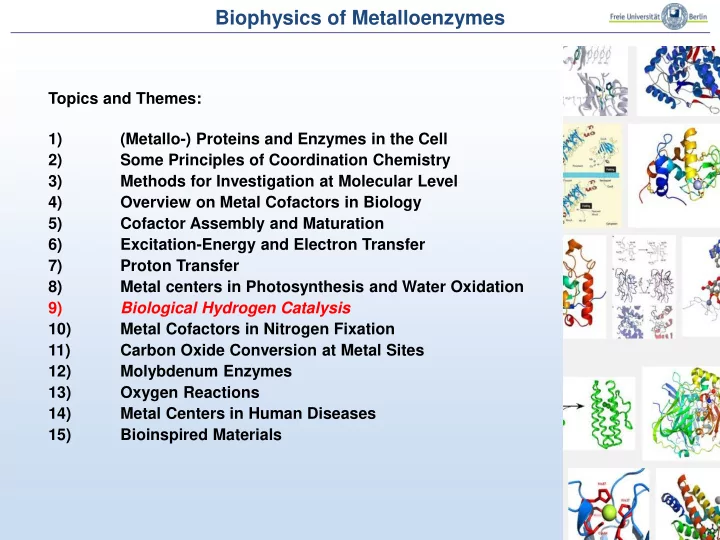
Topics and Themes: 1) (Metallo-) Proteins and Enzymes in the Cell 2) Some Principles of Coordination Chemistry 3) Methods for Investigation at Molecular Level 4) Overview on Metal Cofactors in Biology 5) Cofactor Assembly and Maturation 6) Excitation-Energy and Electron Transfer 7) Proton Transfer 8) Metal centers in Photosynthesis and Water Oxidation 9) Biological Hydrogen Catalysis 10) Metal Cofactors in Nitrogen Fixation 11) Carbon Oxide Conversion at Metal Sites 12) Molybdenum Enzymes 13) Oxygen Reactions 14) Metal Centers in Human Diseases 15) Bioinspired Materials

slide-2
SLIDE 2

Hydrogenase reaction

2H+ + 2e-  H2

Enzymes: >104 s-1

slide-3
SLIDE 3

Belgian architect Vincent Callebaut has designed a conceptual transport system that would involve airships powered by seaweed. Called Hydrogenase, the project envisages that by 2030 there could be farms in the ocean producing biofuel from seaweed and acting as hubs for the aircraft.

http://www.dezeen.com/2010/05/07/hydrogenase-by-vincent-callebaut/

Hydrogen for the future

slide-4
SLIDE 4

http://www2.hu-berlin.de/biologie/microbio/application/sm_application.htm

Hydrogen production and cleavage cycle

Carbon-free energy

slide-5
SLIDE 5

http://www2.hu-berlin.de/biologie/microbio/olenz/Oliver_Lenz_Research.html http://www.rsc.org/Publishing/ChemScience/Volume/2007/01/enzyme_fuel_cells.asp

Hydrogenase fuel cell

Usage of 3 % H2 below combustion limit in air by NiFe hydrogenase can drive an electrical device for >24 h

slide-6
SLIDE 6

Hydrogen producing organisms / evolution

Bacteria (Desulfovibrio, Clostridium, Rhodobacter, Knallgas, archaea, methanogens…) Green algae (Chlamydomonas…) The three types of hydrogenases (NiFe, FeFe, Fe) have evolved independently and convergently

Vignais, FEMS Microbiol Rev 25 (2001) 455

Phylogenetic tree of NiFe hydrogenase large subunit FeFe hydrogenase diversification

slide-7
SLIDE 7

Hydrogen producing bacteria in soil

H2 producers in soil

slide-8
SLIDE 8

[FeFe]-hydrogenase H-cluster [4Fe4S] [2Fe2S] H-cluster [4Fe4S] H-cluster ([4Fe4S]) Chlostridium pasteurianum (3C8Y) Desulfovibrio desulfuricans (1HFE) Chlamydomonas reinhardtii (2LX4) Fe-guanylyl-pyridone-cofactor [Fe]-hydrogenase Methanocaldococcus jannaschii (3F47)

Iron-only containing hydrogenases

Types of hydrogenases

slide-9
SLIDE 9

[NiFe]-hydrogenase [NiFeSe]-hydrogenase Desulfovibrio gigas (1WUK) NiFe-cofactor [4Fe4S] [3Fe4S] Ralstonia eutropha (3RGW) [4Fe3S] Desulfomicrobium baculatum (1CC1) NiFeSe-cofactor [4Fe4S] PH MBH

soluble (SH) membrane bound (MBH)

Hydrogenases ff

slide-10
SLIDE 10

H2 sensors

Shafaat BBA 2013

Protein- histidine kinase PAS domain Dimeric hydrogenase Linker domain H2 sensing triggers expression of energy converting hydrogenases

slide-11
SLIDE 11

Cys His Glu Pb

[4Fe4S] [4Fe3S]

  • x red

[2Fe2S] [3Fe4S] [4Fe3S2O]

Biophysics of Metalloenzymes

  • M. Haumann

SS2014

Iron-sulfur clusters in H2ases

slide-12
SLIDE 12

[Fe]-hydrogenase

M.j. wt (3F47) M.j. C176A+DTT (3F46)

[FeFe]-hydrogenase

Cys Cys Cys Cys Cys

C.p. ox (3C8Y) D.d. red (1HFE) C.p. +CO (1C4C)

H-cluster

Active sites

Iron-only hydrogenases

slide-13
SLIDE 13

Structure of H-cluster in FeFe-hydrogenases

[4Fe4S]H [2Fe]H adt Fep Fed

cys cys cys cys

slide-14
SLIDE 14

Crystal structures of the H-cluster

Bridging ligand long time debated

apo-HydA1 (green algae) bacterial enzymes

slide-15
SLIDE 15

Maturation of FeFe-hydrogenase

3 maturases sufficient to get active enzyme in vivo and in vitro Similar H- cluster on HydF maturase and HydA enzyme

slide-16
SLIDE 16

http://openi.nlm.nih.gov/detailedresult.php?img=3105041_pone.0020346.g001&req=4

In vitro maturation

Apo-protein, maturases and inorganic compounds produce active enzyme

slide-17
SLIDE 17

In vitro maturation 2

Happe et al. 2013-2016

with maturase HydF without maturases

slide-18
SLIDE 18

Esselborn et al. Nat Chem Biol. 2013, 9:607-9.

Reconstitution with chemical compounds

slide-19
SLIDE 19

In vitro maturation 3

Happe et al. 2013-2016

Spontaneous activation of [FeFe]- hydrogenase in vitro with or without maturase HydF and inorganic synthetic cofactors. Works for HydA1 and CpI!

slide-20
SLIDE 20

Modified cofactors from in vitro maturation

Siebel et al. Biochemistry 2015

Infrared control of non-natural synthetic cofactor insertion

slide-21
SLIDE 21

Chalcogenide substitution

Noth et al. Angew. Chem. 2016

In vitro maturation with S/Se exchanged synthetic cofactors => full activity!

slide-22
SLIDE 22

Maturation of FeFe-hydrogenase

All CO and CN ligands are derived from tyrosine

Kuchenreuther PLOSone 2011

slide-23
SLIDE 23

[NiFeSe]-hydrogenase

D.b. H2-red (4KN9) D.v. air-ox (2WPN) D.b. air-ox (4KL8)

[NIFe]-hydrogenase

D.f. H2-red (1YRQ) D.v. +CO (1UBC) D.v. ox Ni-A (1WUI) D.v. ox Ni-B (1WUJ) R.e. H2-red (3RGW) H.m. air-ox (3AYZ) E.c. fecy-ox (3USC)

Cys Cys Cys Sec Cys Cys Cys Cys

Active sites of NiFe-hydrogenases

slide-24
SLIDE 24

Carbamoyl phosphate Synthesis of the Fe(CN)2(CO) site

  • ligomerization

Ni insertion translocation

Assembly and maturation of an MBH (R. eutropha)

slide-25
SLIDE 25

Vincent et al. Dalton Trans.,2005, 3397-3403

Oxygen tolerance in NiFe-H2ases

Standard O2 sensitive periplasmic enzyme (D. gigas) Reactivation requires hours at low

  • potentials. No activity at ambient pO2

O2 tolerant membrane-bound enzyme (R. eutropha) Reactivation is fast after O2 removal, residual activity at ambient pO2

slide-26
SLIDE 26

Electrochemical experiments

H2 production H2 cleavage inactivation H2/H+ equilibrium potential

Rotating graphite disk electrode

Cyclic voltametry Thermodynamic reversible H2 reactions! Almost no overpotential

slide-27
SLIDE 27

Biophysics of Metalloenzymes

  • M. Haumann

SS2014

EPR results

EPR monitors Ni(III)

  • r Ni(I) states,

Ni(II) is EPR silent

NiFe site FeS clusters

61Ni

g-values in various species

Lubitz Chem Rev 2014

Different FeS clusters in O2 tolerant and sensitive enzymes

slide-28
SLIDE 28

Lubitz et al, Chem Rev 2014

FTIR fingerprinting

Spectro-electrochemistry

slide-29
SLIDE 29

SEIRAS

slide-30
SLIDE 30

A new FeS cluster in MBHs

1 2 3 4 5 10 FT of EXAFS reduced distance / Å

I II

3 6 9 12 60 EXAFS xk

3

k / Å

  • 1

B

PH MBH

S S Fe Fe S S S S S Fe S Fe

Cys20 Cys148 Cys112 Cys17

Fe S S Fe S Fe S S Fe S S S S S

Cys17 d Cys20 Cys19 Cys149 Cys120 Cys115

Fritsch, Biochemistry 2012 Sigfridsson, BBA 2014

EXAFS reveals different FeS clusters in O2 tolerant MBHs

Two additional cysteines in small subunit, cluster coordinated by 6 cys

slide-31
SLIDE 31

Structural changes

Proximal cluster [4Fe3S]

Two oxidizing transitions in [4Fe3S] vs

  • nly one in [4Fe4S]
slide-32
SLIDE 32

Biophysics of Metalloenzymes

  • M. Haumann

SS2014

States of NiFe(Se) H2ases

Shafaat, BBA 2013

slide-33
SLIDE 33

NiFe activation and inactivation

Lubitz, Chem Rev 2014

slide-34
SLIDE 34

Modifications at active site

Ser486 Arg463 Cys530 Cys533 Ile531 (Met) Ala532 Cys65 Cys68 His72 Gly66 Val67 Val71 (Thr) Thr553 Arg530 Cys597 Cys600 Leu598 Ala599 Cys75 Cys78 His82 Gly76 Val77 Thr79 Gly80 (Cys, Gly) Cys81 (Ile, Val)

O O

a a b c

Tyr70 (Thr, Leu) Thr69

PH MBH

Ni-A (PH) Ni-B (MBH)

O2, nH+ OHn OHn, nOx nRed Ni 2+ Fe 2+ H O Ni 3+ Fe 2+

  • aerobic

anoxic OHn OHn OH-, (FeS)n- (FeS) Ob Oc Sigfridsson, BBA 2014

slide-35
SLIDE 35

Catalytic cycle in [FeFe]-hydrogenase

Lubitz, Chem Rev 2014

slide-36
SLIDE 36

7110 7120 7130 7140 7150 1

7045 7060

normalized XANES (Kß) excitation energy / eV

normalized Kß emission emission energy / eV

*

Kß1,3 Kß´ [4Fe4S]apo-HydA1 [2Fe]adt

7045 eV 7060 eV

[4Fe4S]apo-HydA1 [2Fe]adt [4Fe4S]apo-HydA1 [2Fe]adt

Kß1,3 Kß1,3 Kß´ high-spin d5 Fe(III) low-spin d7 Fe(I) [4Fe4S] [2Fe] 1s 3d 3p resonant excitation cys cys cys cys

[4Fe4S]apo-HydA1

A B

7080 7095 7110 Kß emission emission energy / eV

C

[4Fe4S]apo-HydA1 [2Fe]adt Kß2,5

[2Fe]adt

v2c c2v

Site-selective XAS/XES on the H-cluster

Chernev Inorg Chem 2014

slide-37
SLIDE 37

XAS/XES on red and sred states

7111 7114 0,0 0,5 pre-edge absorption excitation energy / eV

red sred (sred – red) exp DFT [4Fe4S]H [2Fe]H exp DFT (sred – red) red sred red sred Fed Fep Hy

A

core-to-valence transitions valence-to-core transitions 7090 7110 4 Kß

2,5 emission

emission energy / eV

([4Fe4S]-[2Fe])H exp DFT DFT DFT DFT DFT [4Fe4S]H [2Fe]H red sred red sred (sred – red) x3 red sred exp DFT red sred Hy

B

Fed Fep exp DFT exp DFT DFT DFT

Chernev Inorg Chem 2014

Comparison of experimental and DFT calculated spectra reveals good agreement for a bridging hydride in the super-reduced state

slide-38
SLIDE 38

Briding hydride in sred

CO NC CN OC [4Fe4S] CO NC CN OC C O NC CN OC C O CO

H2 e- H+

  • x

red sred

H

I I I II + I I

cys [4Fe4S] cys [4Fe4S] cys

2+ 2+

e- H+

H [H+] H [H+]

Chernev Inorg Chem 2014

slide-39
SLIDE 39

Calculation of IR modes by DFT

IR spectrum of Hox-CO

slide-40
SLIDE 40

Reversible 13CO labelling

Hox Hox-CO

slide-41
SLIDE 41

DFT on IR frequencies of CO and CN

1750 1800 1850 1900 1950 2000 1750 1800 1850 1900 1950 2000 12121212 13131313 12131212 12121312 12121213 12131312 12131213 12121313 12131313 calculated CO band frequency / cm

  • 1

experimental CO band frequency / cm

  • 1

p m d1 d2

CO:

Hox

 apical open site at Fed

Hox-CO

 apical CO at Fed

 apical CN at Fed

„standard“ „rotamers“

CO/CN geometry in H-cluster may not be settled

slide-42
SLIDE 42

H-cluster in protein environment

Hydrogen-bonded network around H-cluster

slide-43
SLIDE 43

Nuclear resonance spectroscopy (57Fe)

Nuclear resonance vibrational spectroscopy on selectively 57Fe labeled [FeFe]- hydrogenase facilitates identification of vibrational modes of all components of the H-cluster

slide-44
SLIDE 44

Regulation vs. catalysis in [FeFe]-hydrogenase

Haumann & Stripp, Acc. Chem. Res. 2018

regulation catalysis

slide-45
SLIDE 45

Model chemistry

Lubitz Chem Rev 2014

Most synthetic systems still less active than hydrogenases, but improvements underway

slide-46
SLIDE 46

FeFe models

1 [1Hy]+

1.66 1.69 Fe2 Fe1

slide-47
SLIDE 47

Summary

Hydrogen as a fuel H2 producing organisms Types of hydrogenases Cofactors Maturation Oxygen tolerance Spectroscopic results Active site states Catalytic cycle Hydride Model compounds

slide-48
SLIDE 48

Literature

Haumann, M. & Stripp, S. The Molecular Proceedings of Biological Hydrogen Turnover. Acc. Chem. Res. 2018, 51, 1755−1763 Classi¢cation and phylogeny of hydrogenases, Vignais et al., FEMS Microbiology Reviews 25 (2001) 455- 501. [NiFe] hydrogenases: a common active site for hydrogen metabolism under diverse conditions. Shafaat HS, Rüdiger O, Ogata H, Lubitz W. Biochim Biophys Acta. 2013, 1827(8-9):986-1002. Hydrogenases, Lubitz W, Ogata H, Rüdiger O, Reijerse E, Chem. Rev. 2014, 114, 4081−4148. Hydrogen as a Fuel: Learning from Nature, Cammack et al., Routledge Chapman & Hall, 2002 Biohydrogen, Pandey et al., Elsevier, 2013 [FeFe]-Hydrogenase Maturation, Shepard et al., Biochemistry, 2014 Electronic and molecular structures of the active-site H-cluster in [FeFe]-hydrogenase determined by site- selective X-ray spectroscopy and quantum chemical calculations. Lambertz et al., Chem. Sci. 5, 1187- 1203, 2014 Mimicking hydrogenases: From biomimetics to artificial enzymes, Simmons et al., Coordination Chemistry Reviews, Vol 270–271, 2014, 127-150