SLIDE 1
Biophysics of Metalloenzymes
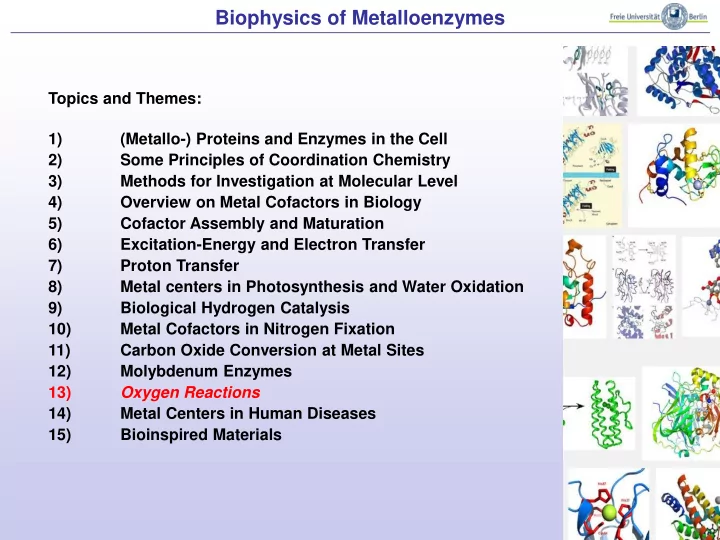
Topics and Themes: 1) (Metallo-) Proteins and Enzymes in the Cell 2) Some Principles of Coordination Chemistry 3) Methods for Investigation at Molecular Level 4) Overview on Metal Cofactors in Biology 5) Cofactor Assembly and Maturation 6) Excitation-Energy and Electron Transfer 7) Proton Transfer 8) Metal centers in Photosynthesis and Water Oxidation 9) Biological Hydrogen Catalysis 10) Metal Cofactors in Nitrogen Fixation 11) Carbon Oxide Conversion at Metal Sites 12) Molybdenum Enzymes 13) Oxygen Reactions 14) Metal Centers in Human Diseases 15) Bioinspired Materials
SLIDE 2 Ferritin Superfamily
Core 4-helix bundle Metal-binding motif
- C. trachomatis R2c (magenta),
- M. tuberculosis R2lox (blue)
and Prochlorococcus marinus alkane synthesizing protein (PDB id: 2oc5) (green). Ferritin Various other enzymes (purple acid phosphatase…) Methane Monooxygenases Ribunucleotide Reductases Ligand-binding oxidases (e.g. in human parasites)
SLIDE 3 Andrews, Biochimica et Biophysica Acta 1800 (2010) 691–705
Member Groups
SLIDE 4
Conserved Metal Ligands
SLIDE 5 Diverse Reactivity
Krebs et al. Curr Opin Chem Biol. 2011; 15(2): 291–303.
SLIDE 6 Ferritin: Metal Transport and Storage
www.uni-ulm.de/fileadmin/website_uni_ulm/presse/pressemitteilungen/2013/Ferritin.jpg
Ferritin
http://www.jbc.org/content/286/29/25620/F1.large.jpg
SLIDE 7
Ribonucleotide Reductase
ß2 Deoxyribonucleotide synthesis
SLIDE 8 Biophysics of Metalloenzymes
SS2014
Radical mechanism
Deoxyribonucleotide formation
SLIDE 9
Three Types of RNRs
FeFe MnMn MnFe
SLIDE 10
MnFe, FeFe, or MnMn
Anomalous diffraction
SLIDE 11 Features
Cotruvo & Stubbe, Annu. Rev. Biochem. 2011. 80:733– 67
SLIDE 12 Tyrosine as Cofactor
R2-Ia RNR
R2-Ic RNR
Jiang et al., Biochemistry. 2008, 47(52): 13736–13744. Gräslund, Annu. Rev. Biophys.
- Biomol. Struct. 1996. 25t259-86
X-band EPR
SLIDE 13 Tyrosine Radical
Bennati et al., Biol. Chem. 386, 1007–1022, 2005
Reorientation of reduced tyrosine Y122 (cyan) as compared with the radical form (green, g- tensor axes yellow), showing a disruption of the radical from the network of hydrogen-bonded amino acids in R2. Angular-dependent 94-GHz EPR spectra of the tyrosyl radical Y122• in R2 single crystals of E. coli RNR.
SLIDE 14 EPR Studies
Mn(III)Fe(III) Fe(III)Fe(III) Fe(IV)
Leidel et al., Biochimica et Biophysica Acta 1817 (2012) 430–444
Mn(IV)Fe(IV)
SLIDE 15
ET between a and ß subunits
SLIDE 16
Crystal Structures
SLIDE 17 Rapid X-ray Photoreduction
Sigfridsson et al. J Biol Chem 2013, 288(14):9648-61
FeFe site in Ct R2 MnFe site in Ct R2
SLIDE 18 Structural Changes upon Redox
DFT
Sigfridsson et al. J Biol Chem 2013, 288(14):9648-61
SLIDE 19
Free Electron Laser
X-ray femtosecond pulses
Structures of high-valent metal sites without X-ray photoreduction Scattering faster than ET from radicals „Measure before destroy“ approach
SLIDE 20
Cofactor Formation
SLIDE 21 Assembly
Griese et al. JBIC 2014
SLIDE 22 Ligand-Binding Oxidase
Griese et al., PNAS 2013, 110, 17189–17194
fatty acid ligand crosslink
SLIDE 23 Structural Comparison
- Fig. 7 Structural comparison of R2c and R2lox. a Superposition of the reduced Mn/Fe-bound
states of R2lox (4HR4 [28]) and R2c (4M1I [56]). b Superposition of the oxidized Mn/Fe-bound state of R2lox (4HR0 [28]) and the oxidized Fe/Fe-bound state of R2c (SYY [51]). Amino acid residues of R2lox are shown in cyan, the fatty acid ligand in blue, and Mn and Fe as purple and orange spheres, respectively, while R2c is shown in gray
Griese et al. JBIC 2014
SLIDE 24
Protonation of Ligands
SLIDE 25 NRVS and QM/MM Studies
Kositzki et al. 2016
SLIDE 26
Specific Cofactor Structure and H-Bonding
SLIDE 27 Biophysics of Metalloenzymes
SS2014
Reactivity
Griese et al., PNAS 2013, 110, 17189–17194
Hypothetical desaturation reaction (substrate) Amino acid crosslink formation
SLIDE 28 Reaction Cycles
Reece & Nocera. Annu Rev Biochem 2009 Bollinger et al. Current Opinion in Structural Biology 2008, 18:650–657
SLIDE 29
Intermediate X
SLIDE 30 O2 Cleavage Energetics
Griese et al. JBIC 2014
SLIDE 31 Long-Range PCET
http://web.mit.edu/biochemistry/research.htm
SLIDE 32
Methane – Liquid Fuel (Methanol)
C-H bond activation O2 activation
SLIDE 33
Technical Methanol Synthesis
High energy demand Low yield Low selectivity Many byproducts
SLIDE 34 Methane Monooxygenase (MMO)
Diiron active site structures of (a) McMMOHox (PDB ID 1MTY) and (b) Mc MMOHred (PDB ID 1FYZ).
Tinberg & Lippard, ACCOUNTS OF CHEMICAL RESEARCH, 280–288, 2011, 44(4)
Top-10 challenges in catalysis
SLIDE 35 Catalytic Cycle
Tinberg & Lippard, ACCOUNTS OF CHEMICAL RESEARCH, 280–288, 2011, 44(4)
SLIDE 36 Biophysics of Metalloenzymes
SS2014
Peroxo Intermediate
Tinberg & Lippard, ACCOUNTS OF CHEMICAL RESEARCH, 280–288, 2011, 44(4)
SLIDE 37 Biophysics of Metalloenzymes
SS2014
Intermediate Q
3 proposed pathways 4 proposed structures
Tinberg & Lippard, ACCOUNTS OF CHEMICAL RESEARCH, 280–288, 2011, 44(4)
SLIDE 38
Summary
Ferritin superfamily Members & reactivities Ferritin iron storage Ribonucleotide reductase Deoxyribonucleotide formation 3 types of RNR (FeFe, MnFe, MnMn) Tyrosine radical Crystal structures X-ray photoreduction Codactor assembly Ligand binding oxidase Amino acid crosslink Reaction cycles O2 cleavage PCET Methane to methanol Methane monooxygenase
SLIDE 39 Literature
Högbom, Metal use in ribonucleotide reductase R2, di-iron, di-manganese and Heterodinuclear, Metallomics 3, 2011, 93–216 Tinberg & Lippard, Dioxygen Activation in Soluble Methane Monooxygenase, ACCOUNTS OF CHEMICAL RESEARCH 44, 2011, 280–288 Reece & Nocera, Proton-Coupled Electron Transfer in Biology, Annu. Rev. Biochem.
Andrews, The Ferritin-like superfamily: Evolution of the biological iron storeman from a rubrerythrin-like ancestor, Biochimica et Biophysica Acta 1800 (2010) 691–705 Cotruvo & Stubbe, Class I Ribonucleotide Reductases: Metallocofactor Assembly and Repair In Vitro and In Vivo, Annu. Rev. Biochem. 2011. 80:733–67 Stubbe & Cotruvo, Control of metallation and active cofactor assembly in the class Ia and Ib ribonucleotide reductases: diiron or dimanganese? Curr Opin Chem Biol. 2011, 15(2): 284–290 Stubbe et al., Radical Initiation in the Class I Ribonucleotide Reductase: Long-Range Proton-Coupled Electron Transfer?Chem. Rev. 2003, 103, 2167-2201 Griese et al., Direct observation of structurally encoded metal discrimination and ether bond formation in a heterodinuclear metalloprotein, PNAS, 2013, 110, 17189–17194 Leidel et al., High-valent [MnFe] and [FeFe] cofactors in ribonucleotide reductases, Biochimica et Biophysica Acta 1817 (2012) 430–444 Sigfridsson et al., Rapid X-ray photoreduction of dimetal-oxygen cofactors in ribonucleotide reductase, J Biol Chem. 2013, 288(14):9648-61