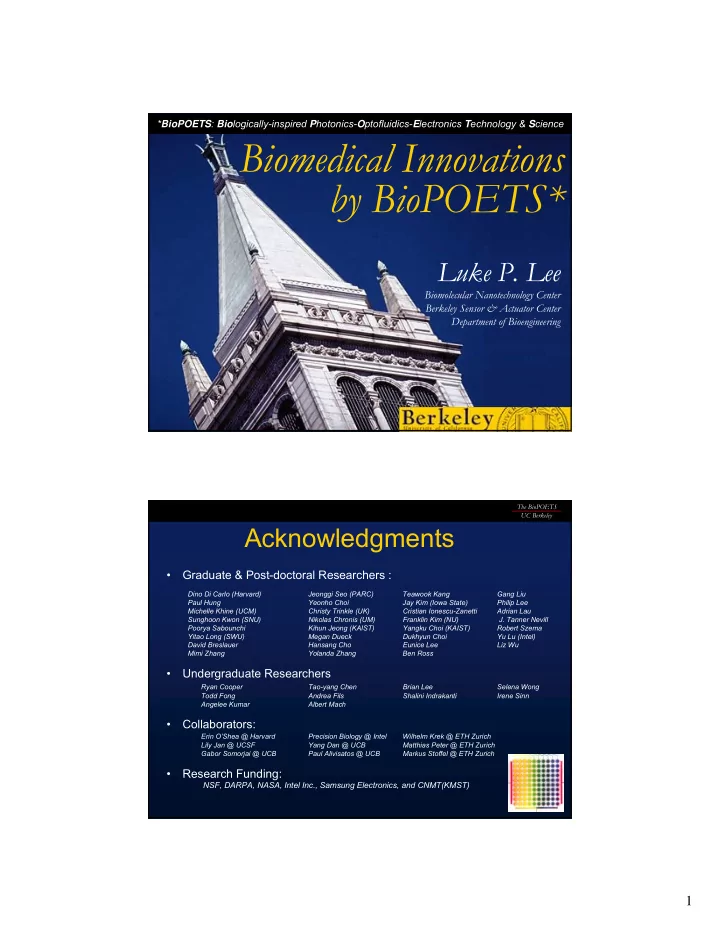
Biomedical Innovations by BioPOETS* Luke P. Lee Biomolecular - - PDF document

biomedical innovations by biopoets
SMART_READER_LITE
LIVE PREVIEW

Biomedical Innovations by BioPOETS* Luke P. Lee Biomolecular - - PDF document

* BioPOETS : Bio logically-inspired P hotonics- O ptofluidics- E lectronics T echnology & S cience Biomedical Innovations by BioPOETS* Luke P. Lee Biomolecular Nanotechnology Center Berkeley Sensor & Actuator Center Department of


slide-1
SLIDE 1

1

Luke P. Lee

Biomolecular Nanotechnology Center Berkeley Sensor & Actuator Center Department of Bioengineering

Biomedical Innovations by BioPOETS*

*BioPOETS: Biologically-inspired Photonics-Optofluidics-Electronics Technology & Science

UC Berkeley The BioPOETS

Acknowledgments

  • Graduate & Post-doctoral Researchers :

Dino Di Carlo (Harvard) Jeonggi Seo (PARC) Teawook Kang Gang Liu Paul Hung Yeonho Choi Jay Kim (Iowa State) Philip Lee Michelle Khine (UCM) Christy Trinkle (UK) Cristian Ionescu-Zanetti Adrian Lau Sunghoon Kwon (SNU) Nikolas Chronis (UM) Franklin Kim (NU)

  • J. Tanner Nevill

Poorya Sabounchi Kihun Jeong (KAIST) Yangku Choi (KAIST) Robert Szema Yitao Long (SWU) Megan Dueck Dukhyun Choi Yu Lu (Intel) David Breslauer Hansang Cho Eunice Lee Liz Wu Mimi Zhang Yolanda Zhang Ben Ross

  • Undergraduate Researchers

Ryan Cooper Tao-yang Chen Brian Lee Selena Wong Todd Fong Andrea Fils Shalini Indrakanti Irene Sinn Angelee Kumar Albert Mach

  • Collaborators:

Erin O’Shea @ Harvard Precision Biology @ Intel Wilhelm Krek @ ETH Zurich Lily Jan @ UCSF Yang Dan @ UCB Matthias Peter @ ETH Zurich Gabor Somorjai @ UCB Paul Alivisatos @ UCB Markus Stoffel @ ETH Zurich

  • Research Funding:

NSF, DARPA, NASA, Intel Inc., Samsung Electronics, and CNMT(KMST)

slide-2
SLIDE 2

2

UC Berkeley The BioPOETS

  • Motivations
  • Biophotonics inspired by Nature
  • Biologically-inspired Optics
  • Biologically-inspired Fluidics
  • Biologically-inspired Electronics
  • Summary

http://biopoets.berkeley.edu

Outline

UC Berkeley The BioPOETS

Quantitative Biomedicine by BioPOETS*

*Biomolecular Photonics-Optofluidics-Electronics Technology & Science

Biologically Inspired Optical Systems Nanoplasmonic SERS for In-vitro Diagnostics Nanocrescent for In- vivo Molecular Probes Optofluidics for Biophotonic Controls Cellular BASICs: Biologic Application Specific Integrated Circuits

slide-3
SLIDE 3

3

UC Berkeley The BioPOETS

Quantitative Biomedical Science

[ ][ ] [ ] [ ]K

z x k t y z x k y x k t x ⋅ = ∂ ∂ ⋅ − = ∂ ∂ 3 2 2 1

Tissue Sample Empirical Analysis Kinetic Model Fitting Personalized Medicine

Fundamental Concepts:

  • Rapid collection of large experimental data sets
  • Intelligent consolidation of quantitative values

UC Berkeley The BioPOETS

Nano-Biophotonics Inspired by Nature

for Cellular Galaxy Biophysics and Imaging

slide-4
SLIDE 4

4

UC Berkeley The BioPOETS

Motivation:

Molecular Imaging

Time to Study the Inner Life: Cellular Galaxy!!

UC Berkeley The BioPOETS

From Telescope to Satellite Telescope

Galileo published Sidereus Nuncius in March 1610

slide-5
SLIDE 5

5

UC Berkeley The BioPOETS

Nanoring Nanotips

L a s e r E x c i t a t i

  • n

Surface-enhanced Raman scattering

Sharp edge (scattering “hot site”)

Nanocrescents:Nanosatellites

Nanoscale Biophotonic Receivers & Transmitters

  • Y. Lu, G. L. Liu, J. Kim, Y. Mejia, & L. P. Lee, Nano Letters, 5(1), 119-124 (2005).

Local Electromagnetic Field Enhancement Effect

UC Berkeley The BioPOETS

In-vivo Cellular Nanoscopy

Optical detection of electron transfer: in vivo for high spatial resolution nanoscopy.

Bionano Receivers & Transmitters 100 nm

slide-6
SLIDE 6

6

UC Berkeley The BioPOETS

SERS-based Nanocrescent’s LFE

600 800 1000 1200 1400 1600 100 200 300 400 500 1nM R6G 1μM R6G 10μM R6G 100μM R6G 1mM R6G Intensity [arb. unit] Raman Shift [cm
  • 1]
615 788 1151 1347 1508 1545 1583 1659 1698 600 800 1000 1200 1400 1600 100 200 100nmO.D. Au nanobowl 60nm Au nanosphere 1698 1659 1583 1545 1508 1347 1151 788 615 Raman Shift [cm
  • 1]
Intensity [arb. unit]

SERS spectra of different concentrations of R6G Comparison of SERS spectra from Au nano-crescent & nanospheres

Estimated LFE factor: ~ 3 Estimated LFE factor: ~ 3× ×10 102

2 Rhodamine 6G

  • High photostability
  • High quantum yield
  • Low cost

Excitation Excitation (785 nm) (785 nm)

1mM R6G
  • cf. Nanorings: LFE < 102

UC Berkeley The BioPOETS

Nanocrescent SERS Probes

Fe Ag Au L a s e r E x c i t a t i
  • n
S u r f a c e
  • e
n h a n c e d R a m a n S c a t t e r i n g Multilayered Nanocrescent SERS Hot Spots

Multiple particles with dispersed SERS hot spots

Multiple SERS Hot Spots

Single nanocrescent with multiple SERS hot spots

SERS Weak Spots

vs.

TEM image of nanocrescent (c)
slide-7
SLIDE 7

7

UC Berkeley The BioPOETS

1 μm 1 μm 1 μm 50 100 150 200 250 300 100 200 300 400 500 600 Pixel Intensity [a.u.] 50 100 150 200 250 300 100 200 300 400 500 600 Pixel Intensity [a.u.] 50 100 150 200 250 300 100 200 300 400 500 600 Pixel Intensity [a.u.] 1 μm 1 μm 1 μm 1 μm 1 μm 1 μm 50 100 150 200 250 300 100 200 300 400 500 600 Pixel Intensity [a.u.] 50 100 150 200 250 300 100 200 300 400 500 600 Pixel Intensity [a.u.] 50 100 150 200 250 300 100 200 300 400 500 600 Pixel Intensity [a.u.]

(b)

400 600 800 1000 1200 50 100 150 Intensity [a.u.] Raman Shift [cm
  • 1]
background
  • blique excitation
perpendicular excitation Au MTMO 400 600 800 1000 1200 50 100 150 Intensity [a.u.] Raman Shift [cm
  • 1]
background
  • blique excitation
perpendicular excitation Au Au MTMO

(c) (d)

500 600 700 800 900 1000 1100 1200 1300 150 200 250 300 350 Intensity [a.u.] Raman Shift [cm
  • 1]
864 1030 637 N S N S N S N S 500 600 700 800 900 1000 1100 1200 1300 150 200 250 300 350 Intensity [a.u.] Raman Shift [cm
  • 1]
864 1030 637 N S N S N S N S 50 100 150 200 250 300 350 5 10 15 20 25 30 35 40 45 Raman Peak Intensity at 637 cm
  • 1
Rotation angle [degree] N S N S N S N S N S 50 100 150 200 250 300 350 5 10 15 20 25 30 35 40 45 Raman Peak Intensity at 637 cm
  • 1
Rotation angle [degree] N S N S N S N S N S N S N S N S N S N S

(e) (f) (a)

Magnetic Nano- Crescent SERS

  • G. L. Liu, Y. Lu,
  • J. Kim, J. C. Doll,

and L. P. Lee

Advanced Materials (2005)

UC Berkeley The BioPOETS

Plasmonic Resonance Energy Transfer (PRET)

  • G. Liu, Y. Long, Y. Choi, T. Kang, and L. P. Lee (Nature Methods, 2007)

Nanospectroscopic Imaging

slide-8
SLIDE 8

8

UC Berkeley The BioPOETS

Time Resolved Dip Spectroscopy

Quantized Nanoplasmonic Dip Spectroscopy by PRET

Cyt C

Cyt C

UC Berkeley The BioPOETS

slide-9
SLIDE 9

9

UC Berkeley The BioPOETS

Molecular Dynamics of Cyt c

10 μm

Time resolved dip change

2μm UC Berkeley The BioPOETS

Multiplexed PRET for Functional Cellular Imaging

slide-10
SLIDE 10

10

UC Berkeley The BioPOETS

Spatially Resolved in-vivo Cellular Imaging

Internalized GNPs Cytochrome c Mitochodrium Nucleus ER

0.5 1.0

Cyt c [c]

Mapping of Cellular Processing: Apoptosis Dynamics

PRET Nanospectroscopic Imaging

UC Berkeley The BioPOETS

Dynamic Molecular Ruler

for Measuring Nuclease Activity & DNA Footprinting

  • G. L. Liu et al. (Nature Nanotechnology, 2006)
slide-11
SLIDE 11

11

UC Berkeley The BioPOETS

Mechanism of Plasmon Resonance Wavelength Shift by Nucleolytic Reactions

1. Effective size change after DNA digestion. 2. Dielectric constant of dsDNA is dependent on its length (Langevin model). 3. Ionic condensation condition change due to the DNA length change

DNA length negative charges PR Shift

Au

s

*

| | | | | | | | | | | | | | | | | | | | | | | | | | | | | | | | | | | s

*

| | | | | | | | | | | | | | | | | | | | | | | | | | | | | | | | | | | s

*

| | | | | | | | | | | | | | | | | | | | | | | | | | | | | | | | | | | s

*

| | | | | | | | | | | | | | | | | | | | | | | | | | | | | | | | | | | s

*

| | | | | | | | | | | | | | | | | | | | | | | | | | | | | | | | | | | s

*

| | | | | | | | | | | | | | | | | | | | | | | | | | | | | | | | | | | s

*

| | | | | | | | | | | | | | | | | | | | | | | | | | | | | | | | | | | s

*

| | | | | | | | | | | | | | | | | | | | | | | | | | | | | | | | | | | s

*

| | | | | | | | | | | | | | | | | | | | | | | | | | | | | | | | | | | s

*

| | | | | | | | | | | | | | | | | | | | | | | | | | | | | | | | | | | s

*

| | | | | | | | | | | | | | | | | | | | | | | | | | | | | | | | | | | s

*

| | | | | | | | | | | | | | | | | | | | | | | | | | | | | | | | | | | s

*

| | | | | | | | | | | | | | | | | | | | | | | | | | | | | | | | | | | s

*

| | | | | | | | | | | | | | | | | | | | | | | | | | | | | | | | | | | s

*

| | | | | | | | | | | | | | | | | | | | | | | | | | | | | | | | | | | s

*

| | | | | | | | | | | | | | | | | | | | | | | | | | | | | | | | | | | s

*

| | | | | | | | | | | | | | | | | | | | | | | | | | | | | | | | | | |

Au

s

*

| | | | | | | | | | | | | | | | | | | | | | | | | | | | | | | | | | | s

*

| | | | | | | | | | | | | | | | | | | | | | | | | | | | | | | | | | | s

*

| | | | | | | | | | | | | | | | | | | | | | | | | | | | | | | | | | | s

*

| | | | | | | | | | | | | | | | | | | | | | | | | | | | | | | | | | | s

*

| | | | | | | | | | | | | | | | | | | | | | | | | | | | | | | | | | | s

*

| | | | | | | | | | | | | | | | | | | | | | | | | | | | | | | | | | | s

*

| | | | | | | | | | | | | | | | | | | | | | | | | | | | | | | | | | | s

*

| | | | | | | | | | | | | | | | | | | | | | | | | | | | | | | | | | | s

*

| | | | | | | | | | | | | | | | | | | | | | | | | | | | | | | | | | | s

*

| | | | | | | | | | | | | | | | | | | | | | | | | | | | | | | | | | | s

*

| | | | | | | | | | | | | | | | | | | | | | | | | | | | | | | | | | | s

*

| | | | | | | | | | | | | | | | | | | | | | | | | | | | | | | | | | | s

*

| | | | | | | | | | | | | | | | | | | | | | | | | | | | | | | | | | | s

*

| | | | | | | | | | | | | | | | | | | | | | | | | | | | | | | | | | | s

*

| | | | | | | | | | | | | | | | | | | | | | | | | | | | | | | | | | | s

*

| | | | | | | | | | | | | | | | | | | | | | | | | | | | | | | | | | | s

*

| | | | | | | | | | | | | | | | | | | | | | | | | | | | | | | | | | |

Au

s

*

| | | | | | | | | | | | | | | | | | | | | | | | | | | | | | | | | | | s

*

| | | | | | | | | | | | | | | | | | | | | | | | | | | | | | | | | | | s

*

| | | | | | | | | | | | | | | | | | | | | | | | | | | | | | | | | | | s

*

| | | | | | | | | | | | | | | | | | | | | | | | | | | | | | | | | | | s

*

| | | | | | | | | | | | | | | | | | | | | | | | | | | | | | | | | | | s

*

| | | | | | | | | | | | | | | | | | | | | | | | | | | | | | | | | | | s

*

| | | | | | | | | | | | | | | | | | | | | | | | | | | | | | | | | | | s

*

| | | | | | | | | | | | | | | | | | | | | | | | | | | | | | | | | | | s

*

| | | | | | | | | | | | | | | | | | | | | | | | | | | | | | | | | | | s

*

| | | | | | | | | | | | | | | | | | | | | | | | | | | | | | | | | | | s

*

| | | | | | | | | | | | | | | | | | | | | | | | | | | | | | | | | | | s

*

| | | | | | | | | | | | | | | | | | | | | | | | | | | | | | | | | | | s

*

| | | | | | | | | | | | | | | | | | | | | | | | | | | | | | | | | | | s

*

| | | | | | | | | | | | | | | | | | | | | | | | | | | | | | | | | | | s

*

| | | | | | | | | | | | | | | | | | | | | | | | | | | | | | | | | | | s

*

| | | | | | | | | | | | | | | | | | | | | | | | | | | | | | | | | | | s

*

| | | | | | | | | | | | | | | | | | | | | | | | | | | | | | | | | | | s

*

| | | | | | | | | | | | | | | | | | | | | | | | | | | | | | | | | | | s

*

| | | | | | | | | | | | | | | | | | | | | | | | | | | | | | | | | | | s

*

| | | | | | | | | | | | | | | | | | | | | | | | | | | | | | | | | | | s

*

| | | | | | | | | | | | | | | | | | | | | | | | | | | | | | | | | | | s

*

| | | | | | | | | | | | | | | | | | | | | | | | | | | | | | | | | | | s

*

| | | | | | | | | | | | | | | | | | | | | | | | | | | | | | | | | | | s

*

| | | | | | | | | | | | | | | | | | | | | | | | | | | | | | | | | | | s

*

| | | | | | | | | | | | | | | | | | | | | | | | | | | | | | | | | | | s

*

| | | | | | | | | | | | | | | | | | | | | | | | | | | | | | | | | | | s

*

| | | | | | | | | | | | | | | | | | | | | | | | | | | | | | | | | | | s

*

| | | | | | | | | | | | | | | | | | | | | | | | | | | | | | | | | | | s

*

| | | | | | | | | | | | | | | | | | | | | | | | | | | | | | | | | | | s

*

| | | | | | | | | | | | | | | | | | | | | | | | | | | | | | | | | | | s

*

| | | | | | | | | | | | | | | | | | | | | | | | | | | | | | | | | | | s

*

| | | | | | | | | | | | | | | | | | | | | | | | | | | | | | | | | | | s

*

| | | | | | | | | | | | | | | | | | | | | | | | | | | | | | | | | | | s

*

| | | | | | | | | | | | | | | | | | | | | | | | | | | | | | | | | | |

UC Berkeley The BioPOETS

DNA Footprinting

  • f the Binding

Position of EcoRI Mutant

Nature Nanotechnology (2006)

slide-12
SLIDE 12

12

UC Berkeley The BioPOETS

Plasmon Resonance Detection

  • f EcoRI Mutant Position on the dsDNA
500 520 540 560 580 600 620 640 660 680 700 200 400 600 800 1000 1200 1400 1600 1800 Intensity [a.u.] Wavelength [nm] 1 min 3 min 5 min 7 min 9 min 11 min 13 min 15 min 17 min 19 min 21 min 520 540 560 580 600 620 640 660 680 700 200 400 600 800 1000 1200 1400 1600 1800 Intensity [a.u.] Wavelength [nm] 1 min 2 min 3 min 4 min 5 min 6 min 7 min 8 min 9 min 10 min 15 min 20 min + DNase I + EcoRI Mutant + DNase I 5 10 15 20 25 30 +DNase I +EcoRI Mutant +DNase I Digested base pair number Time [min] 30 34 38 42 48 27 24 20 17 14 11 8 60 55 50 45 40 35 30 25 20 15 10 5 Wavelength Change [nm]

UC Berkeley The BioPOETS

Oligonucleotides on a Nanoplasmonic Carrier Optical Switch (ONCOS)

Eunice S. Lee, Gang Liu, Franklin Kim, Yitao Long, and Luke P. Lee (unpublished)

Precise Temporal and Spatial Controls of Localized Gene Regulation and Protein Translation

slide-13
SLIDE 13

13

UC Berkeley The BioPOETS

Conjugated GNP Antisense Oligonucleotide released NIR light localized activation – 5 n m – 1 5 n m – r – T

On Demand Localized Gene Regulation

Precise Temporal Spatial & Temperature Controls

UC Berkeley The BioPOETS

ONCOS

b

mRNA nucleus

a

  • ld

protein RNaseH digestion protein translation halted

  • ld

protein protein folding shuttling of new protein nucleus mRNA ribosome conjugated GNPs NIR light

  • Fig. 2

ONCOS Gene Regulation and Protein Translation

slide-14
SLIDE 14

14

UC Berkeley The BioPOETS UC Berkeley The BioPOETS

Time to Study the Inner Life

via Quantum Nanoplasmonics: Nanospectroscopic Imaging

slide-15
SLIDE 15

15

UC Berkeley The BioPOETS

Biologically- inspired Optical Systems

for Biological microprocesor controls, automations, and imaging

UC Berkeley The BioPOETS

Learn from Nature: Watch out carefully

slide-16
SLIDE 16

16

UC Berkeley The BioPOETS

Biologically Inspired Optical System for Advanced Photonic Systems

(Science, Nov. 2005)

UC Berkeley The BioPOETS

Artificial Compound Eye

Jeong et al, “Biologically Inspired Artificial Compound Eyes,” Science, 312, 557-561 (2006)

slide-17
SLIDE 17

17

UC Berkeley The BioPOETS

Biologically Inspired Optical System

Ki-Hun Jeong, “Biologically Inspired Artificial Compound Eyes,” Science, vol. 312, p. 557-561 (2006)

UC Berkeley The BioPOETS

Omni-directional Imaging System

Honeycomb-Packed Polymer Microlens Arrays on a Curvilinear Surface

CMOS Image Sensor Array

Microlens-waveguides

waveguides coupled with ISA Eyelet: up to 5mm

Potential applications: Handheld miniaturized Imaging System for wide field-of-view, Endoscopic imaging system, Omni-directional sensor array for surveillance detection.

slide-18
SLIDE 18

18

UC Berkeley The BioPOETS

Biologically- inspired Fluidic ICs

for Quantitative Cell Biology and Quantitative Medicine on Chip

UC Berkeley The BioPOETS

Cellular BASICs*

BASIC #1 Integrated Microfluidic Patch-clamp Array Chip BASIC #2 Single Cell Electroporation Chip BASIC #3 High-density Single Cell Analysis Chip BASIC #4 Dynamic Cell Culture Chip for Systems Biology BASIC #5 Cell-cell Communication Chip BASIC #6 Cell Lysing Devices for Sample Preparation BASIC #7 Biomimetic Cell Sorting Microfluidic Devices BASIC #8 Micro PALM for Cell Manipulations BASIC #9 Integrated Cell Culture & Lysing & Harvesting BASIC #10 Biomimetic Artificial Livers on a Chip BASIC #11 Biofluidic Self-assembly of Spheroids on a Chip http://biopoets.berkeley.edu

*Biological Application Specific Integrated Circuits

slide-19
SLIDE 19

19

UC Berkeley The BioPOETS

Basics of BASICs: Fluidic Resistance

( ) ( )

v P v v v dt

2

∇ + −∇ = ∇

  • +

η ρ

v P

2

∇ = ∇ η

( )

ρ η , , , , , , P w h z y f v Δ =

( )

R P P w h L f Q Δ = Δ = ρ η, , , , ,

( )

w h w h L Rrect

3

1 / 63 . 1 12 − ≅ η

y x z w L h Time, translation invarience at low Re Pressure Driven Navier-Stokes

7.5*1014 50x50 μm 4.0*1020 2x5 μm R/L (Pa s/m3) Cross Section

R1/R2 = 5.4*105

UC Berkeley The BioPOETS

Mammalian Electrophysiology on Microfluidic BASICs* Platform

BASICs: Biological Application Specific Integrated Circuits

  • C. Ionescu-Zanetti, R. M. Shaw, J. Seo, Y. Jan,
  • L. Y. Jan, and L. P. Lee (PNAS, 2005)
slide-20
SLIDE 20

20

UC Berkeley The BioPOETS

BASIC #3

High-density Single Cell Analysis Chip

http://biopoems.berkeley.edu

UC Berkeley The BioPOETS

BASIC#3: High density Single Cell Array

via Hydrodynamic Single Cell Tweezers

slide-21
SLIDE 21

21

UC Berkeley The BioPOETS UC Berkeley The BioPOETS

Carboxylesterase Kinetics

  • Probed with Calcein

AM – fluorogenic substrate

  • Two different cell

types:

– Human cervical carcinoma vs. human kidney cells

  • Key result:

– Statistically larger esterase activity in kidney cell line. – Means: 50 nM vs. 125 nM

slide-22
SLIDE 22

22

UC Berkeley The BioPOETS

NDGA Inhibition

Key results:

  • IC50 of 233 nM for

carboxylesterase and isozyme inhibition

  • 20 nM of 50 nM total

activity is not inhibited by NDGA.

  • Future: Various fluorogenic

substrates having different enzyme specificity.

UC Berkeley The BioPOETS

slide-23
SLIDE 23

23

UC Berkeley The BioPOETS

Long-term Cytotoxic Drug Assay via Single-Cell Microfluidic Array

Media Input Drug Input Waste Output Single Cell Culture Chamber

log-gradient generator

= 9:1 Media : Drug

UC Berkeley The BioPOETS

Apoptosis Mechanism is Concentration Dependent

100nM Taxol,1μL min-1 perfusion Suppression of MT dynamics low conc. of Taxol (<200nm) Mitotic spindle checkpoint Mitotic arrest Apoptosis Cdc2 activation Bcl-2 phosphoryl C-Mos up regulation LT narrow distributed

T Wang, et al., CANCER (88), 2000

slide-24
SLIDE 24

24

UC Berkeley The BioPOETS

Apoptosis Mechanism is Concentration Dependent

10μM Taxol 20mins,1μL min-1 Massive MT damage High conc. of Taxol (0.2-30μm) Cdc2, Cdks Apoptosis LT dispersed

T Wang, et al., CANCER (88), 2000

JNK activation Caspase activation

UC Berkeley The BioPOETS

Cultural Revolutions

for Physiologically Relevant Cell Culture Array

Creating Dynamic Cell Culture Systems

slide-25
SLIDE 25

25

UC Berkeley The BioPOETS

Biomimetic Physiological Microenvironment

Tissue Complex Extracellular Matrix 0.1 μm/s Interstitial Flow (i) 700 μm/s Circulatory Flow (c) 100-300 μm Size (D)

D c i

Cell Growth and “Interstitial” Space

Cell Loading “Blood” Flow

Surface Coating 0.08-4 μm/s 80-4,000 μm/s 50-1000 μm Microfluidic

UC Berkeley The BioPOETS

Cell Culture Biotechnology

40-80% <10% 5%

Cell Density (v/v)

64-1024 1 1-384

Throughput

2-120 sec 0.5-3 days 3 days

Medium Turnover

3 nl 2 L 50 μl

Volume

Microfluidic Bioreactor CSTR Bioreactor Microtiter Plate

slide-26
SLIDE 26

26

UC Berkeley The BioPOETS

Nanoliter Scale Microbioreactor Array for Quantitative Cell Biology

Lee et al., Biotechnology & Bioengineering, 94 (1), 5-14 (2006)

UC Berkeley The BioPOETS

Design for Uniform Fluid Velocity Profile

With different flow rates applied from the perfusion inlet, shear stresses inside the chamber can be adjusted. This would potentially be beneficial for study the responses of cells under various shear conditions. With different flow rates applied With different flow rates applied from the perfusion inlet, shear from the perfusion inlet, shear stresses inside the chamber stresses inside the chamber can be adjusted. This would can be adjusted. This would potentially be beneficial for potentially be beneficial for study the responses of cells study the responses of cells under various shear conditions. under various shear conditions.

High Aspect Ratio between the Perfusion Channels & Cell Culture Chamber

100μm Loading Waste Perfusion Inlet Perfusion Outlet Cell Culture Chamber 100μm Loading Waste Perfusion Inlet Perfusion Outlet Cell Culture Chamber 50μm Perfusion Channels 50μm Perfusion Channels
slide-27
SLIDE 27

27

UC Berkeley The BioPOETS

Uniform Mass Transfer

2 sec 2 sec 2 sec 2 sec 5 sec 5 sec 15 sec 15 sec

Medium is introduced from the perfusion inlet at 0.2μL/min. Medium is introduced from the perfusion inlet at 0.2 Medium is introduced from the perfusion inlet at 0.2μ μL/min. L/min.

a

UC Berkeley The BioPOETS

Device Fabrication

Key Features:

  • Biocompatible
  • Rapid Processing Time
  • 1.5-250 μm PR Available
  • Optically Transparent
slide-28
SLIDE 28

28

UC Berkeley The BioPOETS

Cell Growth

Cell Growth (HeLa, 30

min/frame, 38 hours)

UC Berkeley The BioPOETS

Quantitative Data

Cell Growth Rate Cell Attachment Kinetics

N dt dN μ =

  • Microfluidic

▲ 24 Well Plate

slide-29
SLIDE 29

29

UC Berkeley The BioPOETS

Cell Types Cultured

HeLa HeLa “tumor” NIH3T3 Fibroblast Primary BAEC HepG2 Hepatocyte SY5Y Neuroblasts

UC Berkeley The BioPOETS

Physiologically- inspired Artificial Liver Sinusoids

Lee et al., Biotechnology and Bioengineering 97, 1340 (2007)

slide-30
SLIDE 30

30

UC Berkeley The BioPOETS

Liver Micro-architecture

  • Sinusoid space transports blood to hepatocytes
  • Lined with fenestrated endothelial barrier
  • Hepatocytes form extensive cell-cell contact

UC Berkeley The BioPOETS

Microfluidic Artificial Liver Sinusoid

  • Microfluidic endothelial barrier
  • High density hepatocyte culture
  • Continuous flow mass transport

1 sec 40 sec 80 sec 120 sec 240 sec 7 days

Hepatocyte Loading

slide-31
SLIDE 31

31

UC Berkeley The BioPOETS

Effect of Hepatocyte Density

  • Microfluidic culture without ECM coating
  • “Spheroid” effect previously documented

High density = happy cells Low density = dead cells

UC Berkeley The BioPOETS

Quantitative Results

  • Collagen coating required for dish based

hepatocyte culture

  • High density loading can rescue viability in

absence of ECM coating

□ High density ▲ Low density ■ Dish (no coat)

slide-32
SLIDE 32

32

UC Berkeley The BioPOETS

Microfluidic Assembly of Spheroids

“Tumor factory” to Accelerate Cancer Drug Development

UC Berkeley The BioPOETS

Effects of Flow Rate in Spheroids Assembly for Drug Screening

slide-33
SLIDE 33

33

UC Berkeley The BioPOETS

Biologically-relevant Stem Cell Research

Known Stem Cell Modulators

Shear Stress Growth Factors Nutrient Content ECM Contact Surface Material Oxygen Level Electrical Signaling Temporal Modulation Co-Culture Genetic Manipulation ? Renewal Endothelial Cell Stem Cell Blood Cell Nerve Cell ? ? ?

2 4 6 8 10 0.0 0.5 1.0 2 4 6 8 10 0.0 0.5 1.0 2 4 6 8 10 0.0 0.5 1.0 Time

Culture Parameter

High Throughput Experimentation Data Analysis and Optimization

UC Berkeley The BioPOETS

Innovative Personalized Medicine

Information Technology

Disposable Diagnostic Biochip Mobile Healthcare iMDs*

Biotechnology Nanotechnology *iMDs: Innovative Medical Diagnostic Systems

slide-34
SLIDE 34

34

UC Berkeley The BioPOETS

Summary

  • Biologically-inspired photonics and optical systems are

being developed for innovative healthcare systems.

  • Cellular BioASICs are being developed for quantitative

biology & medicine.

  • Quantum nanoplasmonic molecular probes, molecular

ruler, ONCOS (gene regulator & protein expression controller) are developed for molecular/cellular imaging, and quantitative in vivo biology.

  • High-content Integrated Quantitative Molecular

Diagnostic (iQMD) system can be created for future preventive, personalized medicine, and integrated health & environmental monitoring systems.