Biodiversity Disturbance Succession Works Cited Return to - - PDF document

biodiversity
SMART_READER_LITE
LIVE PREVIEW

Biodiversity Disturbance Succession Works Cited Return to - - PDF document

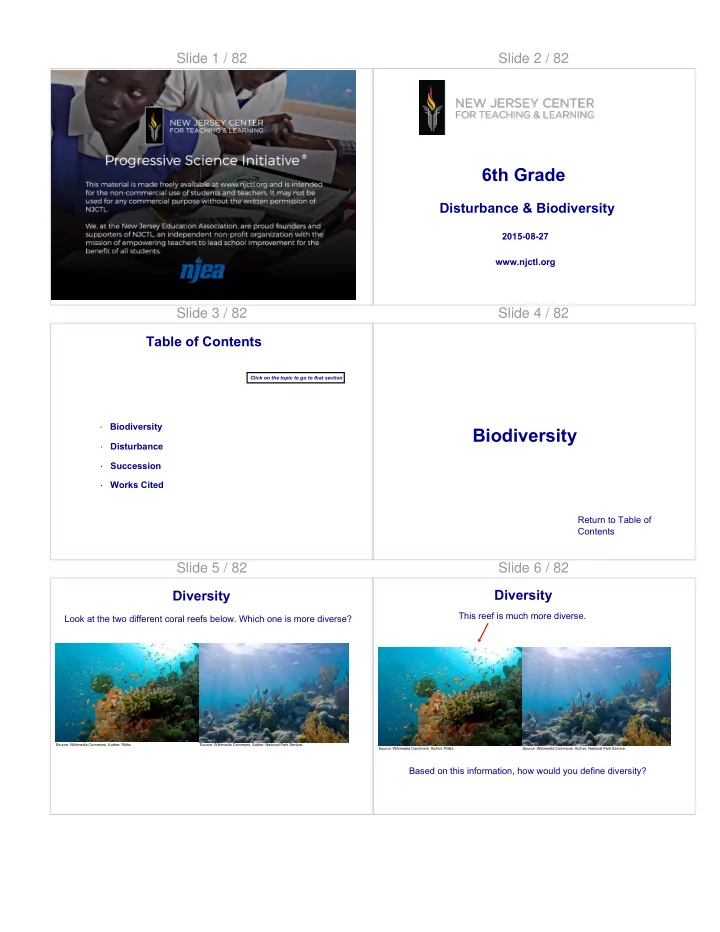
Slide 1 / 82 Slide 2 / 82 6th Grade Disturbance & Biodiversity 2015-08-27 www.njctl.org Slide 3 / 82 Slide 4 / 82 Table of Contents Click on the topic to go to that section Biodiversity Biodiversity Disturbance Succession


slide-1
SLIDE 1

Slide 1 / 82 Slide 2 / 82

6th Grade

Disturbance & Biodiversity

2015-08-27 www.njctl.org

Slide 3 / 82 Table of Contents

Click on the topic to go to that section

· Biodiversity · Disturbance · Succession · Works Cited

Slide 4 / 82

Biodiversity

Return to Table of Contents

Slide 5 / 82 Diversity

Look at the two different coral reefs below. Which one is more diverse?

Source: Wikimedia Commons. Author: Ritiks. Source: Wikimedia Commons. Author: National Park Service.

Slide 6 / 82 Diversity

This reef is much more diverse. Based on this information, how would you define diversity?

Source: Wikimedia Commons. Author: Ritiks. Source: Wikimedia Commons. Author: National Park Service.

slide-2
SLIDE 2

Slide 7 / 82 Biodiversity

Diversity refers to the variety of items present. If "bio" is added to the front of the word, it becomes biodiversity. Based on your knowledge, construct a definition for biodiversity. Write it in the box below and then click in the blue box to check your answer. Biodiversity is the variety of living things in an area. It is the number of different species present in an area.

Slide 8 / 82 Biodiversity

Look at the two boxes below. Each circle represents an organism in an ecosystem. Each different color represents a different species. Circle the ecosystem that has more biodiversity.

Slide 9 / 82 Biodiversity

This ecosystem has more individuals (larger populations). But this ecosystem has a higher biodiversity (more species). Biodiversity refers to the number of species not the total amount of

  • rganisms.

Slide 10 / 82

1 If each box is a different ecosystem, which ecosystem has a higher biodiversity? A B

Slide 10 (Answer) / 82

1 If each box is a different ecosystem, which ecosystem has a higher biodiversity? A B

[This object is a pull tab]

Answer

A

Slide 11 / 82

2 Biodiversity is the total number of organisms present in an ecosystem. True False

slide-3
SLIDE 3

Slide 11 (Answer) / 82

2 Biodiversity is the total number of organisms present in an ecosystem. True False

[This object is a pull tab]

Answer

False Biodiversity is the total number of species in an ecosystem.

Slide 12 / 82 Activity: Calculating Biodiversity

By using something called a biodiversity index, you can calculate and compare the biodiversity of different ecosystems. Find out how in this activity!

Source: Wikipedia. Author: Viatour.

Can you locate two different areas of biodiversity in this picture?

Slide 13 / 82 Biodiversity & Ecosystem Health

To understand how biodiversity affects the health of an ecosystem, we must first look at the concept of resilience.

Source: Wikimedia Commons. Author: Famartin.

Wild flower meadows have a high biodiversity composed of vegetation, insects, birds and herbivores.

Slide 14 / 82 Resilience

Source: Wikimedia Commons. Author: Becker.

Look at the weed growing despite the presence of a sidewalk. What does it mean to have resilience? Write your ideas in the box.

Slide 14 (Answer) / 82 Resilience

Source: Wikimedia Commons. Author: Becker.

Look at the weed growing despite the presence of a sidewalk. What does it mean to have resilience? Write your ideas in the box.

[This object is a pull tab]

Answer Resilience is the ability to recover quickly from difficult conditions.

Slide 15 / 82 Ecosystem Resilience

Ecosystem resilience is the ability of an ecosystem to recover quickly after something disrupts it.

Source: Wikipedia. Author: Hannu.

These pictures show the recovery of a forest 1 year after a fire (left) and 2 years after a fire (right).

slide-4
SLIDE 4

Slide 16 / 82 Activity: Biodiversity & Disease

Biodiversity affects an ecosystem's resilience. Complete this activity to understand how.

Source: Wikipedia. Author: Harris.

Slide 17 / 82 Biodiversity & Resilience

Source: Nature Education

Look at the diagram below. Describe how this diagram illustrates the relationship between biodiversity and resilience. (Hint: What happens when biodiversity is low?)

Slide 18 / 82 Biodiversity & Resilience

As biodiversity increases, so does an ecosystem's resilience.

Source: Nature Education

The more species that are present, the more likely that the ecosystem will survive a disruption. When biodiversity is low, the community does not survive well with a change in temperature. When biodiversity is high, the community is maintained despite changes in temperature.

Slide 19 / 82 Biodiversity

Biodiversity increases an ecosystem's health.

Source: Wikimedia Commons. Author: # # # .

Click here to watch a video about biodiversity.

Every species in an ecosystem is closely tied to all other species. A change to one will bring a change to all.

Slide 20 / 82

3 A coastal ecosystem is destroyed by a hurricane. Despite this, the ecosystem recovers quickly. This ecosystem is very ___. A unhealthy B unstable C stable D resilient

Slide 20 (Answer) / 82

3 A coastal ecosystem is destroyed by a hurricane. Despite this, the ecosystem recovers quickly. This ecosystem is very ___. A unhealthy B unstable C stable D resilient

[This object is a pull tab]

Answer

D

slide-5
SLIDE 5

Slide 21 / 82

4 Biodiversity decreases an ecosystem's resilience. True False

Slide 21 (Answer) / 82

4 Biodiversity decreases an ecosystem's resilience. True False

[This object is a pull tab]

Answer

False

Slide 22 / 82

Disturbance

Return to Table of Contents

Slide 23 / 82 Disturbance

You just learned that an ecosystem's stability and resilience is related to how it reacts to disturbances. What types of disturbances can you think of that would affect ecosystems? Write your thoughts below.

Slide 24 / 82 Disturbance

In an ecosystem, a disturbance is any event that removes organisms

  • r alters available resources.

Just a few examples include:

Source: Wikimedia Commons. Author: Russavia. Source: Wikimedia Commons. Author: Lundeen. Source: Wikimedia Commons. Author: Russavia. Source: Wikimedia Commons. Author: U.S. Fish and Wildlife Service.

Fire Storms Drought Human Activities

Slide 25 / 82 Climate Change

Let's use climate change as an example of a disturbance. Climate change and the impacts of climate change affect ecosystems in a variety of ways. Can you think of ways in which climate could affect an ecosystem? Write your ideas in the box.

slide-6
SLIDE 6

Slide 26 / 82

Warming could force species to migrate to higher latitudes or higher elevations where temperatures are cooler and more conducive to their survival. This means a range expansion or reduction for some species. Animals could be forced to move into less friendly habitat. Some species might have nowhere to go if they are already at the northern or upper limit of their habitat.

Climate and Ecosystems

A warming climate affects the habitats of many species.

Source: Wikimedia Commons. Author: Inaglory.

Slide 27 / 82 Climate and Ecosystems

Climate change also affects water ecosystems in many ways. For example, as sea level rises, saltwater mixes with freshwater

  • ecosystems. This may force some key species to relocate or die,

thus removing predators or prey that were critical in the existing food chain. A glaciers become smaller, there is less spring water flow, making it difficult for salmon to reach spawning grounds.

Source: Wikimedia Commons. Author: U.S. Fish and Wildlife Service.

Slide 28 / 82 Climate and Ecosystems

As rivers and streams warm, warmwater fish are expanding into areas previously inhabited by coldwater species. Coldwater fish, including many highly valued trout species, are losing their habitats. As waters warm, the area of feasible, cooler habitats to which species can migrate is reduced.

Source: Wikimedia Commons. Author: U.S. Fish and Wildlife Service.

Slide 29 / 82

5 A disturbance will ___. A remove species from an area B increase available resources C alter available resources D both A and C

Slide 29 (Answer) / 82

5 A disturbance will ___. A remove species from an area B increase available resources C alter available resources D both A and C

[This object is a pull tab]

Answer

D

Slide 30 / 82 Unbalanced Ecosystems

We have learned that a healthy ecosystem is sustainable through

  • biodiversity. All of the species in an ecosystem have a role to play,

and their interactions have to remain balanced. What happens when that balance is disturbed?

Source: EPA

If the salamander population goes extinct due to acid rain, how would this change the balance in this ecosystem? Write your ideas below.

slide-7
SLIDE 7

Slide 31 / 82 Unbalanced Ecosystems

Even the trout would be affected. The eagles would have decreased prey due to the loss of salamander and so would eat more trout as a result. If the salamander population went extinct, every single species in this ecosystem would feel the effects.

Source: EPA

Slide 32 / 82 Disturbances & Ecosystems

A disturbance to any part of an ecosystem will result in a disturbance to the entire ecosystem because of how all organisms are connected. Similar to dominos, once one piece tips over or changes, all of the

  • ther pieces are affected.

Let's look at a few more examples...

Source: Wikipedia. Author: Aussiegall.

Slide 33 / 82 Case Study: The American Alligator

How could the disappearance

  • f the alligator cause fish

populations to decrease? The American alligator was once thought of as an annoying pest. They showed up in people's pools, golf courses, and ate game fish that people liked to

  • catch. So the American alligator

was hunted without limit until it became an endangered species. This caused an unlikely result. As the alligators disappeared, so did all the game fish.

Source: Wikipedia. Author: Postdlf. http://en.wikipedia.org/wiki/American_alligator#/media/File:American_Alligator.jpg

Slide 34 / 82

Game fish Gar Alligator

Case Study: The American Alligator

Examine this food chain and try the question again: How could the disappearance of the alligator cause fish populations to decrease?

Slide 35 / 82

The alligator's favorite food was a large fish called a gar. With no alligators to hunt them, the gar population exploded. This is a picture of a gar. Can you guess what gar like to eat? With no alligators to keep their numbers down, the gar started gobbling up all the fish! The alligator was put on the endangered species list in 1967 and protected from hunting.

Case Study: The American Alligator

Source: Wikimedia Commons. Author: U.S. Fish and Wildlife Service

Slide 36 / 82 Case Study: The Sea Otter

Sea otters live in the kelp forest ecosystem. Giant kelp are large seaweed that can grow 90 m (300 ft) in one year! They are important producers in the ecosystem and they offer protection to many species, including an important role as fish nurseries.

Source: Wikipedia. Author: NOAA Photo Library. Source: Wikimedia Commons. Author: Baird

slide-8
SLIDE 8

Slide 37 / 82

In the 18th century, on the coast of California, the sea otter was hunted for its beautiful fur. It was also killed by fisherman who thought they were eating too many of the fish that they wanted to

  • catch. The sea otters were hunted almost to extinction!

Case Study: The Sea Otter

These sea otters are holding hands while sleeping.

Source: Wikipedia. Author: Robertson.

Slide 38 / 82

Without the sea otter, fishermen began to see changes in the ecosystem.

Case Study: The Sea Otter

Study this food web and determine some ways that the loss of the sea otter may have affected the kelp forest ecosystem.

Source: Net Industries.

Slide 39 / 82

With the otters gone and the sea urchin numbers growing quickly, the kelp beds began to disappear. Then the fish, with no safe place to spawn, began to disappear. In just a few years, the fishermen noticed that the fish were suddenly gone. Without sea otters, the sea urchin population grew. Sea urchins eat kelp. With so many more sea urchins, they ate # # # all the kelp beds.

Case Study: The Sea Otter

Source: Net Industries.

Slide 40 / 82

Sharks play a very important role in the oceans in a way that an average fish does not. Sharks are at the top of the food chain in virtually every part of every

  • cean. In that role, they keep

populations of other fish healthy and in proper proportion for their ecosystem.

Case Study: The Shark

Source: Wikimedia Commons. Author: Tiburon.

Slide 41 / 82 Case Study: The Shark

Sharks prey on weak, old fish. Can you think of three ways that this would help to keep the ecosystem in check?

Source: Wikimedia Commons. Author: ElkCloner

Slide 41 (Answer) / 82 Case Study: The Shark

Sharks prey on weak, old fish. Can you think of three ways that this would help to keep the ecosystem in check?

Source: Wikimedia Commons. Author: ElkCloner

[This object is a pull tab]

Answer Keeps the fish population healthier. Prevents the spread of disease. Strengthens the gene pool by removing weak individuals.

slide-9
SLIDE 9

Slide 42 / 82

Sharks regulate the behavior of prey species, and prevent them from

  • vergrazing vital habitats.

Scientists in Hawaii found that tiger sharks had a positive impact on the health of sea grass beds. Turtles, which are the tiger sharks’ prey, graze on sea grass. What do you think the scientists found when tiger sharks were removed from the area?

.

Case Study: The Shark

Source: Wikimedia Commons. Author: Kok.

Slide 42 (Answer) / 82

Sharks regulate the behavior of prey species, and prevent them from

  • vergrazing vital habitats.

Scientists in Hawaii found that tiger sharks had a positive impact on the health of sea grass beds. Turtles, which are the tiger sharks’ prey, graze on sea grass. What do you think the scientists found when tiger sharks were removed from the area?

.

Case Study: The Shark

Source: Wikimedia Commons. Author: Kok.

[This object is a pull tab]

Answer The turtles ate all the best quality, most nutritious sea grass and these habitats would be destroyed.

Slide 43 / 82

Sharks are essential for healthy marine ecosystems. Unfortunately, sharks are being killed for their fins to be cooked in shark fin soup, a food that has assumed cultural value but is not important for human survival or health. Sharks have survived for 450 million years, but may be gone within the next decades. Many shark species are nearing extinction due to the fishing of sharks for shark fin soup. This disturbance has caused many other changes in the marine ecosystem.

Case Study: The Shark

Source: Wikipedia. Author: Hungry.

Slide 44 / 82

6 If a parasite decimated the osprey population, which

  • ther population would experience a population

decrease? A Small planktivorous fish B Large piscivorous fish C Bald eagle D Phytoplankton

Source: Wikimedia Commons. Author: U.S. Geological Survey.

Slide 44 (Answer) / 82

6 If a parasite decimated the osprey population, which

  • ther population would experience a population

decrease? A Small planktivorous fish B Large piscivorous fish C Bald eagle D Phytoplankton

Source: Wikimedia Commons. Author: U.S. Geological Survey.

[This object is a pull tab]

Answer

A

Slide 45 / 82

7 A disturbance to one part of an ecosystem results in changes all parts of an ecosystem. True False

slide-10
SLIDE 10

Slide 45 (Answer) / 82

7 A disturbance to one part of an ecosystem results in changes all parts of an ecosystem. True False

[This object is a pull tab]

Answer

True

Slide 46 / 82

Succession

Return to Table of Contents

Slide 47 / 82

We just learned that biodiversity is important for ecosystem health. We also learned that disturbances lower biodiversity. So...does this mean that all disturbances are bad?

Are all disturbances bad?

Let's answer this question by looking at an example...

Slide 48 / 82 Case Study: Intertidal Boulders

Boulders located in the intertidal zone are a challenging habitat due to wave action from the changing tides. Because small boulders weigh less than large boulders, they are turned over and moved around much more frequently. In other words, small boulders experience higher rates of disturbance than large boulders.

Source: Wikimedia Commons. Author: Geoking66.

Slide 49 / 82

Source: Wikimedia Commons. Author: Harmonywriter.

Case Study: Intertidal Boulders

Algae often grow on intertidal boulders. Let's look at how biodiversity changes in response to high, medium and low levels of disturbance. We will consider disturbance levels to be as follows: Small boulders - high disturbance Medium boulders - medium disturbance Large boulders - low disturbance

Slide 50 / 82 Case Study: Intertidal Boulders

Small boulders are easily tossed around and overturned by

  • cean waves due to their smaller size. When this happens,

algae can get crushed or smothered. The only algae that can survive on small boulders must be fast growing. This makes biodiversity on small boulders very low. Low abundance and low diversity.

slide-11
SLIDE 11

Slide 51 / 82 Case Study: Intertidal Boulders

Large boulders in the intertidal zone are very stable. They are not easily moved or disturbed. Many different algae can grow on these boulders; however, the ones that survive are those that are the best

  • competitors. These competitors inevitably get rid of all other species

but themselves. This makes biodiversity on large boulders very low. High abundance but low diversity.

Slide 52 / 82 Case Study: Intertidal Boulders

Medium boulders in the intertidal zone are disturbed an average

  • amount. This means that, once in a while, all species are crushed or
  • disturbed. This ensures that the strong competitors do not have

enough time to exclude other species. There are a variety of algae

  • n the rocks: fast growing, strong competitors, and all other species.

This makes biodiversity on medium boulders very high.

Slide 53 / 82 Case Study: Intertidal Boulders

Based on this case study, what can you conclude about the link between disturbance and biodiversity? Is disturbance always bad? Write your ideas below.

Slide 54 / 82 Intermediate Disturbance Hypothesis

After studying several ecosystems that responded similarly to intertidal boulders, ecologists came up with the intermediate disturbance hypothesis. This hypothesis states that biodiversity is highest with moderate levels

  • f disturbance.

Source: Nature Education

High disturbance results in only fast growing colonizer species surviving. Low disturbance results in only good competitors surviving. Intermediate disturbance results in the survival of the highest amount of species.

Slide 55 / 82

8 All disturbances are bad. True False

Slide 55 (Answer) / 82

8 All disturbances are bad. True False

[This object is a pull tab]

Answer

False

slide-12
SLIDE 12

Slide 56 / 82

9 Suppose that a meadow located next to a river is prone to flooding during the spring snow melt. Under which circumstance would the meadow have the highest amount of biodiversity? A Floods that occur every year B Floods that occur once in a while C Floods that hardly ever occur

Slide 56 (Answer) / 82

9 Suppose that a meadow located next to a river is prone to flooding during the spring snow melt. Under which circumstance would the meadow have the highest amount of biodiversity? A Floods that occur every year B Floods that occur once in a while C Floods that hardly ever occur

[This object is a pull tab]

Answer

B

Slide 57 / 82

10 Fire is a disturbance that occurs naturally in forests. Suppose that a particuclar forest experiences fires every single year. What type of organisms would live in this forest? A Fast growing, colonizing plants B A mix of many different plants C Only the plants that are the strongest competitors

Slide 57 (Answer) / 82

10 Fire is a disturbance that occurs naturally in forests. Suppose that a particuclar forest experiences fires every single year. What type of organisms would live in this forest? A Fast growing, colonizing plants B A mix of many different plants C Only the plants that are the strongest competitors

[This object is a pull tab]

Answer

A

Slide 58 / 82 Ecosystems are Dynamic

Ecosystems are dynamic. They are constantly changing. We now know that a major component of change is disturbance.

Source: Wikimedia Commons. Author: Jamieli. Source: Wikipedia. Author: Osbourn.

The coastal vegetation on this Bahamas beach has been uprooted due to a hurricane. This forest in Greece is being destroyed by a forest fire.

Slide 59 / 82 Ecological Succession

After a disturbance, ecosystems are reestablished through a process called ecological succession.

Source: Wikimedia Commons. Author: Nevilley.

This lava field was originally devoid of life but now has vegetation growing on it.

slide-13
SLIDE 13

Slide 60 / 82 Ecological Succession

There are two different types of ecological succession:

Source: Wikimedia Commons. Author: Bcasterline. Source: USGS. Author: Brantley.

Primary succession occurs when a disturbance creates an area with no life (no soil). Secondary succession occurs when a disturbance destroys an area but leaves the soil intact.

Slide 61 / 82 Primary Succession

Primary succession is known for occurring on new volcanic land or

  • n debris left behind by a retreating glacier.

Although the location may be different, the pattern of primary succession remains the same. Initially, there is no life on the rock.

Source: Wikimedia Commons. Author: Inaglory.

Slide 62 / 82 Primary Succession

The first organisms to grow are called pioneer species. Since there is no other life present, these pioneer species must be able to make their own food. They are producers that do not require soil to grow. Common pioneer species are lichens, mosses and algae.

Source: Wikipedia. Author: Andrewtappert.

This red lichen is growing on volcanic rock.

Slide 63 / 82 Primary Succession

Over time, weathering and erosion breaks the rocks into small,

  • rganic pieces. As the pioneer species die, they decompose into

small, organic pieces. As this organic matter accumulates, it becomes soil. Slowly, grasses are able to grow in the thin soil.

Source: Wikimedia Commons. Author: Dustin.

Slide 64 / 82 Primary Succession

As the grasses die, they contribute to the health of the soil. This allows shrubs and then trees to survive in the new ecosystem. Also, as producers begin to thrive, a variety of consumers start to move into the area. Each time an organism dies, it contributes to the soil, which in turn sustains additional producers.

Source: Wikimedia Commons. Author: Kuran.

Slide 65 / 82 Primary Succession

Eventually, the ecosystem reaches a fully functioning state. This is called the climax community. The climax community experiences little change, until the next disturbance occurs.

Source: Wikimedia Commons. Author: DR04.

slide-14
SLIDE 14

Slide 66 / 82

11 During primary succession, lichens are often the first to grow. This makes lichens a ___. A consumer B climax species C pioneer species D primary species

Slide 66 (Answer) / 82

11 During primary succession, lichens are often the first to grow. This makes lichens a ___. A consumer B climax species C pioneer species D primary species

[This object is a pull tab]

Answer

C

Slide 67 / 82

12 Primary succession occurs where no life or soil are present. True False

Slide 67 (Answer) / 82

12 Primary succession occurs where no life or soil are present. True False

[This object is a pull tab]

Answer

True

Slide 68 / 82 Secondary Succession

Secondary succession occurs when a disturbance destroys an existing ecosystem while keeping the soil intact.

Source: Wikipedia. Author: Murphy.

Steps 1, 2 and 3 A disturbance destroys a healthy ecosystem.

Slide 69 / 82

Source: Wikipedia. Author: Murphy.

Secondary Succession

Step 4 All that remains after the disturbance is soil. Step 5 Grasses and small vegetation grow back first.

slide-15
SLIDE 15

Slide 70 / 82

Source: Wikipedia. Author: Murphy.

Secondary Succession

Steps 6, 7 and 8 As the early vegetation dies, it decomposes and makes the soil

  • healthier. This allows additional vegetation and animals to survive in

the area until a climax community is formed.

Slide 71 / 82

13 A climax community: A is composed of lichens and mosses. B exists in secondary succession but not primary succession. C is only composed of consumers. D is the final stage of succession.

Slide 71 (Answer) / 82

13 A climax community: A is composed of lichens and mosses. B exists in secondary succession but not primary succession. C is only composed of consumers. D is the final stage of succession.

[This object is a pull tab]

Answer

D

Slide 72 / 82

14 A flood kills all the organisms in a meadow but leaves behind a small layer of soil. The ecological succession that occurs in this meadow would be ___. A primary B secondary

Slide 72 (Answer) / 82

14 A flood kills all the organisms in a meadow but leaves behind a small layer of soil. The ecological succession that occurs in this meadow would be ___. A primary B secondary

[This object is a pull tab]

Answer

B

Slide 73 / 82 Case Study: Mount St. Helens

Mount St. Helens is a volcano that erupted in Washington in 1980. It created a 300 mph lateral blast of hot air and debris that flattened 230 square miles of land. Observing how this area has recovered after the disturbance has given ecologists important information about succession.

Source: Wikipedia. Author: USGS.

This picture shows Mount

  • St. Helens the day before it

erupted.

Click here to watch a video about the recovery

  • f Mount St. Helens.
slide-16
SLIDE 16

Slide 74 / 82 Case Study: Mount St. Helens

Wind was an important agent in the recovery of Mount St. Helens. Wind carried seeds and insects into the area. Once small plants and insects were established, birds, deer and elk moved in from neighboring ecosystems. Heavier seeds (not able to be blown by the wind) were carried to the area via bird droppings and animal fur.

Slide 75 / 82 Case Study: Mount St. Helens

Ecologists noticed different pathways that brought life back to the area. · A dead log washed into the area brought bacteria, fungi and animals with it. · Root fragments deposited on the sides of rivers brought new plants. They termed these sources

  • f life "biological legacies".

Source: Wikimedia Commons. Author: Bowman.

Slide 76 / 82

15 The rebuilding of the ecosystem after Mount St. Helen's eruption is an example of ___ succession. A primary B secondary

Slide 76 (Answer) / 82

15 The rebuilding of the ecosystem after Mount St. Helen's eruption is an example of ___ succession. A primary B secondary

[This object is a pull tab]

Answer

A

Slide 77 / 82

16 Why would fungi and bacteria be important

  • rganisms to have during succession?

A They are producers who create food for consumers. B They decrease the biodiversity of an area. C They are decomposers and help to build healthy soil. D All of the above.

Slide 77 (Answer) / 82

16 Why would fungi and bacteria be important

  • rganisms to have during succession?

A They are producers who create food for consumers. B They decrease the biodiversity of an area. C They are decomposers and help to build healthy soil. D All of the above.

[This object is a pull tab]

Answer

C

slide-17
SLIDE 17

Slide 78 / 82 Activity: Ecology Liaison

You have just been selected as your city's first ever Ecology Liaison! For your first assignment, analyze the options for a plot of land that has been gifted to the city.

Source: Wikimedia Commons. Author: Montanabw.

Slide 79 / 82

Works Cited

Return to Table of Contents

Slide 80 / 82

Andrewtappert 2007, Reddish-colored lichen on volcanic rock.jpg, photograph, viewed on 29 March 2015, < http://en.wikipedia.org/wiki/File:Reddish-colored_lichen_on_volcanic_rock.jpg>. Aussiegall 2008, Domino Cascade.jpg, photograph, viewed on 29 March 2015, < http://commons.wikimedia.org/wiki/File:Domino_Cascade.JPG>. Baird, Michael 2007, Sea otter cropped.jpg, photograph, viewed on 29 March 2015, < http://commons.wikimedia.org/wiki/File:Sea_otter_cropped.jpg>. Bcasterline 2007, Forest fire aftermath.jpg, photograph, viewed on 29 March 2015, < http://commons.wikimedia.org/wiki/File:Forest_fire_aftermath.jpg>. Becker, Michael 2005, Conyza canadensis, photograph, viewed on 28 March 2015, <http://commons.wikimedia.org/wiki/Weed#/media/File:Conyza_canadensis_2005.08.11_16.31.04.jpg>. Bowman, Doug 2004, Fuzzy Fungi (Schizophyllum commune).jpg, photograph, viewed on 29 March 2015, < http://commons.wikimedia.org/wiki/File:Fuzzy_Fungi_(Schizophyllum_commune).jpg>. Brantley, S.R. 1999, USGS, Short-lived pahoehoe flow after pause #23, photograph, viewed on 29 March 2015, < http://hvo.wr.usgs.gov/multimedia/archive/19990511/main.html>. DR04 2008, 09272008 BrightonUT.jpg, photograph, viewed on 29 March 2015, < http://commons.wikimedia.org/wiki/File:09272008_BrightonUT.JPG>. Dustin V.S. 2014, Grasses in the Valles Caldera 2014-06-26.jpg, photograph, viewed on 29 March 2015, < http://commons.wikimedia.org/wiki/File:Grasses_in_the_Valles_Caldera_2014-06-26.JPG>. ElkCloner, Shiyam 2012, Dharavandhoo Thila – Hanifaru Bay Sharks.jpg, photograph, viewed on 29 March 2015, < http://commons.wikimedia.org/wiki/File:Dharavandhoo_Thila_-_Hanifaru_Bay_Sharks.jpg>. EPA, Food Web, diagram, viewed on 29 March 2015, < http://www.epa.gov/acidrain/education/site_students/foodweb.html>. Famartin 2014, Wildflowers east of Elko County Route 748, photograph, viewed on 28 March 2015, <http://commons.wikimedia.org/wiki/File:2014-06-24_12_17_46_Wildflowers_east_of_Elko_County_Route_748_(Charleston-Jarbidge_Road) _along_the_border_of_the_Mountain_City_and_Jarbidge_ranger_districts_in_Copper_Basin,_Nevada.JPG>. Fbattail 2004, Tiburon.jpg, photograph, viewed on 29 March 2015, < http://commons.wikimedia.org/wiki/File:Tibur%C3%B3n.jpg>. Geoking66 2007, Newport Beach.jpg, photograph, viewed on 29 March 2015, < http://commons.wikimedia.org/wiki/File:Newport_beach.jpg>. Hannu 2007, Boreal pine forest after fire.jpg, photograph, viewed on 28 March 2015, <http://en.wikipedia.org/wiki/Wildfire#/media/File:Boreal_pine_forest_after_fire.JPG>.

Slide 81 / 82

Harmonywriter 2013, Point emery tidelands.jpg, photograph, viewed on 29 March 2015, < http://commons.wikimedia.org/wiki/File:Point_emery_tidelands.jpg>. Harris, Phil P 2001, Amazon Manaus forest.jpg, photograph, viewed on 28 March 2015, <http://en.wikipedia.org/wiki/File:Amazon_Manaus_forest.jpg>. Hungry, Arthur 2006, Sharksfin.jpg, photograph, viewed on 29 March 2015, < http://commons.wikimedia.org/wiki/File:Sharksfin.jpg>. Inaglory, Brocken 2008, Polar Bear Arctic.jpg, photograph, viewed on 29 March 2015, <http://commons.wikimedia.org/wiki/File:Polar_bear_arctic.JPG>. Inaglory, Brocken 2008, Three Waikupanaha and one Ki lava ocean entries w-edit2.jpg, photograph, viewed on 29 March 2015, < http://commons.wikimedia.org/wiki/File:Three_Waikupanaha_and_one_Ki_lava_ocean_entries_w-edit2.jpg>. Jamieli 2005, Hurricane damage Bahamas.jpg, photograph, viewed on 29 March 2015, < http://commons.wikimedia.org/wiki/File:Hurricane_damage_bahamas.jpg>. Kok, Albert 2009, Tigershark3.jpg, photograph, viewed on 29 March 2015, < http://commons.wikimedia.org/wiki/File:Tigershark3.jpg>. Kuran, Tomasz 2004, Secondary succesion cm01.jpg, photograph, viewed on 29 March 2015, < http://commons.wikimedia.org/wiki/File:Secondary_succesion_cm01.jpg>. Lundeen, Greg 2004, Chaparral Supercell 2.jpg, photograph, viewed on 29 March 2015, <http://commons.wikimedia.org/wiki/File:Chaparral_Supercell_2.JPG>. Montanabw 2007, RoundandSquare.jpg, photograph, viewed on 29 March 2015, < http://commons.wikimedia.org/wiki/File:RoundAndSquare.jpg>. Murphy, Katelyn 2012, Secondary Succession.png, diagram, viewed on 29 March 2015, < http://commons.wikimedia.org/wiki/File:Secondary_Succession.png>. National Park Service 2012, Underwater View in Biscayne National Park, Florida, USA, photograph, viewed on 28 March 2015, <http://commons.wikimedia.org/wiki/Category:Coral_reefs_in_Biscayne_National_Park#/media/File:Biscayne_underwater_NPS1.jpg>. Nature Education 2011, Conceptual diagram showing how increasing diversity can stabilize ecosystem functioning, diagram, viewed on 28 March 2015, <http://www.nature.com/scitable/knowledge/library/biodiversity-and-ecosystem-stability-17059965>. Nature Education 2014, The Intermediate Disturbance Hypothesis (IDH), diagram, viewed on 28 March 2015, <http://www.nature.com/scitable/knowledge/library/disturbance-and-diversity-an-ecological-chicken-and-13256228>. Net Industries 2015, Kelp Forest Food Web, diagram, viewed on 29 March 2015, < http://science.jrank.org/kids/pages/63/FITTING-ALL-TOGETHER.html>. Net Industries 2015, Simple Food Chain, diagram, viewed on 29 March 2015, < http://science.jrank.org/kids/pages/58/OTTERS-URCHINS-KELP.html>. Nevilley 2004, Rangitotolavapath.jpg, photograph, viewed on 29 March 2015, < http://commons.wikimedia.org/wiki/File:Rangitotolavapath.jpg>.

Slide 82 / 82

NOAA Photo Library 2010, Sanc0063 – Flickr – NOAA Photo Library.jpg, photograph, viewed on 29 March 2015, < http://commons.wikimedia.org/wiki/File:Sanc0063_-_Flickr_-_NOAA_Photo_Library.jpg>. Osbourn, Carl 2007, Greece Forest Fire July 25 2007.jpg, photograph, viewed on 29 March 2015, < http://en.wikipedia.org/wiki/File:Greece_Forest_Fire_July_25_2007.jpg>. Postdlf, 2006, American Alligator.jpg, photograph, viewed on 29 March 2015, < http://commons.wikimedia.org/wiki/File:American_Alligator.jpg>. Ritiks 2009, The Coral Reef at the Andaman Islands, jpg, photograph, viewed on 28 March 2015, <http://commons.wikimedia.org/wiki/File:The_Coral_Reef_at_the_Andaman_Islands.jpg>. Robertson, Joe 2012, Sea otters holding hands, cropped.jpg, photograph, viewed on 29 March 2015, < http://commons.wikimedia.org/wiki/File:Sea_otters_holding_hands,_cropped.jpg>. Russavia 2006, Hong Kong (2481012358).jpg, photograph, viewed on 29 March 2015, <http://commons.wikimedia.org/wiki/File:Hong_Kong_(2481012358).jpg>. Russavia 2013, Wildfire in the Pacific Northwest (8776249150).jpg, photograph, viewed on 29 March 2015, <http://commons.wikimedia.org/wiki/File:Wildfire_in_the_Pacific_Northwest_(8776249150).jpg>. U.S. Fish and Wildlife Service 2006, Lepisosteus oculatus.jpg, photograph, viewed on 29 March 2015, < http://commons.wikimedia.org/wiki/File:Lepisosteus_oculatus.jpg>. U.S. Fish and Wildlife Service 2012, Apache trout (Oncorhynchus apache) (12435087154).jpg, photograph, viewed on 29 March 2015, < http://commons.wikimedia.org/wiki/File:Apache_trout_(Oncorhynchus_apache)_(12435087154).jpg>. U.S. Fish and Wildlife Service 2012, Dry Creek Bed Quivira Refuge (8426146245).jpg, photograph, viewed on 29 March 2015, <http://commons.wikimedia.org/wiki/File:Dry_creek_bed,_Quivira_Refuge_(8426146245).jpg>. U.S. Fish and Wildlife Service 2013, Alaska salmon jumping out of water.jpg, photograph, viewed on 29 March 2015, <http://commons.wikimedia.org/wiki/File:Alaska_salmon_jumping_out_of_water.jpg>. U.S. Geological Survey 2008, Chesapeake Waterbird Food Web.jpg, diagram, viewed on 29 March 2015, < http://commons.wikimedia.org/wiki/File:Chesapeake_Waterbird_Food_Web.jpg>. USGS 1980, Sthelens1.jpg, photograph, viewed on 29 March 2015, < http://commons.wikimedia.org/wiki/File:Sthelens1.jpg>. Viatour, Luc (www.Lucnix.be) 2006, Summer Field in Belgium (Hamois), photograph, viewed on 28 March 2015, <http://en.wikipedia.org/wiki/Biodiversity#/media/File:Field_Hamois_Belgium_Luc_Viatour.jpg>. # # # 2007, Plants diversity.jpg, photograph, viewed on 28 March 2015, <http://commons.wikimedia.org/wiki/File:Plants_diversity.jpg>.