Big Dams Panel GEOG 412 Team A Alana M. Carlson, Angela Liu, - - PowerPoint PPT Presentation

big dams panel
SMART_READER_LITE
LIVE PREVIEW

Big Dams Panel GEOG 412 Team A Alana M. Carlson, Angela Liu, - - PowerPoint PPT Presentation

Big Dams Panel GEOG 412 Team A Alana M. Carlson, Angela Liu, Claudia Uhlir, Connor Byron, Kat Dawes, Katie Reeder, Kevin McCallum, Nicolo Jimenez Outline 1. History of dams 2. Political implications a. International politics b.


slide-1
SLIDE 1

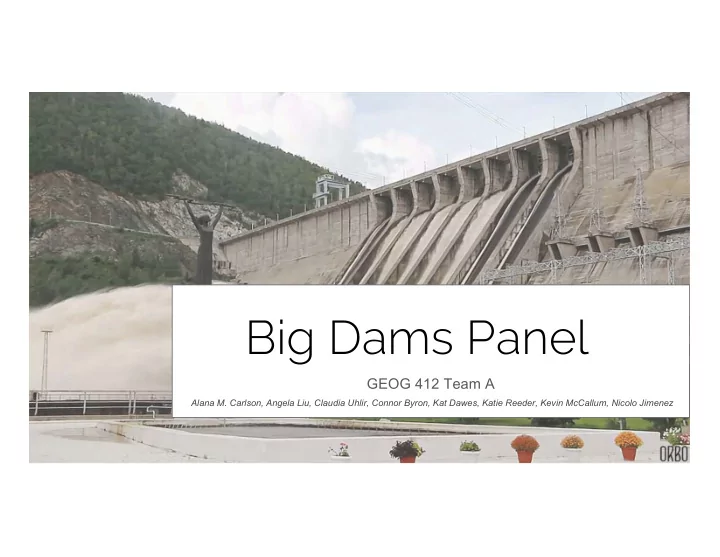
Big Dams Panel

GEOG 412 Team A

Alana M. Carlson, Angela Liu, Claudia Uhlir, Connor Byron, Kat Dawes, Katie Reeder, Kevin McCallum, Nicolo Jimenez
slide-2
SLIDE 2

Outline

  • 1. History of dams
  • 2. Political implications

a. International politics b. Intranational politics

  • 3. The Economics of Dams
  • 4. Environmental effects

a. Abiotic b. Biotic

  • 5. Social consequences
  • 6. Technological Innovation
slide-3
SLIDE 3
slide-4
SLIDE 4

Ancient Dams

@Rapideye

slide-5
SLIDE 5

Early 20th century: 1900s

Aswan Low Dam @Rapideye

slide-6
SLIDE 6

Early 20th century: 1930s

Hoover Dam @Rapideye

slide-7
SLIDE 7

Late 20th century: 1970s

Environmentalist movement @Rapideye

slide-8
SLIDE 8

Late 20th century (1990s) into the 21st century

World Commission on Dams @Rapideye

slide-9
SLIDE 9

Governance Geostrategic Development Foreign Relations

slide-10
SLIDE 10

How to govern?

  • International Law (Binding)
  • International guidelines (Normative rules…

like the World Commission on Dams)

  • Regional: Treaties, agencies, formal

governance institutions. (Binding) What to govern?

  • Compensation for social and

environmental impacts in downstream nations

  • Negotiating discharge volumes
  • Acceptable uses of shared water
slide-11
SLIDE 11

How and why are dams ‘geopolitical’?

  • Consolidating regional power
  • Securing water resources in a warming world.
  • Planning for future needs with trends of social and economic growth
  • Improving foreign relations by sharing benefits of big dams.
  • Aggravating existing diplomatic tensions through competition for water

resources.

Geopolitics

Source: Global Dam Watch

slide-12
SLIDE 12
  • 2018: Turkey’s 1,200 megawatt Ilsu Dam on the Tigris River came online.
  • Ilsu and Turkish goals:

○ Energy sovereignty ○ Growth of agriculture, industry, population. ○ Improvement of national living standards (higher consumption)

  • Turkey, Syria and Iraq share Tigris-Euphrates Basin.
  • Nations have complex, uneven water use agreements.
  • Socioeconomic impacts in Iraq ---> domestic protest, low-level trade war with

Turkey. Image from Global Water Blog

CASE STUDY: Ilsu Dam, Turkey.

slide-13
SLIDE 13

Intra-national Politics and Big Dams

  • Political economy of dam building

and developing state attempts to secure international developmental aid

  • Perceived benefits from projections
  • f demand
  • History of top-down, technocratic

dam management in many nations

  • Nations have simultaneously

incentivized dam building while regulating it

Photo: Construction of the Three Gorges Dam along the Yangtze River in China Source: SceinceSourceImages

slide-14
SLIDE 14

Challenges going forward

  • Local government

circumvention

  • Increasingly lax

standards

  • Project stranding

Photo: abandoned dam at La Colle Falls in Saskatchewan, Canada Source: Jordan Cooper on Flickr

slide-15
SLIDE 15
  • State pressured

to respond to demand projections

  • Removal of

safeguards

  • Lax monitoring
  • Limiting of public

discourse

India and its Increasingly Lax Standards

Photo: hydropower facility in the Indian Himalayas Source: Geotechpedia

slide-16
SLIDE 16

Economics: (Dam)aging Evidence?

Nico Jimenez

slide-17
SLIDE 17

Fun(dam)ental Shifts

Looking Back

  • More than $2 trillion USD in total investments

worldwide in 20th century

  • Peak in 1970s, where an average of two or three

large dams commissioned each day

  • Little regard for social or environmental impacts in

construction or operational costs

Moving Forward

  • Full cost of large dams have emerged as serious

public concern

  • Imperative of integrating a triple bottom line

approach: economically viable, socially equitable, and environmentally sustainable

  • Better and continued monitoring and independent

analyses of dams a necessity

Source: Bhakra Dam, India Source: Triple Bottom Line

slide-18
SLIDE 18

(Dam)ned if we do, (Dam)ned if we don’t

Costs

  • High degree of variability of dams in achieving

technical, financial, and economic targets

  • Substantial cost overruns and tendency towards

delays

Benefits

  • Dams are promoted as an important way to meet

water and energy needs, supporting economic development

  • Services produced by dams are considerable – 12-

16% of world food production, 19% of world electricity supply

Source: Three Gorges Dam, Yangtze RIver Source: Xayaburi Dam Threatens Mekong Basin Food Supply

slide-19
SLIDE 19

(Dam)nified Case Study: Muskrat Falls

  • Original $6.2 billion price tag doubled to

$12.7 billion (CDN) investment

  • Hydroelectric facility one year behind

schedule, pushing Newfoundland economy to brink of bankruptcy

  • Increase provincial gross debt by 50% and

double electricity rates to 23.3 cents per kwh into 2022

Source: Muskrat Falls Dam Source: Muskrat Falls Dam Map

slide-20
SLIDE 20

Environmental Impacts

slide-21
SLIDE 21

Abiotic Environmental Impacts

Alterations to water flow regimes and surrounding ecosystem

  • Timing and amount of discharge
  • Upstream: Stagnation, flooding
  • Downstream: Lack of seasonal variation, reduced peak flows

Alterations to water content

  • Sedimentation, nutrient pollution,

toxic metals accumulation

  • Temperature variations

Climatic Impacts and Carbon Capturing

  • Microclimatic and regional climate

changes

  • Eutrophication and emission of CO2,

CH4, N2O

slide-22
SLIDE 22

La Grande Hydroelectric Complex

Abiotic Environmental Impacts

  • Total mercury (THg) in all fish species studied increased

rapidly after impoundment.

  • Representative of impacts on and of abiotic

environmental components (water composition).

  • A return to average levels: 10–20 years after flooding

(non piscivorous) and 20–31 years (piscivorous), if no additional flooding occurred.

  • Expected average winter runoff rate increase of 52%,

with 6% decrease in summer runoff rate Northern Quebec, Canada: 1973-Present

slide-23
SLIDE 23

Biotic Environmental Impacts

UPSTREAM

  • Impact widespread and varied (ex: dam structure,

sediment, climate)

  • Harmful clearing and repurposing of land.
  • Disruption of free-flowing streams
  • Rise of artificial systems
  • High risk habitats for plants and animals
  • Bottom-up consequences
  • Ex: Sivilay villages (near central Laos) forced to

resettle 4km upstream, further away from necessary resources. DOWNSTREAM

  • Environmental Stream-side degradation
  • Disrupted fish migration
  • Sediment and habitat destruction
  • Overall biodiversity hindered
  • All dependant on variables such as dam size,

location, operation

slide-24
SLIDE 24

CASE STUDIES

CALIFORNIA, US

  • Salmon and Trout have been found to be highly

susceptible to impacts of dams

  • changes in migration between spawning and

rearing habitats.

  • Salmon path blockages have been traced in ~

45% of historical habitats in major rivers (percentages vary by location) BRAZIL

  • Case Study: Três Marias Dam, Central Brazil
  • Large fish population in surrounding areas, risk of

harm due to dam

  • Consequence: many of the migratory fish species are

commonly relied upon in the commercial fisheries

slide-25
SLIDE 25

DAM REMOVAL

  • Restorative goal
  • Unreliable outcome
  • Removal of large dams has a high

risk potential to restore habitat connectivity and flow regimes

  • Endangered species were found to

have a negative response to dam removal .

slide-26
SLIDE 26

Social Impacts

slide-27
SLIDE 27

Site C Dam

slide-28
SLIDE 28

Land Use

slide-29
SLIDE 29

Protest

slide-30
SLIDE 30

What Does the Future Hold?

slide-31
SLIDE 31

Three Gorges Dam

slide-32
SLIDE 32

Displacement

slide-33
SLIDE 33

A Dam Big Mess

slide-34
SLIDE 34

Broken Promises

slide-35
SLIDE 35

Looking to the Future: Technological Innovations

  • Renovating existing dams
  • Policies and practices for building new dams
  • Alternative technologies
slide-36
SLIDE 36

Re-Operating Dams

More than just fixing broken parts, it involves adding new components to diversify the dam and lessen environmental impacts

slide-37
SLIDE 37

Building New Dams

  • EIA’s need to be independently funded and have the power to stop a project
  • The entire water catchment needs to be considered when designing a new dam
slide-38
SLIDE 38

Alternative Hydrokinetic energy

Instream turbine technology is a new for of sustainable hydrokinetic energy which generates power without altering the stream in any major way

slide-39
SLIDE 39

Questions