Beyond the Big Five Extinctions as Experiments in the History of - - PowerPoint PPT Presentation

beyond the big five
SMART_READER_LITE
LIVE PREVIEW

Beyond the Big Five Extinctions as Experiments in the History of - - PowerPoint PPT Presentation

Beyond the Big Five Extinctions as Experiments in the History of Life Rowan Lockwood The College of William and Mary Breakthroughs in Extinction Alvarez et al. (1980) hypothesis that an ET event was responsible for the K/T


slide-1
SLIDE 1

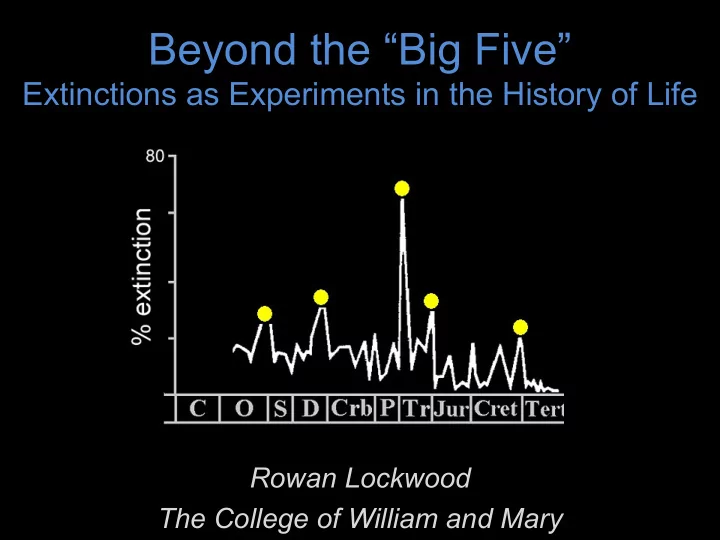
Beyond the “Big Five”

Extinctions as Experiments in the History of Life

Rowan Lockwood The College of William and Mary

slide-2
SLIDE 2

Breakthroughs in Extinction

  • Alvarez et al.

(1980) hypothesis that an ET event was responsible for the K/T extinction

Modified from Alvarez et al. 1980

slide-3
SLIDE 3

Breakthroughs in Extinction

  • Identification of the “Big 5” by Raup and

Sepkoski (1982)

Modified from Raup and Sepkoski 1982

slide-4
SLIDE 4

“Extinction Industry”

  • Handful of papers published in the 1950’s to

1% of all geology papers in 2002

slide-5
SLIDE 5
  • Fossil record is fertile ground for predicting

effects of modern extinction

  • Long time scales and large perturbations
  • History of life has sample size of one
  • Useful to view extinctions as repeated

natural experiments in the history of life

Future Research Directions

slide-6
SLIDE 6

Future Research Directions

  • Will highlight a number of promising

research directions

  • Exploring a central theme— evolutionary

consequences of extinction

  • Focusing on three broad areas
  • 1. Effects of selectivity
  • 2. Importance of recovery intervals
  • 3. Influence of spatial patterns
slide-7
SLIDE 7

Effects of Selectivity

  • Extinctions
  • Eliminate dominant and allow subordinate

taxa to diversify

  • Redirect evo trends by eliminating innovations
  • Limit potential evolution by reducing variability
  • Many of these mechanisms operate via

selectivity

slide-8
SLIDE 8

Selectivity: Trait Variation

  • Majority of studies focus on mean or

dominant traits

  • Ignores trait variation-- prereq for evolution

Modified from Kolbe et al. 2006

slide-9
SLIDE 9

Selectivity: Multivariate Approaches

  • Traditional approach- independent testing of traits
  • Biological traits linked to one another-- which

traits are actually selected for?

  • Tools include regression, path

analysis, structural equation modeling

  • e.g., Harnik 2007, Payne &

Finnegan 2007, Jablonski 2008

Modified from Erwin 1989

slide-10
SLIDE 10

Selectivity: Background Extinction

  • How does selectivity vary across extinctions
  • f different magnitudes and durations?

Modified from Lockwood 2005

slide-11
SLIDE 11

Selectivity: Meta-analyses

  • Several authors have provided reviews of the

selectivity across events and taxonomic levels

  • Missing a quantitative, meta-analytical approach

to this often contradictory literature

  • Recently applied successfully to live-dead studies

and species-energy relationships

Modified from Jablonski 2005

slide-12
SLIDE 12

Importance of Recovery Intervals

  • To understand influence of mass

extinctions on evolutionary patterns, must examine both extinction and recovery

  • Despite recent rise in recovery work, we

still know little about recolonization

  • Unfortunate given potential parallels

between post-extinction recovery and restoration ecology

slide-13
SLIDE 13

Recovery: Selectivity

  • Evolutionary impact of recovery is closely

tied to selectivity; few studies have examined this

  • Failure to recover can be just as important

as failure to survive

  • Prolonged duration of recoveries

increases importance to long-term macroevolutionary trends

slide-14
SLIDE 14

Modified from Lockwood 2004

slide-15
SLIDE 15

Recovery vs. Radiations

  • Repeated nature of

extinctions and recoveries allows us to test hypotheses of phylogenetic versus ecological constraint in the early evolution of clades

  • e.g., Erwin et al.

1987, Foote 1996, 1999

Modified from Erwin et al. 1987

slide-16
SLIDE 16

Recovery: Ecological & Evolutionary trends

  • Few studies have

assessed how trends, from latitudinal diversity gradients to

  • nshore-offshore

patterns of

  • rigination, shift

across recovery intervals

Modified from McGowan 2004

slide-17
SLIDE 17

Influence of Spatial Patterns

  • Studies of extinction often performed at
  • utcrop or global scale
  • Different responses in different regions

can be used as controls in natural experiments of extinction

  • Environmental factors important in one

region may not be in another, allowing us to assess causal mechanisms

slide-18
SLIDE 18

Spatial: Extinction vs. Emigration

  • Difficult to differentiate extinction and
  • rigination from migration
  • Regional studies may help predict which

ecosystems are likely to experience invasion

Modified from Krug and Patzkowsky 2007

slide-19
SLIDE 19

Spatial Autocorrelation

  • Non-independence of samples in space

serious problem for extinction studies

  • Recognized as a potential bias in ecology
  • Can highlight ecologically important

mechanisms such as source-sink dynamics

  • Handful of studies resample patterns

environmentally, but not spatially

slide-20
SLIDE 20

Preservation, Sampling, & Other Factors

  • Understanding of intrinsic and

extrinsic factors that affect extinction metrics

  • Intrinsic factors include variable

sampling, taxonomic standardization, etc.

  • Extrinsic factors include

availability of rock record, sequence architecture, etc.

  • Recent attempts to control for

both yield extremely volatile extinction rates (e.g., Foote 2007; Peters and Ausich 2008)

Modified from Peters and Ausich 2008

slide-21
SLIDE 21

Conclusions I

  • Past century has witnessed significant

breakthroughs in study of extinction in the fossil record

  • Future research directions focus on three

broad research areas

  • 1. Effects of selectivity
  • 2. Importance of recovery intervals
  • 3. Influence of spatial patterns
slide-22
SLIDE 22

Conclusions II

  • Topics explored include:
  • Role that trait variation plays in survivorship
  • Comparative effects of extinctions of varying

magnitudes on evolutionary patterns

  • Re-establishment of patterns in the aftermath
  • f extinction
  • Extent to which spatial autocorrelation affects

extinction patterns

  • Useful to view extinctions as repeated

natural experiments in the history of life and develop hypotheses to explicitly test across multiple events

slide-23
SLIDE 23

Acknowledgments

  • R. Bambach and P. Kelley for developing short

course

  • M. Foote, D. Jablonski, P. Wagner, J. Swaddle,
  • M. Kosnik, P. Kelley, and A. Stigall for useful

feedback

  • ACS Petroleum Research Fund and the Jeffress

Memorial Trust for funding

  • Manuscript developed while a Sabbatical Fellow

at the NCEAS, a Center funded by NSF (Grant #DEB-0553768), the University of California, Santa Barbara, and the State of California