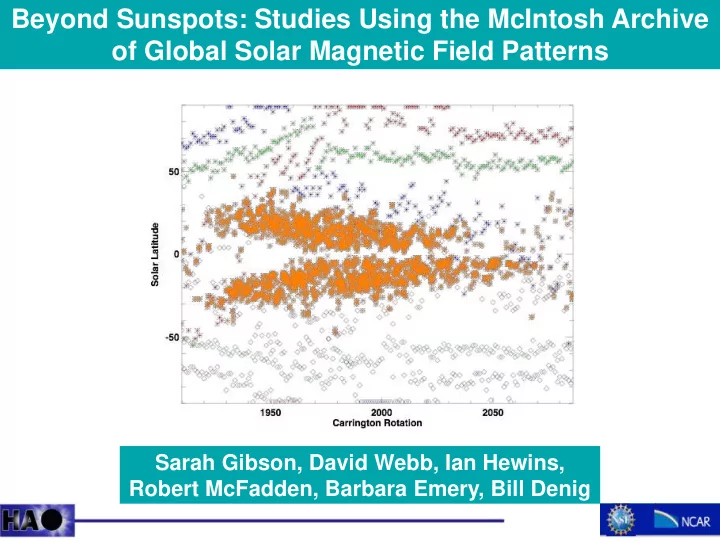
SLIDE 1 Beyond Sunspots: Studies Using the McIntosh Archive
- f Global Solar Magnetic Field Patterns
Sarah Gibson, David Webb, Ian Hewins, Robert McFadden, Barbara Emery, Bill Denig
SLIDE 2
Whole Heliosphere Interval
SLIDE 3 ORIGINAL DIGITIZED
Unique and consistent set of solar Carrington maps drawn by Pat McIntosh Mapping large-scale coronal features over four solar cycles Based on H-alpha, He 10830, and photospheric magnetic
McIntosh Archive: 44 years of solar observations
SLIDE 4
So far SC23 digitized and archived
SLIDE 5
Sunspots, plage, coronal holes, filaments
SLIDE 6
Sunspots, plage, coronal holes, filaments
SLIDE 7
Sunspots, plage, coronal holes, filaments
SLIDE 8
Sunspots, plage, coronal holes, filaments
SLIDE 9
Digital analysis: Sunspots
SLIDE 10
Digital analysis: Sunspots, plage
SLIDE 11
Location of the maximum latitudes of PCFs during SCs 22 and 23 as previously tracked on McIntosh synoptic maps.
Filaments: rush to the poles
SLIDE 12
Digital analysis: Poleward filaments
SLIDE 13
Digital analysis: Sunspots, poleward filaments
SLIDE 14
Coronal holes
SLIDE 15
Digital analysis: Coronal holes (polar and low-lat)
SLIDE 16
Digital analysis: Coronal holes, filaments
SLIDE 17
Digital analysis: Coronal holes, filaments, sunspots
SLIDE 18
CROT 2053 - 2080 ——-> Feb 2007 - May 2009 ——> Stack plots CROT 1488 - 1519 ——->
(McIntosh & Wilson, SP, 1985; McIntosh 2003)
May 1965 - Mar 1967 ——>
Longitude
SLIDE 19
North Polar Zone: N30-N70 South Polar Zone: S30-S70 Equatorial Zone: S20-N20
CROT 1910 - 2086 ——-> June 1996 - July 2009 ——>
0 - 360 longitude 0 - 360 longitude 0 - 360 longitude
SLIDE 20
- Seeking funding to complete the digitization of Cycles 20-22
Conclusions
- Cycle 23 digitized set publicly available by December 2016
(announcement in Solar News)
- Future science applications:
- Coronal hole rotation — where are they rooted?
- Sunspot-filament-coronal hole correlations (evolution study)
- Active longitudes/long-lived low-latitude coronal hole/periodic
solar wind forcing of geospace
- Current status and future plans
- Historical case study context
SLIDE 21
Figure 4 from Knipp et al. (SWxJ, 2016) shows newly digitized maps in SC 20 zooming in on the evolution of “one of the greatest activity complexes of SC 20” (e.g., McIntosh, UAG-70, 1979). The blue box (b) highlights AR 8818, enlarged in (c), which produced a great white-light, proton flare on 23 May 1967. Orange dots are sunspots, images of which are shown in (d) the H wing; (e) H center line; (f) white light. This event had serious space weather implications (Knipp et al., 2016). The 1967 dates centered on these maps are 24 April (CR 1520) and 20 May (CR 1521).
The May 1967 great storm and radio disruption event