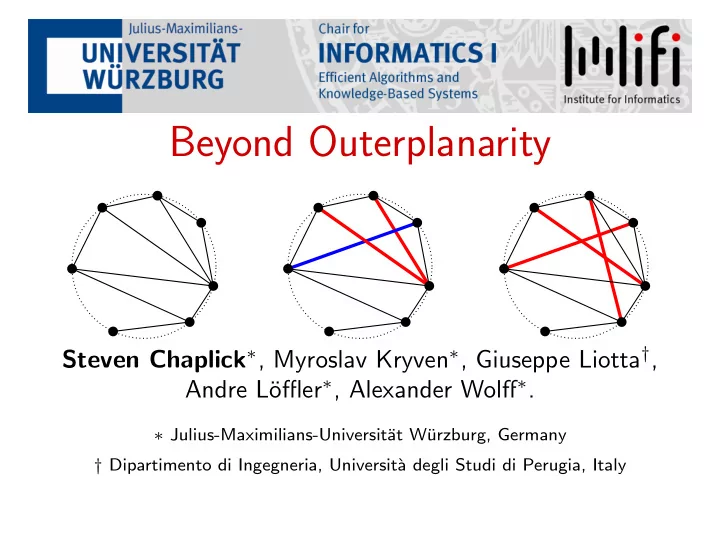
SLIDE 1 Beyond Outerplanarity
Steven Chaplick∗, Myroslav Kryven∗, Giuseppe Liotta†, Andre L¨
- ffler∗, Alexander Wolff∗.
∗ Julius-Maximilians-Universit¨ at W¨ urzburg, Germany † Dipartimento di Ingegneria, Universit` a degli Studi di Perugia, Italy
SLIDE 2
Generalizing Planarity – “nice” crossings
k-planarity: each edge is crossed by ≤ k edges.
SLIDE 3
Generalizing Planarity – “nice” crossings
k-planarity: each edge is crossed by ≤ k edges.
}≤ k
SLIDE 4 Generalizing Planarity – “nice” crossings
k-planarity: each edge is crossed by ≤ k edges. k-quasi-planarity : each k-tuple
- f edges has a non-crossing pair.
}≤ k
4-quasi-planar, but not 3-quasi-planar
SLIDE 5 Generalizing Planarity – “nice” crossings
k-planarity: each edge is crossed by ≤ k edges. k-quasi-planarity : each k-tuple
- f edges has a non-crossing pair.
}≤ k
4-quasi-planar, but not 3-quasi-planar
planarity = 0-planarity = 2-quasi-planarity
SLIDE 6 Generalizing Planarity – “nice” crossings
k-planarity: each edge is crossed by ≤ k edges. k-quasi-planarity : each k-tuple
- f edges has a non-crossing pair.
}≤ k
4-quasi-planar, but not 3-quasi-planar These are quite general ... what about something simpler?
planarity = 0-planarity = 2-quasi-planarity
SLIDE 7 Generalizing Planarity – “nice” crossings
k-planarity: each edge is crossed by ≤ k edges. Outerplanarity: a planar drawing with all vertices on a face. k-quasi-planarity : each k-tuple
- f edges has a non-crossing pair.
}≤ k
4-quasi-planar, but not 3-quasi-planar These are quite general ... what about something simpler?
planarity = 0-planarity = 2-quasi-planarity
SLIDE 8 Generalizing Planarity – “nice” crossings
k-planarity: each edge is crossed by ≤ k edges. Outerplanarity: a planar drawing with all vertices on a face. k-quasi-planarity : each k-tuple
- f edges has a non-crossing pair.
}≤ k
4-quasi-planar, but not 3-quasi-planar These are quite general ... what about something simpler? ≡ straight-line planar drawing w/ vertices in convex position
planarity = 0-planarity = 2-quasi-planarity
SLIDE 9 Generalizing Planarity – “nice” crossings
k-planarity: each edge is crossed by ≤ k edges. Outerplanarity: a planar drawing with all vertices on a face. k-quasi-planarity : each k-tuple
- f edges has a non-crossing pair.
}≤ k
4-quasi-planar, but not 3-quasi-planar These are quite general ... what about something simpler? ≡ straight-line planar drawing w/ vertices in convex position
k-planarity
planarity
planarity = 0-planarity = 2-quasi-planarity
SLIDE 10
Concepts/Problems
Degeneracy: a hereditary graph class is d-degenerate if every graph G in it has a vertex of degree ≤ d. ≤ d G
SLIDE 11
Concepts/Problems
Degeneracy: a hereditary graph class is d-degenerate if every graph G in it has a vertex of degree ≤ d. Obs: d-degenerate → (d + 1)-colorable ≤ d G planar : 5-degenerate; outerplanar : 2-degenerate.
SLIDE 12 Concepts/Problems
Degeneracy: a hereditary graph class is d-degenerate if every graph G in it has a vertex of degree ≤ d. Obs: d-degenerate → (d + 1)-colorable Separation Number (sn): a graph class has sn ≤ k when every graph G in it has a balanced separator of size ≤ k.
≤ 2
3n
≤ 2
3n
≤ k
≤ d G planar : 5-degenerate; outerplanar : 2-degenerate. planar : sn ≤ 2√n; outerplanar : sn ≤ 2 G
} }
SLIDE 13 Concepts/Problems
Degeneracy: a hereditary graph class is d-degenerate if every graph G in it has a vertex of degree ≤ d. Obs: d-degenerate → (d + 1)-colorable Separation Number (sn): a graph class has sn ≤ k when every graph G in it has a balanced separator of size ≤ k.
≤ 2
3n
≤ 2
3n
≤ k
≤ d G planar : 5-degenerate; outerplanar : 2-degenerate. planar : sn ≤ 2√n; outerplanar : sn ≤ 2 G Recognition: Testing for membership in a graph class. both planarity and outerplanarity can be tested in linear time.
} }
SLIDE 14 Background : General Drawings
k-planar graphs – introduced by Ringel ’65.
√ k [Pach, T´
→ 8.216 √ k-degenerate (via avg. degree)
√ kn) treewidth [Dujmovi´ c, Eppstein, Wood ’17] → sn ∈ O( √ kn) k-quasi-planar graphs
- Edge density: (n log n)2α(n)ck
[Fox, Pach, Suk ’13] Conjectured to be ckn [Pach et al ’96]
- 1-planarity testing is NP-hard
[Grigoriev, Bodlaender ’07]
- k-planar ⊂ (k + 1)-quasi-planar:
k > 2 [Angelini et al ’17], k = 2 [Hoffmann, T´
Comparing Classes:
SLIDE 15 Background : Outer Drawings
Outer k-crossing (≤ k crossings in the whole drawing)
√ k) treewidth → sn ∈ O( √ k)
- Ext. Monadic Second Order Logic
(MSO2) formula for outer k-crossing → testing outer k-crossing in time O(f (k)(n + m)) [Bannister, Eppstein ’14]
}
SLIDE 16 Background : Outer Drawings
Outer k-planarity Outer k-crossing (≤ k crossings in the whole drawing)
√ k) treewidth → sn ∈ O( √ k)
- Ext. Monadic Second Order Logic
(MSO2) formula for outer k-crossing → testing outer k-crossing in time O(f (k)(n + m)) [Bannister, Eppstein ’14]
- treewidth ≤ 3k + 11 → sn ≤ 3k + 12
[Wood, Telle ’07]
- Recognition:
- uter 1-planar in linear time [Auer et al ’16, Hong et al ’15]
full outer 2-planar in linear time [Hong, Nagamochi ’16]
}
SLIDE 17 Background : Outer Drawings
Outer k-planarity Outer k-quasi-planarity Outer k-crossing (≤ k crossings in the whole drawing)
√ k) treewidth → sn ∈ O( √ k)
- Ext. Monadic Second Order Logic
(MSO2) formula for outer k-crossing → testing outer k-crossing in time O(f (k)(n + m)) [Bannister, Eppstein ’14]
- treewidth ≤ 3k + 11 → sn ≤ 3k + 12
[Wood, Telle ’07]
- Edge density: ≤ 2(k − 1)n −
2k−1
2
→ (4k − 5)-degenerate
- Recognition:
- uter 1-planar in linear time [Auer et al ’16, Hong et al ’15]
full outer 2-planar in linear time [Hong, Nagamochi ’16]
}
SLIDE 18 Results
Outer k-planar graphs
√ 4k + 1⌋ + 1)-degenerate → (⌊ √ 4k + 1⌋ + 2)-colorable
- separation number ≤ 2k + 3 → quasi-poly time recognition
SLIDE 19 Results
Outer k-planar graphs
√ 4k + 1⌋ + 1)-degenerate → (⌊ √ 4k + 1⌋ + 2)-colorable
- separation number ≤ 2k + 3 → quasi-poly time recognition
Outer k-quasi-planar graphs
- Outer 3-quasi planarity is incomparable with planarity
- edge maximal drawings
SLIDE 20 Results
Outer k-planar graphs
√ 4k + 1⌋ + 1)-degenerate → (⌊ √ 4k + 1⌋ + 2)-colorable
- separation number ≤ 2k + 3 → quasi-poly time recognition
Outer k-quasi-planar graphs
- Outer 3-quasi planarity is incomparable with planarity
- edge maximal drawings
Closed Drawings in MSO2
- closed outer k-planarity and
closed outer k-quasi-planarity can be expressed in MSO2
SLIDE 21 Outline
Outer k-planar graphs
√ 4k + 1⌋ + 1)-degenerate → (⌊ √ 4k + 1⌋ + 2)-colorable
- separation number ≤ 2k + 3 → quasi-poly time recognition
Outer k-quasi-planar graphs
- Outer 3-quasi planarity is incomparable with planarity
- edge maximal drawings
Closed Drawings in MSO2
- closed outer k-planarity and
closed outer k-quasi-planarity can be expressed in MSO2
SLIDE 22
Outer k-planarity
Obs: An outer k-planar clique has ≤ ⌊ √ 4k + 1⌋ + 2 vertices
SLIDE 23 Outer k-planarity
Obs: An outer k-planar clique has ≤ ⌊ √ 4k + 1⌋ + 2 vertices a b
- a complete bipartite graph crosses ab.
Proof:
SLIDE 24 Outer k-planarity
Obs: An outer k-planar clique has ≤ ⌊ √ 4k + 1⌋ + 2 vertices a b
- a complete bipartite graph crosses ab.
- thus, for even n, k ≥ ( n−2
2 )2, and
for odd n, k ≥ 1
4(n − 3)(n − 1)
→ n ≤ ⌊ √ 4k + 1⌋ + 2 Proof:
SLIDE 25
Outer k-planarity
Obs: An outer k-planar clique has ≤ ⌊ √ 4k + 1⌋ + 2 vertices Thm: outer k-planar graphs are (⌊ √ 4k + 1⌋ + 1)-degenerate.
SLIDE 26
Outer k-planarity
Obs: An outer k-planar clique has ≤ ⌊ √ 4k + 1⌋ + 2 vertices Thm: outer k-planar graphs are (⌊ √ 4k + 1⌋ + 1)-degenerate. Proof (idea): a b Suppose, ≥ ℓ vertices left of ab, w/ deg. ≥ δ. ≥ δ ℓ ≤
SLIDE 27
Outer k-planarity
Obs: An outer k-planar clique has ≤ ⌊ √ 4k + 1⌋ + 2 vertices Thm: outer k-planar graphs are (⌊ √ 4k + 1⌋ + 1)-degenerate. Proof (idea): a b Suppose, ≥ ℓ vertices left of ab, w/ deg. ≥ δ. → δℓ − ℓ(ℓ + 1) edges cross ab ≥ δ ℓ ≤
SLIDE 28 Outer k-planarity
Obs: An outer k-planar clique has ≤ ⌊ √ 4k + 1⌋ + 2 vertices Thm: outer k-planar graphs are (⌊ √ 4k + 1⌋ + 1)-degenerate. Proof (idea): a b Suppose, ≥ ℓ vertices left of ab, w/ deg. ≥ δ. → δℓ − ℓ(ℓ + 1) edges cross ab ≥ δ Note: δ > ⌊ √ 4k + 1⌋ + 1, ℓ = ⌊ 1
2
√ 4k + 1⌋ + 1 is not possible by the proof of Obs. ℓ ≤
SLIDE 29 Outer k-planarity
Obs: An outer k-planar clique has ≤ ⌊ √ 4k + 1⌋ + 2 vertices Thm: outer k-planar graphs are (⌊ √ 4k + 1⌋ + 1)-degenerate. Proof (idea): a b Suppose, ≥ ℓ vertices left of ab, w/ deg. ≥ δ. → δℓ − ℓ(ℓ + 1) edges cross ab ≥ δ Note: δ > ⌊ √ 4k + 1⌋ + 1, ℓ = ⌊ 1
2
√ 4k + 1⌋ + 1 is not possible by the proof of Obs. Proceed by induction on the range [ℓ, ℓ∗] where there can be no edge with any x ∈ [ℓ, ℓ∗] vertices on it’s left. ℓ ≤
SLIDE 30 Outer k-planarity
Obs: An outer k-planar clique has ≤ ⌊ √ 4k + 1⌋ + 2 vertices Thm: outer k-planar graphs are (⌊ √ 4k + 1⌋ + 1)-degenerate. Proof (idea): a b Suppose, ≥ ℓ vertices left of ab, w/ deg. ≥ δ. → δℓ − ℓ(ℓ + 1) edges cross ab ≥ δ Note: δ > ⌊ √ 4k + 1⌋ + 1, ℓ = ⌊ 1
2
√ 4k + 1⌋ + 1 is not possible by the proof of Obs. Proceed by induction on the range [ℓ, ℓ∗] where there can be no edge with any x ∈ [ℓ, ℓ∗] vertices on it’s left. ℓ ≤ Cor: Outer k-planarity → (⌊ √ 4k + 1⌋ + 2)-colorable (tight).
SLIDE 31
Outer k-planarity
Thm: Outer k-planar graphs have sn ≤ 2k + 3, and such separators imply quasi-polynomial time (2polylog(n)) recognition. i.e., assuming ETH, recognition is not NP-hard. Proof (sketch):
SLIDE 32 Outer k-planarity
Thm: Outer k-planar graphs have sn ≤ 2k + 3, and such separators imply quasi-polynomial time (2polylog(n)) recognition. i.e., assuming ETH, recognition is not NP-hard. Proof (sketch): a b
2n 3 >
< 2n
3
sn ≤ k + 2 Easy case:
SLIDE 33 Outer k-planarity
Thm: Outer k-planar graphs have sn ≤ 2k + 3, and such separators imply quasi-polynomial time (2polylog(n)) recognition. i.e., assuming ETH, recognition is not NP-hard. Proof (sketch): a b
n 2 >
< n
2
SLIDE 34 Outer k-planarity
Thm: Outer k-planar graphs have sn ≤ 2k + 3, and such separators imply quasi-polynomial time (2polylog(n)) recognition. i.e., assuming ETH, recognition is not NP-hard. Proof (sketch): a b
n 2 >
< n
2
a b Case 1: edge a′b′
a′ first after a b′ first after b.
a′ b′
SLIDE 35 Outer k-planarity
Thm: Outer k-planar graphs have sn ≤ 2k + 3, and such separators imply quasi-polynomial time (2polylog(n)) recognition. i.e., assuming ETH, recognition is not NP-hard. Proof (sketch): a b
n 2 >
< n
2
a b Case 1: edge a′b′
a′ first after a b′ first after b.
a′ b′
SLIDE 36 Outer k-planarity
Thm: Outer k-planar graphs have sn ≤ 2k + 3, and such separators imply quasi-polynomial time (2polylog(n)) recognition. i.e., assuming ETH, recognition is not NP-hard. Proof (sketch): a b
n 2 >
< n
2
a b Case 1: edge a′b′
a′ first after a b′ first after b.
a′ b′ sn ≤ k + 3
SLIDE 37 Outer k-planarity
Thm: Outer k-planar graphs have sn ≤ 2k + 3, and such separators imply quasi-polynomial time (2polylog(n)) recognition. i.e., assuming ETH, recognition is not NP-hard. Proof (sketch): a b
n 2 >
< n
2
a b a b Case 1: edge a′b′
a′ first after a b′ first after b.
a′ b′ Case 2: parallel edges a′b′′, a′′b′ a′ a′′ b′ b′′ sn ≤ k + 3
SLIDE 38 Outer k-planarity
Thm: Outer k-planar graphs have sn ≤ 2k + 3, and such separators imply quasi-polynomial time (2polylog(n)) recognition. i.e., assuming ETH, recognition is not NP-hard. Proof (sketch): a b
n 2 >
< n
2
a b a b Case 1: edge a′b′
a′ first after a b′ first after b.
a′ b′ Case 2: parallel edges a′b′′, a′′b′ a′ a′′ b′ b′′ sn ≤ k + 3 take close pair ...
SLIDE 39 Outer k-planarity
Thm: Outer k-planar graphs have sn ≤ 2k + 3, and such separators imply quasi-polynomial time (2polylog(n)) recognition. i.e., assuming ETH, recognition is not NP-hard. Proof (sketch): a b
n 2 >
< n
2
a b a b Case 1: edge a′b′
a′ first after a b′ first after b.
a′ b′ Case 2: parallel edges a′b′′, a′′b′ a′ a′′ b′ b′′ sn ≤ k + 3 take close pair ... sn ≤ 2k + 3
SLIDE 40 Outline
Outer k-planar graphs
√ 4k + 1⌋ + 1)-degenerate → (⌊ √ 4k + 1⌋ + 2)-colorable
- separation number ≤ 2k + 3 → quasi-poly time recognition
Outer k-quasi-planar graphs
- Outer 3-quasi planarity is incomparable with planarity
- edge maximal drawings
Closed Drawings in MSO2
- closed outer k-planarity and
closed outer k-quasi-planarity can be expressed in MSO2
SLIDE 41
Outer k-quasi-planarity
Thm: Planarity and outer 3-quasi-planarity are incomparable.
SLIDE 42
Outer k-quasi-planarity
Thm: Planarity and outer 3-quasi-planarity are incomparable. Obs 1: K4,4 and K5 are outer 3-quasi-planar.
SLIDE 43 Outer k-quasi-planarity
Thm: Planarity and outer 3-quasi-planarity are incomparable. Obs 1: K4,4 and K5 are outer 3-quasi-planar. Obs 2: planar 3-trees with ≥ 3 complete levels are not
SLIDE 44 Outer k-quasi-planarity
Thm: Planarity and outer 3-quasi-planarity are incomparable. Obs 1: K4,4 and K5 are outer 3-quasi-planar. Obs 2: planar 3-trees with ≥ 3 complete levels are not
(proof via SAT formulation)
SLIDE 45 Outer k-quasi-planarity
Thm: Planarity and outer 3-quasi-planarity are incomparable. Obs 1: K4,4 and K5 are outer 3-quasi-planar. Obs 2: planar 3-trees with ≥ 3 complete levels are not
(proof via SAT formulation) vertex minimal example:
SLIDE 46 Outer k-quasi-planarity
Thm: Planarity and outer 3-quasi-planarity are incomparable. Obs 1: K4,4 and K5 are outer 3-quasi-planar. Obs 2: planar 3-trees with ≥ 3 complete levels are not
(proof via SAT formulation) vertex minimal example:
SLIDE 47 Outer k-quasi-planarity
Thm: Planarity and outer 3-quasi-planarity are incomparable. Obs 1: K4,4 and K5 are outer 3-quasi-planar. Obs 2: planar 3-trees with ≥ 3 complete levels are not
(proof via SAT formulation) vertex minimal example:
SLIDE 48 Edge maximal outer k-quasi-planar drawings
Thm: Each edge maximal outer k-quasi-planar drawing of G = (V , E) has |E| = |V |
2
2(k − 1)|V | − 2k−1
2
SLIDE 49 Edge maximal outer k-quasi-planar drawings
Some equivalent questions: Thm: Each edge maximal outer k-quasi-planar drawing of G = (V , E) has |E| = |V |
2
2(k − 1)|V | − 2k−1
2
SLIDE 50 Edge maximal outer k-quasi-planar drawings
Some equivalent questions: For a convex n-gon, how many chords can be inserted without making k pairwise crossings? [Nakamigawa ’00] Thm: Each edge maximal outer k-quasi-planar drawing of G = (V , E) has |E| = |V |
2
2(k − 1)|V | − 2k−1
2
SLIDE 51 Edge maximal outer k-quasi-planar drawings
Some equivalent questions: For a convex n-gon, how many chords can be inserted without making k pairwise crossings? [Nakamigawa ’00] What is the biggest line arrangment in the hyperbolic plane with ≤ n points at ∞ and without k mutually crossing lines (Karzanov number ≤ k − 1) ? [Dress et al. 2002] Thm: Each edge maximal outer k-quasi-planar drawing of G = (V , E) has |E| = |V |
2
2(k − 1)|V | − 2k−1
2
SLIDE 52 Results
Outer k-planar graphs
√ 4k + 1⌋ + 1)-degenerate → (⌊ √ 4k + 1⌋ + 2)-colorable.
- separation number ≤ 2k + 3 → quasi-poly time recognition.
Outer k-quasi-planar graphs
- Outer 3-quasi planarity is incomparable with planarity
- edge maximal drawings
Closed Drawings in MSO2
closed k-quasi-planarity can be expressed in MSO2.
SLIDE 53
Monadic Second Order Logic (MSO2)
Thm (Courcelle): If a property P is expressed as ϕ ∈ MSO2, then for every graph G with treewidth at most t, P can be tested in time O(f (t, |ϕ|)(n + m)) for a computable function f .
SLIDE 54
Monadic Second Order Logic (MSO2)
Thm (Courcelle): If a property P is expressed as ϕ ∈ MSO2, then for every graph G with treewidth at most t, P can be tested in time O(f (t, |ϕ|)(n + m)) for a computable function f . But, what is MSO2 again?
SLIDE 55
Monadic Second Order Logic (MSO2)
Thm (Courcelle): If a property P is expressed as ϕ ∈ MSO2, then for every graph G with treewidth at most t, P can be tested in time O(f (t, |ϕ|)(n + m)) for a computable function f . But, what is MSO2 again? Partition(A, B, C) ≡ (∀u)[(u ∈ A ∨ u ∈ B ∨ u ∈ C) ∧(u ∈ A → (u / ∈ B ∧ u / ∈ C)) ∧ (u ∈ B → (...)) ∧ (...)]
SLIDE 56 Monadic Second Order Logic (MSO2)
Thm (Courcelle): If a property P is expressed as ϕ ∈ MSO2, then for every graph G with treewidth at most t, P can be tested in time O(f (t, |ϕ|)(n + m)) for a computable function f . But, what is MSO2 again? Formally:
- variables: vertices, edges, sets of vertices, and sets of edges;
- binary relations: equality (=), set membership (∈), subset
- f a set (⊆), and edge–vertex incidence (I);
- standard propositional logic operators: ¬, ∧, ∨, →, ↔.
- standard quantifiers (∀, ∃).
Partition(A, B, C) ≡ (∀u)[(u ∈ A ∨ u ∈ B ∨ u ∈ C) ∧(u ∈ A → (u / ∈ B ∧ u / ∈ C)) ∧ (u ∈ B → (...)) ∧ (...)]
SLIDE 57
Encoding a Crossing in MSO2
e e′ V-Partition(A, B, C) ≡ (A, B, C) is a partition of the vertex set.
SLIDE 58
Encoding a Crossing in MSO2
e e′ A B C V-Partition(A, B, C) ≡ (A, B, C) is a partition of the vertex set.
SLIDE 59
Encoding a Crossing in MSO2
Conn(V , E) ≡ the graph (V,E) is connected. e e′ A B C V-Partition(A, B, C) ≡ (A, B, C) is a partition of the vertex set.
SLIDE 60
Encoding a Crossing in MSO2
Conn(V , E) ≡ the graph (V,E) is connected. e e′ A B C Hamiltonian(E ∗) ≡ The edge set E ∗ is a Hamiltonian cycle in the graph G. V-Partition(A, B, C) ≡ (A, B, C) is a partition of the vertex set.
SLIDE 61 Encoding a Crossing in MSO2
Conn(V , E) ≡ the graph (V,E) is connected. Crossing(E ∗, e, e′) ≡ (∀A, B, C)
∧ (x ∈ C ↔ I(e, x)) ∧ Conn(A, E ∗) ∧ Conn(B, E ∗)
- → (∃a ∈ A)(∃b ∈ B)[I(e′, a) ∧ I(e′, b)]
- e
e′ A B C Hamiltonian(E ∗) ≡ The edge set E ∗ is a Hamiltonian cycle in the graph G. V-Partition(A, B, C) ≡ (A, B, C) is a partition of the vertex set.
SLIDE 62 Implications of our MSO2 formulae
- closed drawings which are k-planar or k-quasi planar can
be expressed in MSO2.
- closed k-planarity can be tested in linear FPT-time
(parameterized by k).
- closed k-quasi-planarity can be tested in linear FPT-time
(parameterized by both k and treewidth).
- Note: edge maximal outer k-planarity ⊂ closed k-planarity.
→ efficient testing of edge maximal outer k-planarity.
SLIDE 63 Implications of our MSO2 formulae
- closed drawings which are k-planar or k-quasi planar can
be expressed in MSO2.
- closed k-planarity can be tested in linear FPT-time
(parameterized by k).
- closed k-quasi-planarity can be tested in linear FPT-time
(parameterized by both k and treewidth).
- Note: edge maximal outer k-planarity ⊂ closed k-planarity.
→ efficient testing of edge maximal outer k-planarity. Can these expressions be generalized to full drawings? no crossing “visible” from “outside”
SLIDE 64 Implications of our MSO2 formulae
- closed drawings which are k-planar or k-quasi planar can
be expressed in MSO2.
- closed k-planarity can be tested in linear FPT-time
(parameterized by k).
- closed k-quasi-planarity can be tested in linear FPT-time
(parameterized by both k and treewidth).
- Note: edge maximal outer k-planarity ⊂ closed k-planarity.
→ efficient testing of edge maximal outer k-planarity. Can these expressions be generalized to full drawings? no crossing “visible” from “outside” full outer 2-planarity testing in linear time [Hong, Nagamochi ’16]
SLIDE 65 Conclusion
Outer k-planar graphs:
- tight bounds on degeneracy, and chromatic number.
Quasi-polynomial time recognition via balanced separators, closed drawings testable in linear time.
- Open: polytime recognition for all k > 1.
SLIDE 66 Conclusion
Outer k-planar graphs:
- tight bounds on degeneracy, and chromatic number.
Quasi-polynomial time recognition via balanced separators, closed drawings testable in linear time.
- Open: polytime recognition for all k > 1.
Outer k-quasi-planar graphs:
- outer 3-quasi-planarity is incomparable with planarity.
Open: planarity vs. outer 4-quasi-planarity.
- closed drawings are expressible in MSO2.
Open: recognition both in general and for closed drawings.
- Open: tight bounds on: degeneracy, chromatic number,
page number.
SLIDE 67 Conclusion
Thank you for your attention :-) Outer k-planar graphs:
- tight bounds on degeneracy, and chromatic number.
Quasi-polynomial time recognition via balanced separators, closed drawings testable in linear time.
- Open: polytime recognition for all k > 1.
Outer k-quasi-planar graphs:
- outer 3-quasi-planarity is incomparable with planarity.
Open: planarity vs. outer 4-quasi-planarity.
- closed drawings are expressible in MSO2.
Open: recognition both in general and for closed drawings.
- Open: tight bounds on: degeneracy, chromatic number,
page number.