
WELCOA’S ONLINE BULLETIN FOR YOUR FA MILY’S SAFET Y
BETTERSAFE
National Asthma & Allergy Awareness Month
HOW TO CARE FOR YOURSELF AND OTHERS WITH ASTHMA & ALLERGIES
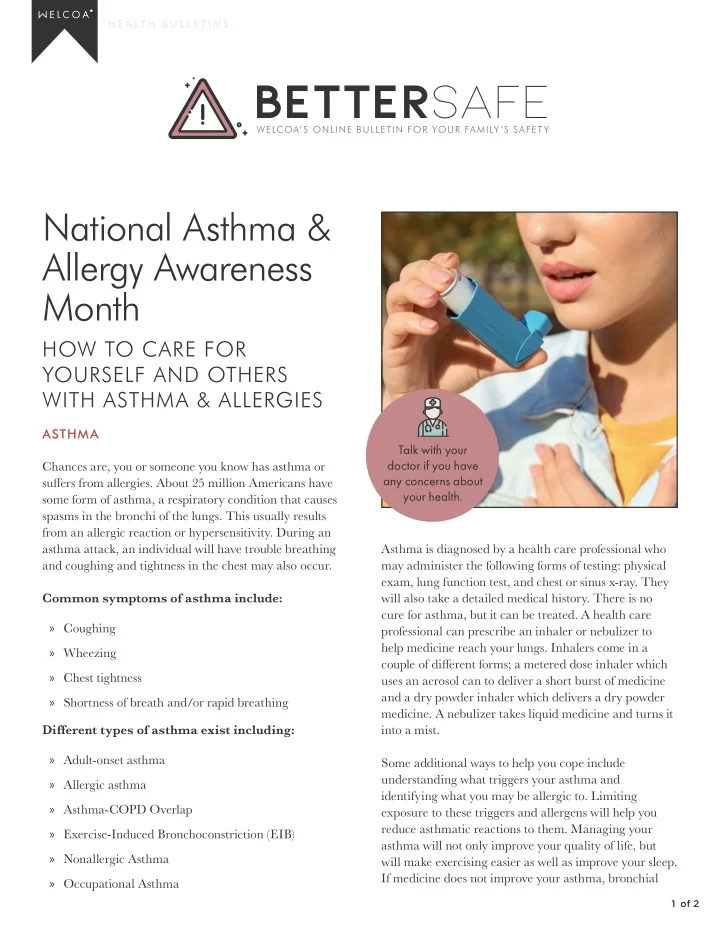
ASTHMA Chances are, you or someone you know has asthma or sufgers from allergies. About 25 million Americans have some form of asthma, a respiratory condition that causes spasms in the bronchi of the lungs. This usually results from an allergic reaction or hypersensitivity. During an asthma attack, an individual will have trouble breathing and coughing and tightness in the chest may also occur. Common symptoms of asthma include: » Coughing » Wheezing » Chest tightness » Shortness of breath and/or rapid breathing Difgerent types of asthma exist including: » Adult-onset asthma » Allergic asthma » Asthma-COPD Overlap » Exercise-Induced Bronchoconstriction (EIB) » Nonallergic Asthma » Occupational Asthma Asthma is diagnosed by a health care professional who may administer the following forms of testing: physical exam, lung function test, and chest or sinus x-ray. They will also take a detailed medical history. There is no cure for asthma, but it can be treated. A health care professional can prescribe an inhaler or nebulizer to help medicine reach your lungs. Inhalers come in a couple of difgerent forms; a metered dose inhaler which uses an aerosol can to deliver a short burst of medicine and a dry powder inhaler which delivers a dry powder
- medicine. A nebulizer takes liquid medicine and turns it
into a mist. Some additional ways to help you cope include understanding what triggers your asthma and identifying what you may be allergic to. Limiting exposure to these triggers and allergens will help you reduce asthmatic reactions to them. Managing your asthma will not only improve your quality of life, but will make exercising easier as well as improve your sleep. If medicine does not improve your asthma, bronchial
H E A LT H B U L L E T I N S
- f 2
1
Talk with your doctor if you have any concerns about your health.