BestFaceForward More than skin deep chambers of the eyes, cochlea - - PowerPoint PPT Presentation

bestfaceforward
SMART_READER_LITE
LIVE PREVIEW

BestFaceForward More than skin deep chambers of the eyes, cochlea - - PowerPoint PPT Presentation

M | Body & Spa BestFaceForward More than skin deep chambers of the eyes, cochlea and dura mater. Esthetic effects are usually seen right away. When I do a To understand the specific role of Lymph Drainage class demonstration using Lymph


slide-1
SLIDE 1

22 | MASSAGE Magazine | February 2012 | www.massagemag.com |

|Body & Spa

M

W

ith the baby boomer generation in its middle-to-senior years and the nation’s interest in natural therapies growing, an increasing number of clients is looking for therapeutic techniques to stave off and even reverse the signs of aging. Of the battery of manual techniques I have learned over my lifetime as a medical doctor and

  • steopath, I have found those working with the

lymphatic system—Lymph Drainage Therapy, in particular—are on the top of the list in terms of effective esthetic applications. Lymph Drainage Therapy utilizes light, rhythmic, relaxing strokes that clients find

  • soothing. They especially appreciate the

improvement in facial skin tone and texture that may be achieved, giving the appearance of a mini face-lift. Moreover, the effects of lymphatic drainage are seen fairly rapidly, and the cost to the client is far less than invasive procedures and many anti- aging products on the market.

The Mini Face-Lift Effects of Lymph Drainage Therapy

BestFaceForward

by Bruno Chikly, M.D., D.O.

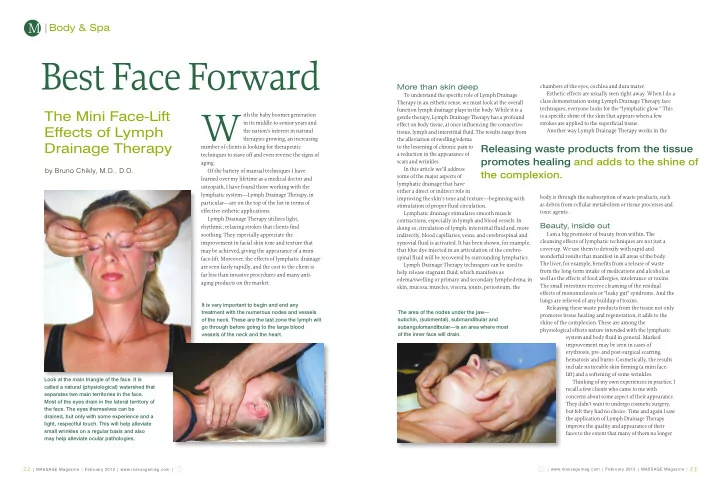
Look at the main triangle of the face. It is called a natural (physiological) watershed that separates two main territories in the face. Most of the eyes drain in the lateral territory of the face. The eyes themselves can be drained, but only with some experience and a light, respectful touch. This will help alleviate small wrinkles on a regular basis and also may help alleviate ocular pathologies. It is very important to begin and end any treatment with the numerous nodes and vessels

  • f the neck. These are the last zone the lymph will

go through before going to the large blood vessels of the neck and the heart.

More than skin deep

To understand the specific role of Lymph Drainage Therapy in an esthetic sense, we must look at the overall function lymph drainage plays in the body. While it is a gentle therapy, Lymph Drainage Therapy has a profound effect on body tissue, at once influencing the connective tissue, lymph and interstitial fluid. The results range from the alleviation of swelling/edema to the lessening of chronic pain to a reduction in the appearance of scars and wrinkles. In this article we’ll address some of the major aspects of lymphatic drainage that have either a direct or indirect role in improving the skin’s tone and texture—beginning with stimulation of proper fluid circulation. Lymphatic drainage stimulates smooth muscle contractions, especially in lymph and blood vessels. In doing so, circulation of lymph, interstitial fluid and, more indirectly, blood capillaries, veins, and cerebrospinal and synovial fluid is activated. It has been shown, for example, that blue dye injected in an articulation of the cerebro- spinal fluid will be recovered by surrounding lymphatics. Lymph Drainage Therapy techniques can be used to help release stagnant fluid, which manifests as edema/swelling or primary and secondary lymphedema, in skin, mucosa, muscles, viscera, joints, periosteum, the chambers of the eyes, cochlea and dura mater. Esthetic effects are usually seen right away. When I do a class demonstration using Lymph Drainage Therapy face techniques, everyone looks for the “lymphatic glow.” This is a specific shine of the skin that appears when a few strokes are applied to the superficial tissue. Another way Lymph Drainage Therapy works in the body is through the reabsorption of waste products, such as debris from cellular metabolism or tissue processes and toxic agents.

Beauty, inside out

I am a big promoter of beauty from within. The cleansing effects of lymphatic techniques are not just a cover-up. We use them to detoxify with rapid and wonderful results that manifest in all areas of the body. The liver, for example, benefits from a release of waste from the long-term intake of medications and alcohol, as well as the effects of food allergies, intolerance or toxins. The small intestines receive cleansing of the residual effects of mononucleosis or “leaky gut” syndrome. And the lungs are relieved of any buildup of toxins. Releasing these waste products from the tissue not only promotes tissue healing and regeneration, it adds to the shine of the complexion. These are among the physiological effects nature intended with the lymphatic system and body fluid in general. Marked improvement may be seen in cases of erythrosis, pre- and post-surgical scarring, hematosis and burns. Cosmetically, the results include noticeable skin firming (a mini face- lift) and a softening of some wrinkles. Thinking of my own experiences in practice, I recall a few clients who came to me with concerns about some aspect of their appearance. They didn’t want to undergo cosmetic surgery, but felt they had no choice. Time and again I saw the application of Lymph Drainage Therapy improve the quality and appearance of their faces to the extent that many of them no longer The area of the nodes under the jaw— subchin, (submental), submandibular and subangulomandibular—is an area where most

  • f the inner face will drain.
| www.massagemag.com | February 2012 | MASSAGE Magazine | 23

Releasing waste products from the tissue promotes healing and adds to the shine of the complexion.

PHOTOS COURTESY OF THE CHIKLY HEALTH INSTITUTE
slide-2
SLIDE 2

Nuances of esthetic Lymph Drainage Therapy

To achieve the profound esthetic responses spoken of here, it is important for the Lymph Drainage Therapy practitioner to study the specific network of vessels in the face and neck, as well as possible contraindications. The human body houses a total of 500 to 750 nodes. Of those, approximately 250 are in the neck area. This huge network of thin lymphatic vessels throughout the body is easy to engage because the vessels are often located right under the skin. Their anatomy is specific and doesn’t follow the anatomy of muscle, fascia, arteries or veins you may have studied. As far as application, I always recommend Lymph Drainage Therapy practitioners initially apply shorter lymph sessions to new clients to see how they react to the

  • therapy. This is especially wise if the client has an important

event coming up, such as a wedding or other occasion where she will be out in public. This is just a precaution in case the client has a reaction to the detoxification process. This is not so much the case with advanced lymph practitioners who know how to properly drain the liver. Many clients have numerous toxins in their body and are not used to deeply cleansing bodywork like this. A Lymph Drainage Therapy student told of working on a new client who requested a full lymph session in the first appointment. The client was a yoga teacher who jogged every day and ate a healthy, organic diet, so she requested a full session. Afterward, she felt as if she had been “hit by a truck.” The practitioner and client hadn’t anticipated the fact that lymphatic work cleans deep as well as superficial compartments of the body, areas not always impacted by the benefits of sports and other disciplines. Other reactions may include flu-like symptoms or even small skin reactions if the initial sessions are too long. Clients should always be advised to drink a lot of water prior to an appointment in order to help prevent these reactions.

Getting started

As a massage therapist, you may not consider esthetics as a major application of your work. As a medical doctor and an osteopath, I had the same initial reaction. But the amazing esthetic responses I witnessed in client after client made me reconsider some of the applications of lymph work. Still, how do you successfully incorporate esthetic Lymph Drainage Therapy into your practice once you have the skills? It is a question I often receive from practitioners

  • f all disciplines. One of the best success stories I have heard

came from a massage therapist who relocated to another state, leaving behind a thriving practice.

| www.massagemag.com | February 2012 | MASSAGE Magazine | 25

|Body & Spa

M

felt they needed to have surgery. One note I received from a client after three Lymph Drainage Therapy sessions read: “My face changed so dramatically, a friend politely asked me if I had had a face-lift.” Two other actions of lymph drainage are known for how they influence both general health and local cutaneous

  • inflammation. They involve the reabsorption of

macromolecules (large proteins) and the stimulation of the immune system. Lymph Drainage Therapy helps to eliminate protein-rich fluid from the extracellular tissue, which assists in the reabsorption of inflammation and edema. In addition, increasing the transport of lymph in the lymph nodes stimulates the humoral and cellular immunity. Lymphatic techniques have been found to help with chronic or subacute inflammatory processes that include bronchitis, sinusitis and laryngitis, as well as acne and

  • eczema. Numerous local skin problems related to stress,

hormones, food intake, infection, scars and post-surgical conditions can be alleviated with Lymph Drainage Therapy. This brings us to the deeply relaxing effects of Lymph Drainage Therapy that result from stimulation of the parasympathic response. Lymph Drainage Therapy‘s gentle on-off touch to the skin can be almost clinically hypnotic to the client, and it can rapidly stimulate parasympathetic response (sympatholytic action). By stimulating parasympathetic tone, Lymph Drainage Therapy can trigger deep relaxation along with antispastic and antalgic effects. This is beneficial in cases of stress, loss

  • f vitality and insomnia. By releasing skin tension, Lymph

Drainage Therapy helps tissue to regenerate and oxygenate, thereby improving overall facial beauty. Also by stimulating parasympathetic tone, Lymph Drainage Therapy naturally decreases muscle spasms (voluntary and involuntary) and relaxes facial muscles with hypersympathetic tone.

Skin problems related to stress, hormones, food intake, infection, scars and post-surgical conditions can be alleviated with Lymph Drainage Therapy.

24 | MASSAGE Magazine | February 2012 | www.massagemag.com |

slide-3
SLIDE 3

26 | MASSAGE Magazine | February 2012 | www.massagemag.com |

|Body & Spa

M

This therapist immediately went to work, contacting all the plastic surgeons in the area. She asked them for an appointment to discuss an offer she had for their clients to receive one free pre- or post-surgical lymph treatment. In return, she simply asked that the doctors put her introductory information and a Discover Lymph Draining Therapy brochure in each patient’s welcome packet. Three doctors agreed to her offer, and she provided many free sessions. Within three months, she was completely booked in her practice with paying clients. After feeling and seeing the wonderful results of a Lymph Drainage Therapy treatment, they wanted more. We, in America, are discovering what Europeans have known for decades about the esthetic benefits of lymphatic

  • drainage. The process of detoxification of the body and

rejuvenation of tissues naturally promotes anti-aging. Today, manual lymphatic techniques are the number-one esthetic massage used in European skin care, and most cosmetologists include it in their face-and-body treatments.

Easy integration

The effects of Lymph Drainage Therapy on the superficial layers of the skin are tremendous. What is more, the techniques are easy to apply and noninvasive for everyday use. You can easily integrate this natural and powerful technique of mini face-lifting into your practice. With the market for anti-aging products in the billions

  • f dollars, massage therapists should not overlook the

potential boon to their practice with the addition of esthetic Lymph Drainage Therapy. Bruno Chikly, M.D., D.O., is the developer of Lymph Drainage Therapy and author of Silent Waves: Theory and Practice of Lymph Drainage Therapy, the first comprehensive textbook on the lymphatic system and lymphedema in North America. For information on Lymph Drainage Therapy and available courses, contact the Chikly Health Institute at www.ChiklyInstitute.com.

M

You can easily integrate this natural and powerful technique of mini face-lifting into your practice.