Best Practice for Using Nutrition and Gender Measurement Tools in - - PowerPoint PPT Presentation

best practice for using nutrition and gender measurement
SMART_READER_LITE
LIVE PREVIEW

Best Practice for Using Nutrition and Gender Measurement Tools in - - PowerPoint PPT Presentation

Best Practice for Using Nutrition and Gender Measurement Tools in Zambia Rhoda Mofya- Mukuka and Mulako Kabisa 5 th International Food Security Symposium Building Institutional Capacity for Food Security University of Illinois at Urbana


slide-1
SLIDE 1

Indaba Agricultural Policy Research Institute

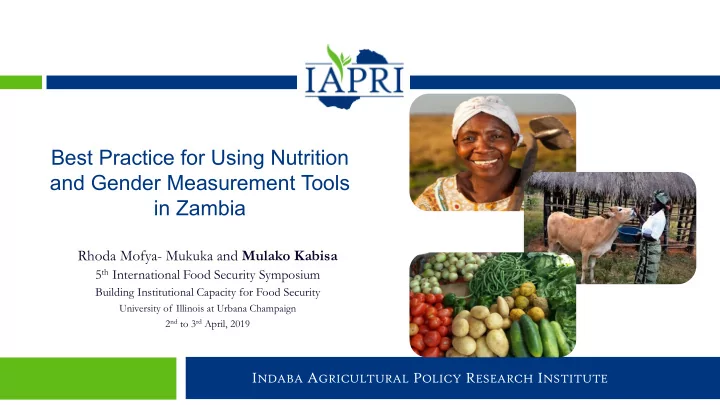
INDABA AGRICULTURAL POLICY RESEARCH INSTITUTE Rhoda Mofya- Mukuka and Mulako Kabisa

5th International Food Security Symposium

Building Institutional Capacity for Food Security

University of Illinois at Urbana Champaign 2nd to 3rd April, 2019

Best Practice for Using Nutrition and Gender Measurement Tools in Zambia

slide-2
SLIDE 2

Indaba Agricultural Policy Research Institute

ZAMBIA’S STATUS QUO

2

59.3% of unpaid family workers are women Women are often involved in food crop production and men in cash crop production The labour burden of rural women is high, yet their time use is not adequately documented

slide-3
SLIDE 3

Indaba Agricultural Policy Research Institute

FIELD TESTED TOOLS

  • Household Dietary Diversity Score (HDDS)
  • Minimum Dietary Diversity for Women (MDD-W)
  • Minimum Dietary Diversity for Children (MDD-C)
  • Household Hunger Scale (HHS)

Household Food Access

  • Women’s Empowerment in Agriculture Index (WEAI) and

Women’s Assets Ownership Index (WAOI)

  • Asset Ownership
  • Access to credit
  • Agricultural production
  • Decision making (input and extent)
  • Time allocation
  • Leisure time

Women’s Empowerment

3

slide-4
SLIDE 4

Indaba Agricultural Policy Research Institute

EMPOWERING WOMEN THROUGH AGRICULTURAL SUPPORT (EWAS) PROJECT

  • Improve female farmers’ livelihoods through increased incomes

and resilience to the effects of climate change.

4

Incomes and Livelihoods by Scaling Home Gardens Gender and Nutrition Climate Smart agriculture and Food Security

slide-5
SLIDE 5

Indaba Agricultural Policy Research Institute

METHOD

Questionnaire administered by the enumerators to 148 women Self administered questionnaire by enumerators Questionnaire administered to the respondent by the supervisors after the main interview

5

slide-6
SLIDE 6

Indaba Agricultural Policy Research Institute

RESULTS: FOOD ACCESS

“The respondent found it difficult to remember the hunger events as isolated because of regularly having insufficient food in the household.” “Her understanding of hunger was having only vegetables with nshima so she found it difficult to reconcile hunger as having no food completely.” “The question is difficult to answer because you anticipate being given food when asked such a question so being truthful can be difficult.”

2 4 6 8 10 12 14

HDDS MDD-W MDD-C HHS

Percentage Measurement Tool

Enumerators Respondents

6

slide-7
SLIDE 7

Indaba Agricultural Policy Research Institute

5 10 15 20 25 30

Percentage Gender Equity Indicators

Enumerators Respondents

RESULTS: WOMEN’S EMPOWERMENT

“Cultural norms mean that women would think they will be looked at as disrespectful to their husbands if they said they took a bigger part in decision making.” “I was not comfortable with the way the question was coming out. Wife and husband make decisions together which makes it difficult to answer the question.” “It makes someone wonder why someone would want to know your household dynamics. What are their intentions?’”

7

slide-8
SLIDE 8

Indaba Agricultural Policy Research Institute

BEST PRACTICE

FOOD ACCESS

Avoid data collection on different dietary diversity indicators in one questionnaire if possible When conducting HHS during the lean season, caution must be taken because respondents may report higher than actual levels of hunger in anticipation of food aid Differentiate the terms ‘hunger’ and ‘insufficient food’ clearly to the respondent

WOMEN’S EMPOWERMENT

Explain the difference between input and extent Consider the cultural norms that govern the attitudes towards women giving input and the extent of their input in decision making Be open about why data is being collected and emphasize anonymity

8
slide-9
SLIDE 9

Indaba Agricultural Policy Research Institute

9

THANK YOU