
090102 Bibliotheca Alexandrina Compiled by Ahmed Ghazi
Bertolt Brecht
(1898-1956)
Biography
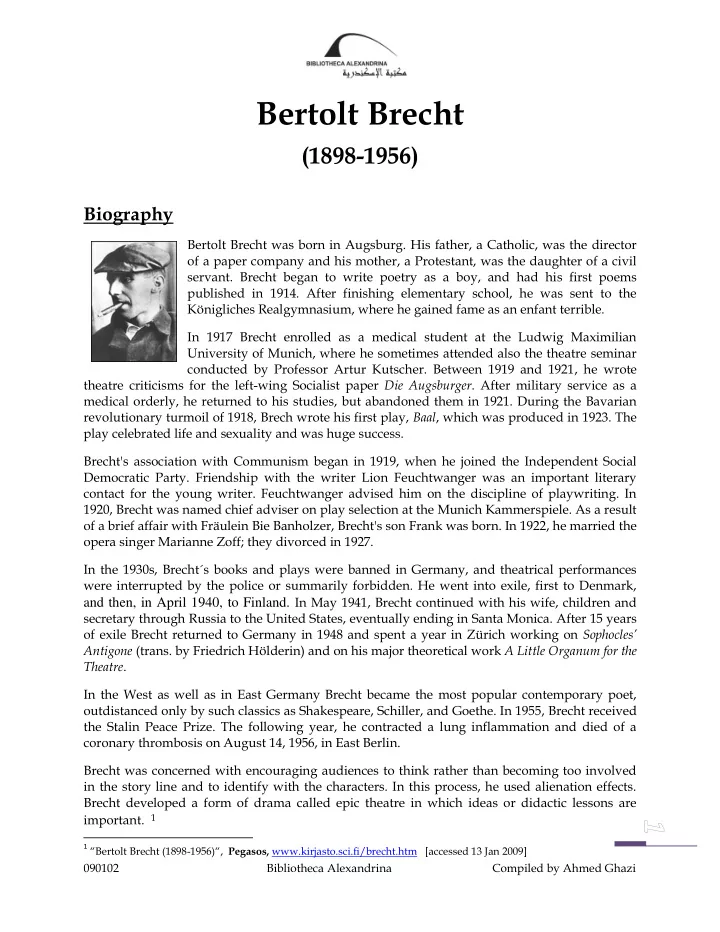
Bertolt Brecht was born in Augsburg. His father, a Catholic, was the director
- f a paper company and his mother, a Protestant, was the daughter of a civil
- servant. Brecht began to write poetry as a boy, and had his first poems
published in 1914. After finishing elementary school, he was sent to the Königliches Realgymnasium, where he gained fame as an enfant terrible. In 1917 Brecht enrolled as a medical student at the Ludwig Maximilian University of Munich, where he sometimes attended also the theatre seminar conducted by Professor Artur Kutscher. Between 1919 and 1921, he wrote theatre criticisms for the left-wing Socialist paper Die Augsburger. After military service as a medical orderly, he returned to his studies, but abandoned them in 1921. During the Bavarian revolutionary turmoil of 1918, Brech wrote his first play, Baal, which was produced in 1923. The play celebrated life and sexuality and was huge success. Brecht's association with Communism began in 1919, when he joined the Independent Social Democratic Party. Friendship with the writer Lion Feuchtwanger was an important literary contact for the young writer. Feuchtwanger advised him on the discipline of playwriting. In 1920, Brecht was named chief adviser on play selection at the Munich Kammerspiele. As a result
- f a brief affair with Fräulein Bie Banholzer, Brecht's son Frank was born. In 1922, he married the
- pera singer Marianne Zoff; they divorced in 1927.
In the 1930s, Brecht´s books and plays were banned in Germany, and theatrical performances were interrupted by the police or summarily forbidden. He went into exile, first to Denmark,
and then, in April 1940, to Finland. In May 1941, Brecht continued with his wife, children and
secretary through Russia to the United States, eventually ending in Santa Monica. After 15 years
- f exile Brecht returned to Germany in 1948 and spent a year in Zürich working on Sophocles’
Antigone (trans. by Friedrich Hölderin) and on his major theoretical work A Little Organum for the Theatre. In the West as well as in East Germany Brecht became the most popular contemporary poet,
- utdistanced only by such classics as Shakespeare, Schiller, and Goethe. In 1955, Brecht received
the Stalin Peace Prize. The following year, he contracted a lung inflammation and died of a coronary thrombosis on August 14, 1956, in East Berlin. Brecht was concerned with encouraging audiences to think rather than becoming too involved in the story line and to identify with the characters. In this process, he used alienation effects. Brecht developed a form of drama called epic theatre in which ideas or didactic lessons are
- important. 1
1 “Bertolt Brecht (1898-1956)“, Pegasos, www.kirjasto.sci.fi/brecht.htm [accessed 13 Jan 2009]