Bernalillo County Our journey: Vendor Invoice SAP Accounts - - PowerPoint PPT Presentation

bernalillo county
SMART_READER_LITE
LIVE PREVIEW

Bernalillo County Our journey: Vendor Invoice SAP Accounts - - PowerPoint PPT Presentation

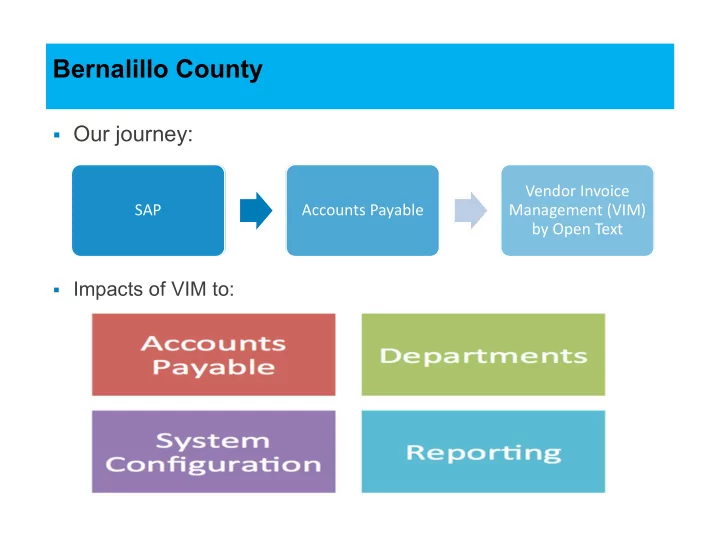
Bernalillo County Our journey: Vendor Invoice SAP Accounts Payable Management (VIM) by Open Text Impacts of VIM to: Bernalillo County Located in central New Mexico Incorporates the City of Albuquerque Population 662,562


slide-1
SLIDE 1
  • Our journey:
  • Impacts of VIM to:

Bernalillo County

SAP Accounts Payable Vendor Invoice Management (VIM) by Open Text

slide-2
SLIDE 2
  • Located in central New Mexico
  • Incorporates the City of Albuquerque
  • Population 662,562
  • Employs ~2,500 full time employees
  • 5 Commissioners – elected by district
  • 5 Elected Officials – Assessor, Clerk, Probate Judge, Sheriff, and Treasurer are elected

countywide

  • County Manager oversees 30 county departments that range from animal services to zoning

Bernalillo County

slide-3
SLIDE 3
  • Went live with SAP in July 2008 –

“Failure is not an option”

  • ECC, SRM & Portal
  • ERP Module Landscape
  • General Ledger
  • Controlling
  • Funds Management
  • Grants Management
  • Accounts Payable & Vendor Invoice

Management

  • Accounts Receivable/ PSCD
  • Materials Management
  • SRM
  • Inventory Management
  • Asset Accounting
  • 11 month implementation
  • On-time & within budget
  • Project Systems
  • Cash Management
  • Treasury Management
  • Plant Maintenance & Mobile Work

Manager

  • HR Mini-Master
  • Budget Prep (Controlling)
  • Cross Application Timesheets
  • Business Intelligence/Business

Warehouse

  • Travel (Portal)
  • Governance Risk & Compliance

SAP Implementation

slide-4
SLIDE 4
  • Pre-SAP
  • Legacy mainframe system
  • Encumbrance worksheets in Excel
  • Paper purchase requisitions & purchase orders
  • Invoices hand-delivered to AP by departments
  • 2-way match (PO & Invoice)
  • SAP 2008 – 2012
  • Invoices entered using MIRO or FB60
  • SRM shopping carts & purchase orders
  • 3-way match (PO, Invoice & Goods Receipt)
  • Decentralized invoice receipting
  • Invoice would be delivered to AP (hard copy, email) by departments

Accounts Payable

slide-5
SLIDE 5
  • SAP 2008 – 2012 (continued)
  • AP would check if GR in the system
  • Post invoice
  • write SAP doc # on invoice
  • scan & attach image to doc in SAP using 3rd party system for attachments
  • If no GR in the system
  • AP would email department scanned copy of invoice
  • AP ask department to enter GR
  • Invoice tracking & process to pay was a nightmare
  • AP processors with stacks of invoices on their desks awaiting GRs
  • Departments would send duplicate copies of invoices to AP
  • AP unable to pay invoice until department entered GR

Accounts Payable

slide-6
SLIDE 6
  • SAP – 2008 – 2012 (continued)
  • AP’s hands were tied until department entered GR
  • CFO was pushing AP to pay invoices without GR
  • Even requesting that AP enter GR (AP Manager did not allow)
  • ERP team was asked to make system configuration changes:
  • Enter Invoice before GR
  • Caused many issues later
  • GR/IR mismatch report

Accounts Payable

slide-7
SLIDE 7
  • Invoices were everywhere (except in the system)
  • AP could not tell: how many or how much
  • Vendors would call Commissioners
  • AP has no visibility to the invoice
  • AP would call the department/vendor
  • Request the invoice
  • Rush the payment process
  • AP Manager wanted to central invoice receipts
  • Had no way to control it
  • Departments would tell vendors to send them the invoices
  • Departments wanted to see the invoice & approve it

Pain Points

slide-8
SLIDE 8
  • AP Manager attended a conference in 2009 – the vision was born
  • VISION
  • Centralize receipt of invoices
  • Scan and capture data and images of invoices
  • Workflow invoices to an approver
  • Creating visibility of the liability and every step in the invoice process

Journey for an Automated AP Solution began

slide-9
SLIDE 9
  • AP Manager had to sell the vision to CFO, departments, & County

leaders

  • Pain points had to be addressed
  • Began process of explaining needs to ERP
  • Standard SAP functionality analyzed
  • Challenging for AP Manager to explain the vision
  • Management of AP changed
  • Asked AP Manager to walk through the process (white board it)
  • Vision finally clear to the organization!

Automating AP

slide-10
SLIDE 10

AP White board drawing of the vision

slide-11
SLIDE 11

AP Vision & Requirements to bring it to life

slide-12
SLIDE 12
  • Why VIM?
  • Chosen over other 3rd party solutions due to its integration with SAP
  • Looks & feels like SAP
  • Other solutions didn’t have this
  • Didn’t want integration issues or another logon
  • Provided the automated solution
  • Front end imaging & OCR for greater efficiency
  • Workflow Approvals
  • Data elements captured for reporting
  • Aging reports
  • Performance measures
  • Addresses audit concerns of timely invoice payments
  • Cash Flow Reporting

Vendor Invoice Management (VIM)

slide-13
SLIDE 13

Success Indicators – Driving Factors for Implementation

slide-14
SLIDE 14
  • 8 month timeline
  • Fiscal year go-live – July 1, 2013
  • Strong focus on:
  • Communicating changes to departments & vendors
  • Training end users

VIM Implementation

slide-15
SLIDE 15
  • Impacts to:

Pre-VIM & Post-VIM

slide-16
SLIDE 16

Pre-VIM vs. Post-VIM – Accounts Payable

Pre VIM

  • Invoices touched multiple times by AP (Scan,

email, follow up on GR, pile on desk, wait, eventually post)

VIM

  • AP touches invoice only to scan/validate &

index/post

slide-17
SLIDE 17

Pre-VIM vs. Post-VIM – Accounts Payable

Pre VIM

  • Invoice rejected, manual process to notify AP

invoice is not valid

VIM

  • Invoice rejected, department rejects and

workflows back to AP processor to obsolete

  • r resubmit for approval
slide-18
SLIDE 18

Pre-VIM vs. Post-VIM – Accounts Payable

Pre VIM

  • All communication was phone or email,

nothing tracked in the system

VIM

  • AP can insert comments in the document

and workflow to department & GR/approver can insert comments for AP

slide-19
SLIDE 19

AP Comments for Department

slide-20
SLIDE 20

Pre-VIM vs. Post-VIM – Accounts Payable

Pre VIM

  • Manual process to identify duplicate invoices

VIM

  • AP set criteria for suspected duplicate

invoices; multiple system checks

slide-21
SLIDE 21
  • Configured suspected duplicate checks:
  • Check 1: Reference Number & Vendor OR
  • Check 2: Vendor, Invoice Date & Amount

Suspected Duplicate Checks

slide-22
SLIDE 22

Pre-VIM vs. Post-VIM – Accounts Payable

Pre VIM

  • No automated invoice approvals; manual

process to determine who to contact to enter GR

VIM

  • Invoices that cannot find a Goods Recipient

workflow to AP Management to determine correct GR (PO # is key!)

slide-23
SLIDE 23

Pre-VIM vs. Post-VIM – Department

Pre VIM

  • Manual invoice approval process; AP posts

VIM

  • Invoice processed as a DP doc in VIM (no

parked document in SAP) using standard VIM functionality

slide-24
SLIDE 24

Pre-VIM vs. Post-VIM – Department

Pre VIM

  • Manual process (email scanned copy of

invoice) to notify department to enter GR and approve Invoice; no traceability

VIM

  • Automated notification to department to

enter GR; AP processor has a button to send notification

slide-25
SLIDE 25

AP Sends GR Notification to Department

slide-26
SLIDE 26

Pre-VIM vs. Post-VIM – Department

Pre VIM

  • AP posts credit memo, no notification to

department

VIM

  • Workflow approval of credit memo; AP posts

credit memo

slide-27
SLIDE 27

Pre-VIM vs. Post-VIM – Department

Pre VIM

  • Bond funded invoices require a manual

approval process (paper forms; all departments required to submit to bond accountant)

VIM

  • Special except approval (2nd level of

workflow approval) for bond funded invoices – looks at all lines on the PO for bond fund

slide-28
SLIDE 28

Pre-VIM vs. Post-VIM – System Configuration

Pre VIM

  • No automated system

VIM

  • Implement standard VIM functionality

whenever possible, results in accurate processing and reporting (initially custom code was

developed for notifications, workflow, parked documents)

slide-29
SLIDE 29

System Landscape

slide-30
SLIDE 30

Pre-VIM vs. Post-VIM – System Configuration

Pre VIM

3rd party document viewing system enhanced to work with SAP (backend scanning); difficult to use

VIM

  • Open Text Viewer used to view invoices

(initially used Windows Photo Viewer; printing or emailing image difficult)

slide-31
SLIDE 31

Pre-VIM vs. Post-VIM – Reporting

Pre VIM

No reporting or tracking of steps in the process; difficult to identify bottlenecks

VIM

  • VIM Analytics report tracks DP stages (e.g.

scanned, workflowed, etc.); realistic picture

  • f liability & bottlenecks
slide-32
SLIDE 32

Pre-VIM vs. Post-VIM – Reporting

Pre VIM

No reporting of outstanding liabilities; only reporting possible was for posted invoices

VIM

  • VIM Analytics; Custom reports developed;

Next: VIM Central Reporting for high level analytics/dashboard type reporting

slide-33
SLIDE 33

Pre-VIM vs. Post-VIM – Reporting

Pre VIM

No performance measures; no ability to report

  • n steps in the process as they are not in the

system

VIM

  • Established performance measures &

developed performance measure reports to track post go-live

slide-34
SLIDE 34

Performance Measures

  • 95% of invoices are scanned &

validated within 2 business days of receipt

AP Performance Measure

  • 95% of invoices are approved and

goods receipted within 5 business days of invoice delivery via workflow

Department GR/Approval Performance Measure

  • 95 % of invoices are indexed within 5

business days of invoice delivery via workflow

AP Performance Measure

slide-35
SLIDE 35

Performance Measure Reports

slide-36
SLIDE 36
  • Success Indicators
  • Performance Measures
  • Implementer that knows the latest version of VIM; use standard VIM functionality
  • Follow a proven project implementation methodology
  • No implementation is perfect
  • plan for post go live support, changes, fixes
  • Reports
  • Utilize standard reports as much as possible
  • Plan for some custom for performance measure tracking
  • Central reporting for dashboard reports

VIM Implementation Lessons Learned

slide-37
SLIDE 37

Contact Information