
SLIDE 1
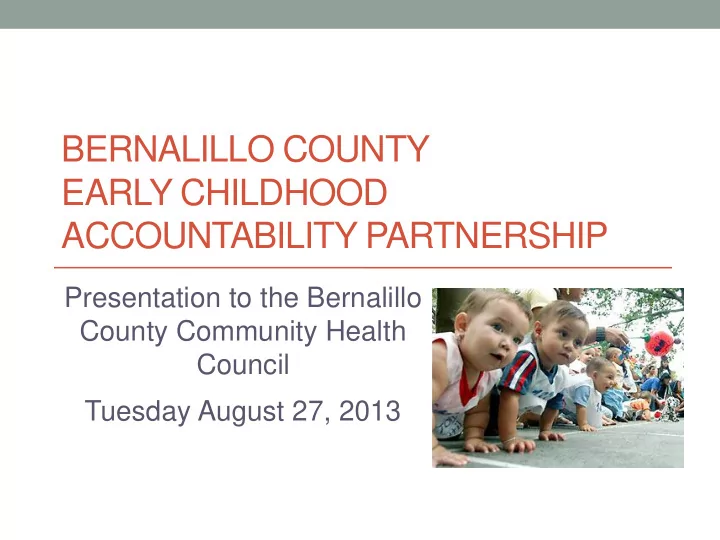
BERNALILLO COUNTY EARLY CHILDHOOD ACCOUNTABILITY PARTNERSHIP - - PowerPoint PPT Presentation
BERNALILLO COUNTY EARLY CHILDHOOD ACCOUNTABILITY PARTNERSHIP Presentation to the Bernalillo County Community Health Council Tuesday August 27, 2013 ECAP HISTORY AND BACKGROUND Background Place-based effort Pregnancy to age 8
WHAT ARE THE BIG GOALS ? To develop a common agenda with a diverse group of stake holders through a Collective Impact Framework To develop strategies that build on the strengths of our families, children and community, To be accountable to create measurable change in a specified period of time WHO ARE THE PARTNERS? ECAP membership consists of a group of leaders from different sectors who have come together to make a public commitment to achieve collective impact. .
Focus on a Single Measurable Result and Core Set of Indicators
Public Accountability
accountable for accelerating progress within a specific measurement period. Collaborative Leadership
and learn a set of collaborative leadership skills and competencies that have proven successful in other cities to mobilize collective impact with accountability. Aligned Contributions
improvement to the school readiness and success of young children in Bernalillo County.
Outcome Indicators: 1A.Kindergarten readiness 1B. 3rd grade reading proficiency 1C. 8th grade math proficiency 1D. High school graduation Outcome Indicators: 2A.College enrollment
2C.Certificate or degree attainment
educational attainment Outcome Indicators:
graduation gap
degree attainment gap Outcome Indicator: 3A.Employment in a high-wage job in Bernalillo, Sandoval, Torrance, or Valencia County
problems - and their solutions arise - from interaction of many organizations within larger system
government, nonprofit, philanthropic and corporate sectors as partners
coordinating their action and sharing lessons learned
goal and measuring the same things
The Five Conditions of Collective Impact
12
Shared vision, common understanding of the problem, and a joint approach to solving the problem.
Collecting data to measure results on a regular basis so that participants can hold each other accountable.
Coordinated, but differentiated activities among the participant organizations.
Consistent and open communication to: build trust, assure mutual objectives, and create common motivation.
A separate organization to coordinate the overall initiative and the participating
Source: Hanleybrown, Kania, & Kramer. 2012. “Channeling Change: Making Collective Impact Work.” Stanford Social Innovation Review.
The Three Phases of Collective Impact in Relation to ECAP
(Kania and Kramer, 2011)
13
Governance and Infrastructure Committee Strategic Planning and Data Committee Communications and Community Engagement Committee