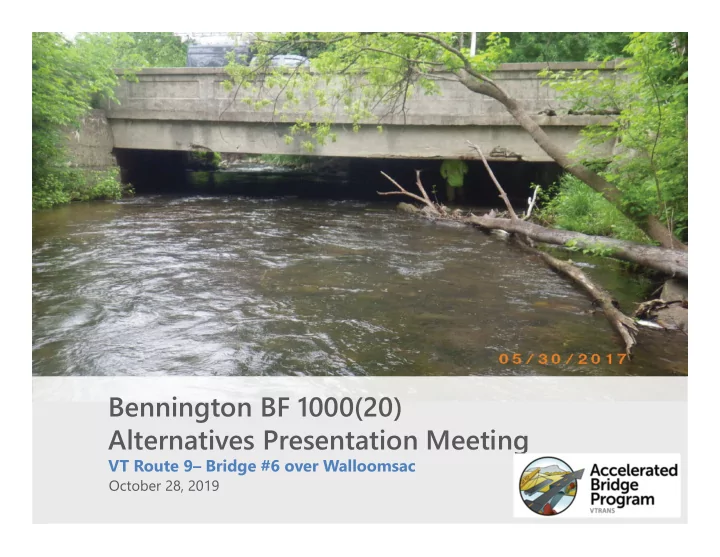
Bennington BF 1000(20) Alternatives Presentation Meeting VT Route 9 - - PowerPoint PPT Presentation

bennington bf 1000 20 alternatives presentation meeting
SMART_READER_LITE
LIVE PREVIEW

Bennington BF 1000(20) Alternatives Presentation Meeting VT Route 9 - - PowerPoint PPT Presentation

Bennington BF 1000(20) Alternatives Presentation Meeting VT Route 9 Bridge #6 over Walloomsac October 28, 2019 Introductions Laura Stone, P.E. VTrans Scoping Engineer Rob Young, P.E. VTrans Project Manager Tom Knight, P.E. Stantec


slide-1
SLIDE 1

Bennington BF 1000(20) Alternatives Presentation Meeting

VT Route 9– Bridge #6 over Walloomsac

October 28, 2019

slide-2
SLIDE 2

Introductions

Laura Stone, P.E.

VTrans Scoping Engineer

Rob Young, P.E.

VTrans Project Manager

Tom Knight, P.E.

Stantec Project Manager

slide-3
SLIDE 3

Purpose of Meeting

  • Provide an understanding of our approach to the

project

  • Provide an overview of project constraints
  • Discuss our recommended alternative
  • Provide an opportunity to ask questions and voice

concerns

slide-4
SLIDE 4

Location Map

slide-5
SLIDE 5

Bridge 6 Project Location

slide-6
SLIDE 6

Meeting Overview

  • VTrans Project Development Process
  • Project Overview

– Existing Conditions – Alternatives Considered – Recommended Alternative

  • Maintenance of Traffic
  • Schedule
  • Summary
  • Questions
slide-7
SLIDE 7

VTrans Project Development Process

Project Definition Project Design Construction Project Funded Project Defined Contract Award

  • Quantify areas of

impact

  • Environmental

permits

  • Develop plans,

estimate and specifications

  • Right-of-Way

process if necessary

Initiated

  • Identify resources &

constraints

  • Evaluate alternatives
  • Public participation
  • Build Consensus
slide-8
SLIDE 8

Who are you representing?

A. Municipal Official B. Resident of Bennington C. Resident of Neighboring Town

  • D. Emergency Services

E. Local Business F. Independent Organization

  • G. Press
  • H. Other
slide-9
SLIDE 9

How often do you use this segment of VT Route 9?

  • A. Daily
  • B. Weekly
  • C. Monthly
  • D. Rarely
  • E. Never
slide-10
SLIDE 10

How often do you walk over the bridge?

  • A. Daily
  • B. Weekly
  • C. Monthly
  • D. Rarely
  • E. Never
slide-11
SLIDE 11

How often do you bike over the bridge?

  • A. Daily
  • B. Weekly
  • C. Monthly
  • D. Rarely
  • E. Never
slide-12
SLIDE 12

What is your reason for attending this meeting?

  • A. Specific concern
  • B. General Interest
  • C. Live in close vicinity
  • D. Other
slide-13
SLIDE 13

Description of Terms Used

slide-14
SLIDE 14

ACT 153 of the 2012 Legislative Session

Local Share Road Closed During Construction Road Open During Construction Rehabilitation 2.5% 5% Replacement 5% 10%

  • Per Act 153, the local share is reduced by 50% for rehabilitating

versus replacement

  • Per Act 153, the local share is reduced by 50% for closing the

road to traffic during construction

slide-15
SLIDE 15

Existing Conditions – Bridge #6

  • Roadway Classification – Principal Arterial, National Highway

System, Urban (Class 1 Town Highway)

  • Bridge Type – 46’ Span Reinforced Concrete T-Beam Bridge
  • Ownership – Town of Bennington
  • Constructed in 1923

Looking West over Bridge

slide-16
SLIDE 16

Existing Conditions – Bridge #6

  • Wide sidewalks over bridge
  • Located in densely populated area
  • Bridge is skewed

Looking East over Bridge

slide-17
SLIDE 17

Existing Conditions – Bridge #6

  • The substructures and superstructure are in fair condition with a rating of
  • 5. There is significant deterioration of the concrete and bridge seats.

– Spalling, voids, and cracks in the abutments.

  • Settlement cracks in Abutment 2.
  • There are drainage features on the bridge that are leaking and saturating

concrete members, accelerating deterioration.

  • The bridge does not meet the minimum hydraulic requirements and is

located within a flood insurance study area.

– Negative 4-feet of freeboard at the design storm

slide-18
SLIDE 18

Existing Conditions - Bridge #6

  • Deck Rating

6 (Satisfactory)

  • Superstructure Rating

5 (Fair)

  • Substructure Rating

5 (Fair) Condition Ratings

slide-19
SLIDE 19

Existing Conditions - Bridge #6

  • Scour, spalling, cracks

Substructure

slide-20
SLIDE 20

Existing Conditions - Bridge #6

Abutment

slide-21
SLIDE 21

Existing Conditions - Bridge #6

Abutment

slide-22
SLIDE 22

Existing Conditions - Bridge #6

  • Adjacent to house with brick

foundation Wingwall in Southwest Quadrant

slide-23
SLIDE 23

Existing Conditions - Bridge #6

  • Northern Long Eared Bat Habitat
  • Archaeological Resources
  • Historic Resources

– Bridge No. 6 and the former Safford-Morgan House at 722 Main Street

  • FEMA Floodplains
  • Hazardous Waste Site
  • Utilities

Resources – Looking Downstream

slide-24
SLIDE 24

Existing Conditions - Bridge #6

  • 22. Hazardous Material Contamination. The cost of handling, treatment and disposal of

petroleum-contaminated soils or other hazardous material contamination in existence prior to construction of the Project shall be non-participating. Accordingly, any costs associated therewith shall be the sole responsibility of the MUNICIPALITY. Hazardous material generated during the construction of the project shall be disposed of as provided for in the project specifications and shall be a participating cost.

Finance and Maintenance Agreement: Hazardous Waste

slide-25
SLIDE 25

Existing Layout

slide-26
SLIDE 26

Existing Typical Section

slide-27
SLIDE 27

Existing Profile

slide-28
SLIDE 28
  • ADT of 9,800
  • DHV of 1,000
  • % Trucks: 4.6
  • Design Speed of 30 mph
  • Utilities

Design Criteria and Considerations

slide-29
SLIDE 29
  • No Action

– Additional maintenance required within 10 years

  • All Alternatives 8’-12’-12’-8’ Typical
  • Minor Rehabilitation

– Superstructure and substructure repair – 15-year design life

  • Superstructure Replacement

– Substructure repair – 30-year design life based on condition of abutments

  • Full Bridge Replacement On Alignment

– Maintain horizontal and vertical alignment – Substandard hydraulically – 100-year design life

Alternatives Considered – Bridge #6

slide-30
SLIDE 30

Alternative 1: Minor Rehabilitation Typical Section

slide-31
SLIDE 31

Alternative 1: Minor Rehabilitation Layout Bridge #6

  • Concrete Repair: Superstructure and Substructure
  • New Bridge Joints and Membrane and Pave
  • 8’-12’-12’-8’ Typical with 9’ wide sidewalks on both sides of the bridge
  • 15-year design life
slide-32
SLIDE 32

Alternative 2: Superstructure Replacement Typical Section

slide-33
SLIDE 33

Alternative 2: Superstructure Replacement Layout Bridge #6

  • New deck and beams on existing substructures
  • Concrete repair as needed for substructures
  • 8’-12’-12’-8’ Typical with 9’ wide sidewalks on both sides of the bridge
  • 30-year design life based on current condition of substructures
slide-34
SLIDE 34

Alternative 3: Full Bridge Replacement Typical Section

slide-35
SLIDE 35

Alternative 3: Full Bridge Replacement Layout Bridge #6

  • All new bridge components
  • 8’-12’-12’-8’ Typical with 9’ wide sidewalks on both sides of the bridge
  • Does not meet minimum hydraulic standard
  • 100-year design life
slide-36
SLIDE 36

Proposed Profile

slide-37
SLIDE 37

Recommended Alternative - Bridge #6

  • Full Bridge Replacement

– 12’/8’ typical with 9-foot wide sidewalk on both sides – Span length of approximately 50’ – Remains Hydraulically Inadequate – Shallow superstructure type to be chosen – 100-year design life

slide-38
SLIDE 38

Maintenance of Traffic Options Considered

  • Offsite Detour
  • Short Term Lane Closures

– Minor rehab only – During Off-Peak Hours

  • Phased Construction

– 2 ways need to be maintained as well as pedestrians – Option 1: 2-Way Traffic Maintained by Phasing w/ Offsite Pedestrian Detour – Option 2: Pedestrian and 1-Way Eastbound Vehicular Traffic Maintained by Phasing w/ Offsite Detour for Westbound Vehicular Traffic

slide-39
SLIDE 39

Road Closure

  • Detour signed by State
  • Detour distance: 5.4 miles end-to-end
  • 60-day closure with Incentive/Disincentive
  • Night-time Work Allowed
  • Local share is reduced by 50% per VT Legislation Act 153 of 2012
slide-40
SLIDE 40
  • Detour: VT Route 9, to

US Route 7, and VT Route 279, back to VT Route 9 (5.4 miles end- to-end)

  • Appropriate for large

trucks

  • Adds 2.7 miles to the

through route

Traffic Control – Offsite Detour: Trucks

slide-41
SLIDE 41
  • Passenger Car and Pedestrian Detour Routes: VT Route 9, to

Safford Street, (Gage Street or Coolidge Street), and Bradford Street back to VT Route 9 (0.6 to 0.8 miles end-to-end)

Traffic Control – Offsite Detour: Passenger Cars and Pedestrians

slide-42
SLIDE 42

Phased Construction – Option 1

  • Two-way traffic maintained
  • Bridge closed to pedestrians – offsite

pedestrian detour for construction season

slide-43
SLIDE 43

Option 1 Phased Construction - Phase 1

slide-44
SLIDE 44

Option 1 Phased Construction - Phase 2

slide-45
SLIDE 45

Phased Construction – Option 2

  • Pedestrian and 1-way eastbound vehicular

traffic maintained

  • Offsite detour for westbound traffic
slide-46
SLIDE 46

Option 2 Phased Construction - Phase 1

slide-47
SLIDE 47

Option 2 Phased Construction - Phase 2

slide-48
SLIDE 48

Recommended Scope

  • Full Bridge Replacement with Traffic Maintained on an Offsite

Detour

– 60 day proposed closure, detour signed by State – 12’/8’ typical with 9-foot wide sidewalk on both sides – Span length of approximately 50’ – Does not meet hydraulic standard - none of the options considered would meet hydraulic standard due to site constraints – Shallow superstructure type to be chosen – Historic railing – 100-year design life – Right of Way Needed – Aerial Utility Relocation – Municipal/Buried Utility Relocation

slide-49
SLIDE 49

Bennington BF 1000(20)

Alt 1 Alt 2a Alt 2b Alt 2c Alt 3a Alt 3b Superstructure Repair Superstructure Replacement Full Bridge Replacement

Short Term Lane Closures Offsite Detour 2‐Way Traffic Maintained by Phasing w/ Offsite Pedestrian Detour Pedestrian and 1‐Way Eastbound Vehicular Traffic Maintained by Phasing w/ Offsite Detour for Westbound Vehicular Traffic Offsite Detour Phased Construction

Total Project Costs 568,984 1,753,734 2,473,765 2,541,265 3,138,822 4,285,470

Annualized Costs 37,932 58,458 82,459 84,709 31,388 42,855

TOWN SHARE 28,449 43,843 123,688 127,063 156,941 428,547 TOWN % 5% 2.5% 5% 5% 5% 10%

Project Development Duration 4 years 4 years 4 years 4 years 4 years 4 years Construction Duration 2 months 3 months 9 months 9 months 6 months 9 months Closure Duration (If Applicable) N/A 30 days N/A N/A 60 days N/A Typical Section ‐ Roadway (feet) 40 40 40 40 40 40 Typical Section ‐ Bridge (feet) 40 40 40 40 40 40 Geometric Design Criteria Meets Minimum Standard Meets Minimum Standard Meets Minimum Standard Meets Minimum Standard Meets Minimum Standard Meets Minimum Standard Hydraulics Substandard Hydraulics and BFW Substandard Hydraulics and BFW Substandard Hydraulics and BFW Substandard Hydraulics and BFW Substandard Hydraulics Substandard Hydraulics Utilities No Change Relocation ‐ Aerial and Buried Relocation ‐ Aerial and Buried Relocation ‐ Aerial and Buried Relocation ‐ Aerial and Buried Relocation ‐ Aerial and Buried ROW Acquisition Yes Yes Yes Yes Yes Yes Road Closure No Yes No No Yes No Design Life 15 30 30 30 100 100

Alternatives Matrix

Recommended

slide-50
SLIDE 50

What would be the maximum acceptable length of closure for Bridge #6?

  • A. 30 days (≈4 weeks)
  • B. 45 days (≈6 weeks)
  • C. 60 days (≈9 weeks)
  • D. 90 days (≈13 weeks)
  • E. A closure is not

acceptable

slide-51
SLIDE 51

Which time of year would be most acceptable for Bridge #6 to be closed?

  • A. May - June
  • B. June - July
  • C. July - August
  • D. August – September
  • E. During Summer Break
  • F. Other
slide-52
SLIDE 52

Preliminary Project Schedule

  • Construction Start – 2023

– Total Cost Estimate: $3,140,000

  • Town Share: $157,000
slide-53
SLIDE 53

Which design aspect is the most important to you?

  • A. Shoulder

width/bicycle accommodations

  • B. Aesthetics - Bridge

Railing

  • C. Construction year
  • D. Construction Duration
  • E. Cost
  • F. Other
slide-54
SLIDE 54

Which would you be most concerned about?

  • A. Construction delays on

VT Route 9

  • B. Detour Distance
  • C. Duration of Detour
  • D. Bridge Aesthetics
  • E. Business Impacts
  • F. Environmental Impacts
  • G. Recreational Impacts
  • H. Other

I. Not really concerned

slide-55
SLIDE 55

Did you find this presentation to be?

  • A. Too technical in nature
  • B. Too simplified
  • C. Just about right
  • D. Not much use at all
slide-56
SLIDE 56

Do you find the recommended scope of work satisfactory?

  • A. Yes
  • B. No
slide-57
SLIDE 57

This is a list of a few important activities expected in the near future and is not a complete list of activities.

Wait for Town response to recommendation on proposed project

  • Develop Conceptual plans and distribute for comment
  • Request a Public Information meeting
  • Process local agreements
  • Right-of-Way process (if needed)

Next Steps – Bridge #6

slide-58
SLIDE 58

Bennington BF 1000(20) Questions & Comments

VT Route 9– Bridge #6 over Walloomsac

October 28, 2019

For more information:

  • https://outside.vermont.gov/agency/vtrans/external/Projects/Structures/12J606