BEEM103 Optimization Techniques for Economists Level Curves - - PowerPoint PPT Presentation

beem103 optimization techniques for economists
SMART_READER_LITE
LIVE PREVIEW

BEEM103 Optimization Techniques for Economists Level Curves - - PowerPoint PPT Presentation

Functions in two variables Functions in two variables Partial derivatives Partial derivatives Optimization Optimization Unconstrained Optimization Unconstrained Optimization Second order conditions Second order conditions Functions in two


slide-1
SLIDE 1

Functions in two variables Partial derivatives Optimization Unconstrained Optimization Second order conditions

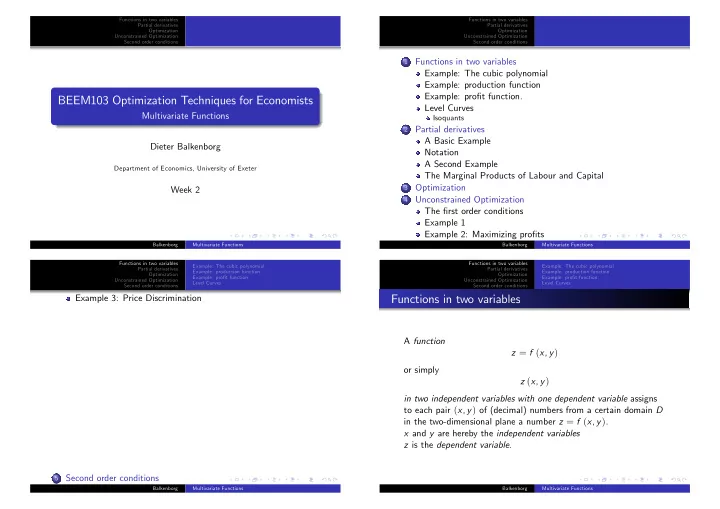
BEEM103 Optimization Techniques for Economists

Multivariate Functions Dieter Balkenborg

Department of Economics, University of Exeter

Week 2

Balkenborg Multivariate Functions Functions in two variables Partial derivatives Optimization Unconstrained Optimization Second order conditions

1

Functions in two variables Example: The cubic polynomial Example: production function Example: profit function. Level Curves

Isoquants

2

Partial derivatives A Basic Example Notation A Second Example The Marginal Products of Labour and Capital

3

Optimization

4

Unconstrained Optimization The first order conditions Example 1 Example 2: Maximizing profits

Balkenborg Multivariate Functions Functions in two variables Partial derivatives Optimization Unconstrained Optimization Second order conditions Example: The cubic polynomial Example: production function Example: profit function. Level Curves

Example 3: Price Discrimination

5

Second order conditions

Balkenborg Multivariate Functions Functions in two variables Partial derivatives Optimization Unconstrained Optimization Second order conditions Example: The cubic polynomial Example: production function Example: profit function. Level Curves

Functions in two variables

A function z = f (x, y)

  • r simply

z (x, y) in two independent variables with one dependent variable assigns to each pair (x, y) of (decimal) numbers from a certain domain D in the two-dimensional plane a number z = f (x, y). x and y are hereby the independent variables z is the dependent variable.

Balkenborg Multivariate Functions

slide-2
SLIDE 2

Functions in two variables Partial derivatives Optimization Unconstrained Optimization Second order conditions Example: The cubic polynomial Example: production function Example: profit function. Level Curves

Outline

1

Functions in two variables Example: The cubic polynomial Example: production function Example: profit function. Level Curves

Isoquants

2

Partial derivatives A Basic Example Notation A Second Example The Marginal Products of Labour and Capital

3

Optimization

4

Unconstrained Optimization The first order conditions Example 1 Example 2: Maximizing profits Example 3: Price Discrimination

5

Second order conditions Balkenborg Multivariate Functions Functions in two variables Partial derivatives Optimization Unconstrained Optimization Second order conditions Example: The cubic polynomial Example: production function Example: profit function. Level Curves

Example: The cubic polynomial

The graph of f is the surface in 3-dimensional space consisting of all points (x, y, f (x, y)) with (x, y) in D. z = f (x, y) = x3 − 3x2 − y2

1

  • 5

y

1

x

  • 1

2

z

5 2 3

  • 1
  • 2

Exercise: Evaluate z = f (2, 1), z = f (3, 0), z = f (4, −4), z = f (4, 4)

Balkenborg Multivariate Functions Functions in two variables Partial derivatives Optimization Unconstrained Optimization Second order conditions Example: The cubic polynomial Example: production function Example: profit function. Level Curves

Outline

1

Functions in two variables Example: The cubic polynomial Example: production function Example: profit function. Level Curves

Isoquants

2

Partial derivatives A Basic Example Notation A Second Example The Marginal Products of Labour and Capital

3

Optimization

4

Unconstrained Optimization The first order conditions Example 1 Example 2: Maximizing profits Example 3: Price Discrimination

5

Second order conditions Balkenborg Multivariate Functions Functions in two variables Partial derivatives Optimization Unconstrained Optimization Second order conditions Example: The cubic polynomial Example: production function Example: profit function. Level Curves

Example: production function

Q =

6

√ K √ L = K

1 6 L 1 2

capital K ≥ 0, labour L ≥ 0, output Q ≥ 0

10 20

y

20 10 15

x

5 2 4

z

6

Balkenborg Multivariate Functions

slide-3
SLIDE 3

Functions in two variables Partial derivatives Optimization Unconstrained Optimization Second order conditions Example: The cubic polynomial Example: production function Example: profit function. Level Curves

Outline

1

Functions in two variables Example: The cubic polynomial Example: production function Example: profit function. Level Curves

Isoquants

2

Partial derivatives A Basic Example Notation A Second Example The Marginal Products of Labour and Capital

3

Optimization

4

Unconstrained Optimization The first order conditions Example 1 Example 2: Maximizing profits Example 3: Price Discrimination

5

Second order conditions Balkenborg Multivariate Functions Functions in two variables Partial derivatives Optimization Unconstrained Optimization Second order conditions Example: The cubic polynomial Example: production function Example: profit function. Level Curves

Example: profit function

Assume that the firm is a price taker in the product market and in both factor markets. P is the price of output

Balkenborg Multivariate Functions Functions in two variables Partial derivatives Optimization Unconstrained Optimization Second order conditions Example: The cubic polynomial Example: production function Example: profit function. Level Curves

Example: profit function

Assume that the firm is a price taker in the product market and in both factor markets. P is the price of output r the interest rate (= the price of capital)

Balkenborg Multivariate Functions Functions in two variables Partial derivatives Optimization Unconstrained Optimization Second order conditions Example: The cubic polynomial Example: production function Example: profit function. Level Curves

Example: profit function

Assume that the firm is a price taker in the product market and in both factor markets. P is the price of output r the interest rate (= the price of capital) w the wage rate (= the price of labour)

Balkenborg Multivariate Functions

slide-4
SLIDE 4

Functions in two variables Partial derivatives Optimization Unconstrained Optimization Second order conditions Example: The cubic polynomial Example: production function Example: profit function. Level Curves

Example: profit function

Assume that the firm is a price taker in the product market and in both factor markets. P is the price of output r the interest rate (= the price of capital) w the wage rate (= the price of labour) total profit of this firm: Π (K, L) = TR − TC = PQ − rK − wL = PK

1 6 L 1 2 − rK − wL Balkenborg Multivariate Functions Functions in two variables Partial derivatives Optimization Unconstrained Optimization Second order conditions Example: The cubic polynomial Example: production function Example: profit function. Level Curves

P = 12, r = 1, w = 3: Π (K, L) = PK

1 6 L 1 2 − rK − wL

= 12K

1 6 L 1 2 − K − 3L

20

x

10

z

10

  • 10

20

y

20 10

Balkenborg Multivariate Functions Functions in two variables Partial derivatives Optimization Unconstrained Optimization Second order conditions Example: The cubic polynomial Example: production function Example: profit function. Level Curves

P = 12, r = 1, w = 3: Π (K, L) = PK

1 6 L 1 2 − rK − wL

= 12K

1 6 L 1 2 − K − 3L

20

x

10

z

10

  • 10

20

y

20 10

Profits is maximized at K = L = 8.

Balkenborg Multivariate Functions Functions in two variables Partial derivatives Optimization Unconstrained Optimization Second order conditions Example: The cubic polynomial Example: production function Example: profit function. Level Curves

Outline

1

Functions in two variables Example: The cubic polynomial Example: production function Example: profit function. Level Curves

Isoquants

2

Partial derivatives A Basic Example Notation A Second Example The Marginal Products of Labour and Capital

3

Optimization

4

Unconstrained Optimization The first order conditions Example 1 Example 2: Maximizing profits Example 3: Price Discrimination

5

Second order conditions Balkenborg Multivariate Functions

slide-5
SLIDE 5

Functions in two variables Partial derivatives Optimization Unconstrained Optimization Second order conditions Example: The cubic polynomial Example: production function Example: profit function. Level Curves

Level Curves

The level curve of the function z = f (x, y) for the level c is the solution set to the equation f (x, y) = c where c is a given constant.

Balkenborg Multivariate Functions Functions in two variables Partial derivatives Optimization Unconstrained Optimization Second order conditions Example: The cubic polynomial Example: production function Example: profit function. Level Curves

Level Curves

The level curve of the function z = f (x, y) for the level c is the solution set to the equation f (x, y) = c where c is a given constant. Geometrically, a level curve is obtained by intersecting the graph of f with a horizontal plane z = c and then projecting into the (x, y)-plane. This is illustrated on the next page for the cubic polynomial discussed above:

Balkenborg Multivariate Functions Functions in two variables Partial derivatives Optimization Unconstrained Optimization Second order conditions Example: The cubic polynomial Example: production function Example: profit function. Level Curves

1

  • 5

2 1

x

2 3 5

  • 1

z y

  • 1
  • 2
  • 1

1 2 3 2 1

x z-1 y

  • 2

compare: topographic map

Balkenborg Multivariate Functions Functions in two variables Partial derivatives Optimization Unconstrained Optimization Second order conditions Example: The cubic polynomial Example: production function Example: profit function. Level Curves

Isoquants

In the case of a production function the level curves are called

  • isoquants. An isoquant shows for a given output level

capital-labour combinations which yield the same output.

x

20 20

y

10

z

6 10 20 20 10

x y z

Balkenborg Multivariate Functions

slide-6
SLIDE 6

Functions in two variables Partial derivatives Optimization Unconstrained Optimization Second order conditions Example: The cubic polynomial Example: production function Example: profit function. Level Curves

Finally, the linear function z = 3x + 4y has the graph and the level curves:

4 2

x

4

y

2 20

z 10

30

z

2 4

y x

2 4

The level curves of a linear function form a family of parallel lines: c = 3x + 4y 4y = c − 3x y = c 4 − 3 4x slope − 3

4, variable intercept c 4.

Balkenborg Multivariate Functions Functions in two variables Partial derivatives Optimization Unconstrained Optimization Second order conditions Example: The cubic polynomial Example: production function Example: profit function. Level Curves

Exercise: Describe the isoquant of the production function Q = KL for the quantity Q = 4. Exercise: Describe the isoquant of the production function Q = √ KL for the quantity Q = 2.

Balkenborg Multivariate Functions Functions in two variables Partial derivatives Optimization Unconstrained Optimization Second order conditions Example: The cubic polynomial Example: production function Example: profit function. Level Curves

Remark: The exercises illustrate the following general principle: If h (z) is an increasing (or decreasing) function in one variable, then the composite function h (f (x, y)) has the same level curves as the given function f (x, y) . However, they correspond to different levels.

4 2 4

y x

2 20

z

10 4 2 4

y x

2

z

2 4

Q = KL Q = √ KL

Balkenborg Multivariate Functions Functions in two variables Partial derivatives Optimization Unconstrained Optimization Second order conditions A Basic Example Notation A Second Example The Marginal Products of Labour and Capital

Objectives for the week

Functions in two independent variables. The lecture should enable you for instance to calculate the marginal product of labour.

Balkenborg Multivariate Functions

slide-7
SLIDE 7

Functions in two variables Partial derivatives Optimization Unconstrained Optimization Second order conditions A Basic Example Notation A Second Example The Marginal Products of Labour and Capital

Objectives for the week

Functions in two independent variables. Level curves ← → indifference curves or isoquants The lecture should enable you for instance to calculate the marginal product of labour.

Balkenborg Multivariate Functions Functions in two variables Partial derivatives Optimization Unconstrained Optimization Second order conditions A Basic Example Notation A Second Example The Marginal Products of Labour and Capital

Objectives for the week

Functions in two independent variables. Level curves ← → indifference curves or isoquants Partial differentiation ← → partial analysis in economics The lecture should enable you for instance to calculate the marginal product of labour.

Balkenborg Multivariate Functions Functions in two variables Partial derivatives Optimization Unconstrained Optimization Second order conditions A Basic Example Notation A Second Example The Marginal Products of Labour and Capital

Outline

1

Functions in two variables Example: The cubic polynomial Example: production function Example: profit function. Level Curves

Isoquants

2

Partial derivatives A Basic Example Notation A Second Example The Marginal Products of Labour and Capital

3

Optimization

4

Unconstrained Optimization The first order conditions Example 1 Example 2: Maximizing profits Example 3: Price Discrimination

5

Second order conditions Balkenborg Multivariate Functions Functions in two variables Partial derivatives Optimization Unconstrained Optimization Second order conditions A Basic Example Notation A Second Example The Marginal Products of Labour and Capital

Partial Derivatives: A Basic Example

Exercise: What is the derivative of z (x) = a3x2 with respect to x when a is a given constant? Exercise: What is the derivative of z (y) = y3b2 with respect to y when b is a given constant?

Balkenborg Multivariate Functions

slide-8
SLIDE 8

Functions in two variables Partial derivatives Optimization Unconstrained Optimization Second order conditions A Basic Example Notation A Second Example The Marginal Products of Labour and Capital

Outline

1

Functions in two variables Example: The cubic polynomial Example: production function Example: profit function. Level Curves

Isoquants

2

Partial derivatives A Basic Example Notation A Second Example The Marginal Products of Labour and Capital

3

Optimization

4

Unconstrained Optimization The first order conditions Example 1 Example 2: Maximizing profits Example 3: Price Discrimination

5

Second order conditions Balkenborg Multivariate Functions Functions in two variables Partial derivatives Optimization Unconstrained Optimization Second order conditions A Basic Example Notation A Second Example The Marginal Products of Labour and Capital

Partial derivatives: Notation

Consider function z = f (x, y). Fix y = y0, vary only x: z = F (x) = f (x, y0). The derivative of this function F (x) is called the partial derivative of f with respect to x and denoted by ∂z ∂x |y=y0 = dF dx

Balkenborg Multivariate Functions Functions in two variables Partial derivatives Optimization Unconstrained Optimization Second order conditions A Basic Example Notation A Second Example The Marginal Products of Labour and Capital

Partial derivatives: Notation

Consider function z = f (x, y). Fix y = y0, vary only x: z = F (x) = f (x, y0). The derivative of this function F (x) is called the partial derivative of f with respect to x and denoted by ∂z ∂x |y=y0 = dF dx Notation: “d”=“dee”, “δ”=“delta”, “∂”=“del”

Balkenborg Multivariate Functions Functions in two variables Partial derivatives Optimization Unconstrained Optimization Second order conditions A Basic Example Notation A Second Example The Marginal Products of Labour and Capital

Partial derivatives: Notation

Consider function z = f (x, y). Fix y = y0, vary only x: z = F (x) = f (x, y0). The derivative of this function F (x) is called the partial derivative of f with respect to x and denoted by ∂z ∂x |y=y0 = dF dx Notation: “d”=“dee”, “δ”=“delta”, “∂”=“del” It suffices to think of y and all expressions containing only y as exogenously fixed constants. We can then use the familiar rules for differentiating functions in one variable in order to

  • btain ∂z

∂x .

Balkenborg Multivariate Functions

slide-9
SLIDE 9

Functions in two variables Partial derivatives Optimization Unconstrained Optimization Second order conditions A Basic Example Notation A Second Example The Marginal Products of Labour and Capital

Partial derivatives: Notation continued

Other common notations for partial derivatives are ∂f

∂x , ∂f ∂y or

fx, fy orf ′

x , f ′ y .

Balkenborg Multivariate Functions Functions in two variables Partial derivatives Optimization Unconstrained Optimization Second order conditions A Basic Example Notation A Second Example The Marginal Products of Labour and Capital

Partial derivatives: Notation continued

Other common notations for partial derivatives are ∂f

∂x , ∂f ∂y or

fx, fy orf ′

x , f ′ y .

Consider again function z = f (x, y). Fix y = y0, vary only x: z = F (x) = f (x, y0). Then evaluate at x = x0

Balkenborg Multivariate Functions Functions in two variables Partial derivatives Optimization Unconstrained Optimization Second order conditions A Basic Example Notation A Second Example The Marginal Products of Labour and Capital

Partial derivatives: Notation continued

Other common notations for partial derivatives are ∂f

∂x , ∂f ∂y or

fx, fy orf ′

x , f ′ y .

Consider again function z = f (x, y). Fix y = y0, vary only x: z = F (x) = f (x, y0). Then evaluate at x = x0 The derivative of this function F (x) at x = x0 is called the partial derivative of f with respect to x and denoted by ∂z ∂x |x=x0,y=y0 = dF dx |x=x0 = dF dx (x0)

Balkenborg Multivariate Functions Functions in two variables Partial derivatives Optimization Unconstrained Optimization Second order conditions A Basic Example Notation A Second Example The Marginal Products of Labour and Capital

Partial derivatives: The example continued

Example: Let z (x, y) = y3x2 Then ∂z ∂x = y32x = 2y3x ∂z ∂y = 3y2x2

Balkenborg Multivariate Functions

slide-10
SLIDE 10

Functions in two variables Partial derivatives Optimization Unconstrained Optimization Second order conditions A Basic Example Notation A Second Example The Marginal Products of Labour and Capital

Outline

1

Functions in two variables Example: The cubic polynomial Example: production function Example: profit function. Level Curves

Isoquants

2

Partial derivatives A Basic Example Notation A Second Example The Marginal Products of Labour and Capital

3

Optimization

4

Unconstrained Optimization The first order conditions Example 1 Example 2: Maximizing profits Example 3: Price Discrimination

5

Second order conditions Balkenborg Multivariate Functions Functions in two variables Partial derivatives Optimization Unconstrained Optimization Second order conditions A Basic Example Notation A Second Example The Marginal Products of Labour and Capital

Partial derivatives: A second example

Example: Let z = x3 + x2y2 + y4. Setting e.g. y = y0 = 1 we obtain z = x3 + x2 + 1 and hence ∂z ∂x |y=1 = 3x2 + 2x Evaluating at x = x0 = 1 we then obtain: ∂z ∂x |x=1,y=1 = 5

Balkenborg Multivariate Functions Functions in two variables Partial derivatives Optimization Unconstrained Optimization Second order conditions A Basic Example Notation A Second Example The Marginal Products of Labour and Capital

Partial derivatives: A second example

For fixed, but arbitrary, y we obtain ∂z ∂x = 3x2 + 2xy2 as follows: We can differentiate the sum x3+x2y2+y4 with respect to x term-by-term. Differentiating x3 yields 3x2, differentiating x2y2 yields 2xy2 because we think now of y2 as a constant and

d(ax 2) dx

= 2ax holds for any constant a. Finally, the derivative of any constant term is zero, so the derivative of y4 with respect to x is zero. Similarly considering x as fixed and y variable we obtain ∂z ∂y = 2x2y + 4y3

Balkenborg Multivariate Functions Functions in two variables Partial derivatives Optimization Unconstrained Optimization Second order conditions A Basic Example Notation A Second Example The Marginal Products of Labour and Capital

Outline

1

Functions in two variables Example: The cubic polynomial Example: production function Example: profit function. Level Curves

Isoquants

2

Partial derivatives A Basic Example Notation A Second Example The Marginal Products of Labour and Capital

3

Optimization

4

Unconstrained Optimization The first order conditions Example 1 Example 2: Maximizing profits Example 3: Price Discrimination

5

Second order conditions Balkenborg Multivariate Functions

slide-11
SLIDE 11

Functions in two variables Partial derivatives Optimization Unconstrained Optimization Second order conditions A Basic Example Notation A Second Example The Marginal Products of Labour and Capital

The Marginal Products of Labour and Capital

Example: The partial derivatives ∂q

∂K and ∂q ∂L of a production

function q = f (K, L) are called the marginal product of capital and (respectively) labour. They describe approximately by how much output increases if the input of capital (respectively labour) is increased by a small unit. Fix K = 64, then q = K

1 6 L 1 2 = 2L 1 2 which has the graph

1 2 3 4 5 1 2 3 4

x Q

Balkenborg Multivariate Functions Functions in two variables Partial derivatives Optimization Unconstrained Optimization Second order conditions A Basic Example Notation A Second Example The Marginal Products of Labour and Capital

The Marginal Products

This graph is obtained from the graph of the function in two variables by intersecting the latter with a vertical plane parallel to L-q-axes.

10 20

z

2 4 6

y

20

x

15 10 5

The partial derivatives ∂q

∂K and ∂q ∂L describe geometrically the slope

  • f the function in the K- and, respectively, the L- direction.

Balkenborg Multivariate Functions Functions in two variables Partial derivatives Optimization Unconstrained Optimization Second order conditions A Basic Example Notation A Second Example The Marginal Products of Labour and Capital

Diminishing productivity of labour:

The more labour is used, the less is the increase in output when

  • ne more unit of labour is employed. Algebraically:

∂q ∂L = 1 2K

1 6 L− 1 2 = 1

2

6

√ K

2

√ L > 0, ∂2q ∂L2 = ∂ ∂L ∂q ∂L

  • = −1

4K

1 6 L− 3 2 = −1

4

6

√ K

2

√ L3 < 0, Exercise: Find the partial derivatives of z =

  • x2 + 2x

y3 − y2 + 10x + 3y

Balkenborg Multivariate Functions Functions in two variables Partial derivatives Optimization Unconstrained Optimization Second order conditions

Optimization

“Since the fabric of the universe is most perfect, and is the work of a most perfect creator, nothing whatsoever takes place in the universe in which some form of maximum or minimum does not appear.” Leonhard Euler, 1744

Balkenborg Multivariate Functions

slide-12
SLIDE 12

Functions in two variables Partial derivatives Optimization Unconstrained Optimization Second order conditions

Objectives

Subject: Optimization of multivariate functions

Balkenborg Multivariate Functions Functions in two variables Partial derivatives Optimization Unconstrained Optimization Second order conditions

Objectives

Subject: Optimization of multivariate functions Two basic types of problems:

Balkenborg Multivariate Functions Functions in two variables Partial derivatives Optimization Unconstrained Optimization Second order conditions

Objectives

Subject: Optimization of multivariate functions Two basic types of problems:

1

unconstrained (e.g. profit maximization)

Balkenborg Multivariate Functions Functions in two variables Partial derivatives Optimization Unconstrained Optimization Second order conditions

Objectives

Subject: Optimization of multivariate functions Two basic types of problems:

1

unconstrained (e.g. profit maximization)

2

constrained

Balkenborg Multivariate Functions

slide-13
SLIDE 13

Functions in two variables Partial derivatives Optimization Unconstrained Optimization Second order conditions The first order conditions Example 1 Example 2: Maximizing profits Example 3: Price Discrimination

Unconstrained Optimization

  • 4
  • 2
  • 4
  • 50
  • 40
  • 2

y x

  • 30

z

  • 20
  • 10

2 4 2 4

Balkenborg Multivariate Functions Functions in two variables Partial derivatives Optimization Unconstrained Optimization Second order conditions The first order conditions Example 1 Example 2: Maximizing profits Example 3: Price Discrimination

Unconstrained Optimization

Objective: Find (absolute) maximum of function z = f (x, y) i.e., find a pair (x∗, y ∗) such that f (x∗, y ∗) ≥ f (x, y) holds for all pairs (x, y).

Hereby both pairs of numbers (x∗, y ∗) and (x, y) must be in the domain of the function. For an absolute minimum require f (x∗, y ∗) ≤ f (x, y).

f (x, y) is called the “objective function”.

Balkenborg Multivariate Functions Functions in two variables Partial derivatives Optimization Unconstrained Optimization Second order conditions The first order conditions Example 1 Example 2: Maximizing profits Example 3: Price Discrimination

Example

The function z = f (x, y) = − (x − 2)2 − (y − 3)2 has a maximum at (x∗, y ∗) = (2, 3) .

4

y

2 4

  • 15
  • 10

z

  • 5

x

2 4 2

y z

2

x

4

Balkenborg Multivariate Functions Functions in two variables Partial derivatives Optimization Unconstrained Optimization Second order conditions The first order conditions Example 1 Example 2: Maximizing profits Example 3: Price Discrimination

Outline

1

Functions in two variables Example: The cubic polynomial Example: production function Example: profit function. Level Curves

Isoquants

2

Partial derivatives A Basic Example Notation A Second Example The Marginal Products of Labour and Capital

3

Optimization

4

Unconstrained Optimization The first order conditions Example 1 Example 2: Maximizing profits Example 3: Price Discrimination

5

Second order conditions Balkenborg Multivariate Functions

slide-14
SLIDE 14

Functions in two variables Partial derivatives Optimization Unconstrained Optimization Second order conditions The first order conditions Example 1 Example 2: Maximizing profits Example 3: Price Discrimination

First order conditions

The following must hold: freeze the variable y at the optimal value y ∗, vary only x then the function in one variable F (x) = f (x, y ∗) must have maximum at x∗: dF

dx (x∗) = 0. Thus we obtain the first

  • rder conditions

∂z ∂x |x=x ∗,y=y ∗ = 0 ∂z ∂y |x=x ∗,y=y ∗ = 0

Balkenborg Multivariate Functions Functions in two variables Partial derivatives Optimization Unconstrained Optimization Second order conditions The first order conditions Example 1 Example 2: Maximizing profits Example 3: Price Discrimination

Outline

1

Functions in two variables Example: The cubic polynomial Example: production function Example: profit function. Level Curves

Isoquants

2

Partial derivatives A Basic Example Notation A Second Example The Marginal Products of Labour and Capital

3

Optimization

4

Unconstrained Optimization The first order conditions Example 1 Example 2: Maximizing profits Example 3: Price Discrimination

5

Second order conditions Balkenborg Multivariate Functions Functions in two variables Partial derivatives Optimization Unconstrained Optimization Second order conditions The first order conditions Example 1 Example 2: Maximizing profits Example 3: Price Discrimination

Example 1

z = f (x, y) = − (x − 2)2 − (y − 3)2 ∂z ∂x = −2 (x − 2) × (+1) = 0 ∂z ∂y = −2 (y − 3) × (+1) = 0 x∗ = 2 y ∗ = 3 The maximum (at least the only critical or stationary point) is at (x∗, y ∗) = (2, 3)

Balkenborg Multivariate Functions Functions in two variables Partial derivatives Optimization Unconstrained Optimization Second order conditions The first order conditions Example 1 Example 2: Maximizing profits Example 3: Price Discrimination

Outline

1

Functions in two variables Example: The cubic polynomial Example: production function Example: profit function. Level Curves

Isoquants

2

Partial derivatives A Basic Example Notation A Second Example The Marginal Products of Labour and Capital

3

Optimization

4

Unconstrained Optimization The first order conditions Example 1 Example 2: Maximizing profits Example 3: Price Discrimination

5

Second order conditions Balkenborg Multivariate Functions

slide-15
SLIDE 15

Functions in two variables Partial derivatives Optimization Unconstrained Optimization Second order conditions The first order conditions Example 1 Example 2: Maximizing profits Example 3: Price Discrimination

Maximizing profits

Production function Q (K, L). r interest rate w wage rate P price of output profit Π (K, L) = PQ (K, L) − rK − wL. FOC for profit maximum: ∂Π ∂K = P ∂Q ∂K − r = 0 (1) ∂Π ∂L = P ∂Q ∂L − w = 0 (2)

Balkenborg Multivariate Functions Functions in two variables Partial derivatives Optimization Unconstrained Optimization Second order conditions The first order conditions Example 1 Example 2: Maximizing profits Example 3: Price Discrimination

Intuition: Suppose P ∂Q

∂K − r > 0. By using one unit of capital

more the firm could produce ∂Q

∂K units of output more. The

revenue would increase by P ∂Q

∂K , the cost by r and so profit would

  • increase. Thus we cannot have a profit optimum. If P ∂Q

∂K − r < 0

it would symmetrically pay to reduce capital input. Hence P ∂Q

∂K − r = 0 must hold in optimum.

Balkenborg Multivariate Functions Functions in two variables Partial derivatives Optimization Unconstrained Optimization Second order conditions The first order conditions Example 1 Example 2: Maximizing profits Example 3: Price Discrimination

Rewrite FOC as ∂Q ∂K = r P (3) ∂Q ∂L = w P (4) Division yields: MRS = − dL dK = ∂Q ∂K ∂Q ∂L = r P w P = r w (5) The marginal rate of substitution must equal the ratio of the input prices!

Balkenborg Multivariate Functions Functions in two variables Partial derivatives Optimization Unconstrained Optimization Second order conditions The first order conditions Example 1 Example 2: Maximizing profits Example 3: Price Discrimination

Why? If the firm uses one unit of capital less and ∂Q

∂K

  • ∂Q

∂L units of

labour more, output remains (approximately) the same. The firm would save r on capital and spend ∂Q

∂K

  • ∂Q

∂L × w on more labour

while still making the same revenue. Profit would increase unless r ≤ ∂Q

∂K

  • ∂Q

∂L × w. As symmetric argument interchanging the role

  • f capital and labour shows that r ≥ ∂Q

∂K

  • ∂Q

∂L × w must hold if

the firm optimizes profits.

Balkenborg Multivariate Functions

slide-16
SLIDE 16

Functions in two variables Partial derivatives Optimization Unconstrained Optimization Second order conditions The first order conditions Example 1 Example 2: Maximizing profits Example 3: Price Discrimination

Example

Q (K, L) = K

1 6 L 1 2

∂Q ∂K = 1 6K

1 6 −1L 1 2

∂Q ∂L = 1 2K

1 6 L 1 2 −1

∂Q ∂K = 1 6K − 5

6 L 1 2

∂Q ∂L = 1 2K

1 6 L− 1 2

FOC: 1 6K − 5

6 L 1 2

= r P 1 2K

1 6 L− 1 2 = w

P ∂Q ∂K ∂Q ∂L = 1 3K − 5

6 − 1 6 L 1 2 −(− 1 2) = r

w ∂Q ∂K ∂Q ∂L = 1 3 L K = r w

Balkenborg Multivariate Functions Functions in two variables Partial derivatives Optimization Unconstrained Optimization Second order conditions The first order conditions Example 1 Example 2: Maximizing profits Example 3: Price Discrimination

Example

P = 12, r = 1 and w = 3; FOC: 1 6K − 5

6 L 1 2

= 1 12 1 2K

1 6 L− 1 2 = 3

12 2K − 5

6 L 1 2

= 1 (*) 2K

1 6 L− 1 2 = 1

1 3 L K = 1 3 = ⇒ K = L Substituting L = K into (*) we get 2K − 5

6 K 1 2

= 2K − 2

6 = 2K − 1 3 = 1 =

⇒ 2 = K

1 3 =

⇒ K ∗ = L∗ = 23 = 8 Q∗ = K

1 6 L 1 2 = 8 1 6 + 1 2 = 8 4 6 = 8 2 3 = 22 = 4

Π∗ = 12Q∗ − 1K ∗ − 3L∗ = 48 − 8 − 24 = 16

Balkenborg Multivariate Functions Functions in two variables Partial derivatives Optimization Unconstrained Optimization Second order conditions The first order conditions Example 1 Example 2: Maximizing profits Example 3: Price Discrimination

20 15

x

10 5 10

z

  • 10

20 10 20 15

y

5

Balkenborg Multivariate Functions Functions in two variables Partial derivatives Optimization Unconstrained Optimization Second order conditions The first order conditions Example 1 Example 2: Maximizing profits Example 3: Price Discrimination

Outline

1

Functions in two variables Example: The cubic polynomial Example: production function Example: profit function. Level Curves

Isoquants

2

Partial derivatives A Basic Example Notation A Second Example The Marginal Products of Labour and Capital

3

Optimization

4

Unconstrained Optimization The first order conditions Example 1 Example 2: Maximizing profits Example 3: Price Discrimination

5

Second order conditions Balkenborg Multivariate Functions

slide-17
SLIDE 17

Functions in two variables Partial derivatives Optimization Unconstrained Optimization Second order conditions The first order conditions Example 1 Example 2: Maximizing profits Example 3: Price Discrimination

Example 3: Price Discrimination

A monopolist with total cost function TC (Q) = Q2 sells his product in two different countries. When he sells QA units of the good in country A he will obtain the price PA = 22 − 3QA for each unit. When he sells QB units of the good in country B he

  • btains the price

PB = 34 − 4QB. How much should the monopolist sell in the two countries in order to maximize profits?

Balkenborg Multivariate Functions Functions in two variables Partial derivatives Optimization Unconstrained Optimization Second order conditions The first order conditions Example 1 Example 2: Maximizing profits Example 3: Price Discrimination

Solution

Total revenue in country A: TRA = PAQA = (22 − 3QA) QA Total revenue in country B: TRB = PBQB = (34 − 4QB) QB Total production costs are: TC = (QA + QB)2 Profit: Π (QA, QB) = (22 − 3QA) QA + (34 − 4QB) QB − (QA + QB)2

Balkenborg Multivariate Functions Functions in two variables Partial derivatives Optimization Unconstrained Optimization Second order conditions The first order conditions Example 1 Example 2: Maximizing profits Example 3: Price Discrimination

Profit: Π (QA, QB) = (22 − 3QA) QA + (34 − 4QB) QB − (QA + QB)2 FOC: ∂Π ∂QA = −3QA + (22 − 3QA) − 2 (QA + QB) = 22 − 8QA − 2QB = 0 ∂Π ∂QB = −4QB + (34 − 4QB) − 2 (QA + QB) = 34 − 2QA − 10QB =

  • r

8QA + 2QB = 22 (6) 2QA + 10QB = 34. linear simultaneous system

Balkenborg Multivariate Functions Functions in two variables Partial derivatives Optimization Unconstrained Optimization Second order conditions

Second order conditions: A peak

critical point of function z = f (x, y) = −x2 − y2: (0, 0)

  • 4
  • 30
  • 20

z

  • 10

x y

2 4

  • 2
  • 4

4

Balkenborg Multivariate Functions

slide-18
SLIDE 18

Functions in two variables Partial derivatives Optimization Unconstrained Optimization Second order conditions

Second order conditions: A trough

critical point of function z = f (x, y) = +x2 + y2: (0, 0)

  • 4
  • 4
  • 2

x

  • 2

y

2

z

30 20 10 4 2 4

Balkenborg Multivariate Functions Functions in two variables Partial derivatives Optimization Unconstrained Optimization Second order conditions

Second order conditions: A saddle point

critical point of function z = f (x, y) = +x2 − y2: (0, 0)

100

  • 10
  • 5

50 10

z

5

y

  • 50
  • 5
  • 10

10 5

x

  • 100

Balkenborg Multivariate Functions Functions in two variables Partial derivatives Optimization Unconstrained Optimization Second order conditions

Second order conditions: A monkey saddle

critical point of function z = f (x, y) = yx2 − y3: (0, 0) This and more complex possibilities will be ignored.

Balkenborg Multivariate Functions Functions in two variables Partial derivatives Optimization Unconstrained Optimization Second order conditions

The Hessian matrix

  • ∂2z

∂x 2 ∂2z ∂y ∂x ∂2z ∂x∂y ∂2z ∂y 2

  • Balkenborg

Multivariate Functions

slide-19
SLIDE 19

Functions in two variables Partial derivatives Optimization Unconstrained Optimization Second order conditions

Theorem Suppose that the function z = f (x, y) has a critical point at (x∗, y ∗). If the determinant of the Hessian det H =

  • ∂2z

∂x 2 ∂2z ∂y ∂x ∂2z ∂x∂y ∂2z ∂y 2

  • = ∂2z

∂x2 ∂2z ∂y2 − ∂2z ∂x∂y ∂2z ∂y∂x = ∂2z ∂x2 ∂2z ∂y2 − ∂2z ∂x∂y 2 is negative at (x∗, y ∗) then (x∗, y ∗) is a saddle point. If this determinant is positive at (x∗, y ∗) then (x∗, y ∗) is a peak or a trough. In this case the signs of ∂2z

∂x 2 |(x ∗,y ∗) and ∂2z ∂y 2 |(x ∗,y ∗) are the

  • same. If both signs are positive, then (x∗, y ∗) is a trough. If both

signs are negative, then (x∗, y ∗) is a peak. Nothing can be said if the determinant is zero.

Balkenborg Multivariate Functions Functions in two variables Partial derivatives Optimization Unconstrained Optimization Second order conditions

Theorem Suppose that the function z = f (x, y) has a critical point at (x∗, y ∗). If the determinant of the Hessian det H =

  • ∂2z

∂x 2 ∂2z ∂y ∂x ∂2z ∂x∂y ∂2z ∂y 2

  • = ∂2z

∂x2 ∂2z ∂y2 − ∂2z ∂x∂y ∂2z ∂y∂x = ∂2z ∂x2 ∂2z ∂y2 − ∂2z ∂x∂y 2 is negative at (x∗, y ∗) then (x∗, y ∗) is a saddle point. If this determinant is positive at (x∗, y ∗) then (x∗, y ∗) is a peak or a trough. In this case the signs of ∂2z

∂x 2 |(x ∗,y ∗) and ∂2z ∂y 2 |(x ∗,y ∗) are the

  • same. If both signs are positive, then (x∗, y ∗) is a trough. If both

signs are negative, then (x∗, y ∗) is a peak. Nothing can be said if the determinant is zero. Notice that det H > 0 implies sign ∂2z

∂x 2 = sign ∂2z ∂y 2

Balkenborg Multivariate Functions Functions in two variables Partial derivatives Optimization Unconstrained Optimization Second order conditions

det H      < 0: saddle point > 0:

  • ∂2z

∂x 2 > 0:

trough

∂2z ∂x 2 < 0:

peak

Balkenborg Multivariate Functions Functions in two variables Partial derivatives Optimization Unconstrained Optimization Second order conditions

Example z = x2 − y2. The partial derivatives are ∂z

∂x = 2x and ∂z ∂y = −2y.

Clearly, (0, 0) is the only critical point. The determinant of the Hessian is det H =

  • ∂2z

∂x 2 ∂2z ∂y ∂x ∂2z ∂x∂y ∂2z ∂y 2

  • =
  • 2

−2

  • = (2) (−2) − 0× 0 = −4 < 0

Hence the function has a saddle point at (0, 0).

Balkenborg Multivariate Functions

slide-20
SLIDE 20

Functions in two variables Partial derivatives Optimization Unconstrained Optimization Second order conditions

Example z = −x2 − y2. The partial derivatives are ∂z

∂x = −2x and ∂z ∂y = −2y. Clearly, (0, 0) is the only critical point. The

determinant of the Hessian is det H =

  • ∂2z

∂x 2 ∂2z ∂y ∂x ∂2z ∂x∂y ∂2z ∂y 2

  • =
  • −2

−2

  • = 4 > 0

and ∂2z

∂x 2 < 0. Hence the function has a peak at (0, 0).

Balkenborg Multivariate Functions Functions in two variables Partial derivatives Optimization Unconstrained Optimization Second order conditions

Example z = −x2 + 5 2xy − y2 ∂z ∂x = −2x + 5 2y ∂z ∂y = 5 2x − 2y (0, 0) critical point.

Balkenborg Multivariate Functions Functions in two variables Partial derivatives Optimization Unconstrained Optimization Second order conditions

Determinant of the Hessian is det H =

  • ∂2z

∂x 2 ∂2z ∂y ∂x ∂2z ∂x∂y ∂2z ∂y 2

  • =
  • −2

5 2 5 2

−2

  • = (−2) (−2) −

5 2 2 = −9 4 < 0 Hence (0, 0) saddle point although both ∂2z

∂x 2 and ∂2z ∂y 2 negative.

Balkenborg Multivariate Functions Functions in two variables Partial derivatives Optimization Unconstrained Optimization Second order conditions

  • 2

z

  • 50
  • 100

x y

  • 4
  • 2
  • 4

2 2 4 4

z

4 2

y x

  • 2
  • 4
  • 2

2 4

  • 4

Balkenborg Multivariate Functions