
SLIDE 1
Safety and getting the basics right!
(image courtesy of Easternwell)
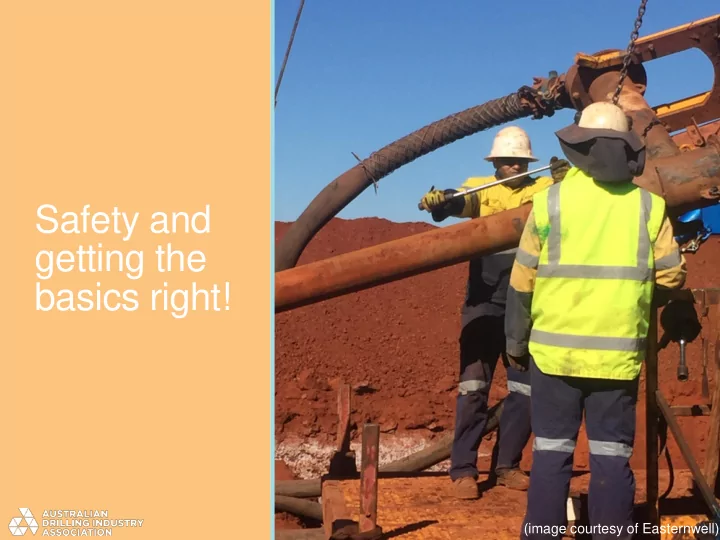
basics right! (image courtesy of Easternwell) Where have we come - - PowerPoint PPT Presentation
Safety and getting the basics right! (image courtesy of Easternwell) Where have we come from 1970s Early 1990s! Current Day - 2019 (image courtesy of Foraco) What changes have we seen since the 1970s THEN NOW Almost zero
(image courtesy of Easternwell)
(image courtesy of Foraco)
Almost zero body protection No equipment guarding Operator at the rig Hook/Clamshell for rod handling Basic foot-clamp arrangements Stilson wrenches No exclusion zones No safety systems
Full PPE Rod guard with interlocks Remote control panel Remote control rod handler Rod spinners/clamps Rod breakers Designated work zones Crew working to an embedded standard
health and safety
come home from work safe and uninjured.
EH&S statistics.
throughout the business.
companies
advancements in the workplace
comply with client requirements.
reinvestment in the business.
Senior Management must be 100% committed and provide the resources Operations Management must live and breathe the standards and “walk the talk”. The drill crews need to have clarity and support on an ongoing basis and a safety culture they can identify with. They must be encouraged to feedback unsafe situations.
Standards and Expectations Operational Feedback
Many low level injuries in the workplace are with employees with less than 2 years experience. Select the right employees in the first instance and then give them the necessary training and opportunity.
Companies who are serious about best practice on safety will have an embedded “way of doing things”. These will vary company to company but they will generally run across similar lines:
ADIA has recently produced a set of 4 posters covering some of these themes.
Contractor Qualifications Training Inductions Rig audit Engineering Maintenance Client Reporting Culture Communication Meetings Responsibilities Expectations
The contractor is engaged to drill, therefore the majority of the work to comply with safety expectations needs to be signed-off before arriving at site. The client will have their own expectations and protocols and these need to be clear and defined from the outset. How well will these mesh with the contractor needs to be determined early.
Contractor Communication Respect Empathy Mentoring Management interaction Demonstrate support. Client Communication Respect Sensibility Learn Engage after- hours Not sure, ask!
2018-19 has been a busy period for drillers, meaning a lot of new recruits starting in the industry. How do we ensure we look after them? More drilling is an outcome of more investment into exploration and expansion. This has resulted in a lot of “green” personnel on the client side also.
Contractor Communication Investigate Management support Identify cause and rectification Employee welfare Client Communication Investigate Independent review Consistency in approach
Unfortunately incidents are still
Investigations need to be completed before cause and blame are attributed. Shut-down of
to be commensurate with incident magnitude and not seen as penalisation.
“Training is
and flick exercise” “Bridge it out and fix it later!” “Don’t report it as the rig may get shut down.” “I’ll be right, I’ve only had a couple of beers” “Put your glasses on, the geo is coming” “Harden up princess!”
(image courtesy of Bostech)