Basic Idea The routing problem in ASIC is typically solved using a - - PDF document

basic idea
SMART_READER_LITE
LIVE PREVIEW

Basic Idea The routing problem in ASIC is typically solved using a - - PDF document

11/2/2018 G L O BA L RO UT ING PRO F. INDRA NIL SENG UPT A DEPA RT DEPA RT MENT MENT O F C O MPUT O F C O MPUT ER SC IENC E A ND ENG INEERING ER SC IENC E A ND ENG INEERING Basic Idea The routing problem in ASIC is typically solved


slide-1
SLIDE 1

11/2/2018 1

G L O BA L RO UT ING

PRO F. INDRA NIL SENG UPT A

DEPA RT MENT O F C O MPUT ER SC IENC E A ND ENG INEERING DEPA RT MENT O F C O MPUT ER SC IENC E A ND ENG INEERING

Basic Idea

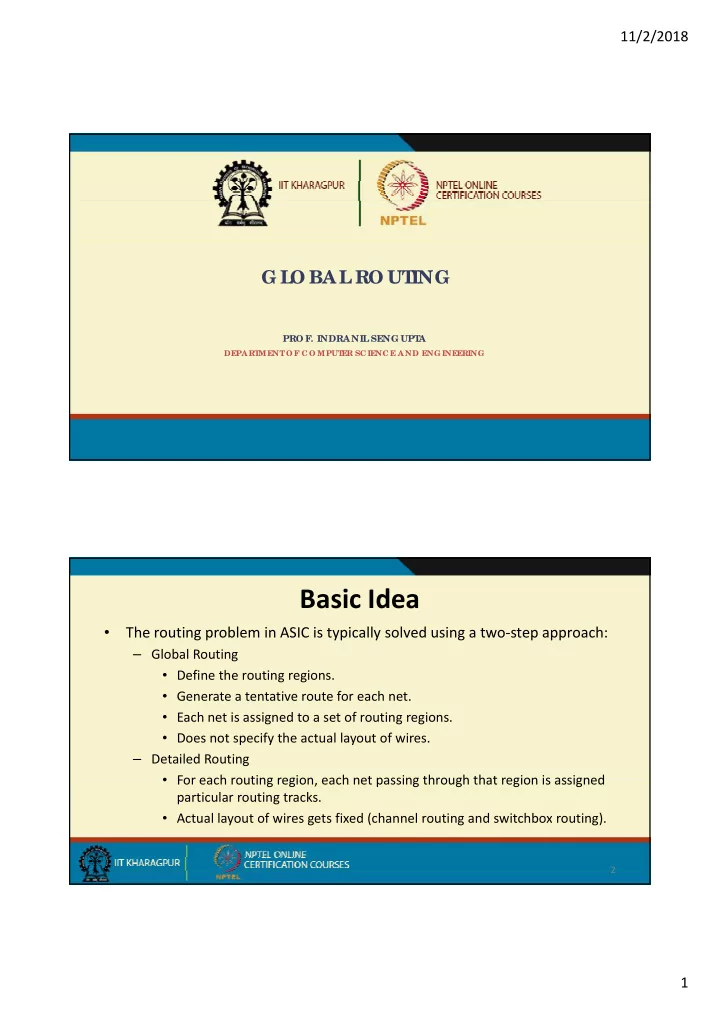
  • The routing problem in ASIC is typically solved using a two‐step approach:

– Global Routing

  • Define the routing regions.
  • Generate a tentative route for each net.
  • Each net is assigned to a set of routing regions.
  • Does not specify the actual layout of wires.

– Detailed Routing F h i i h i h h h i i i d

2

  • For each routing region, each net passing through that region is assigned

particular routing tracks.

  • Actual layout of wires gets fixed (channel routing and switchbox routing).
slide-2
SLIDE 2

11/2/2018 2

3

Global Routing Detailed Routing

Routing Regions

  • Regions through which interconnecting wires are laid out.

H t d fi th i ?

  • How to define these regions?

– Partition the routing area into a set of non‐intersecting rectangular regions. – Types of routing regions:

  • Horizontal channel: parallel to the x‐axis with pins at their top and bottom

boundaries.

  • Vertical channel: parallel to the y‐axis with pins at their left and right

4

p y p g boundaries.

  • Switchbox: rectangular regions with pins on all four sides.
slide-3
SLIDE 3

11/2/2018 3

  • Points to note:

– Identification of routing regions is a crucial first step to global routing. – Routing regions often do not have pre‐fixed capacities. – The order in which the routing regions are considered during detailed routing plays a vital part in determining overall routing quality.

5

Types of Channel Junctions

  • Three types of channel junctions may occur:

L‐type:

  • Occurs at the corners of the layout surface.
  • Ordering is not important during detailed routing.
  • Can be routed using channel routers.

T‐type:

  • The leg of the “T” must be routed before the shoulder.
  • Can be routed using channel routers.

6

+‐type:

  • More complex and requires switchbox routers.
  • Advantageous to convert +‐junctions to T‐junctions.
slide-4
SLIDE 4

11/2/2018 4

Design Style Specific Issues

  • Full Custom

– The problem formulation is similar to the general formulation as discussed.

  • All the types of routing regions and channels junctions can occur.

– Since channels can be expanded, some violation of capacity constraints are allowed.

7

– Major violation in constraints are, however, not allowed.

  • May need significant changes in placement.
  • Standard Cell

– At the end of the placement phase

  • Location of each cell in a row is fixed.
  • Capacity and location of each feed‐through is fixed.
  • Feed‐throughs have predetermined capacity.

– Only horizontal channels exist.

  • Channel heights are not fixed.

Insufficient feed throughs may lead to failure

8

– Insufficient feed‐throughs may lead to failure. – Over‐the‐cell routing can reduce channel height, and change the global routing problem.

slide-5
SLIDE 5

11/2/2018 5 A B A cannot be connected to B

9

B

  • Gate Array

F il d

– The size and location of cells are fixed. – Routing channels & their capacities are also fixed. – Primary objective of global routing is to guarantee routability.

Failed

10

– Secondary objective may be to minimize critical path delay.

slide-6
SLIDE 6

11/2/2018 6

Graph Models used in Global Routing

  • Global routing is typically studied as a graph problem.

d h l h d l d h – Routing regions and their relationships modeled as graphs.

  • Three important graph models:
  • 1. Grid Graph Model

– Most suitable for area routing

  • 2. Checker Board Model

11

  • 3. Channel Intersection Graph Model

– Most suitable for global routing

Grid Graph Model

  • A layout is considered to be a collection of unit side square cells (grid).
  • Define a graph:

E h ll i d – Each cell ci is represented as a vertex vi. – Two vertices vi and vj are joined by an edge if the corresponding cells ci and cj are adjacent. – A terminal in cell ci is assigned to the corresponding vertex vi. – The occupied cells are represented as filled circles, whereas the others as clear circles.

12

– The capacity and length of each edge is set to 1.

  • Given a 2‐terminal net, the routing problem is to find a path between the

corresponding vertices in the grid graph.

slide-7
SLIDE 7

11/2/2018 7

Grid Graph Model :: Illustration

13

Checker Board Model

  • More general than the grid graph model.

A i t th l t id

  • Approximates the layout as a coarse grid.
  • Checker board graph is generated in a manner similar to the grid graph.
  • The edge capacities are computed based on the actual area available for

routing on the cell boundary.

– The partially blocked edges have a capacity of 1. Th bl k d d h it f 2

14

– The unblocked edges have a capacity of 2.

  • Given the cell numbers of all terminals of a net, the global routing

problem is to find a path in the coarse grid graph.

slide-8
SLIDE 8

11/2/2018 8

Checker Board Model :: Illustration

1 1 1

15

2 1 1 1 1 2 1

Channel Intersection Graph

  • Most general and accurate model for global routing.
  • Define a graph:

– Each vertex vi represents a channel intersection CIi. – Channels are represented as edges. – Two vertices vi and vj are connected by an edge if there exists a channel between CIi and CIj. Ed i h h l i

16

– Edge weight represents channel capacity.

slide-9
SLIDE 9

11/2/2018 9

Illustration

17

Extended Channel Intersection Graph

  • Extension of the channel intersection graph.

Includes the pins as vertices so that the connections between the – Includes the pins as vertices so that the connections between the pins can be considered.

  • The global routing problem is simply to find a path in the channel

intersection graph.

– The capacities of the edges must not be violated. l d h ll

18

– For 2‐terminal nets, we can consider the nets sequentially. – For multi‐terminal nets, we can have an approximation to minimum Steiner tree.

slide-10
SLIDE 10

11/2/2018 10

Illustration

19

Approaches to Global Routing

  • What does a global router do?

– It decomposes a large routing problem into small and manageable sub‐problems

  • Called detailed routing

– This is done by finding a rough path for each net.

S f b i i h h

20

  • Sequences of sub‐regions it passes through
slide-11
SLIDE 11

11/2/2018 11

When Floorplan is Given

  • The dual graph of the floorplan (shown in red) is used for global

routing routing.

  • Each edge is assigned with:

– A weight wij representing the capacity of the boundary. – A value Lij representing the edge length.

  • Global routing of a two‐terminal net

21

– Terminals in rectangles r1 and r2. – Path connecting vertices v1 and v2 in G.

5 2 1 6 3

22

4

slide-12
SLIDE 12

11/2/2018 12

When Placement is Given

  • The routing region is partitioned into simpler regions.

T i ll t l i h – Typically rectangular in shape.

  • A routing graph can be defined.

– Vertices represent regions, and correspond to channels. – Edges represent adjacency between channels.

  • Global routing of a two‐terminal net

i l i i d

23

– Terminals in regions r1 and r2. – Path connecting vertices v1 and v2 in G.

Sequential Approaches

  • Nets are routed sequentially, one at a time.

– First an ordering of the nets is obtained based on: (a) Number of terminals, First an ordering of the nets is obtained based on: (a) Number of terminals,

(b) Bounding box length, (c) Criticality.

– Each net is then routed as dictated by the ordering.

  • Most of these techniques use variations of maze running or line search

methods.

  • Very efficient at finding routes for nets as they employ well‐known

24

  • Very efficient at finding routes for nets as they employ well‐known

shortest path algorithms.

– Rip up and reroute heuristic in case of conflict.

slide-13
SLIDE 13

11/2/2018 13

Hierarchical Approaches

  • Use the hierarchy of the routing graph to decompose a large routing

problem into sub‐problems of manageable size. p p g

– The sub‐problems are solved independently. – Sub‐solutions are combined to get the total solution.

  • A cut tree is defined on the routing graph.

– Each interior node represents a primitive global routing problem. E h bl i l d ti ll b t l ti it i t i t

25

– Each problem is solved optimally by translating it into an integer programming problem. – The solutions are finally combined.

Hierarchical Approach :: Illustration

4 3 2 1 4 3 2 1 C B A F

26

F 4 3 D A F E E D C B

slide-14
SLIDE 14

11/2/2018 14

Hierarchical Routing :: Top‐Down Approach

  • Let the root of the cut tree T be at level 1, and the leaves of T at

level h level h.

– h is the height of T.

  • The top‐down approach traverses T from top to down, level by

level.

– Ii denotes the routing problem instance at level i.

27

  • The solutions to all the problem instances are obtained using an

integer programming formulation.

Algorithm

procedure Hier_Top_Down begin Compute solution Ri of the routing problem I1; for i=2 to h do begin for all nodes n at level i‐1 do Compute solution Rn of the routing problem In; Combine all solutions Rn for all nodes n, and Ri‐1 into solution Ri; d

28

end end

slide-15
SLIDE 15

11/2/2018 15

Hierarchical Routing :: Bottom‐up Approach

  • In the first phase, the routing problem associated with each

b h l d b branch in T is solved by IP.

  • The partial routings are then combined by processing

internal tree nodes in a bottom‐up manner.

  • Main disadvantage of this approach:

29

– A global picture is obtained only in the later stages of the process.

Algorithm

procedure Hier_Bottom_Down begin C l i R f h l l h b i f h bl Compute solution Rh of the level‐h abstraction of the problem; for i=h to 1 do begin for all nodes n at level i‐1 do Compute solution Rn of the routing problem In by combining the solution to the children of node n; end;

30

end; end;

slide-16
SLIDE 16

11/2/2018 16

Integer Linear Programming Approach

  • The problem of concurrently routing the nets is computationally hard.

– The only known technique uses integer programming.

  • Global routing problem can be formulated as a 0/1 integer program.
  • The layout is modeled as a grid graph.

– N vertices: each vertex represents a grid cell. – M edges: an edge connects vertices i and j if the grid cells i and j are

31

M edges: an edge connects vertices i and j if the grid cells i and j are adjacent. – The edge weight represents the capacity of the boundary.

  • For each net i, we identify the different ways of routing the

net.

Suppose that there are n possible Steiner trees ti ti ti to route – Suppose that there are ni possible Steiner trees ti

1,ti 2,…,ti ni to route

the net. – For each tree ti

j, we associate a variable xijas:

xij = 1, if net i is routed using tree ti

j

= 0, otherwise.

– Only one tree must be selected for each net:

n

32

ni

 xij = 1

j=1

slide-17
SLIDE 17

11/2/2018 17

  • For a grid graph with M edges and T = ni trees, we can represent the routing

trees as a 0‐1 matrix AMxT =[aip]. aip = 1, if edge i belongs to tree p = 0, otherwise.

  • Capacity of each arc (boundary) must not be exceeded:

N nk

  aip xlk  ci

k=1 l=1

  • If each tree tj

i is assigned a cost gij, a possible objective function to minimize is: 33

If each tree t i is assigned a cost gij, a possible objective function to minimi e is:

N nk

F = 

 gij xij

i=1 j=1

  • 0‐1 integer programming formulation:

Minimize N nk

    gij xij

i=1 j=1

Subject to:

ni

 xij = 1,

1  i  N

j=1 N nk

34

k

  aip xlk  ci ,

1  i  M

k=1 l=1

xkj = 0,1 1  k  N, 1  j  nk

slide-18
SLIDE 18

11/2/2018 18

Performance Driven Routing

  • Advent of deep sub‐micron technology

– Interconnect delay constitutes a significant part of the total net delay. Interconnect delay constitutes a significant part of the total net delay. – Reduction in feature sizes has resulted in increased wire resistance. – Increased proximity between the devices and interconnections results in increased cross‐talk noise.

  • Routers should model the cross‐talk noise between adjacent nets.
  • For routing high‐performance circuits, techniques adopted:

– Buffer insertion

35

Buffer insertion – Wire sizing – High‐performance topology generation