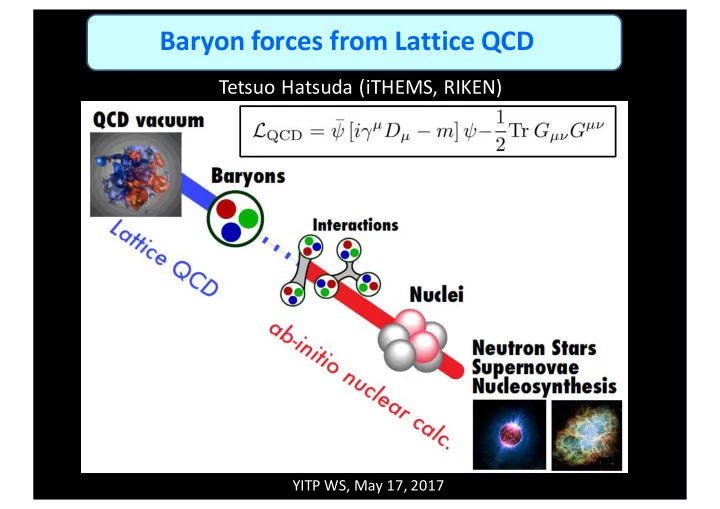
SLIDE 1
Baryon forces from Lattice QCD
Tetsuo Hatsuda (iTHEMS, RIKEN)
YITP WS, May 17, 2017
SLIDE 2
- 1. Introduction on hadronic interactions from LQCD
- 2. How “fake plateaux” ruin all the previous works
(except for HAL QCD)
”Mirage in temporal correlation functions for baryon-baryon interactions in lattice QCD”, arXiv: 1607.06371 [hep-lat] (JHEP 10 (2016) 101) by HAL QCD Coll. “Are two nucleons bound in lattice QCD for heavy quark masses ? – Sanity check with Lucsher’s finite volume formula –” arXiv: 1703.07210 [hep-lat] (submitted to PRD) by HAL QCD Coll.
- 3. Hyperons in dense matter
Contents
- S. Aoki, D. Kawai, T. Miyamato, K. Sasaki, T. Aoyama (YITP)
- T. Doi, T. M. Doi, S. Gongyo, T.Hatsuda, T. Iritano (RIKEN)
- T. Inoue (Nihon Univ.)
- Y. Ikeda, N. Ishii, K. Murano (RCNP)
- H. Nemura (Univ. of Tsukuba)
- F. Etminan (Univ. of Birjand)
SLIDE 3
LQCD for multi-hadron (2015-)
K computer RIKEN (10 PFlops)
HAL QCD Collaboration
0.121 fm x 32 = 3.9 fm Mπ > 350 MeV 0.085 fm x 96 = 8.2 fm Mπ = 145 MeV
SLIDE 4
Fundamental difference between A=1 and A > 1 Δ ~ΛQCD N N+π Δ
Single nucleon Two nucleons
0 << ΛQCD NN NN+π
elastic inelastic
B
SLIDE 5
N N+π Δ t-1 = Δ ~200 MeV NN NN+π B t-1 = δE ~20 (9/L)2 MeV δE Fundamental difference between A=1 and A > 1
SLIDE 6
Scattering observables from LQCD
Imaginary time space
x y
J † J †
Luescher, Nucl. Phys. B354 (1991) 531 Ishii, Aoki & Hatsuda, PRL 99 (2007) 022001 Ishii et al. [HAL QCD Coll.], PLB 712 (2012) 437
φ(r,t) à 2PI kernel (T=U+GUT) à phase shift, binding energy Finite Volume Method HAL QCD Method En (L) à phase shift, binding energy
SLIDE 7
Parisi, Lepage (1989)
Signal/Noise ~ √Nconf
Single pion Multi pion
Signal/Noise ~ √Nconf
Single nucleon
Signal/Noise ~ exp(- mN t) x √Nconf
Multi nucleon
Signal/Noise ~ √exp(- A mN t) x Nconf
Problem of Signal to Noise Ratio
SLIDE 8
N N+π Δ t-1 = Δ ~200 MeV NN NN+π B t-1 = δE ~20 (9/L)2 MeV δE Fundamental difference between A=1 and A > 1
S/N ~ exp(- mN t) x √Nconf ~ 10-2 x √Nconf S/N ~ exp(- 2mN t) x √Nconf ~ 10-41 x √Nconf
SLIDE 9
SLIDE 10 Demo by Mock-up data @ mπ =0.51GeV, L=4.3fm
Same setup as Yamazaki et al. (’12)
Ground state energy : ~ 1 MeV precision required Elastic scattering threshold : sensitive to L (10% contamination) (1% contamination) Inelastic threshold : insensitive to L
SLIDE 11
True ground state for t > 10 fm
Zoom + typical stat error
“Fake plateaux” or “Mirage” at t ~ 1 fm
SLIDE 12
Actual data for ΞΞ (1S0) @ mπ =0.51GeV, L=4.3fm, a=0.09fm
Source dependence
SLIDE 13 smeared source wall source
Sink dependence
Actual data for ΞΞ (1S0) @ mπ =0.51GeV, L=4.3fm, a=0.09fm
JHEP1610(2016)101
All the previous results (Yamazaki et al., NPL QCD, CalLat) using the smeared source were looking at ”Fake Plateaux”.
SLIDE 14
Analysis of all existing data for Baryon-Baryon interactions using plateau method
SLIDE 15 11/01/2013 15
Summary Table : At least single “No” implies the result is “Mirage”
SLIDE 16
Luscher’s formula: Scatterings on the lattice
Wave function at |x|> R for infinite L: Quantization condition for finite L with PBC: Schroedinger eq. in (1+1)-dimension:
|x|<R
Lucsher’s formula in (1+1)-D
SLIDE 17
Luscher’s formula: Scatterings on the lattice
Quantization condition for finite L with PBC: NBS equation in (3+1)-dimension:
R L
Wave function at |x|> R for infinite L: Wave function at |x|> R for finite L with PBC: Lucsher’s formula in (3+1)-D
SLIDE 18
Effective Range Expansion (ERE)
infinite V
Re[k] Im[k]
X S-matrix
SLIDE 19
Re[k] Im[k]
S-matrix
finite V
Dotted lines from Luscher’s formula
Effective Range Expansion (ERE)
x x x x
SLIDE 20 (ii) Singular behavior
Data by Yamazaki et al (2012)
“Sanity Check” for all the existing data
arXiv:1703.07210
Data by NPL Coll. (2015)
(i) Inconsistent ERE (iii) Unphysical pole residue
SLIDE 21 11/01/2013 21
Summary Table : At least single “No” implies the result is “Mirage”
SLIDE 22
HAL QCD Method : the Master equation
Imaginary time space
x y
J † J †
Ishii, Aoki & Hatsuda, PRL 99 (2007) 022001 Ishii et al. [HAL QCD Coll.], PLB 712 (2012) 437
R(r,t) à 2PI kernel (T=U+GUT)à phase shift, binding energy
SLIDE 23 Time-dependent HAL method
N.Ishii et al. (HAL QCD Coll.) PLB712(2012)437
. . .
All equations can be combined as
Elastic Inelastic NNπ NN
All the elastic states share the same non-local potential U(r,r’) Plateau method HAL QCD method Inelastic states Noise Noise Elastic states Noise Signal Ground state Signal Signal necessary t t > 10 fm t ~ 1 fm Exponential Improvement !
SLIDE 24
HAL QCD Method
Fate of the fake plateau
a=0.09 fm mπ=0.51 GeV mK=0.62 GeV
No ΞΞ bound state
SLIDE 25
Physical point LQCD studies on multi-hadron (2015-) HAL QCD Collaboration
0.085 fm x 96 = 8.2 fm Mπ = 145 MeV
SLIDE 26
SLIDE 27
SLIDE 29
SLIDE 32
- 1. Introduction on hadronic interactions from LQCD
Physical point BB data are now available
- 2. “Fake plateaux” ruin all the previous works except for HAL
”Mirage in temporal correlation functions for baryon-baryon interactions in lattice QCD”, arXiv: 1607.06371 [hep-lat] (JHEP 10 (2016) 101) by HAL QCD Coll. “Are two nucleons bound in lattice QCD for heavy quark masses ? – Sanity check with Lucsher’s finite volume formula –” arXiv: 1703.07210 [hep-lat] (submitted to PRD) by HAL QCD Coll.
- 3. Hyperons in dense matter
Summary