Bananas: The Uncertain Future of a Favorite Fruit Dan Koeppel - - PowerPoint PPT Presentation

bananas the uncertain future of a favorite fruit
SMART_READER_LITE
LIVE PREVIEW

Bananas: The Uncertain Future of a Favorite Fruit Dan Koeppel - - PowerPoint PPT Presentation

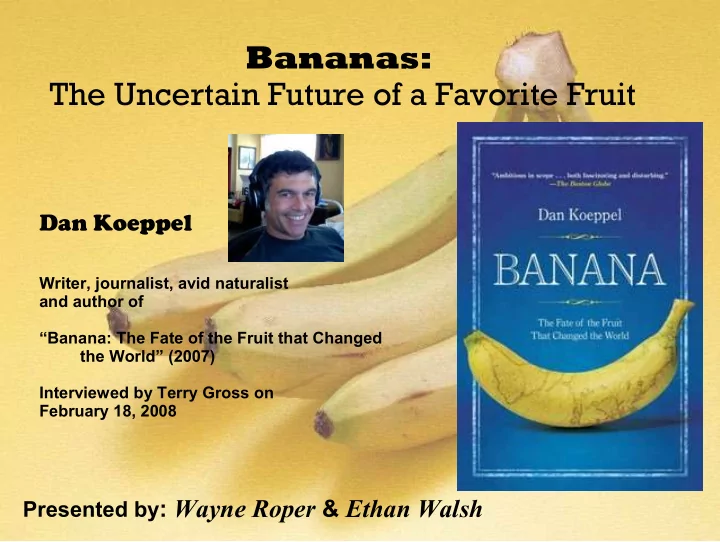
Bananas: The Uncertain Future of a Favorite Fruit Dan Koeppel Writer, journalist, avid naturalist and author of Banana: The Fate of the Fruit that Changed the World (2007) Interviewed by Terry Gross on February 18, 2008 Presented by :


slide-1
SLIDE 1

Bananas: The Uncertain Future of a Favorite Fruit

Dan Koeppel

Writer, journalist, avid naturalist and author of “Banana: The Fate of the Fruit that Changed the World” (2007) Interviewed by Terry Gross on February 18, 2008

Presented by: Wayne Roper & Ethan Walsh

slide-2
SLIDE 2

Bananas: Where?

Grown in practically every humid tropical region that can sustain them. Typically any place that can sustain a temperature of 10-27ºC (50-80ºF) year round. There are a few “hardy” banana species, but most are cultivars, and did not exist naturally. Typical Locations: Southeast Asia, tropical Africa, South America, the Caribbean.

Banana plantation in Costa Rica Banana plantation in India

slide-3
SLIDE 3

Bananas: What?

Bananas are a large herbaceous flowering

  • plant. They are NOT trees

The large leaves grow from the root and combine together to form a “pseudostem” that makes the plant very sturdy A single root (corm) may produce multiple shoots

Banana pseudostems growing close together. One corm, multiple “stems”

slide-4
SLIDE 4

Bananas: What?

The fruit grow in hanging clusters that can contain more than 50 bananas per bunch and weigh over 100 lbs. (45 kg)

Market bananas contain lots of sugar, while wild bananas usually contain more starch. There are over 1000 different banana varieties.

Bananas on display at a Sri Lankan market

slide-5
SLIDE 5

Bananas: Who?

Kingdom

Plantae

(Plants)

Phylum (division) Magnoliophyta

(flowering plants)

Class

Liliopsida

(monocotyledon)

Order

Zingiberales

(tropical, psedostem, banana leaves)

Family

Musaceae

(Banana and Enset)

Genus

Musa

(Banana and plantain)

Species

Acuminata

Cultivar

Dwarf Cavendish

slide-6
SLIDE 6

Bananas: Who?

The Cavendish banana is currently the most popular commercial variety. “Dwarf Cavendish”, named so because of its short pseudostem, is the most common Cavendish cultivar. Cavendish is the name of the person who first popularized the cultivar for distribution. The full name for the species is:

Musa acuminata Colla (AAA group) cv. 'Dwarf Cavendish'

  • “Colla” Refers to the Italian botanist that described the

acuminata species.

  • “AAA group” Is reference to the species being a triploid

clone of the wild banana species M. acuminata.

  • “cv.” Is short for “cultivar”
  • M. acuminata is native to Southeast Asia and is believed to have been domesticated

as long as 8000 years ago. There are many edible cultivars of banana that originate from this species. It became popular because of its parthenocarpy, natural production of seedless fruit. In its native habitat M. Acuminata is considered a pioneer species because of its ability to grow easily in disturbed areas and the large quanity of wildlife that feed on and spread its seeds.

slide-7
SLIDE 7

Bananas: Cavendish

The commercial sale of this specific cultivar date back to the early 1900s but it did not become popular worldwide until the 1950s. There are other Cavendish banana species, but the Dwarf Cavendish is the most popular because of several factors.

  • high yield rate
  • Shorter size (6-8 ft; 2-2.5 m) makes it more resistant

to falling over from wind and easier to pick from.

  • pericarp not too sensitive to shipping and handling
  • more resistant to infection than other banana

species

Flowering Cavendish plant Cavendish ripening at a Cameroon facility

slide-8
SLIDE 8

Bananas: Panama disease

Unfortunately, it was recently discovered that the Dwarf Cavendish banana IS susceptible to Panama disease. The fungi Fusarium oxysporum is a plant pathogen that kills many different types of plants through a process called Fusarium wilt. Panama disease is considered one

  • f the most destructive plant

pathogens in the world. It is resistant to fungicide and chemical treatments have not resulted in its eradication. It is believed that the fungus

  • riginated in Southeast Asia.

Fusarium oxysporum fungi

slide-9
SLIDE 9

Bananas: Panama disease

  • F. oxysporum on a petri dish

The specific species is called Fusarium oxysporum f.sp. cubense

The mycelia or spores of F. oxysporum penetrate the roots of a plant and advance intracellularly into the xylem. The mycelia inside the xylem produce more spores and eventually get trapped in the sap stream of the plant. The vascular vessels become clogged and are no longer able to efficiently transport water and nutrients upward. Eventually the plant tissues above the clog die, followed by the death of the entire plant, including the roots. The fungus then invades all of the plant tissue and begins creating more spores to continue spreading.

Left: Wilting leaves; Right: Clogged vascular tissue

slide-10
SLIDE 10

Bananas: Gros Michel

Gros Michel banana AKA “Big Mike”

Because Panama disease is spread by such a strong plant pathogen, a strong banana variety is needed to resist its effects. The Gros Michel banana is another triploid cultivar of Musa acuminata and has similar properties to the Dwarf Cavendish, except it is better in some respects.

  • Generally said to be tastier than the Cavendish
  • Larger size than Cavendish
  • Tougher skin than Cavendish (allowed for easier transportation)
slide-11
SLIDE 11

Bananas: Gros Michel

BAD NEWS

The Gros Michel banana was actually a world commodity before the

  • Cavendish. It has been in the global market since the 1880s and was

preferred over all other varieties. In the mid-1900s the Gros Michel was devastated by Panama disease and production slowed to a crawl. It was believed that the Cavendish banana was resistant to the

  • disease. Companies began

switching their plantations over to the new cultivar, lead by Standard Banana, now known as Dole. Companies that resisted the change either went bankrupt or near bankrupt because of the increasing loss of yield due to Panama disease.

Labels of various banana production companies

slide-12
SLIDE 12

Bananas: What went wrong?

A different strain of Fusarium oxysporum, named “Tropical Race 4” is what is affecting the Dwarf Cavendish variety. TR4 is slightly different from the first discovered form of the fungi and bypasses the Cavendish's genetic resistance. The new strain was discovered after some resistant Cavendish were brought to Asia and the fungus began spreading once again. It only takes a clump of contaminated soil or a few spores to transfer the pathogen to another region. The latest reported cases of the pathogen have been contained but if Fusarium

  • xysporum spores are not contained it would take as little as 10 to 30 years for

the pathogen to significantly reduce commercial Banana yields.

Global distribution of Panama disease (2006)

slide-13
SLIDE 13

Bananas: The Problem

Every individual of Musa acuminata Colla (AAA group) cv. 'Dwarf Cavendish' is genetically the same as the others. The only known resistance to Fusarium wilt is genetic resistance. Because Cavendish have no seeds and reproduce asexually, genetic variation is decreased and it is difficult to breed different types. There are no other commercially available banana cultivars that have a resistance to fusarium wilt. It would require lots of new technology and infrastructure to bring different and less fragile bananas to market. The industry is not set up to handle this method globally

Dole banana shipping boat

slide-14
SLIDE 14

Bananas: The Problem

Those who cannot remember the past are condemned to repeat it.

  • George Santayana (1863-1952)

Insanity: doing the same thing over and over again and expecting different results

  • Albert Einstein (1879-1955) (attributed)

Is it good enough to keep trying to find varieties of banana that are resistant to Fusarium wilt and mass market only a couple varieties

  • r should a different approach be taken?
slide-15
SLIDE 15

Bananas: The Problem

Most varieties of banana do not have the acceptable mix of characteristics that make them commercially efficient.

  • Some may have tough skin for shipping, but are susceptible to disease.
  • Some may be resistant to disease, but too small or too starchy.

It takes an excellent mix of genes to make a fruit widely marketable. Since large scale banana farming is limited to tropical climates, plantations cannot be created worldwide to make distribution less harsh

  • n the fruit.

Organic farming of banana varieties could help create some genetic diversity and resistance, but organic bananas, in order to fight disease, have to be grown at higher altitudes and cooler temperatures. There is not enough land to grow enough bananas to sustain demand.

Dole organic banana tag

slide-16
SLIDE 16

Bananas: The solution?

Koeppel believes that genetic modification is the only possible solution at the moment due to the lack of ability for most other bananas to be be produced in mass and shipped globally to market. Plant cross breeders have been working toward finding other cultivars of banana that are resistant to Fusarium oxysporum and its various strains. A few varieties have already been created and cultivated in limited areas (subsistence farming), but the taste or texture of these recent findings are not equivalent or better than the Cavendish and have been held back from the global market. There have been efforts to use gene splicing to create transgenic varieties of

  • banana. Because F. oxysporum does not affect all crop plants there is a

possibility of mixing genes. Radish varieties, for example, are resistant to a similar fungus, and mixing Cavendish genes with radish may produce a stronger banana.

+ = ?

slide-17
SLIDE 17

Bananas: Talking points

Bananas are limited in distribution by the need for a tropical climate to sustain the most productive growth. One banana variety, the Gros Michel, has already caused a market disruption due to disease Cavendish bananas have had a good run, but keeping a resistant fungus such as Fusarium

  • xysporum in containment is difficult.

Most experts say it is inevitable that the new case of Panama disease will spread worldwide, and since all Cavendish bananas are genetically the same, the plant pathogen will have little trouble infecting new crops If bananas are going to continue as a worldwide commodity, there is no way

  • rganic or local farming will be able to keep pace with demand

If genetic variability is the only feasible solution, it may be better to create several different varieties for global distribution instead of one super variety. Otherwise, a new infrastructure would be needed to help ship weaker banana varieties.
slide-18
SLIDE 18

SOURCES

Interview between Koeppel and Terry Gross of NPR

http://www.npr.org/2011/08/30/139787380/bananas-the-uncertain-future-of-a-favorite-fruit

Pests and Diseases Image Library

http://www.padil.gov.au/

“Can This Fruit Be Saved?”

http://www.popsci.com/scitech/article/2008-06/can-fruit-be-saved

Species profile for Pacific Island agroforestry, Musa species

http://agroforestry.net/tti/Musa-banana-plantain.pdf