BALLOON PAYLOAD PROGRAM WILLIAM COOPER GILBERT, KC3EMR(-11) SPACE - - PowerPoint PPT Presentation

balloon payload program
SMART_READER_LITE
LIVE PREVIEW

BALLOON PAYLOAD PROGRAM WILLIAM COOPER GILBERT, KC3EMR(-11) SPACE - - PowerPoint PPT Presentation

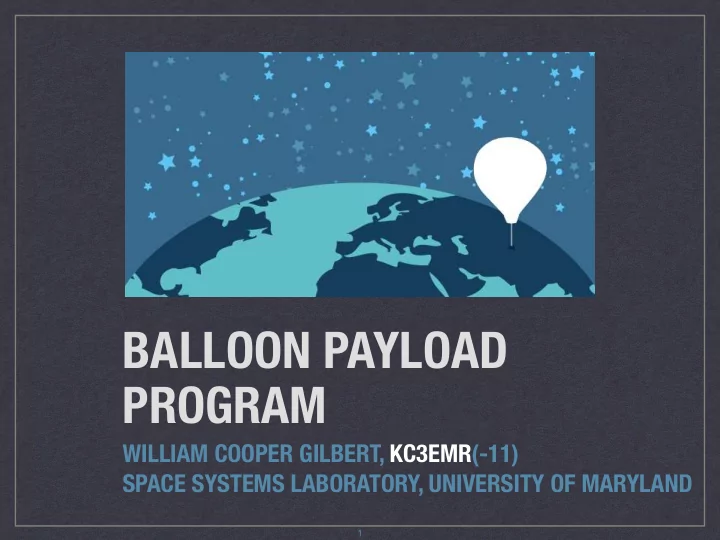
BALLOON PAYLOAD PROGRAM WILLIAM COOPER GILBERT, KC3EMR(-11) SPACE SYSTEMS LABORATORY, UNIVERSITY OF MARYLAND 1 BALLOON PAYLOAD PROGRAM Launch helium sounding balloons into the upper atmosphere Low density gas generates buoyancy (approx.

slide-1
SLIDE 1

BALLOON PAYLOAD PROGRAM

WILLIAM COOPER GILBERT, KC3EMR(-11) SPACE SYSTEMS LABORATORY, UNIVERSITY OF MARYLAND

1

slide-2
SLIDE 2

2

BALLOON PAYLOAD PROGRAM

Launch helium sounding balloons into the upper atmosphere

  • Low density gas generates buoyancy (approx. 25 lbs)
  • Buoyancy used to lift 12 lbs of Payloads (Cubesats, structures, etc.)
  • Payloads are carried to between 70,000 ft and 110,000 ft above MSL
  • Pressurized helium expands with altitude, eventually causing

rupture of elastic balloon material (burst)

  • Parachute attached to payloads for safe recovery of equipment

UHF and VHF Radio used for tracking systems

  • APRS (144.39 MHz) for receiving omnidirectional broadcast of GPS

position data and altitude [VHF]

  • 900 MHz transceivers for telemetry and active control [UHF]
  • Cellular GSM network transmitter used for ground location [UHF]
slide-3
SLIDE 3

3

BALLOON PAYLOAD PROGRAM

slide-4
SLIDE 4

4

BALLOON PAYLOAD PROGRAM

KC3EMU KC3EMQ

slide-5
SLIDE 5

5

BALLOON PAYLOAD PROGRAM

Photo taken by TurtleNest payload at 103,000 ft

slide-6
SLIDE 6

BALLOON PAYLOAD PROGRAM

6

Funded by the NASA Space Grant, through the Maryland Space Grant Consortium (MDSGC) Mission Statement of the NASA Space Grant: “…to contribute to the nation’s science enterprise by funding education, research, public engagement…”

slide-7
SLIDE 7

7

BALLOON PAYLOAD PROGRAM

Education (Fall semesters)

  • Introduction to Aerospace Engineering ENAE100
  • Theoretical calculations for space flight
  • Laboratory experience

Research (Spring and Summer semesters)

  • Improve select ENAE100 payloads
  • Refine and advance equipment used for ENAE100
  • Develop new payload platforms

Public Engagement

  • Public Launches from Clear Spring, MD
  • Maryland Day
slide-8
SLIDE 8

8

BALLOON PAYLOAD PROGRAM

Large Research Initiatives

  • Tracking and Air-to-Air data logging systems [Command Module]
  • Attitude stabilization platform [BADASS]
  • High velocity and deployable parachute platform [Supersonic]
  • Directed Air-to-Ground telemetry systems [Link]

Small Research Initiatives

  • Solar energy generation platform [Spectre]
  • Dynamically-controlled isothermal chamber [SpaceQube]
  • Atmospheric gas concentration instrument package [ATMOS]
  • Spherical imaging system [Looking Glass]
slide-9
SLIDE 9

9

BALLOON PAYLOAD PROGRAM

Automatic Packet Reporting System

slide-10
SLIDE 10

BALLOON PAYLOAD PROGRAM

APRS - Automatic Packet Reporting System Distributed network of digital ax.25 packet radio repeaters and/or internet gateways on a location-specific frequency (United States - 144.39 MHz)

  • Transmitter Node formats packet in software
  • Repeater Node receives packet, rebroadcasts unmodified packet,

possibly uploads to internet database

  • Terminal Node receives packet, decodes with controller (TNC),

displays packet as a data string

  • UTC, GPS coordinates, altitude, callsign, repeaters, i-gates,

additional user defined data (e.g. http://www.umd.edu)

  • Data interface via radio control head or website

Developed by Bob Bruninga (WB4APR) in the 1980s

slide-11
SLIDE 11

BALLOON PAYLOAD PROGRAM

slide-12
SLIDE 12

BALLOON PAYLOAD PROGRAM

Flight Tracking Systems

  • Command Module
  • Primary and redundant transmitter nodes
  • Transmitters are both HABduino units
  • Product of Nevis Computers Ltd, UK High Altitude

Society

  • Built off of Arduino Uno series Micro-controller
  • Use Radiometrix HX-1, 300mW radio transmitter
  • Callsign W3EAX, SSID 9-12
  • High velocity, parachute platform (Supersonic)
  • Tertiary transmitter node
  • Needed because of separation from launch vehicle
  • Custom tracking unit, also made by Nevis Computers Ltd.
slide-13
SLIDE 13

BALLOON PAYLOAD PROGRAM

Ground Tracking Systems

  • Tracking Vehicles
  • At least one terminal node per vehicle, sometimes two
  • Terminal nodes are Kenwood D710a, D710g series radios
  • Data received via head controller, custom software, APRS.fi
  • Head controller data called out on handheld radios to

convoy for routing recovery teams

  • Custom software decodes, filters, parses, and logs data
  • Written by Nick Rossomando (KD2IFB)
  • APRS.fi stores packets for post-processing in Matlab
  • Post processing done by Steve Lentine (KD2DRI)
slide-14
SLIDE 14

BALLOON PAYLOAD PROGRAM

Why APRS?

  • Distributed Network
  • Line-of-sight limitations for ground tracking systems
  • Power limitations for space vehicle
  • Limited Access
  • FCC licensure requirement for operators
  • 900 MHz (unlicensed) telemetry radios are noisy despite being

restricted to Industrial, Scientific, and Medical uses (ISM band)

  • Availability of affordable equipment
  • HABduino unit ($150), Arduino Uno ($25), Kenwood D710g ($650)
  • Low barriers to entry
  • Short time frame for students to participate, develop expertise
slide-15
SLIDE 15

15

BALLOON PAYLOAD PROGRAM

Current Callsigns Steve Lentine - KD2DRI Nick Rossomando - KD2IFB William Cooper Gilbert - KC3EMR Camden Miller - KC3EMV Sarah “Sky” Onimus - KC3EMQ Peter Wight - KC3EMU + 8 more by the end of this year University of Maryland - W3EAX

slide-16
SLIDE 16

BALLOON PAYLOAD PROGRAM

W3EAX

slide-17
SLIDE 17

BALLOON PAYLOAD PROGRAM

Brief History

  • Callsign for the University of Maryland Amateur Radio Association
  • Had the callsign since at least 1932
  • One of the oldest HAM radio clubs in the US
  • First QSL card from 1933
  • Received ARRL recognition in 1947
  • Currently the club is classified as student group, funded by the

Student Government Association

  • Trustee - Yehuda Katz [KB3UZY]
  • President - Perry Bloch
slide-18
SLIDE 18

BALLOON PAYLOAD PROGRAM

Main Tower - 60 ft. Rohn 25G South Campus Dining Facility

slide-19
SLIDE 19

BALLOON PAYLOAD PROGRAM

Past Tower Operations

  • Analog repeater station for the College Park neighborhood
  • Due to its size and location, it has functioned as a repeater for all of

the northeastern part of the DC metropolitan area.

  • The UMD Archive records that…

“on two occasions, the club has received commendations for quick and accurate broadcasting and assistance to local news stations during the Three Mile Island crisis in 1979 and the U.S. Invasion of Grenada in 1983.”

slide-20
SLIDE 20

BALLOON PAYLOAD PROGRAM

slide-21
SLIDE 21

BALLOON PAYLOAD PROGRAM

slide-22
SLIDE 22

BALLOON PAYLOAD PROGRAM

Current Tower Operations

  • Struck by lightning sometime around 10 years ago, damaging much
  • f the equipment
  • Gradually fallen into further disrepair since then
  • Repeater still online, but range is only a few meters
  • SGA will not allow funding to spent on repairs
slide-23
SLIDE 23

BALLOON PAYLOAD PROGRAM

  • Urgent need for functioning repeater tower
  • Analog repeater functions
  • APRS operations / Digital Repeater / I-Gate system
  • Large gap in coverage for the DC metro area currently
  • HFHN - High Frequency Hospital Net, other emergency

coordination activities in the region

  • Focus of attention due to high profile activities
  • Balloon Program
  • UMD HAM club
slide-24
SLIDE 24

BALLOON PAYLOAD PROGRAM

OPPORTUNITY

“A set of circumstances that makes it possible to do something synomyms: chance, lucky chance, favorable time/occation/moment…”