Ballistic Launcher Project Ballistic Launcher Project ELO 2017 Why - - PowerPoint PPT Presentation

ballistic launcher project ballistic launcher project
SMART_READER_LITE
LIVE PREVIEW

Ballistic Launcher Project Ballistic Launcher Project ELO 2017 Why - - PowerPoint PPT Presentation

Ballistic Launcher Project Ballistic Launcher Project ELO 2017 Why Am I Here? Why Am I Here? https://upload.wikimedia.org/wikipedia/commons/e/e0/Question -mark-blackandwhite.png Goals for my Project Goals for my Project How can I


slide-1
SLIDE 1

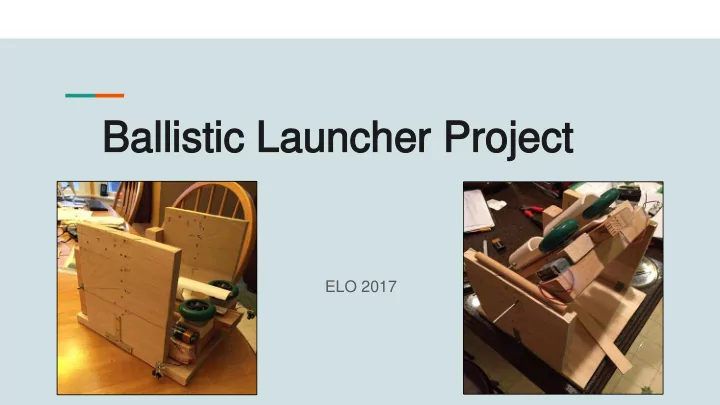
Ballistic Launcher Project Ballistic Launcher Project

ELO 2017
slide-2
SLIDE 2

Why Am I Here? Why Am I Here?

https://upload.wikimedia.org/wikipedia/commons/e/e0/Question -mark-blackandwhite.png

slide-3
SLIDE 3

Goals for my Project Goals for my Project

  • How can I effectively construct and predict the performance of a

ballistic launcher?

  • Do the results of the performance of this launcher differ at a

statistically significant level from my predictions for them?

  • Based on my results, how

reliable and accurateis my product? What revisions need to be made, if any?

slide-4
SLIDE 4

Timeline/Milestones Timeline/Milestones

  • My goal was to follow the Design Process used in my IED and POE classes
  • 1. Problem

Identification

  • 2. Concepts Design
  • 3. Design Analysis
  • 4. Refinement
  • 5. Implementation
  • a. Construction/Launch Predictions
  • b. Launch Testing/Statistical Analysis
  • 6. Reflection
  • 7. Presentation
slide-5
SLIDE 5

Tracking my Progress Tracking my Progress

  • Kept a project folder to hold important documents

and information related to my project, as well as a daily journal highlighting my work from that day when I first did this project

  • Will do the same thing now as well
slide-6
SLIDE 6

Initial Research Initial Research

  • Researched variety of possible designs, materials,

and examples of other launchers

  • Didn’t have in mind a specific idea of what type of

launcher I wanted to build

  • kept my research broad
  • Spent too much time on this phase
slide-7
SLIDE 7

Concept Design Concept Design

  • Decided to make five concepts to explore a variety of different ideas and

features for a launcher

  • Decided that it was best to design concepts that were improvements of the

last launcher I designed and eliminate the problems that occurred with it ○ The design of my first launcher involved a motor

  • powered wheel

apparatus ○ My first launcher launched ping pong balls

slide-8
SLIDE 8

Concept Design Concept Design

Original concept design and final launcher (from 2016)

slide-9
SLIDE 9

Left: Left: Concept 1 Concept 1 - “Slingshot Design” “Slingshot Design” Right: Right: Concept 2 Concept 2 - “Spring “Spring- Loaded Design” Loaded Design”

slide-10
SLIDE 10

Left: Left: Concept 4 Concept 4 - “Dual “Dual- Wheel Design” Wheel Design” Right: Right: Concept 3 Concept 3 - “Single “Single- Wheel Design” Wheel Design”

slide-11
SLIDE 11

Concept Design Concept Design

Left: Left: Concept 5 Concept 5 - “Dual “Dual- Wheel Spring Loaded Wheel Spring Loaded Design” Design”

slide-12
SLIDE 12

Design Analysis Design Analysis

  • Needed to choose what concept I wanted to work off of going forward
  • “Constraints” were used to score each concept; the concept with the

highest score was chosen

  • Four constraints were used in the last project and were kept
  • Two additional constraints were added to ensure this new design

would be an improvement of the old one

  • Concept 4 ended with the highest score
slide-13
SLIDE 13

Design Analysis Design Analysis

List of Constraints: List of Constraints:

  • 1. Must be constructed using the materials outlined by the instructor.
  • 2. Must be adjustable to different angles, including: 0, 15, 30, 40, 45, 50,

60, and 75 degrees.

  • 3. Must have the same initial velocity at any adjusted angle.
  • 4. Must have a projectile of at least 5
  • 15 feet.
  • 5. Must be able to hold more than one ball at a time, and be easily

reloadable.

  • 6. Must be created in a way that is visually appealing, or covers up any

unsightly qualities.

slide-14
SLIDE 14

Design Analysis Design Analysis

Cnstnt. 1 Cnstnt. 2 Cnstnt. 3 Cnstnt. 4 Cnstnt. 5 Cnstnt. 6 Description (Drawbacks) Total Score Concept 1

4.5 5 3.5 5 1.5 4 Original idea, but elasticity of slingshot band could wear down over time, & at a higher angle would be harder for ball to get up long ramp, creating different initial velocities. Only holds 1 ball at a time. Appealing design. Metal rod VEX? 23.5

Concept 2

4.5 5 3 5 4 4 Might be hard to build spring structure, too time consuming. Spring could be contracted to varying lengths and therefore lead to different initial velocities. Metal VEX rod? 25.5

Concept 3

4 3 4.5 5 4 4 VEX motor? Metal rod angle set up hard to be precise with, could have different initial velocity if battery dries. 24.5

Concept 4

4 4 4.5 5 4.5 4.5 2 VEX motors? Could have different initial velocity if battery dries, angle set up likely hard to build. 26.5

Concept 5

4 5 3 5 4 5 2 VEX motors? Angle adjustment good, ball might not always be launched by wheels at same speed,Spring could be contracted to varying lengths and therefore lead to different initial velocities. Might be hard to refill with balls. 26

Table 1 Table 1 - Concept Score based on Individual Constraints Concept Score based on Individual Constraints

slide-15
SLIDE 15

Design Analysis Design Analysis

Chart 1 Chart 1 - Concept Score based on Concept Score based on Individual Constraints Individual Constraints

slide-16
SLIDE 16

Design Analysis Design Analysis

https://cdn.pixabay.com/photo/2016/03/31/20/55/boy

  • 1296092_960_720.png

https://cdn.pixabay.com/photo/2017/01/31/13/12/first

  • 2023915_960_720.png

Winning Winning Concept: Concept: Concept 4 Concept 4 -

“Dual-Wheel Design”

slide-17
SLIDE 17

Refinement Refinement

  • Made changes to Concept 4 in order to improve the

design

  • Changes included combining some of the aspects

that other concepts included in their designs

slide-18
SLIDE 18

Refinement Refinement

What’s New: What’s New:

  • Moved wheels to front
  • f launcher
  • Added wooden blocks

for angle suspension

  • Added a push
  • stick to

push ball into launcher

slide-19
SLIDE 19

Implementation Implementation

  • Used my refinement sketch to begin building my

launcher

  • Originally planned to spend two weeks building my

launcher, but ended up spending close to four

  • Had trouble designing the angle pieces, mounting the

wheels, and getting the ball to launch straight

slide-20
SLIDE 20

Implementation Implementation

  • Took a picture every

day to keep track of progress

  • Materials used include

wood, PVC pipe, DC motors, 9V batteries, screws, etc.

Day 3 Day 3 Day 5 Day 5

slide-21
SLIDE 21

Implementation Implementation

Left: Left: Day 12 Day 12 Right: Right: Day 14 Day 14

slide-22
SLIDE 22

Implementation Implementation

  • Final Product:

Final Product: Finished Day 21 Finished Day 21

  • Made edits to

design as I went along to improve design

slide-23
SLIDE 23

Implementation Implementation

slide-24
SLIDE 24

Implementation Implementation

Predictions for Launch Distance: Predictions for Launch Distance:

  • Needed to find initial velocity first at 0 degrees, could assume it was constant

for every angle

  • Researched for a formula to find the predicted distances, talked to Mr. Edgar
  • Found my values were way too high
  • off by 40-50 feet
  • Realized that air resistance was slowing the ball down, so I needed a new

formula

  • Mr. Edgar let me use some computer software to get a more accurate velocity

and find the rate at which the ball is slowing down in the air (deceleration)

  • This helped me make more accurate predictions
slide-25
SLIDE 25

Implementation Implementation

slide-26
SLIDE 26

Implementation Implementation

Testing: Testing:

  • 5 trials each at 7 angles (15
  • 75 degrees)
  • Sunny, about 45 degrees, slight wind
  • Batteries were wearing out quickly, had to

switch out at one point

  • Data did not appear to be consistent at

first

slide-27
SLIDE 27

Statistical Analysis Statistical Analysis

  • What does that mean?
  • We will use a significance test
slide-28
SLIDE 28

Statistical Analysis Statistical Analysis

What is a significance test? What is a significance test?

  • Tests a null hypothesis against an alternative hypothesis
  • Conditions must be met to ensure the data was collected randomly,

and that the sample was large enough

  • Find the mean AD
  • PD for each of the 35 trials and the standard

deviation from this, and find the ¨P-value¨

  • Make a conclusion based off of this
slide-29
SLIDE 29

Statistical Analysis Statistical Analysis

Sample Mean (AD Sample Mean (AD

  • PD):

PD):-86.340 inches Sample Standard Deviation: Sample Standard Deviation: 54.955 inches P-value: value: About 0 Conclusion: Conclusion: Reject the null hypothesis; convincing evidence that there is difference between AD and PD

slide-30
SLIDE 30

Reflection Reflection

Did I achieve my goals? Did I achieve my goals?

  • I built an effective launcher, but did not successfully

predict the launch distances

  • Was able to conduct a significance test, and reached a

conclusion

  • Product launches straight, but due to the power source

did not provide consistent/reliable data.

slide-31
SLIDE 31

Reflection Reflection

Difficulties: Difficulties:

  • Designing angle pieces
  • Finding a consistent power source
  • Mounting motors

Successes: Successes:

  • Getting launcher to launch straight
  • Running a significance test
  • Finding a way to account for air resistance
slide-32
SLIDE 32

Reflection Reflection

  • Decided to re-rank my final design based on my

constraints to see if it accurately met them

  • Decided not to revise my launcher any further, as the
  • nly major problem was with the power source and

its consistency in launching the ball

  • New Score: 23.5

New Score: 23.5(original 26.5)

slide-33
SLIDE 33

Reflection Reflection

What could I have done differently? What could I have done differently?

  • Find a way to account for air resistance more in my calculations
  • Allow myself more time for building and calculations
  • was rushed at times and

could’ve been more precise

  • Choose a different power source/a method of launching that is more consistent
  • too expensive to keep buying new batteries since they wear out so quickly
  • Collect more data at each angle so I could use a stronger significance test
  • Do more work outside of class
  • didn’t do much outside until deadlines began

approaching

slide-34
SLIDE 34

Presentation Presentation

  • How does the launcher work?
slide-35
SLIDE 35

References/Acknowledgements References/Acknowledgements

  • Mr. Gosselin
  • Mr. Gosselin- for the opportunity to extend my knowledge, the use of his classroom, and his

guidance and assistance along the way

  • Mr. Myers
  • Mr. Myers - for assisting with the statistical analysis involved in my project, as well as the physics

involved with my calculations

  • Mr. Edgar
  • Mr. Edgar- for assisting with the physics involved with my calculations, and the use of his

computer software to accomplish this My Dad My Dad - for his assistance in building my project

  • Ms. Couture
  • Ms. Couture - for the opportunity to do something outside of the classroom setting
slide-36
SLIDE 36

Questions/Demonstration Questions/Demonstration