Background Poisson or Binomial data with the following properties - - PowerPoint PPT Presentation

background
SMART_READER_LITE
LIVE PREVIEW

Background Poisson or Binomial data with the following properties - - PowerPoint PPT Presentation

Background Poisson or Binomial data with the following properties GLM with clustered data A large data set, partitioned into many relatively small groups, A fixed effects approach and where members within groups have something in G oran


slide-1
SLIDE 1

GLM with clustered data

A fixed effects approach

  • ran Brostr¨
  • m

Department of Statistics Ume˚ a University SE–901 87 Ume˚ a, Sweden

GLM with clustered data – p. 1

Background

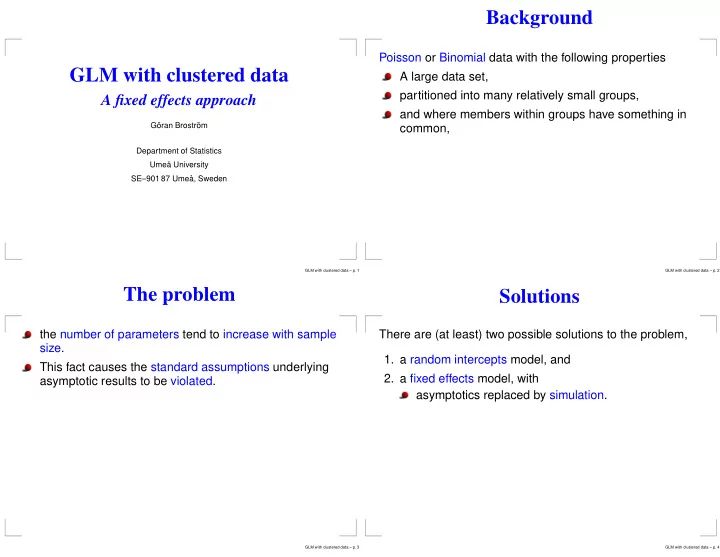
Poisson or Binomial data with the following properties A large data set, partitioned into many relatively small groups, and where members within groups have something in common,

GLM with clustered data – p. 2

The problem

the number of parameters tend to increase with sample size. This fact causes the standard assumptions underlying asymptotic results to be violated.

GLM with clustered data – p. 3

Solutions

There are (at least) two possible solutions to the problem,

  • 1. a random intercepts model, and
  • 2. a fixed effects model, with

asymptotics replaced by simulation.

GLM with clustered data – p. 4

slide-2
SLIDE 2

Packages in R

The package Matrix has lmer, the MASS package has glmmPQL, Jim Lindsey’s glmm in his repeated package, Myles’ and Clayton’s GLMMGibbs for fitting mixed models by Gibbs sampling. Adding to that glmmML and glmmboot in the package glmmML.

GLM with clustered data – p. 5

Data structure

n clusters of sizes ni, i = 1, . . . , n. For each cluster i, i = 1, . . . , n, observe responses (yi1, . . . , yini) and vectors of explanatory variables (xi1, . . . , xini), where xij are p-dimensional vectors with the first element identically equal to unity, corresponding to the mean value of the random intercepts. The random part, ui of the intercepts are normal with mean zero and variance σ2, and it is assumed that u1, . . . , un are independent.

GLM with clustered data – p. 6

The conditional distribution

given the random intercepts β1 + ui, i = 1, . . . , n: Pr(Yij = yij | ui; x) = P(βxij + ui, yij), yij = 0, 1, . . . ; j = 1, . . . , ni, i = 1, . . . , n.

Bernoulli distribution logit link, P(x, y) = exy 1 + ex , y = 0, 1; −∞ < x < ∞, cloglog link P(x, y) = ` 1 − exp(−ex) ´y exp ` −(1 − y)ex´ , y = 0, 1; −∞ < x < ∞, Poisson distribution with log link P(x, y) = exy y! e−ex, y = 0, 1, 2, . . . ; −∞ < x < ∞

GLM with clustered data – p. 7

Likelihood function

In the fixed effects model (and in the conditional random effects model), the likelihood function is L

  • (β, γ); y, x
  • =

n

  • i=1

ni

  • j=1

P(βxij + γi, yij). The log likelihood function is ℓ

  • (β, γ); y, x
  • =

n

  • i=1

ni

  • j=1

log P(βxij + γi, yij),

GLM with clustered data – p. 8

slide-3
SLIDE 3

Tests of cluster effect

Testing is performed via a simple bootstrap (glmmboot). Under the null hypothesis of no grouping effect, the grouping factor can be randomly permuted without changing the probability distribution (the conditional approach), or a parametric bootstrap approach: simulate

  • bservations from the fitted model under the null

hypothesis (the unconditional approach).

GLM with clustered data – p. 9

Computational aspects

A profiling approach reduces an optimizing problem in high dimensions to a problem consisting of solving several one-variable equations followed by

  • ptimization in low dimensions.

GLM with clustered data – p. 10

The score vector

The partial derivatives wrt βm, m = 1; . . . , p, of the log likelihood function are: Um(β, γ) = ∂ ∂βm ℓ

  • (β, γ); y, x
  • =

n

  • i=1

ni

  • j=1

xijmG(βxij + γi, yij), m = 1, . . . , p. where G(x, y) = ∂ ∂x log P(x, y) =

∂ ∂xP(x, y)

P(x, y)

GLM with clustered data – p. 11

Cluster components of the score

The partial derivatives wrt γi, i = 1, . . . , n, are Up+i(β, γ) = ∂ ∂γi ℓ

  • (β, γ); y, x
  • =

ni

  • j=1

G(βxij + γi, yij), i = 1, . . . , n.

GLM with clustered data – p. 12

slide-4
SLIDE 4

With profiling

Setting Up+i(β, γ) = 0 defines γ implicitly as functions of β, γi = γi(β), i = 1, . . . , n: F

  • β, γi(β)
  • =

ni

  • j=1

G

  • βxij + γi(β), yij
  • = 0,

i = 1, . . . , n. From ∂ ∂βm F

  • β, γi(β)
  • = ∂γi

∂βm ∂F ∂γi + ∂F ∂βm = 0 we get

GLM with clustered data – p. 13

Profile score

∂γi(β) ∂βm = −

∂F ∂βm ∂F ∂γi

= − ni

j=i xijmH

  • βxij + γi, yij
  • ni

j=1 H

  • βxij + γi, yij
  • ,

i = 1, . . . , n; m = 1, . . . , which is needed when calculating the score corresponding to the profile likelihood.

GLM with clustered data – p. 14

Profile loglihood

Replacing γ by γ(β) gives the profile log likelihood ℓ(P): ℓ(P) β; y, x

  • =

n

  • i=1

ni

  • j=1

log P

  • βxij + γi(β), yij
  • ,

as a function of β alone.

GLM with clustered data – p. 15

Profile partial derivatives

The partial derivatives wrt βm, m = 1; . . . , p, of the log profile likelihood function becomes: U(P)

m (β) =

∂ ∂βm ℓ(P)(β; y, x) =

n

  • i=1

ni

  • j=1
  • xijm + ∂γi(β)

∂βm

  • G
  • βxij + γi(β), yij
  • = Um
  • β, γ(β)
  • +

n

  • i=1

∂γi(β) ∂βm

ni

  • j=1

G

  • βxij + γi(β), yij
  • = Um(β, γ(β)),

Thus we get back the unprofiled partial derivatives.

GLM with clustered data – p. 16

slide-5
SLIDE 5

Profile hessian

−I(P )

ms (β) =

∂ ∂βs Um

  • β, γ(β)
  • =

n

  • i=1

ni

  • j=1

xijm

  • xijs + ∂γi(β)

∂βs

  • H
  • βxij + γi(β), yij
  • = −Ims(β, γ(β))

n

  • i=1

ni

j=1 xijmHij

ni

j=1 xijsHij

ni

j=1 Hij

, m, s = 1, . . . , p. where Hij = H

  • βxij + γi(β), yij
  • ,

j = 1, . . . ni; i = 1, . . . , n.

GLM with clustered data – p. 17

At the maximum

Justifying the use of the profile likelihood: Theorem 1 (Patefield) The inverse hessians from the full likelihood and from the profile likelihood for β are equal when (γ, β) = (ˆ γ, ˆ β).

GLM with clustered data – p. 18

Preparation for R

ℓ(P)(β) = n

i=1

ni

j=1 log P

  • βxij + γi(β), yij
  • ,

U(P)

m (β) = n i=1

ni

j=1 xijmG

  • βxij + γi(β), yij

, m = 1, . . . , p. For fixed β, γi(β) is found by solving

ni

  • j=1

G(βxij + γi, yij) = 0, with respect to γi, i = 1, . . . , n. The maximization is performed by optim, via the C function vmmin, available as an entry point in the C code of R.

GLM with clustered data – p. 19

Implementation in R

Implemented in the package glmmML in R. Covers three cases,

  • 1. Binomial with logit link,
  • 2. Binomial with cloglog link,
  • 3. Poisson with log link.

The function is glmmboot, Testing of cluster effect is done by simulation (a simple form of bootstrapping). conditionally, or unconditionally.

GLM with clustered data – p. 20

slide-6
SLIDE 6

Binomial with logit link

P(x, y) = exp(xy)/(1 + exp(x)), G(x, y) = y − P(x, 1). We get (γ1, . . . , γn) by solving the equations

ni

  • j=1

yij =

ni

  • j=1

exp(βxij + γi) 1 + exp(βxij + γi) for i = 1, . . . , n (using the C version of uniroot). Special cases: yij = 0 or ni; giving γi = −∞ or + ∞, respectively. Corresponding cluster can be thrown out. (Should be used in glm?)

GLM with clustered data – p. 21

Binomial with cloglog link

P(x, y) = (1 − exp(− exp(x))y exp(−(1 − y) exp(x)), G(x, y) = exp(x)

P(x,1){y − P(x, 1)}

We get (γ1, . . . , γn) by solving the equations

ni

  • j=1

yij = ni −

ni

  • j=1

exp(− exp(βxij + γi)) for i = 1, . . . , n (using the C version of uniroot). Special cases: yij = 0 or ni; γi = −∞ or + ∞, respectively. Corresponding cluster can be thrown out.

GLM with clustered data – p. 22

Poisson with log link

P(x, y) = exy

y! exp(− exp(x))

G(x, y) = y − ex We get (γ1, . . . , γn) from

ni

  • j=1

yij = eγi

ni

  • j=1

exp(βxij), i = 1, . . . , n, giving γi = log

  • j yij
  • j exp(βxij)
  • ,

i = 1, . . . , n. Special case: yij = 0, giving γi = −∞.

GLM with clustered data – p. 23

Simulation

Model: P(Yij = 1 | γi) = 1 − P(Yij = 0 | γi) = eγi 1 + eγi , j = 1, . . . , 5; i = 1, . . . , n, where γ1, . . . , γn are iid N(0, σ). Hypothesis: σ = 0.

GLM with clustered data – p. 24

slide-7
SLIDE 7

Simulation specifications

σ = 0, 0.5. n = 5, 50, 500. Four methods: glmmboot, unconditional and conditional, glmmML, glm (naively?).

GLM with clustered data – p. 25

Null model (σ = 0); 5 clusters

0.0 0.2 0.4 0.6 0.8 1.0 0.0 0.2 0.4 0.6 0.8 1.0

Boot

p F(p) 0.0 0.2 0.4 0.6 0.8 1.0 0.0 0.2 0.4 0.6 0.8 1.0

Boot, conditional

p F(p) 0.0 0.2 0.4 0.6 0.8 1.0 0.0 0.2 0.4 0.6 0.8 1.0

ML

p F(p) 0.0 0.2 0.4 0.6 0.8 1.0 0.0 0.2 0.4 0.6 0.8 1.0

glm

p F(p)

GLM with clustered data – p. 26

Null model (σ = 0); 50 clusters

0.0 0.2 0.4 0.6 0.8 1.0 0.0 0.2 0.4 0.6 0.8 1.0

Boot

p F(p) 0.0 0.2 0.4 0.6 0.8 1.0 0.0 0.2 0.4 0.6 0.8 1.0

Boot, conditional

p F(p) 0.0 0.2 0.4 0.6 0.8 1.0 0.0 0.2 0.4 0.6 0.8 1.0

ML

p F(p) 0.0 0.2 0.4 0.6 0.8 1.0 0.0 0.2 0.4 0.6 0.8 1.0

glm

p F(p)

GLM with clustered data – p. 27

Null model (σ = 0); 500 clusters

0.0 0.2 0.4 0.6 0.8 1.0 0.0 0.2 0.4 0.6 0.8 1.0

Boot

p F(p) 0.0 0.2 0.4 0.6 0.8 1.0 0.0 0.2 0.4 0.6 0.8 1.0

Boot, conditional

p F(p) 0.0 0.2 0.4 0.6 0.8 1.0 0.0 0.2 0.4 0.6 0.8 1.0

ML

p F(p) 0.0 0.2 0.4 0.6 0.8 1.0 0.0 0.2 0.4 0.6 0.8 1.0

glm

p F(p)

GLM with clustered data – p. 28

slide-8
SLIDE 8

Clustering (σ = 0.5); 5 clusters

0.0 0.2 0.4 0.6 0.8 1.0 0.0 0.2 0.4 0.6 0.8 1.0

Boot

p F(p) 0.0 0.2 0.4 0.6 0.8 1.0 0.0 0.2 0.4 0.6 0.8 1.0

Boot, conditional

p F(p) 0.0 0.2 0.4 0.6 0.8 1.0 0.0 0.2 0.4 0.6 0.8 1.0

ML

p F(p) 0.0 0.2 0.4 0.6 0.8 1.0 0.0 0.2 0.4 0.6 0.8 1.0

glm

p F(p)

GLM with clustered data – p. 29

Clustering (σ = 0.5); 50 clusters

0.0 0.2 0.4 0.6 0.8 1.0 0.0 0.2 0.4 0.6 0.8 1.0

Boot

p F(p) 0.0 0.2 0.4 0.6 0.8 1.0 0.0 0.2 0.4 0.6 0.8 1.0

Boot, conditional

p F(p) 0.0 0.2 0.4 0.6 0.8 1.0 0.0 0.2 0.4 0.6 0.8 1.0

ML

p F(p) 0.0 0.2 0.4 0.6 0.8 1.0 0.0 0.2 0.4 0.6 0.8 1.0

glm

p F(p)

GLM with clustered data – p. 30

Clustering (σ = 0.5); 500 clusters

0.0 0.2 0.4 0.6 0.8 1.0 0.0 0.2 0.4 0.6 0.8 1.0

Boot

p F(p) 0.0 0.2 0.4 0.6 0.8 1.0 0.0 0.2 0.4 0.6 0.8 1.0

Boot, conditional

p F(p) 0.0 0.2 0.4 0.6 0.8 1.0 0.0 0.2 0.4 0.6 0.8 1.0

ML

p F(p) 0.0 0.2 0.4 0.6 0.8 1.0 0.0 0.2 0.4 0.6 0.8 1.0

glm

p F(p)

GLM with clustered data – p. 31

Timings, 5 clusters

> system.time(glmmboot(y ˜ 1, cluster = cluster, + data = timing, conditional = FALSE, boot = 2000)) [1] 0.06 0.00 0.06 0.00 0.00 > system.time(glmmboot(y ˜ 1, cluster = cluster, data = timing, conditional = TRUE, boot = 2000)) [1] 0.044 0.000 0.044 0.000 0.000 > system.time(glmmML(y ˜ 1, cluster = cluster, data = timing)) [1] 0.013 0.000 0.012 0.000 0.000 > system.time(glm(y ˜ factor(cluster), data = timing, family = binomial)) [1] 0.008 0.000 0.008 0.000 0.000

GLM with clustered data – p. 32

slide-9
SLIDE 9

Timings, 50 clusters

> system.time(glmmboot(y ˜ 1, cluster = cluster, data = timing, conditional = FALSE, boot = 2000)) [1] 0.529 0.000 0.529 0.000 0.000 > system.time(glmmboot(y ˜ 1, cluster = cluster, data = timing, conditional = TRUE, boot = 2000)) [1] 0.376 0.000 0.376 0.000 0.000 > system.time(glmmML(y ˜ 1, cluster = cluster, data = timing)) [1] 0.079 0.000 0.080 0.000 0.000 > system.time(glm(y ˜ factor(cluster), data = timing, family = binomial)) [1] 0.047 0.002 0.061 0.000 0.000

GLM with clustered data – p. 33

Timings, 500 clusters

> system.time(glmmboot(y ˜ 1, cluster = cluster, data = timing, conditional = FALSE, boot = 2000)) [1] 5.208 0.000 5.214 0.000 0.000 > system.time(glmmboot(y ˜ 1, cluster = cluster, data = timing, conditional = TRUE, boot = 2000)) [1] 3.713 0.003 3.719 0.000 0.000 > system.time(glmmML(y ˜ 1, cluster = cluster, data = timing)) [1] 0.611 0.000 0.611 0.000 0.000 > system.time(glm(y ˜ factor(cluster), data = timing, family = binomial)) [1] 27.840 0.593 28.434 0.000 0.000

GLM with clustered data – p. 34

glm vs. glmmboot(boot = 0)

Execution times

  • No. of clusters

glm glmmboot 5 0.008 0.007 25 0.019 0.008 100 0.182 0.011 500 28.434 0.031 1000 223.288 0.056 Conclusion: Profiling is numerically very efficient.

GLM with clustered data – p. 35