Background External Fixator to Internal Fixators in an Unstable - - PowerPoint PPT Presentation

background
SMART_READER_LITE
LIVE PREVIEW

Background External Fixator to Internal Fixators in an Unstable - - PowerPoint PPT Presentation

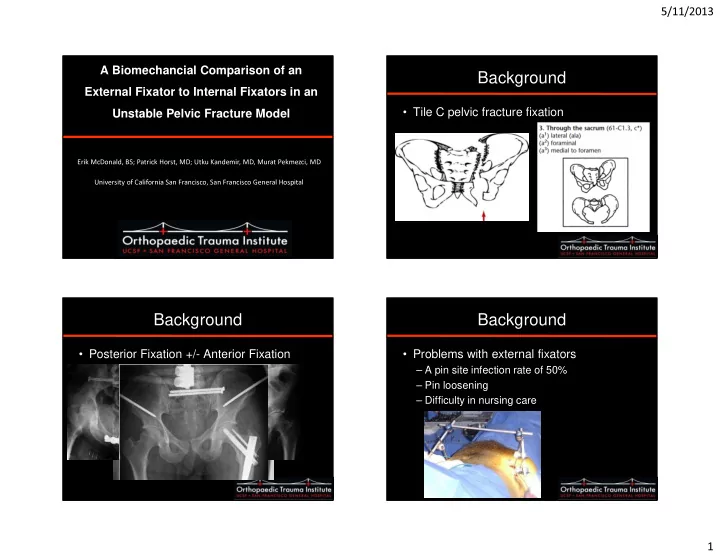
5/11/2013 A Biomechancial Comparison of an Background External Fixator to Internal Fixators in an Unstable Pelvic Fracture Model Tile C pelvic fracture fixation Erik McDonald, BS; Patrick Horst, MD; Utku Kandemir, MD, Murat Pekmezci, MD


slide-1
SLIDE 1

5/11/2013 1 A Biomechancial Comparison of an External Fixator to Internal Fixators in an Unstable Pelvic Fracture Model

Erik McDonald, BS; Patrick Horst, MD; Utku Kandemir, MD, Murat Pekmezci, MD University of California San Francisco, San Francisco General Hospital

Background

  • Tile C pelvic fracture fixation

Background

  • Posterior Fixation +/- Anterior Fixation

Background

  • Problems with external fixators

– A pin site infection rate of 50% – Pin loosening – Difficulty in nursing care

slide-2
SLIDE 2

5/11/2013 2

Anterior Internal Fixators

Anterior Internal Fixators

  • Kuttner et al, 2009

Anterior Internal Fixators Purpose

  • To compare In-Fix to external fixator
  • To compare different configurations of In-

Fix in an unstable sacral fracture with comminuted anterior ring injury model.

slide-3
SLIDE 3

5/11/2013 3

Methods

  • Synthetic sawbone pelvis (Sawbones, Vashon, WA)

were divided into two groups which received one of the following posterior fixation methods:

  • A single 7.0mm transsacral screw through the S1

body (TS)

  • A single illiosacral screw through the S1 body (IS)

Methods

  • The

following 4 anterior fixation techniques were investigated:

  • Group I (ExFix): Supra-acetabular external fixation with

6.0mm pins

  • Group II (InFix): Supra-acetabular INFIX with 7.5mm

pedicle screws

  • Group III (Double InFix): Supra-acetabular Infix with two

7.5mm pedicle screws bilaterally, each connected by a rod

  • Group IV (Double InFix w/ CC): the addition of three cross

connectors to the Double InFix configuration.

Methods

Group I (Ex-Fix): Supra-acetabular external fixation with 6.0mm pins

Methods

Group II (In-Fix): Supra-acetabular INFIX with 7.5mm pedicle screws

slide-4
SLIDE 4

5/11/2013 4

Methods

Group III (Double In-Fix): Supra- acetabular Infix with two 7.5mm pedicle screws bilaterally, each connected by a rod

Methods

Group IV (Double In-Fix w/ CC): the addition of three cross connectors to the Double InFix configuration.

Test Protocol

  • All anterior fixation groups were

tested on each specimen with nondestructive loading by means

  • f a single leg stance model.
  • The specimens were subjected to

25 cycles

  • f

cyclic loading between 100 and 200N and then loaded in displacement control to a maximum load of 300N.

Test Protocol

  • Three dimensional displacement and rotation was

measured using an optical tracking system.

  • Peak to peak (P2P) displacement and rotation,
  • Condition displacement (CD), or settling
  • Differences between outcome metrics between the

anterior fixation was analyzed using the a non- parametric repeat measures test with Dunn’s post hoc comparison with p<0.05 considered significant.

slide-5
SLIDE 5

5/11/2013 5

Results

50 100 150 200 250 300 350 ExFix InFix Double Cross Maximum Load (N)

The Ex-Fix group failed in 8/9 TS specimens, and 7/9 IS specimens

Results

1 2 3 4 InFix Double Cross Conditioning Elongation (mm) Pubic Displacement Sacral Displacement 0.5 1 1.5 2 2.5 3 InFix Double Cross Peak to Peak Elongation (mm) Pubic Displacement Sacral Displacement 0.5 1 1.5 2 2.5 InFix Double Cross Conditioning Elongation (deg) Pubic Rotation Sacral Rotation 0.1 0.2 0.3 0.4 0.5 0.6 InFix Double Cross Peak to Peak Elongation (deg) Pubic Rotation Sacral Rotation

Discussion

  • Construct Stiffness
slide-6
SLIDE 6

5/11/2013 6

  • 24 patients, Oct ’09-Jul ’10
  • 2 LFCN palsy
  • 1 HO
  • No Loss of reduction

Limitations

  • Saw Bone Model

– Cadaver model for higher loads

  • Using the same model for all constructs

Conclusions

  • In-Fix is stronger than external fixation in an unstable

pelvic fracture model when only one level of posterior fixation is implemented.

  • Addition of another In-Fix or cross connectors did

not result in less displacement or rotation over the Single In-Fix group.

slide-7
SLIDE 7

5/11/2013 7

Conclusions

  • The improved biomechanical characteristics

– Significant advantage for anterior pelvic ring fixation when traditional internal fixation is not an

  • ption.

THANK YOU