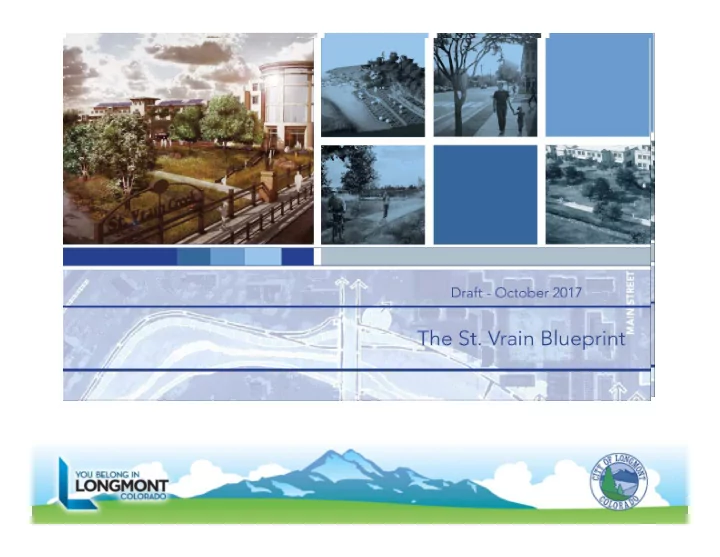
SLIDE 1
SLIDE 2 Background
- September 12, 2013 – 100 to 500 Year Flood Event
- 18,000 cfs
above Left Hand Creek
below confluence with Left Hand Creek
SLIDE 3 Background
- Significant damage to public and private
property and infrastructure
SLIDE 4 Background
- Damage to City’s St. Vrain Greenway
SLIDE 5 Background
– Updated St. Vrain Floodplain – Anderson Study – Looked at options to improve channel to carry 100 year flows – Enhance corridor (recreation/aesthetics) and development/redevelopment options – St. Vrain Blueprint
SLIDE 6
- St. Vrain Blueprint Study Area
Hover Road Main Street Martin Street Boston Avenue Ken Pratt Boulevard Nelson Road 3rd Avenue
Downtown
- St. Vrain Blueprint Study Area
SLIDE 7
- St. Vrain Blueprint Goals
- 1. Significantly reduce property, infrastructure, and
life safety hazards due to 100‐year flood events.
- 2. Restore and enhance the St. Vrain Greenway to
natural conditions and improve user amenities and experience within the greenway environment.
- 3. Leverage safety improvements and a beautiful
greenway to encourage quality investment and economic development on properties in the St. Vrain Blueprint Plan Area.
SLIDE 8
Regulatory, Existing Conditions, Post Project
SLIDE 9 Work Predicated on and Coordinated with Existing Plans
- 2001 The St. Vrain Greenway Master Plan East
Corridor Update
- 2002 Open Space and Trails Master Plan (volume II)
- 2005 The Wildlife Management Plan
- 2006 Southeast Longmont Urban Renewal Plan
- 2006 Focus on Longmont Strategic Plan
SLIDE 10 …Existing Plans continued
- 2010 St. Vrain Greenway Riparian Corridor
Protection Plan
- 2012 The 1st & Main Station Transit &
Revitalization Plan
- 2014 Parks, Recreation & Trails Master Plan
- 2014 Dickens Farm Park Master Plan (August draft)
SLIDE 11
- 2014 Saint Vrain Creek through Longmont:
100‐Year Analysis and Conceptual Design
- 2014 St. Vrain Creek Watershed Master Plan
- Longmont Land Development Code
- 2016 Envision Longmont
- Longmont Sustainability Plan
…Existing Plans continued
SLIDE 12 Stakeholder and Community Input
- Property owner meetings
- Booth tent at Rhythm on the River and
community downtown events
- Public charrette, citizen meetings
- Open houses
SLIDE 13 The Evolving Blueprint Scope
- Originally commissioned to be a
redevelopment study
- Study commenced in June 2013, flood
- ccurred in September 2013,
- Scope of study changed to recovery and
resiliency
SLIDE 14
Alternative Scenarios—Greenway Corridor & Focus Areas
SLIDE 15 HOVER ROAD
…Greenway Alternative Scenarios continued
SLIDE 16
…Greenway Alternative Scenarios continued
SLIDE 17
Izaak Walton Section View
SLIDE 18
…Greenway Alternative Scenarios continued
SLIDE 19
South of Boston Court View
SLIDE 20
Focus Area: Main Street to BNSF Bridge
SLIDE 21 St Vrain Blueprint and Resilient St Vrain Working in Tandem
- Concepts of natural stream design and
environmentally friendly natural stream riparian corridor communicated to RSVP.
- Vision of creek greenway restoration being
implemented by RSVP
SLIDE 22
Example of Channel Cross Section
SLIDE 23
Example of Channel Cross Section
SLIDE 24
Example of Channel Cross Section
SLIDE 25
Example of Channel Cross Section
SLIDE 26 Design Themed Infrastructure
- Use of sandstone as a locally referenced
resource,
- Acknowledge previous bridge designs on KPB,
- Main Street and Sunset Bridges
- Art on Main Street bridge part of greenway
vision
SLIDE 27
Bridges & Materials
SLIDE 28
Bridges & Materials
SLIDE 29 Wildlife Considerations
- Public input on greenway character was
natural conditions native to Colorado high plains riparian system.
- Goal to restore flood damaged greenway to
wildlife habitat areas,
- Design of RSVP has wildlife corridor on south
sided of creek corridor.
SLIDE 30 Wildlife Considerations
- Existing 150’ wildlife setback applies over
existing developed properties,
- SVBP recommends leaving 150’ setback in
place until a post project condition better defines what the creek corridor will look like,
- Wildlife management plan update can
evaluate.
SLIDE 31 Redevelopment
- SVBP plan includes imagery of potential
redevelopment vision,
- Redevelopment will result in positive
economic impact,
- Redevelopment/reinvestment will occur over
time, not immediately
- Reflected in Envison Longmont and
compatible with 1st and Main transit area
SLIDE 32 Reserve slides for 3D images and photo simulations of concepts
Alternative Scenarios—Concept Images
SLIDE 33
Land Use Concepts: Boston/Bowen
SLIDE 34
Land Use Concepts: Greenway Neighborhood
SLIDE 35 BEFORE AFTER
Land Use Concepts: Boston Avenue
SLIDE 36
LAND USE CONCEPTS: BOSTON / BOWEN NEIGHBORHOOD
SLIDE 37
LAND USE CONCEPTS: FIRST & MAIN NEIGHBORHOOD
SLIDE 38 Resiliency
- SVBP is fundamentally about resiliency
- SVBP plan reviewed using the Sustainability
Evaluation System – some insights gained
- Use of materials that are manufactured with
minimal energy, carbon, and water use
- Use of materials to reduce energy, carbon, and
water use in application & are weather resistant
SLIDE 39 Resiliency
- Use of recycled materials
- Reuse of existing structures and materials to
reduce demolition waste
- Use of locally sourced materials to reduce
transportation needs and related carbon emissions
- Use of building materials that can be recycled
- r reused at the end of their lifespans
SLIDE 40 Resiliency
- Use of materials that are responsibly
harvested or extracted
- Avoiding use of toxic materials
- Design of site to maximize solar access
- Optimization and adaption of existing
infrastructure
- Use of natural water quality systems on site.