Background IDPH has been awarded the Disability and Health Program - - PDF document

background
SMART_READER_LITE
LIVE PREVIEW

Background IDPH has been awarded the Disability and Health Program - - PDF document

4/12/2016 Including People with Disabilities in Disaster Drills and Exercises Karin Ford, MSPS, ICEM April 14, 2016 Background IDPH has been awarded the Disability and Health Program (DHP) funding through CDC since 1996 Focus on


slide-1
SLIDE 1

4/12/2016 1

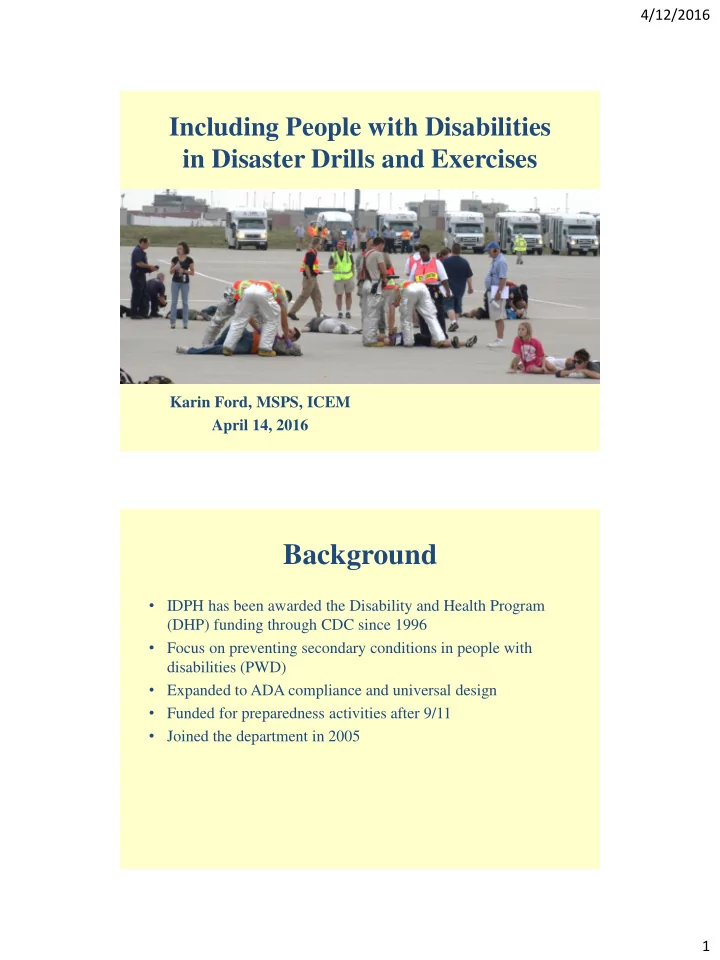
Including People with Disabilities in Disaster Drills and Exercises

Karin Ford, MSPS, ICEM April 14, 2016

Background

  • IDPH has been awarded the Disability and Health Program

(DHP) funding through CDC since 1996

  • Focus on preventing secondary conditions in people with

disabilities (PWD)

  • Expanded to ADA compliance and universal design
  • Funded for preparedness activities after 9/11
  • Joined the department in 2005
slide-2
SLIDE 2

4/12/2016 2

My Background

  • 20 years social work
  • Disability expertize
  • ADA expertize
  • Emergency response
  • Planner
  • Blended all together = accessible sheltering

Photo courtesy of FEMA/Patsy Lynch

Grant Activities

  • Main focus on individual preparedness
  • Difficult to measure progress or success
  • Large scale disasters potentially could eliminate personal

planning

  • Preparedness evolved into Whole Community Planning
  • Expanding the planning process to inclusive and accessible
slide-3
SLIDE 3

4/12/2016 3

Current Grant Activities

Target: Promote State participation of people with disabilities in emergency planning and exercise planning Activities: Promote the inclusion of people with disabilities and their caregivers, attendants or other key support people in emergency preparedness training and education exercises.

  • Participated in 2012 and 2016 Des Moines International

Airport Exercise

  • Provided technical assistance on exercise planning, identifying

participants, evaluator

Des Moines International Airport

  • FAA requires full scale exercise for the airport to maintain its

license/certification to operate, every three years

  • Scenario for each is a simulated passenger air plane crash
slide-4
SLIDE 4

4/12/2016 4

Purpose for Exercise

  • Test and evaluate the Des Moines International Airport

Emergency Plan (AEP) and capabilities

  • Included state, county, and local emergency responders
  • Local hospitals and county medical examiner
  • Public, private entities and service providers

Exercise Participants

  • Full Scale Exercise held on August 4th, 2012
  • 351 people participated – 110 actors
  • 6 PWD participated, including developmental, mobility, low to

no hearing and communication disabilities

  • Full Scale Exercise held on August 8, 2015
  • Over 300 people participated – 152 actors
  • 8 PWD participated, including mobility, developmental

disability, mental health and low to no hearing

slide-5
SLIDE 5

4/12/2016 5

Exercise Participants

2015 exercise

  • 2 Federal agencies
  • 2 State agencies
  • 2 county agencies
  • 8 municipal agencies
  • 8 hospitals
  • 2 public entities
  • 3 private entities

Hotwash

  • Polk County Emergency Management (PCEM) hosted a

hotwash after both exercises

  • Responders struggled with responding to the PWD/actors
  • Questioned if PWD would even be on a plane
  • Had little understanding how to communicate or assist with

evacuating them from the crash site

  • Left power wheel chair outside during rain delay
  • Responders spoke to care givers, not PWD/actors
  • Did not secure crash site from PWD/actors
slide-6
SLIDE 6

4/12/2016 6

Hotwash

  • Overhead announcements were not provided in alternate

method

  • Low to no vision not addressed
  • Some responders believed PWD with power chairs would not

be on a plane

  • Blurred response from day to day disaster to major event
  • Meaning, they went into “get them to the hospital” my piece is

done

  • In large scale events, infrastructure may not be in place
  • The exercise provided a different way to look at response

Outcomes

  • Had a candid discussion about PWD living independent
  • Importance of assistive technology and how it needs to be

evacuated with the person

  • Ask what assistance PWD need
  • Responders agreed that they needed training on how to

communicate more effectively with PWD

  • Provided recommendations for training and modifications to

plans

  • All players need instruction on their role in the exercise
slide-7
SLIDE 7

4/12/2016 7

Disability Experience

  • Better understanding of the role of emergency management
  • Better understanding what their personal role is in

preparedness

  • Non-injured PWD/actors reported that transportation partners

were knowledgeable, felt comfortable and safe

Partnerships

  • PCEM has worked extensively with the DHP on inclusive

disaster planning, response and recovery

  • PCEM also has an established partnership with LINK

Associates; a greater Des Moines community based non-profit

  • rganization that provides support services to adults with

developmental disabilities and their families

  • This partnership includes a robust accessible transportation

capability which has been activated several times in the past few years for evacuation purposes for fires and flooding

slide-8
SLIDE 8

4/12/2016 8

Possible Opportunities for Participation in a Disaster Exercise

  • County emergency managers and planners
  • Airport exercise
  • Academic institutions
  • Hospitals, care facilities
  • Providers
  • Events centers

Your Role

Evaluators

  • Observe and document performance against established

capability targets and critical tasks

  • Evaluate and provide feedback on a designated functional area
  • f the exercise
  • You are a SME in disability and hold desirable expertise to the

exercise

  • Volunteer as an evaluators
  • Come to the table to solve problems
slide-9
SLIDE 9

4/12/2016 9

Partnerships for Emergency Managers and Planners

  • Local, county and state public health
  • Area on Aging
  • Easter Seals
  • Disability councils, boards and commissions
  • Disability providers
  • Direct care providers
  • Local VOAD
  • If you don’t know where to start, contact me

Contact

Jon Davis, Deputy Director, PCEM Jon.Davis@polkcountyiowa.gov 515-286-2107

slide-10
SLIDE 10

4/12/2016 10

Questions/Comments

Karin Ford, MSPS, ICEM Iowa Department of Public Health 515-242-6336 Karin.Ford@idph.iowa.gov