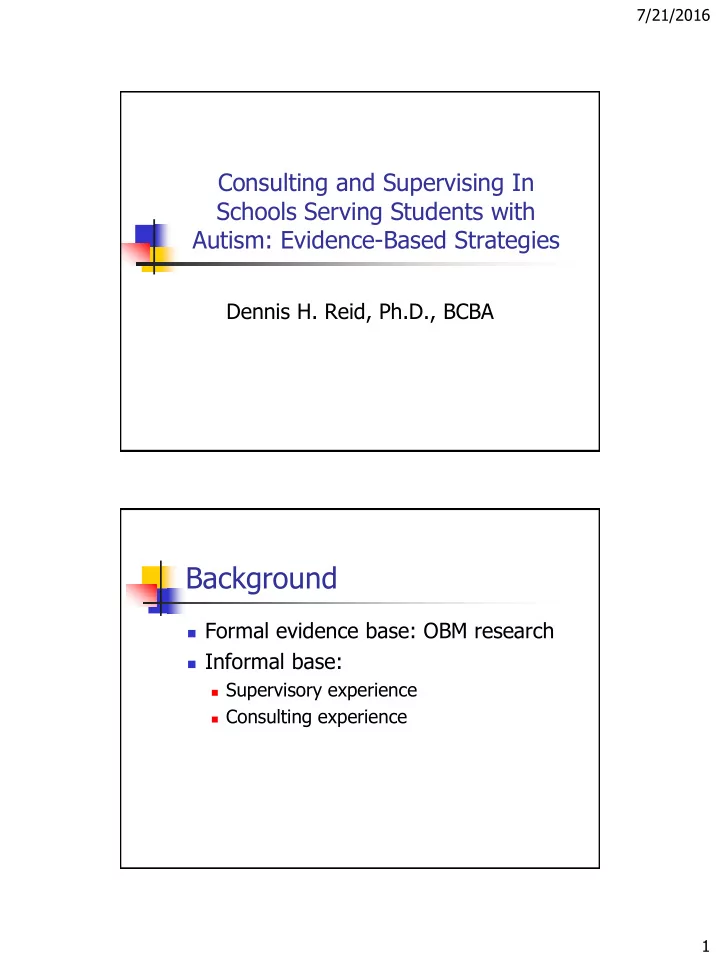
Background Formal evidence base: OBM research Informal base: - - PDF document

background
SMART_READER_LITE
LIVE PREVIEW

Background Formal evidence base: OBM research Informal base: - - PDF document

7/21/2016 Consulting and Supervising In Schools Serving Students with Autism: Evidence-Based Strategies Dennis H. Reid, Ph.D., BCBA Background Formal evidence base: OBM research Informal base: Supervisory experience Consulting


slide-1
SLIDE 1

7/21/2016 1

Consulting and Supervising In Schools Serving Students with Autism: Evidence-Based Strategies

Dennis H. Reid, Ph.D., BCBA

Background

 Formal evidence base: OBM research  Informal base:

 Supervisory experience  Consulting experience

slide-2
SLIDE 2

7/21/2016 2

Qualifications

 Focus on consulting

 From outside an agency  Within an agency

 Not focusing on agency-wide

supervisory systems

 Not focusing on the business end

 One point: > 2- way diversification

Agenda

 Key point approach  Basic premises and prerequisites  Strategies

 Basic (technological)  General (experiential)

slide-3
SLIDE 3

7/21/2016 3

Common Obstacles to Consulting Premises and Prerequisites

 Two primary consumer groups: students and

staff . . . (and of course the payer)

 Assume you are an aversive stimulus  Know what you don’t know and acknowledge

such

 It’s about outcomes and acceptability, not

billable hours

 Behavior analytic consulting cannot be done

from afar

 Know BACB ethics rules and adhere to them

slide-4
SLIDE 4

7/21/2016 4

Basic Strategy 1

 Always take some data

 For knowing what to do  For evaluating your effectiveness  For giving feedback  To cover your backside

Basic Strategy 2

 Train with evidence-based procedures  Performance- and competency-based or

BST

 Formally and/or informally

slide-5
SLIDE 5

7/21/2016 5

Common (Problematic) Approach to Training Staff Training Steps

 1. Explain rationale  2. Describe skills  3. Provide written summary  4. Demonstrate skills  5. Trainee practice with feedback  6. Repeat #s 4 & 5 until competency

slide-6
SLIDE 6

7/21/2016 6

Basic Strategy 3

 Be skilled in, and practice, evidence-

based feedback delivery

Feedback Protocol

  • 1. Begin with positive or empathetic statement
  • 2. Identify skills performed correctly
  • 3. Identify skills performed incorrectly
  • 4. Specify how to change/improve incorrect

performance

  • 5. Solicit questions
  • 6. Describe next actions
  • 7. End with positive or empathetic statement
slide-7
SLIDE 7

7/21/2016 7

Basic Strategy 4

 Monitor acceptably

Making Monitoring Acceptable

 Reid & Parsons (1995). Comparing

choice and questionnaire measures of the acceptability of a staff training

  • procedure. Journal of Applied Behavior

Analysis, 28, 95-96.

slide-8
SLIDE 8

7/21/2016 8

Making Monitoring Acceptable

 Greet staff upon entering work site  Briefly explain reason for monitoring  Use common sense re proceeding  Provide feedback quickly  Acknowledge staff upon departing

General Strategy 1

 Make job of staff as easy to do as

possible (while maintaining effectiveness)

 With data collection  With interventions

slide-9
SLIDE 9

7/21/2016 9

General Strategy 2

 Do what paid to do and what front-line

staff want

General Strategy 3

 Get some quick success

slide-10
SLIDE 10

7/21/2016 10

General Strategy 4

 Forget about bibliotherapy (almost)

General Strategy 5

 Use technical language judiciously

slide-11
SLIDE 11

7/21/2016 11

General Strategy 6

 Know when you will likely not succeed

and acknowledge such

General Strategy 7

 Be willing to work for more than you

are paid . . . at least initially

slide-12
SLIDE 12

7/21/2016 12

Reference

 Reid, D.H., Parsons, M.B., & Green, C.W.

(2012). The supervisor’s guidebook: Evidence-based strategies for promoting work quality and enjoyment among human service staff.

 www.behaviordevelopmentsolutions.com

Summary

 Use the available evidence-based

technology

 For students  For staff (training, feedback)

 Be very diligent  Be pleasant  Focus on outcome and acceptability

slide-13
SLIDE 13

7/21/2016 13

Contact

 Denny Reid

 drhmc@vistatech.net  828 432 0030