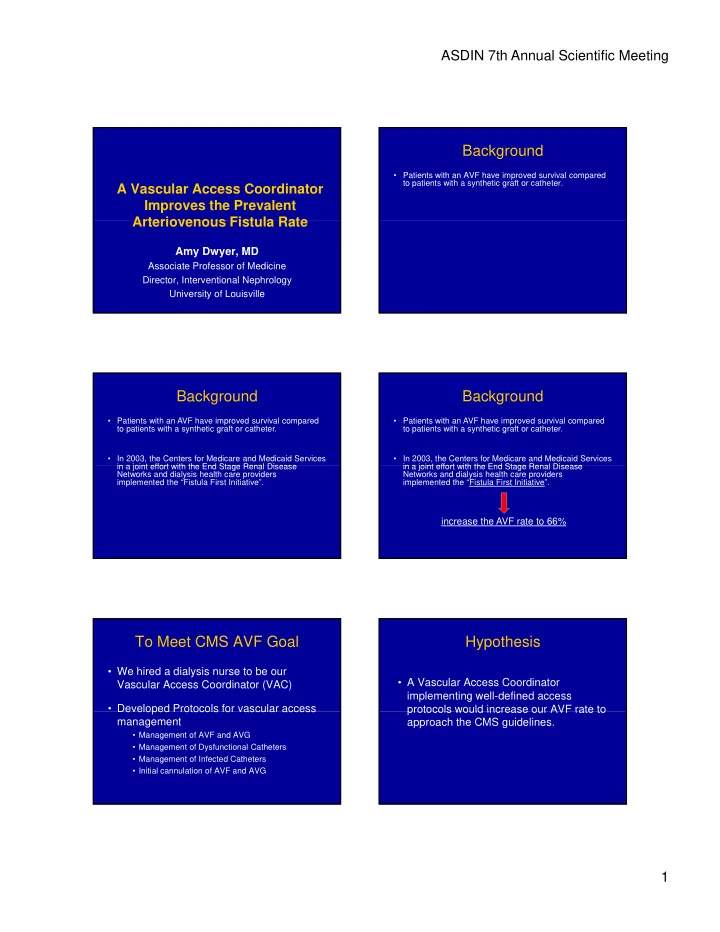
Background Patients with an AVF have improved survival compared to - - PDF document

background
SMART_READER_LITE
LIVE PREVIEW

Background Patients with an AVF have improved survival compared to - - PDF document

ASDIN 7th Annual Scientific Meeting Background Patients with an AVF have improved survival compared to patients with a synthetic graft or catheter. A Vascular Access Coordinator Improves the Prevalent Arteriovenous Fistula Rate


slide-1
SLIDE 1

ASDIN 7th Annual Scientific Meeting 1 A Vascular Access Coordinator Improves the Prevalent Arteriovenous Fistula Rate Arteriovenous Fistula Rate

Amy Dwyer, MD

Associate Professor of Medicine Director, Interventional Nephrology University of Louisville

Background

  • Patients with an AVF have improved survival compared

to patients with a synthetic graft or catheter.

Background

  • Patients with an AVF have improved survival compared

to patients with a synthetic graft or catheter.

  • In 2003, the Centers for Medicare and Medicaid Services

in a joint effort with the End Stage Renal Disease in a joint effort with the End Stage Renal Disease Networks and dialysis health care providers implemented the “Fistula First Initiative”.

Background

  • Patients with an AVF have improved survival compared

to patients with a synthetic graft or catheter.

  • In 2003, the Centers for Medicare and Medicaid Services

in a joint effort with the End Stage Renal Disease in a joint effort with the End Stage Renal Disease Networks and dialysis health care providers implemented the “Fistula First Initiative”.

increase the AVF rate to 66%

To Meet CMS AVF Goal

  • We hired a dialysis nurse to be our

Vascular Access Coordinator (VAC)

  • Developed Protocols for vascular access

Developed Protocols for vascular access management

  • Management of AVF and AVG
  • Management of Dysfunctional Catheters
  • Management of Infected Catheters
  • Initial cannulation of AVF and AVG

Hypothesis

  • A Vascular Access Coordinator

implementing well-defined access protocols would increase our AVF rate to protocols would increase our AVF rate to approach the CMS guidelines.

slide-2
SLIDE 2

ASDIN 7th Annual Scientific Meeting 2

Vascular Access Coordinator Responsibilities

  • Serve as patient liaison between the Interventional Nephrology Center and dialysis facilities,

nephrologists, nurse practitioners and surgeons on all vascular access related issues

  • Monthly vascular access evaluation with physical exam
  • Monthly review of previous 12 dialysis treatment data including:

Delivered dose, Kt/V Ability to achieve prescribed blood flow Venous Pressures Arterial Pressures

  • Report physical exam and dialysis treatment abnormalities to Nephrologist, NP
  • Refer patients for vascular access evaluation based on findings
  • Schedule vascular access procedures (angiography, vein mapping, surgery)
  • Schedule outpatient dialysis treatments around vascular access procedures
  • Review patient allergies and provide Rx for sensitivities to IV contrast
  • Review patient history and provide pre-medication Rx for procedures in CKD patients
  • Obtain medical records and forward to Interventional Nephrology Center
  • Schedule appointments with surgeons for pre-access evaluation
  • Coordinate with surgeons office for access placement surgery
  • Schedule post-op access placement appointments
  • Remove sutures from access procedures
  • Evaluate difficult cannulations and all new accesses
  • Provide recommendations to dialysis staff about access needle size
  • Educate patients and staff about vascular access care and maintenance
  • Document all vascular access appointments in electronic database
  • Maintain accurate records of all dialysis access events
  • Track Monthly Access Related Infections
  • Participate in vascular access data collection
  • Provide Renal Network with monthly reports and data required
  • Attend Network required in-services and education
  • Work with Director of Interventional Nephrology to develop Policies & Procedures

Important Characteristics of VAC

  • Hemodialysis experience
  • Excellent organizational skills

C bl f f ti i i d d tl

  • Capable of functioning independently
  • Outstanding communication skills

Methods

  • Retrospective review of monthly Renal

Network Vascular Access Tracking Reports from Jan 2008 to Dec 2010

  • Prevalent access type
  • Prevalent Catheter rates
  • Type of access at HD initiation

Statistical Analysis

  • 1. The effect of a Vascular Access

Coordinator on the rate of change in fistula and catheter rate was determined by regression of the rate of change by regression of the rate of change during the 12 months prior to hiring compared to the 12 months after hiring and implementation of vascular access protocols.

Statistical Analysis

  • 2. Comparison of vascular access type for

new patients was performed by chi- square analysis.

University of Louisville Vascular Access

40 50 60 70

tients (%) AVF

Results

p< 0.001

10 20 30 40

Jan-08 Apr-08 Jul-08 Oct-08 Jan-09 Apr-09 Jul-09 Oct-09 Jan-10 Apr-10 Jul-10 Oct-10 Jan-11 Percent of Pat GRAFT CATHETER CMS GOAL

slide-3
SLIDE 3

ASDIN 7th Annual Scientific Meeting 3

University of Louisville Catheters

10 12 14 16

tients (%)

Cath Only < 90 Days Cath Only > 90 Days

Results

(p=0.000018)

2 4 6 8

J a n

  • 8

M a y

  • 8

S e p

  • 8

J a n

  • 9

M a y

  • 9

S e p

  • 9

J a n

  • 1

M a y

  • 1

S e p

  • 1

J a n

  • 1

1

Percent of Pat

Cath with AVF Maturing Cath with Graft Maturing CMS Goal (p )

Access Type at Dialysis Initiation for New patients

20 25 30

tients

Results

5 10 15

2008 2009 2010 Number of Pat AVF Catheter Cath + AVF

Conclusions

  • 1. A VAC with defined responsibilities and

implementing detailed vascular access protocols protocols

  • Can improve the prevalent fistula rate
  • Decrease catheter rate

Conclusions

  • 2. Despite high incident catheter rates, the

prevalent catheter rate (catheter > 90 days) can be decreased and prevalent days) can be decreased and prevalent AVF rate increased.

Future Directions

  • We are developing a similar protocol

driven approach that provides the same level of commitment in non-dialysis stage level of commitment in non dialysis stage 4 CKD patients

Acknowledgement

  • Paula Shelton, RN
  • Michael Brier PhD
  • Michael Brier, PhD
  • George Aronoff, MD