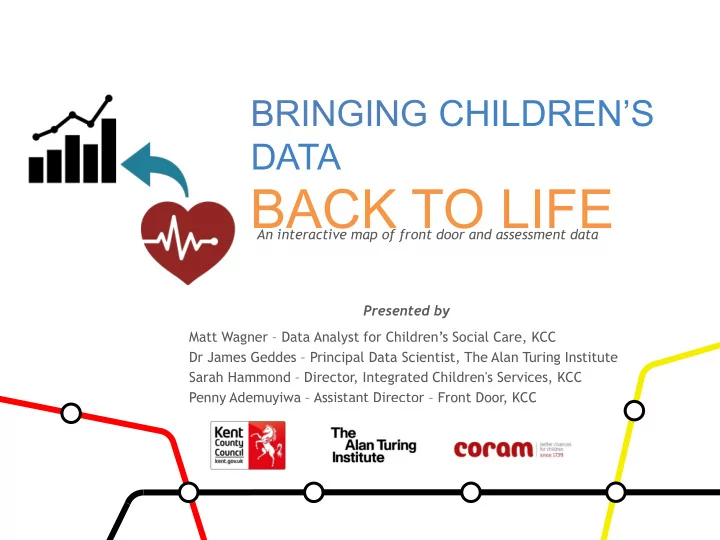
BACK TO LIFE An interactive map of front door and assessment data - - PowerPoint PPT Presentation

back to life
SMART_READER_LITE
LIVE PREVIEW

BACK TO LIFE An interactive map of front door and assessment data - - PowerPoint PPT Presentation

BRINGING CHILDRENS DATA BACK TO LIFE An interactive map of front door and assessment data Presented by Matt Wagner Data Analyst for Childrens Social Care, KCC Dr James Geddes Principal Data Scientist, The Alan Turing Institute


slide-1
SLIDE 1

BRINGING CHILDREN’S DATA

BACK TO LIFE

Presented by Matt Wagner – Data Analyst for Children’s Social Care, KCC Dr James Geddes – Principal Data Scientist, The Alan Turing Institute Sarah Hammond – Director, Integrated Children's Services, KCC Penny Ademuyiwa – Assistant Director – Front Door, KCC An interactive map of front door and assessment data

slide-2
SLIDE 2

Challenges/opportunities in Kent Project set-up & problem definition Creating the prototype The prototype in action Possible developments Q&A

WHAT WE’LL BE COVERING

1 2 3 4 5 6

slide-3
SLIDE 3

STRENGTHS CHALLENGES

Wealth of well-understood data “Performance management systems provide detailed data and helpful analysis to monitor and develop services effectively.”

  • Ofsted Report, March 2017 -

There are many factors impacting children’s routes and outcomes, which can be hard to identify Variety of information available to managers and front-line workers How do we know that we are asking the right questions? COULD LOOKING AT THE DATA DIFFERENTLY HELP US TO UNDERSTAND HOW TO

WORK WITH CHILDREN AND FAMILIES MORE EFFECTIVELY?

slide-4
SLIDE 4

WORKSTREAM SETUP

CONCEPT GENERATION

Two primary applications of data visualisation in children’s social care: Quickly testing hypotheses Spotting unexpected trends or relationships 1 2 Application 2 was chosen with a focus on the entry into the social care system (including contact, referral and assessment).

AIM

CREATE A PROTOTYPE DATA VISUALISATION AS A PROOF-OF-CONCEPT TO DEMONSTRATE SOME OF THE

POTENTIAL BENEFITS WITHIN CHILDREN’S SOCIAL CARE.

slide-5
SLIDE 5

“BY VISUALIZING INFORMATION, WE TURN IT INTO A LANDSCAPE THAT YOU CAN EXPLORE WITH YOUR EYES. A SORT OF INFORMATION MAP.

AND WHEN YOU’RE LOST IN INFORMATION, AN INFORMATION MAP IS KIND OF USEFUL.”

  • David McCandless -
slide-6
SLIDE 6

NFA/ IAG EH Other NFA/ cancel Other NFA/ cancel CIN CP NFA/ cancel CIN Other NFA/ cancel EH CIN Other C&F Ax Strategy Discussion Section 47 ICPC Initial Contact Referral Key Front Door Team District Teams Early Help Universal Support

OUR INFORMATION MAP

slide-7
SLIDE 7

CREATING THE VISUALISATIO N

EXTRACT DATA

into 10 datasets

1

COMBINE & ANONYMISE

2

RESTRUCTUR E & SYNTHETISE

for developer

3

DEVELOP

initial visualisation

4

ENHANCE

visualisation

5

slide-8
SLIDE 8

PROTOTYPE VISUALISATION

slide-9
SLIDE 9

FUTURE POSSIBILITIES (1/2)

DEVELOPMENT OF THIS VISUALISATION

  • Different classification
  • ptions:

– Age; – Gender; – Asylum status; – Referral source; – # of missing episodes; – etc.

  • Expand the scope of the

map

  • Display key statistics

– e.g. % of children taking each route out of a node

slide-10
SLIDE 10

FUTURE POSSIBILITIES (2/2)

DIFFERENT VISUALISATION OPTIONS

  • Visualisation of aggregate information (e.g. average duration)

– E.g. Boston subway map example

  • Comparison between teams within the LA
  • Comparison to other local authorities

WIDER USE OF THESE TOOLS

  • Standard data input tool for local authorities to use

– Similar to Annex A / CHAT tool

  • Could there be a facility to compare your aggregate information to that of
  • ther local authorities if you also agree to share yours?
slide-11
SLIDE 11

CLOSING REMARKS

slide-12
SLIDE 12

QUESTIONS & ANSWERS