AZERBAIJAN & ARMENIA Conflict in Nagorno-Karabakh Short note - - PowerPoint PPT Presentation

azerbaijan armenia
SMART_READER_LITE
LIVE PREVIEW

AZERBAIJAN & ARMENIA Conflict in Nagorno-Karabakh Short note - - PowerPoint PPT Presentation

AZERBAIJAN & ARMENIA Conflict in Nagorno-Karabakh Short note 11 October 2020 On 27 September, heavy fighting broke out between Azerbaijan and Armenian forces in and around the contested region of Nagorno-Karabakh. The region is


slide-1
SLIDE 1

AZERBAIJAN & ARMENIA

Conflict in Nagorno-Karabakh

Short note – 11 October 2020

Any questions? Please contact us at info@acaps.org

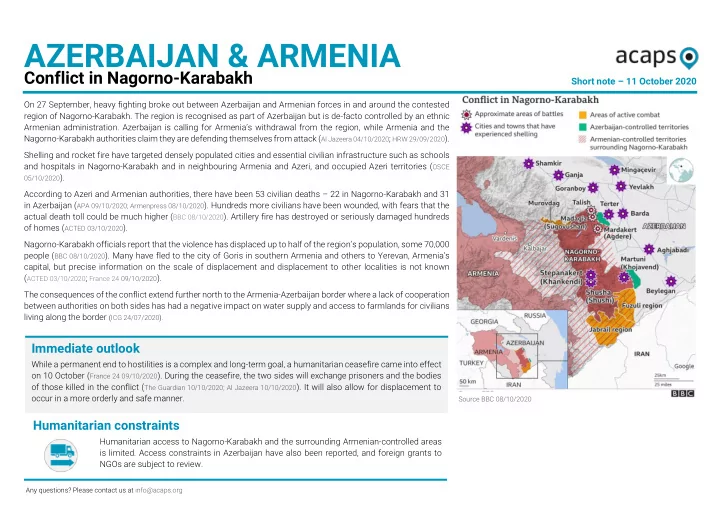
On 27 September, heavy fighting broke out between Azerbaijan and Armenian forces in and around the contested region of Nagorno-Karabakh. The region is recognised as part of Azerbaijan but is de-facto controlled by an ethnic Armenian administration. Azerbaijan is calling for Armenia’s withdrawal from the region, while Armenia and the Nagorno-Karabakh authorities claim they are defending themselves from attack (Al Jazeera 04/10/2020; HRW 29/09/2020). Shelling and rocket fire have targeted densely populated cities and essential civilian infrastructure such as schools and hospitals in Nagorno-Karabakh and in neighbouring Armenia and Azeri, and occupied Azeri territories (OSCE

05/10/2020).

According to Azeri and Armenian authorities, there have been 53 civilian deaths – 22 in Nagorno-Karabakh and 31 in Azerbaijan (APA 09/10/2020; Armenpress 08/10/2020). Hundreds more civilians have been wounded, with fears that the actual death toll could be much higher (BBC 08/10/2020). Artillery fire has destroyed or seriously damaged hundreds

  • f homes (ACTED 03/10/2020).

Nagorno-Karabakh officials report that the violence has displaced up to half of the region’s population, some 70,000 people (BBC 08/10/2020). Many have fled to the city of Goris in southern Armenia and others to Yerevan, Armenia’s capital, but precise information on the scale of displacement and displacement to other localities is not known (ACTED 03/10/2020; France 24 09/10/2020). The consequences of the conflict extend further north to the Armenia-Azerbaijan border where a lack of cooperation between authorities on both sides has had a negative impact on water supply and access to farmlands for civilians living along the border (ICG 24/07/2020).

Source BBC 08/10/2020

Humanitarian constraints

Humanitarian access to Nagorno-Karabakh and the surrounding Armenian-controlled areas is limited. Access constraints in Azerbaijan have also been reported, and foreign grants to NGOs are subject to review.

Immediate outlook

While a permanent end to hostilities is a complex and long-term goal, a humanitarian ceasefire came into effect

  • n 10 October (France 24 09/10/2020). During the ceasefire, the two sides will exchange prisoners and the bodies
  • f those killed in the conflict (The Guardian 10/10/2020; Al Jazeera 10/10/2020). It will also allow for displacement to
  • ccur in a more orderly and safe manner.
slide-2
SLIDE 2

ACAPS short note: Conflict in Nagorno-Karabakh 2

Direct impact on Nagorno-Karabakh

Over 50 large and small towns have been affected by shelling in Nagorno-Karabakh, resulting in widespread damage to infrastructure, large population displacements, and almost 400 military and civilian deaths (Human Rights Ombudsman 01/10/2020). Stepanakert, the region’s capital and home to 55,000 people, has endured continuous and intense bombardment since 27 September. The capital is located 30km from the line of

  • contact. Much of the city has been left without power (BBC 08/10/2020).

Shelling has killed four civilians and wounded 11 in Martuni and caused an unidentified number of casualties in Shusha, where a historic cathedral also sustained serious damage (Al Jazeera 08/10/2020; Human Rights Ombudsman 01/10/2020). Up to 50% of the Nagorno-Karabakh population – some 70,000 people – are reported to have left the region and headed towards Armenian cities including Yerevan and Goris or towards the Azeri town of Barda (ECHO 30/09/2020; BBC 08/10/2020; ACTED 03/10/2020). Those that remain are sheltering in bunkers (Al Jazeera 03/10/2020).

Humanitarian access

ICRC is the only international organisation providing support in Nagorno-Karabakh and has reported limited ability to move in the area because of the intensity and volatility of the fighting (ICRC 02/10/2020). It also has no access to the 17,000 people living in the adjacent, Armenian-controlled territories (ICG 06/05/2020). Since Nagorno-Karabakh is generally considered Azerbaijani territory, no international

  • rganisation can operate there without Azerbaijan’s permission (ICG 06/05/2020).

Pre-existing vulnerability

Years of conflict had already weakened the region’s medical infrastructure, with limited supplies and technical capacity. The situation is especially severe outside Stepanakert, where basic equipment and emergency vehicles are outdated and in short supply (ICG

06/05/2020).

Anticipated needs

Prote tecti tion: People remaining in Nagorno-Karabakh face serious protection concerns. The use of cluster bombs and the apparent targeting of civilian areas puts the population at high risk of injury and death (OSCE 06/10/2020). Where buildings have been damaged, people are also exposed to the dangers of unexploded ordnances (ICRC 02/10/2020). Up to 90% of those displaced from Nagorno-Karabakh are reported to be women and children as men have stayed behind to fight (DW 07/10/2020). They could face increased protection concerns as a result. Health: Although exact figures are unavailable, thousands of civilians and soldiers have sustained conflict-related injuries and require emergency healthcare (ECHO 07/10/2020). Displaced populations, host communities, and those sheltering in shared bunkers are at heightened risk of COVID-19 transmission because of communal living spaces and insufficient hygiene supplies. Food s secur urit ity a and nd liv liveliho lihoods: Damage to industrial infrastructure such as factories, hydroelectric power plants, and service facilities are likely to reduce livelihood options (Human Rights Ombudsman 01/10/2020). As people continue to leave the region, businesses are closing and many men are mobilised to fight. Those left behind are likely to face severely limited access to food. She helt lter a and nd no non-food food i items ms ( (NFIs Is): Shelling has destroyed hundreds of homes, leaving many households with urgent shelter and NFI needs (ACTED 03/10/2020). For those sheltering in public buildings in host communities, expected NFI needs are warm clothing, bedding, and cooking equipment. People who remain in cities targeted by shelling are hiding in unheated basements and also require assistance. Information on people displaced within Nagorno-Karabakh is currently unavailable. Educ ucatio ion: n: In Nagorno-Karabakh, the conflict has disrupted learning for children, who are just weeks into the new school term (ICRC 02/10/2020). There are reports that artillery fire has destroyed or damaged several schools in the region. This disruption will compound learning losses caused by school closures because of COVID-19.

Information gaps

Detailed information on the makeup and needs of the population that has stayed in Nagorno-Karabakh is not yet available. Further information could be gained from conducting interviews with displaced populations in Armenia.

The situation in Armenia

While most military strikes are occurring in Nagorno-Karabakh and Azeri territory near the line of contact, there are also reports of artillery fire in Armenia. Shelling has killed at least two civilians in Vardenis, a city of 12,000 people located close to the Nagorno- Karabakh conflict zone (ICG 02/10/2020; ACTED 03/10/2020). The Armenian city of Goris, which has a population of 20,000, is receiving thousands of spontaneous arrivals from Stepanakert, with an estimated 600 additional arrivals daily

slide-3
SLIDE 3

ACAPS short note: Conflict in Nagorno-Karabakh 3

(key informant interview 08/10/2020). Armenia’s capital, Yerevan, has also received arrivals from Nagorno-Karabakh (ECHO 30/09/2020).

Pre-existing vulnerabilities

Since 1991, conflict and related border closures with Azerbaijan and Turkey have constrained economic development in Armenia and almost 25% of the population live in poverty (compared to 5% in Azerbaijan) (WFP 08/2020). In October 2019, 15% of Armenians were food insecure and 6% were undernourished. 9% of children were chronically malnourished (WFP 10/2019). The country is highly dependent on food imports, making it extremely vulnerable to external shocks. Prior to the current crisis, COVID-19 had already negatively affected food security, purchasing power, and livelihoods, particularly in urban areas (WFP 08/2020).

Humanitarian access

Two of Armenia’s four borders are closed, as they are shared with Azerbaijan and Turkey. This may complicate humanitarian access and response (WFP 05/2019). However, humanitarian organisations have much easier access to populations in need in Armenia than in Nagorno-Karabakh or Azerbaijan. Because of the COVID-19 pandemic, people arriving from other countries to Armenia are required to self-isolate for 14 days upon entry in locations determined by the Armenian

  • authorities. Isolation can be ended in the case of a negative test taken from self-isolation.

There appears to be no exemptions for humanitarian workers (The Government of the Republic

  • f Armenia last accessed 09/10/2020).

There are limitations on entry via land borders for non-nationals, but workers from international organisations and their family members are allowed to enter (The Government

  • f the Republic of Armenia last accessed 09/10/2020).

Anticipated needs

She helt lter a and nd N NFIs: Spontaneous arrivals in Goris are staying with hosts or sheltering in public buildings such as schools and community halls (key informant interview 08/10/2020). The onset of cold winter weather makes the provision of suitable shelter and NFIs such as blankets and warm clothes crucial (key informant interview 07/10/2020). As people continue to arrive, increasingly overcrowded communal spaces used for shelter will present higher risks of COVID-19 transmission. Food s secur urit ity a and liv liveliho lihoods: Pre-existing economic and food security vulnerabilities in Armenia limit coping capacity in the urban centres currently receiving high numbers of spontaneous arrivals. The new arrivals are likely to require food assistance, although detailed assessments of their needs are currently unavailable. Health: : As of 9 October, Armenia has over 55,000 confirmed COVID-19 cases and over 1,000 confirmed deaths (WHO 08/10/2020). Spontaneous arrivals and host communities will require hygiene supplies and PPE to reduce vulnerability to COVID-19 as living spaces become more crowded (ACTED 03/10/2020). It is possible that some arrivals may have conflict-related injuries and require medical assistance, although this cannot be confirmed.

Information gaps

Precise information on the scale of the displacement, and displacement to localities other than Goris and Yerevan, is not known. More information on sectoral needs should be available in the short term as organisations conduct needs assessments on displaced populations in Goris. Information on access to social protection mechanisms in Armenia

  • r Azerbaijan for people displaced from Nagorno-Karabakh is not known.

The situation in other parts of Azerbaijan

A significant number of people in Azerbaijan are exposed to the effects of the conflict. Around 300,000 people live within 15km of the line of contact. Several cities have experienced shelling, including Beylgan, Agdjabadi, Barda, Tartar, Yevlakh, Mingechevir, Goranboy, Ganja, and Shamkir, which are home to a total of 1.29 million people (ICG

02/10/2020; BBC 08/10/2020; The State Statistical Committee of the Republic of Azerbaijan 2020).

Shelling in Ganja has killed at least one civilian and wounded four more. Hundreds of buildings were also destroyed. Tartar, a city located 90km from the Nagorno-Karabakh border, has also been targeted. Shelling there has killed at least one civilian and badly damaged the train station. Reports state that most of the city’s 100,000 inhabitants appear to have left, but there is no information available on where they have gone (BBC

08/10/2020; Al Jazeera 01/10/2020). Missiles fired towards Mingecevir landed close to the

city’s hospital, town centre, and hydroelectric plant, which supplies electricity to the whole

  • country. There are concerns that the city’s water reservoir may also be targeted, which

could cause extensive flooding across 14 Azeri cities (Al Jazeera 05/10/2020).

Humanitarian access

Humanitarian presence in affected areas in Azerbaijan is limited (key informant interview

07/10/2020). Additional constraints exist as a result of a complex registration process for

NGOs and a review process for foreign grants (ICNL 30/09/2020). Because of the COVID-19 pandemic, land borders remain closed as of 9 October and air borders are open for specific cargo and specific charter flights only. People entering
slide-4
SLIDE 4

ACAPS short note: Conflict in Nagorno-Karabakh 4

Azerbaijan need to present a negative COVID-19 test and are subject to a 14-day quarantine (Azerbaijan Travel accessed 09/10/2020). Information on exemptions for humanitarian workers was not available.

Anticipated needs

She helt lter a and nd N NFIs: Shelter and NFI assistance may be needed for displaced populations currently sheltering in public buildings in Barda, although the severity of needs is not

  • known. Providing shelter assistance will allow for these buildings, including schools, to

return to their original use. Displacement to other cities in Azerbaijan has not yet been reported. Food

  • od secur

urit ity and nd liv liveliho lihoods: : Farmers in Gazakh district and parts of Aghstafa district – north of Nagorno-Karabakh, along the border with Armenia – have faced movement restrictions since 2018 when the government started requiring daily permissions to access their fields. Access to fields is also hampered by the presence of landmines and unexploded ordnances (ICG 24/07/2020). It is unclear whether the renewed conflict has further restricted movement for these populations. Below-average rainfall at the start of 2020 in the Ganja-Gazakh economic region was predicted to severely affect agricultural

  • utput (FAO 05/06/2020).

WASH SH: Limited access to drinking water is of concern on the border between Armenia and Azerbaijan, to the north of Nagorno-Karabakh. The Soviet-era cross-border water supply lines have not been maintained since the 1992–1994 war, which has led to shortages and unsafe water (ICG 24/07/2020). Prote tecti tion: Populations in cities subject to shelling face protection concerns as civilian areas have already been hit (Al Jazeera 01/10/2020). The presence of landmines along the border with Armenia has generated protection needs north of Nagorno-Karabakh.

Information gaps

There is very little information on the impact that shelling has had on Azeri cities. Azerbaijan authorities report that 30 civilians have died and 143 have been injured as a result of shelling by Armenia (Al Jazeera 08/10/2020). Some parts of Ganja have experienced electricity and gas shortages (The Guardian 05/10/2020). There are reports of displacement in Barda, where displaced populations are taking shelter in public buildings (Al Jazeera

03/10/2020).

Needs for populations along the border with Nagorno-Karabakh and in cities that have suffered shelling are difficult to predict, because of a lack of information on the pre-crisis situation and on displacement flows in Azerbaijan.