
Slide 1 / 157
This material is made freely available at www.njctl.org and is intended for the non-commercial use of students and teachers. These materials may not be used for any commercial purpose without the written permission of the owners. NJCTL maintains its website for the convenience of teachers who wish to make their work available to other teachers, participate in a virtual professional learning community, and/or provide access to course materials to parents, students and others.
Click to go to website: www.njctl.org New Jersey Center for Teaching and Learning Progressive Science Initiative
Slide 2 / 157
www.njctl.org
Mole / Stoichiometry Calculations
Slide 3 / 157 Table of Contents
· Avagadro's Number · Molar Mass · Emperical Formula · Molar Volume · Percent Composition
Click on the topic to go to that section
Slide 4 / 157
Return to Table of Contents
Avogadro's Number
Slide 5 / 157 Moles
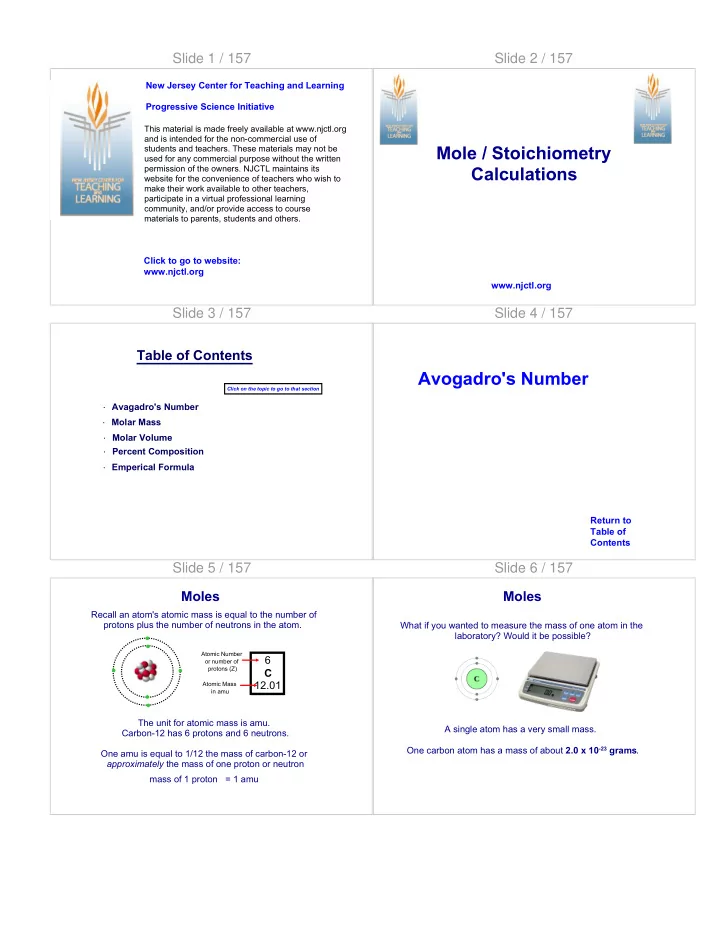
Recall an atom's atomic mass is equal to the number of protons plus the number of neutrons in the atom.
C 6 12.01
Atomic Number
- r number of
protons (Z) Atomic Mass in amu
The unit for atomic mass is amu. Carbon-12 has 6 protons and 6 neutrons. One amu is equal to 1/12 the mass of carbon-12 or approximately the mass of one proton or neutron mass of 1 proton = 1 amu
Slide 6 / 157 Moles
What if you wanted to measure the mass of one atom in the laboratory? Would it be possible? A single atom has a very small mass. One carbon atom has a mass of about 2.0 x 10⁻²³ grams.