Minimum Number Of Nodes Minimum number of nodes in a binary tree - - PDF document

minimum number of nodes
SMART_READER_LITE
LIVE PREVIEW

Minimum Number Of Nodes Minimum number of nodes in a binary tree - - PDF document

Binary Tree Properties & Representation Minimum Number Of Nodes Minimum number of nodes in a binary tree whose height is h. At least one node at each of first h levels. minimum number of nodes is h Maximum Number Of Nodes Number


slide-1
SLIDE 1

Binary Tree Properties & Representation

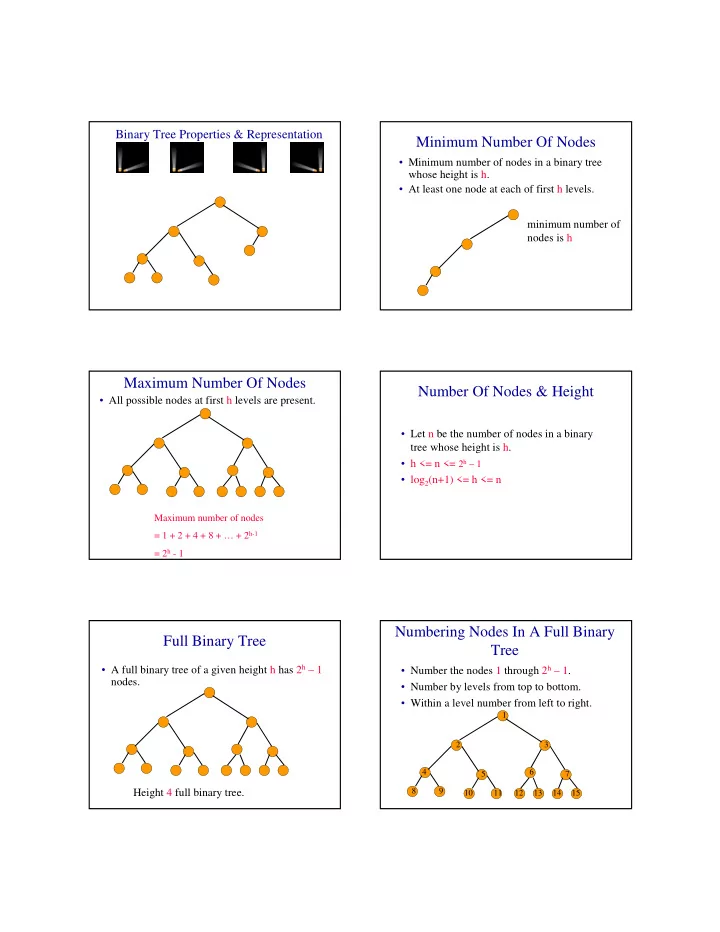
Minimum Number Of Nodes

  • Minimum number of nodes in a binary tree

whose height is h.

  • At least one node at each of first h levels.

minimum number of nodes is h

Maximum Number Of Nodes

  • All possible nodes at first h levels are present.

Maximum number of nodes = 1 + 2 + 4 + 8 + … + 2h-1 = 2h - 1

Number Of Nodes & Height

  • Let n be the number of nodes in a binary

tree whose height is h.

  • h <= n <= 2h – 1
  • log2(n+1) <= h <= n

Full Binary Tree

  • A full binary tree of a given height h has 2h – 1

nodes. Height 4 full binary tree.

Numbering Nodes In A Full Binary Tree

  • Number the nodes 1 through 2h – 1.
  • Number by levels from top to bottom.
  • Within a level number from left to right.

1 2 3 4 5 6 7 8 9 10 11 12 13 14 15

slide-2
SLIDE 2

Node Number Properties

  • Parent of node i is node i / 2, unless i = 1.
  • Node 1 is the root and has no parent.

1 2 3 4 5 6 7 8 9 10 11 12 13 14 15

Node Number Properties

  • Left child of node i is node 2i, unless 2i > n,

where n is the number of nodes.

  • If 2i > n, node i has no left child.

1 2 3 4 5 6 7 8 9 10 11 12 13 14 15

Node Number Properties

  • Right child of node i is node 2i+1, unless 2i+1

> n, where n is the number of nodes.

  • If 2i+1 > n, node i has no right child.

1 2 3 4 5 6 7 8 9 10 11 12 13 14 15

Complete Binary Tree With n Nodes

  • Start with a full binary tree that has at least

n nodes.

  • Number the nodes as described earlier.
  • The binary tree defined by the nodes

numbered 1 through n is the unique n node complete binary tree.

Example

  • Complete binary tree with 10 nodes.

1 2 3 4 5 6 7 8 9 10 11 12 13 14 15

Binary Tree Representation

  • Array representation.
  • Linked representation.
slide-3
SLIDE 3

Array Representation

  • Number the nodes using the numbering scheme

for a full binary tree. The node that is numbered i is stored in tree[i].

tree[]

5 10 a b c d e f g h i j b a c d e f g h i j 1 2 3 4 5 6 7 8 9 10

Right-Skewed Binary Tree

  • An n node binary tree needs an array whose

length is between n+1 and 2n.

a b 1 3 c 7 d 15

tree[]

5 10 a

  • b -
  • c -
  • 15

d

Linked Representation

  • Each binary tree node is represented as an
  • bject whose data type is BinaryTreeNode.
  • The space required by an n node binary tree

is n * (space required by one node).

The Class BinaryTreeNode

package dataStructures; public class BinaryTreeNode { Object element; BinaryTreeNode leftChild; // left subtree BinaryTreeNode rightChild;// right subtree // constructors and any other methods // come here }

Linked Representation Example

a c b d f e g h leftChild element rightChild root

Some Binary Tree Operations

  • Determine the height.
  • Determine the number of nodes.
  • Make a clone.
  • Determine if two binary trees are clones.
  • Display the binary tree.
  • Evaluate the arithmetic expression

represented by a binary tree.

  • Obtain the infix form of an expression.
  • Obtain the prefix form of an expression.
  • Obtain the postfix form of an expression.
slide-4
SLIDE 4

Binary Tree Traversal

  • Many binary tree operations are done by

performing a traversal of the binary tree.

  • In a traversal, each element of the binary tree is

visited exactly once.

  • During the visit of an element, all action (make

a clone, display, evaluate the operator, etc.) with respect to this element is taken.

Binary Tree Traversal Methods

  • Preorder
  • Inorder
  • Postorder
  • Level order