Binary Search Trees get(), put() and remove() Dictionary - - PDF document

binary search trees
SMART_READER_LITE
LIVE PREVIEW

Binary Search Trees get(), put() and remove() Dictionary - - PDF document

Complexity Of Dictionary Operations Binary Search Trees get(), put() and remove() Dictionary Operations: Data Structure Worst Case Expected get(key) Hash Table O(n) O(1) put(key, value) remove(key) Binary Search O(n) O(log


slide-1
SLIDE 1

Binary Search Trees

  • Dictionary Operations:

get(key) put(key, value) remove(key)

  • Additional operations:

ascend() get(index) (indexed binary search tree) remove(index) (indexed binary search tree)

Complexity Of Dictionary Operations get(), put() and remove()

Data Structure Worst Case Expected Hash Table O(n) O(1) Binary Search Tree O(n) O(log n) Balanced Binary Search Tree O(log n) O(log n)

n is number of elements in dictionary

Complexity Of Other Operations ascend(), get(index), remove(index)

Data Structure ascend get and remove Hash Table O(D + n log n) O(D + n log n) Indexed BST O(n) O(n) Indexed Balanced BST O(n) O(log n)

D is number of buckets

Definition Of Binary Search Tree

  • A binary tree.
  • Each node has a (key, value) pair.
  • For every node x, all keys in the left

subtree of x are smaller than that in x.

  • For every node x, all keys in the right

subtree of x are greater than that in x.

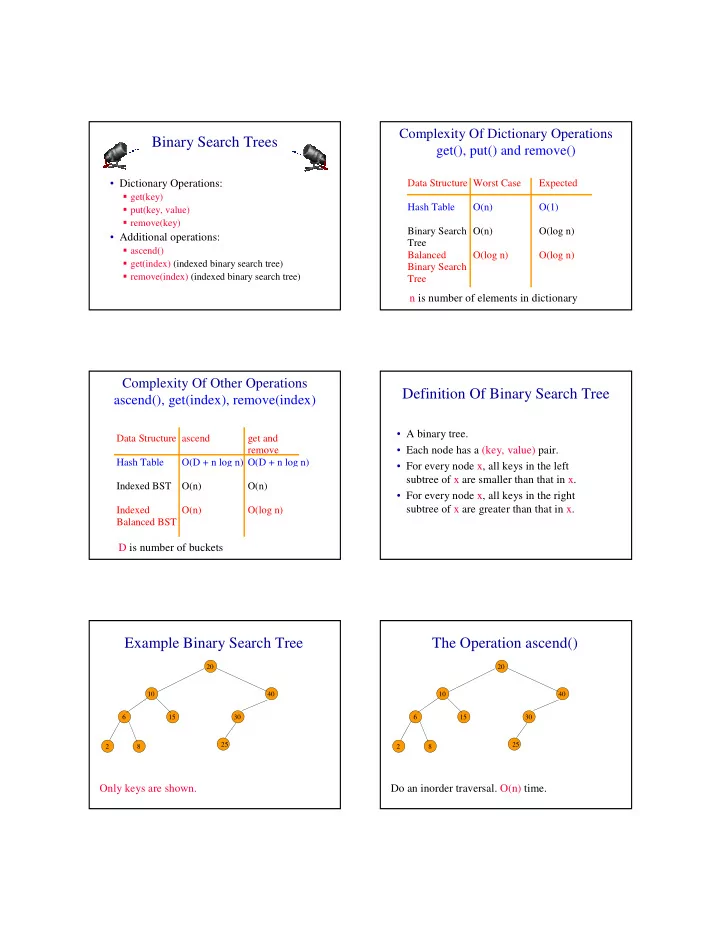
Example Binary Search Tree

20 10 6 2 8 15 40 30 25

Only keys are shown.

The Operation ascend()

20 10 6 2 8 15 40 30 25

Do an inorder traversal. O(n) time.

slide-2
SLIDE 2

The Operation get()

20 10 6 2 8 15 40 30 25

Complexity is O(height) = O(n), where n is number of nodes/elements.

The Operation put()

20 10 6 2 8 15 40 30 25

Put a pair whose key is 35.

35

The Operation put()

Put a pair whose key is 7.

20 10 6 2 8 15 40 30 25 35 7

The Operation put()

20 10 6 2 8 15 40 30 25

Put a pair whose key is 18.

35 7 18

The Operation put()

20 10 6 2 8 15 40 30 25

Complexity of put() is O(height).

35 7 18

The Operation remove()

Three cases: Element is in a leaf. Element is in a degree 1 node. Element is in a degree 2 node.

slide-3
SLIDE 3

Remove From A Leaf

Remove a leaf element. key = 7

20 10 6 2 8 15 40 30 25 35 7 18

Remove From A Leaf (contd.)

Remove a leaf element. key = 35

20 10 6 2 8 15 40 30 25 35 7 18

Remove From A Degree 1 Node

Remove from a degree 1 node. key = 40

20 10 6 2 8 15 40 30 25 35 7 18

Remove From A Degree 1 Node (contd.)

Remove from a degree 1 node. key = 15

20 10 6 2 8 15 40 30 25 35 7 18

Remove From A Degree 2 Node

Remove from a degree 2 node. key = 10

20 10 6 2 8 15 40 30 25 35 7 18

Remove From A Degree 2 Node

20 10 6 2 8 15 40 30 25

Replace with largest key in left subtree (or smallest in right subtree).

35 7 18

slide-4
SLIDE 4

Remove From A Degree 2 Node

20 10 6 2 8 15 40 30 25

Replace with largest key in left subtree (or smallest in right subtree).

35 7 18

Remove From A Degree 2 Node

20 8 6 2 8 15 40 30 25

Replace with largest key in left subtree (or smallest in right subtree).

35 7 18

Remove From A Degree 2 Node

20 8 6 2 8 15 40 30 25

Largest key must be in a leaf or degree 1 node.

35 7 18

Another Remove From A Degree 2 Node

Remove from a degree 2 node. key = 20

20 10 6 2 8 15 40 30 25 35 7 18

Remove From A Degree 2 Node

20 10 6 2 8 15 40 30 25

Replace with largest in left subtree.

35 7 18

Remove From A Degree 2 Node

20 10 6 2 8 15 40 30 25

Replace with largest in left subtree.

35 7 18

slide-5
SLIDE 5

Remove From A Degree 2 Node

18 10 6 2 8 15 40 30 25

Replace with largest in left subtree.

35 7 18

Remove From A Degree 2 Node

18 10 6 2 8 15 40 30 25

Complexity is O(height).

35 7

Indexed Binary Search Tree

  • Binary search tree.
  • Each node has an additional field.

leftSize = number of nodes in its left subtree

Example Indexed Binary Search Tree

20 10 6 2 8 15 40 30 25 35 7 18

1 1 4 7 1 3

leftSize values are in red

leftSize And Rank

Rank of an element is its position in inorder (inorder = ascending key order). [2,6,7,8,10,15,18,20,25,30,35,40] rank(2) = 0 rank(15) = 5 rank(20) = 7 leftSize(x) = rank(x) with respect to elements in subtree rooted at x

leftSize And Rank

20 10 6 2 8 15 40 30 25 35 7 18

1 1 4 7 1 3

sorted list = [2,6,7,8,10,15,18,20,25,30,35,40]

slide-6
SLIDE 6

get(index) And remove(index)

7

20 10 6 2 8 15 40 30 25 35 7 18

1 1 4 1 3

sorted list = [2,6,7,8,10,15,18,20,25,30,35,40]

get(index) And remove(index)

  • if index = x.leftSize desired element is

x.element

  • if index < x.leftSize desired element is

index’th element in left subtree of x

  • if index > x.leftSize desired element is

(index - x.leftSize-1)’th element in right subtree of x

Applications

(Complexities Are For Balanced Trees)

Best-fit bin packing in O(n log n) time. Representing a linear list so that get(index), add(index, element), and remove(index) run in O(log(list size)) time (uses an indexed binary tree, not indexed binary search tree). Can’t use hash tables for either of these applications.

Linear List As Indexed Binary Tree

h e b a d f l j i k c g

1 1 4 7 1 3

list = [a,b,c,d,e,f,g,h,i,j,k,l]

add(5,’m’)

h e b a d f l j i k c g

1 1 4 7 1 3

list = [a,b,c,d,e,f,g,h,i,j,k,l]

add(5,’m’)

h e b a d f l j i k c g

1 1 4 7 1 3

list = [a,b,c,d,e, m,f,g,h,i,j,k,l] find node with element 4 (e)

slide-7
SLIDE 7

add(5,’m’)

h e b a d f l j i k c g

1 1 4 7 1 3

list = [a,b,c,d,e, m,f,g,h,i,j,k,l] find node with element 4 (e)

add(5,’m’)

h e b a d f l j i k c g

1 1 4 7 1 3

add m as right child of e; former right subtree of e becomes right subtree of m

m

add(5,’m’)

h e b a d f l j i k c g

1 1 4 7 1 3

add m as leftmost node in right subtree

  • f e

m

add(5,’m’)

  • Other possibilities exist.
  • Must update some leftSize values on path

from root to new node.

  • Complexity is O(height).