Balanced Binary Search Trees Balanced Binary Search Trees height - - PDF document

balanced binary search trees balanced binary search trees
SMART_READER_LITE
LIVE PREVIEW

Balanced Binary Search Trees Balanced Binary Search Trees height - - PDF document

Balanced Binary Search Trees Balanced Binary Search Trees height is O(log n), where n is the Indexed AVL trees number of elements in the tree Indexed red-black trees AVL (Adelson-Velsky and Landis) Indexed operations also


slide-1
SLIDE 1

Balanced Binary Search Trees

  • height is O(log n), where n is the

number of elements in the tree

  • AVL (Adelson-Velsky and Landis)

trees

  • red-black trees
  • get, put, and remove take O(log n)

time

Balanced Binary Search Trees

  • Indexed AVL trees
  • Indexed red-black trees
  • Indexed operations also take

O(log n) time

Balanced Search Trees

  • weight balanced binary search trees
  • 2-3 & 2-3-4 trees
  • AA trees
  • B-trees
  • BBST
  • etc.

AVL Tree

  • binary tree
  • for every node x, define its balance factor

balance factor of x = height of left subtree of x

  • height of right subtree of x
  • balance factor of every node x is -1, 0, or 1

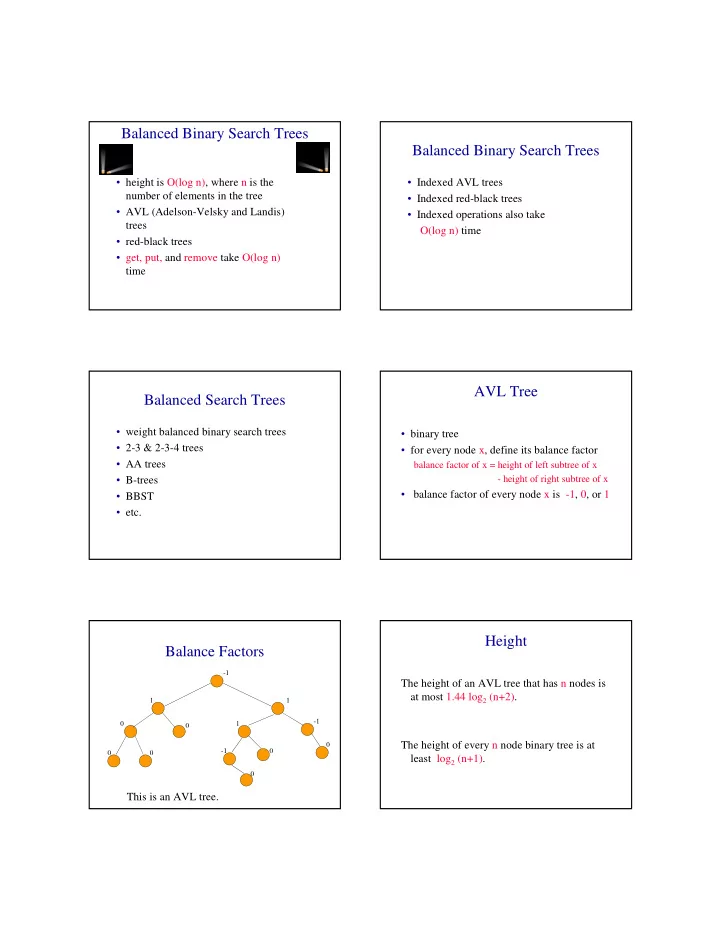
Balance Factors

1

  • 1

1

  • 1

1

  • 1

This is an AVL tree.

Height

The height of an AVL tree that has n nodes is at most 1.44 log2 (n+2). The height of every n node binary tree is at least log2 (n+1).

slide-2
SLIDE 2

AVL Search Tree

1

  • 1

1

  • 1

1

  • 1

10 7 8 3 1 5 30 40 20 25 35 45 60

put(9)

1

  • 1

1

  • 1

1

  • 1

9 0

  • 1

10 7 8 3 1 5 30 40 20 25 35 45 60

put(29)

1 1

  • 1

1

  • 1

10 7 8 3 1 5 30 40 20 25 35 45 60 29

  • 1
  • 1
  • 2

RR imbalance => new node is in right subtree of right subtree of blue node (node with bf = -2)

put(29)

1 1

  • 1

1

  • 1

10 7 8 3 1 5 30 40 25 35 45 60

RR rotation.

20 29

AVL Rotations

  • RR
  • LL
  • RL
  • LR

Red Black Trees

Colored Nodes Definition

  • Binary search tree.
  • Each node is colored red or black.
  • Root and all external nodes are black.
  • No root-to-external-node path has two

consecutive red nodes.

  • All root-to-external-node paths have the

same number of black nodes

slide-3
SLIDE 3

Example Red Black Tree

10 7 8 1 5 30 40 20 25 35 45 60 3

Red Black Trees

Colored Edges Definition

  • Binary search tree.
  • Child pointers are colored red or black.
  • Pointer to an external node is black.
  • No root to external node path has two

consecutive red pointers.

  • Every root to external node path has the

same number of black pointers.

Example Red Black Tree

10 7 8 1 5 30 40 20 25 35 45 60 3

Red Black Tree

  • The height of a red black tree that has n

(internal) nodes is between log2(n+1) and 2log2(n+1).

  • java.util.TreeMap => red black tree

Graphs

  • G = (V,E)
  • V is the vertex set.
  • Vertices are also called nodes and points.
  • E is the edge set.
  • Each edge connects two different vertices.
  • Edges are also called arcs and lines.
  • Directed edge has an orientation (u,v).

u v

Graphs

  • Undirected edge has no orientation (u,v).

u v

  • Undirected graph => no oriented edge.
  • Directed graph => every edge has an
  • rientation.
slide-4
SLIDE 4

Undirected Graph

2 3 8 10 1 4 5 9 11 6 7

Directed Graph (Digraph)

2 3 8 10 1 4 5 9 11 6 7

Applications—Communication Network

  • Vertex = city, edge = communication link.

2 3 8 10 1 4 5 9 11 6 7

Driving Distance/Time Map

  • Vertex = city, edge weight = driving

distance/time.

2 3 8 10 1 4 5 9 11 6 7 4 8 6 6 7 5 2 4 4 5 3

Street Map

  • Some streets are one way.

2 3 8 10 1 4 5 9 11 6 7

Complete Undirected Graph

Has all possible edges. n = 1 n = 2 n = 3 n = 4

slide-5
SLIDE 5

Number Of Edges—Undirected Graph

  • Each edge is of the form (u,v), u != v.
  • Number of such pairs in an n vertex graph is

n(n-1).

  • Since edge (u,v) is the same as edge (v,u),

the number of edges in a complete undirected graph is n(n-1)/2.

  • Number of edges in an undirected graph is

<= n(n-1)/2.

Number Of Edges—Directed Graph

  • Each edge is of the form (u,v), u != v.
  • Number of such pairs in an n vertex graph is

n(n-1).

  • Since edge (u,v) is not the same as edge

(v,u), the number of edges in a complete directed graph is n(n-1).

  • Number of edges in a directed graph is <=

n(n-1).

Vertex Degree

Number of edges incident to vertex. degree(2) = 2, degree(5) = 3, degree(3) = 1

2 3 8 10 1 4 5 9 11 6 7

Sum Of Vertex Degrees

Sum of degrees = 2e (e is number of edges)

8 10 9 11

In-Degree Of A Vertex

in-degree is number of incoming edges indegree(2) = 1, indegree(8) = 0

2 3 8 10 1 4 5 9 11 6 7

Out-Degree Of A Vertex

  • ut-degree is number of outbound edges
  • utdegree(2) = 1, outdegree(8) = 2

2 3 8 10 1 4 5 9 11 6 7

slide-6
SLIDE 6

Sum Of In- And Out-Degrees

each edge contributes 1 to the in-degree of some vertex and 1 to the out-degree of some

  • ther vertex

sum of in-degrees = sum of out-degrees = e, where e is the number of edges in the digraph