SLIDE 1
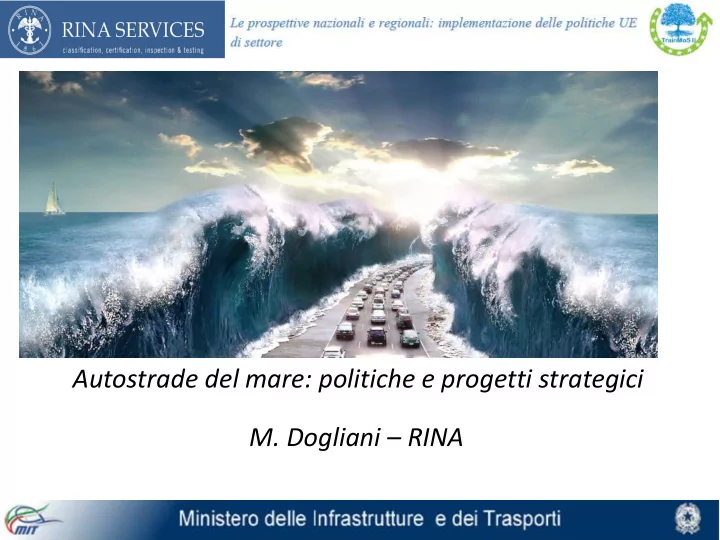
Autostrade del mare: politiche e progetti strategici
SLIDE 2 [...] # 1 “Safety” [...] # 4 “ Digital Administration ” ...increased use of Information Technology ... .. implementation of the Italian Law (Code of Digital Administration).. ... electronic data exchange systems leading to:
- paperless administration
- reduction of administrative burdern
- simplification
[...] # 3 “Increased Transport System Efficiency” ... use of Intelligent Transport Systems (ITS)... ... mobility management along the whole chain .... … intermodality …. ... reduced environmental impact...
MIT priorities & RINA’s role
SLIDE 3
Reporting Formalities Use of e-data by trade EU (D65) – 2015 WORLD (IMO FAL 39) - 2019 NMSW Italian flagged ships able to report to NMSWs worldwide e-certificates Use of e-data by NCAs ILO’s MLC Services to passengers Interface with PCSs Crew skill reporting Interface with ITS TEN-T Projects CEF Projects MIELE 2010 B2MOS 2013 ML2 2013 Future 2015-2020 ANNA 2013
#4 Digital Administration
SLIDE 4
Fuel emissions Other aspects EU cross-border-continuity National Framework Avoid shift back from sea to land world wide cross border continuity Energy efficiency EU (2014-2030) Sulphur (D2012/33) Alternative fuels (D2014/94) WORLD IMO (2015-2025) MARPOL ANNEX VI WORLD IMO (2015...) MARPOL Other Annexes TEN-T Projects CEF Projects
#3 Transport efficiency & sustainability
COSTA 2012 Future 2015 - 2020 SEATERMINALS 2014 POSEIDON MED 2014 GREENCRANES 2012
SLIDE 5
GAINN_IT & MALTA
Sulphur cap: where & when
0,1% 2015 0,5% 2020 0,5% 2020-2025
SLIDE 6 Cartagena 500 Mcm/y Huelva 500 Mcm/y Barcelona 500 Mcm/y Zeebrugge 1000 Mcm/y Marmara 650 Mcm/y Aliaga 350 Mcm/y Skangass 400 Mcm/y Gasnor 200 Mcm/y Musel 350 Mcm/y Gate 50 Mcm/y Gothenburg 6 Mcm/y Swinoujscie 130 Mcm/y Montoir-de-Bretagne up to 0.07 Mcm/y (exp. to 0.36 Mcm/y) Fos Tonkin (up to 0.07 Mcm/y,
Existing terminals with reloading/Truck services Planned terminals with reloading/Truck services Small scale LNG production LNG storage accessible for ships
Available ship LNG refuelling facilities (none in the Med; only via trucks)
SLIDE 7
Can we afford the wait & see #1?
+50% fuel cost + 20% waterborne transport cost shift back from sea to road 4 -10% increase congestion Road congestion in 2009 costed Italy 40 B€ (3% GDP)
SLIDE 8
WORLDWIDE SHIP TRAFFIC INTENSITY
PIT STOP
Can we afford the wait & see #2?
SLIDE 9 LIVORNO
Italian Alternative Fuels Network
Three national grids :
- Tyrrenic-Ligurian pilot LNG grid
- South Italy pilot LNG grid
- Adriatic-Ionic pilot LNG grid
‘Element’ involved:
- Genova
- Livorno
- Augusta
- Ancona
- Venezia
- La Spezia
- Ravenna
- Civitavecchia
- Messina
SLIDE 10 LNG Bunkering ship ISO-Tank Offshore/Onshore storage Natural Gas Network + Microliquefactor Storage & ancillaries LNG fuelled ship LNG fuelled vehicles
LNG receving system
LNG refuelling for vehicles and/or LNG fuelled vehicles
LNG storage system
LNG refuelling for ship and/or LNG fuelled ship
Expected in 2020
(2014 hypotesis)
SLIDE 11
Partners/Stakeholders
SLIDE 12 A13 – I13 Lack of skilled seafarers
Depending on the number of LNG fuelled ships in 2020/2030 the number of seafarers can be (…) a significant fraction of the more than 1,2 millions seafarers demanded in 2020 (…). The likelihood of the issue not to be solved is judged low since it will be demand driven and passage to LNG will
The direct impact of not having the necessary workforce trained is high since it directly affects the possibility to safely operate LNG fuelled ships. The possibility to manage the issue is judged high since training programmes can be established in due time before 2020.
Aspects related to this issue are:
- training of ashore personnel
- lack of training infrastructures
Can we afford the wait & see #3?